Mental health leave in Ontario is not a separate ESA category, but the time off is still job-protected. After two weeks with your employer, you get three unpaid sick days per calendar year for personal illness—including anxiety, depression, and burnout. For a longer recovery, the Ontario Human Rights Code treats many mental health conditions as disabilities and requires accommodation to the point of undue hardship.
You do not have to disclose your diagnosis. A doctor’s note confirming you need leave, the expected duration, and any return-to-work limits is usually enough.
Leave denied, or worried about being fired or pushed out? Call 905-744-8888 or email info@ullaw.ca before you resign. You can also book a consultation.
Understanding Your Right to Mental Health Leave

It’s a common—and stressful—misconception that without a formal leave category, employees are out of luck. The truth is, your protections are woven into two powerful pieces of legislation: the Employment Standards Act, 2000 (ESA) and the Ontario Human Rights Code (the Code).
Think of these two laws as your employment safety net. The ESA is like the immediate first-aid kit, while the Code provides the framework for a more comprehensive, long-term recovery plan.
The Two Pillars of Your Protection
First up is the ESA. This act gives most employees in Ontario access to a basic amount of job-protected sick leave for any personal illness, injury, or medical emergency. This is your go-to when you need a few days off right away to manage an acute mental health flare-up or get to an urgent appointment.
The Ontario Human Rights Code, however, is where the real power lies for more significant situations. Under the Code, many mental health conditions—like clinical anxiety, severe burnout, or depression—are recognized as disabilities. This recognition triggers your employer’s duty to accommodate you to the point of undue hardship, which is a very high legal standard for them to meet.
This human rights framework is what supports longer leaves of absence and other necessary changes to your work environment. For a closer look at this, you can learn more about how conditions like depression are classified as a disability in Ontario.
Your job is protected not by a special leave category, but by established laws that treat mental health with the same seriousness as physical health. Understanding this distinction is the first step toward advocating for the time and support you need.
Let’s quickly summarize how these two legal frameworks protect you when you need to take time off for your mental health.
How Your Mental Health Leave is Protected in Ontario
| Legal Framework | What It Provides | Best For |
|---|---|---|
| Employment Standards Act (ESA) | Provides a minimum number of job-protected sick days per year (currently 3). | Short-term absences, like needing a day for a therapy appointment or to manage a sudden spike in symptoms. |
| Ontario Human Rights Code | Protects you from discrimination based on disability, which includes mental health. Requires employers to provide accommodation, which can include an extended leave of absence. | Longer periods of leave needed for treatment and recovery from a significant mental health condition. |
Knowing these protections exist is crucial for getting the support you are entitled to.
Why This Matters for You
Understanding how these laws work together gives you the confidence to ask for what you need. It shifts the conversation from a personal plea to a discussion about your legal rights here in Ontario.
This dual-framework ensures you have options for both:
- Short-term relief: Using your ESA sick days for immediate needs without worrying about losing your job.
- Long-term solutions: Requesting a formal leave of absence or other accommodations under the Human Rights Code when you’re facing a more serious challenge.
Ultimately, these interconnected laws form a robust safety net. They ensure that when you feel overwhelmed and need to step back, your focus can be on your recovery, not on the fear of losing your livelihood. This guide will walk you through exactly how to navigate taking a mental health leave in Ontario.
Using Your Basic Leave Entitlements Under the ESA
When a mental health issue flares up and you need time off right now, your first line of defence is often Ontario’s Employment Standards Act, 2000 (the ESA). Think of it as an emergency stop-gap. It gives you the legal right to step away from work for a few days to get your bearings, without worrying about losing your job.
This isn’t a long-term fix, but it’s an absolutely critical starting point. The leaves provided by the ESA are designed for those urgent, unexpected situations—maybe you need to see a therapist last-minute, you’re navigating an acute anxiety episode, or you simply need a day to stabilize during a tough time.
Sick Leave: It’s for Your Brain, Too
Under the ESA, if you’ve been with your employer for at least two straight weeks, you’re entitled to three days of unpaid, job-protected sick leave every calendar year. A huge misconception is that this is just for physical sickness like the flu or a bad cold.
Let’s be crystal clear: This leave absolutely covers personal illness, injury, or a medical emergency, and that 100% includes mental health. Whether you’re grappling with burnout, depression, or an anxiety disorder, you have the right to use these days for your well-being.
Your employer can’t legally punish you for taking this time. It’s your right. While the ESA only mandates unpaid leave, your company might offer paid sick days in your employment contract or benefits package. It’s always a good idea to check.
Family Responsibility Leave: When You’re the Caregiver
The ESA has another often-overlooked tool in the toolbox: Family Responsibility Leave. This gives you up to three days of unpaid, job-protected leave each year for urgent matters involving a close family member.
This can be a huge help for your own mental health, especially if you’re a caregiver. You can use this leave when you need to:
- Support a child who is having a mental health crisis.
- Take your spouse or parent to an emergency psychiatric appointment.
- Deal with a sudden breakdown in care for a dependent.
Trying to support a loved one through a mental health challenge is incredibly draining. This leave acknowledges that your family’s health is tied to your own, giving you the breathing room to be there for them without putting your job at risk.
How to Tell Your Employer
Taking this kind of leave is usually pretty simple. You just need to tell your employer you’re taking the time off, ideally as soon as you know you need it. If it’s a true emergency, you can let them know after you’ve already started the leave, but advance notice is always better if possible.
You don’t have to get into the nitty-gritty of your diagnosis. A simple, “I’m unwell and need to take a sick day” is usually all that’s required. That said, your employer can ask for evidence that is “reasonable in the circumstances” to prove you’re entitled to the leave. This often means a doctor’s note, but their request has to be reasonable. It’s important to know your rights here, as an employer’s request can’t overstep other legal protections, which we cover in our guide on the Employment Standards Act and termination.
Ultimately, these ESA leaves act as a vital bridge. They give you immediate, job-protected time off to manage an urgent health situation while you figure out what comes next, whether that’s arranging a longer-term accommodation or starting a disability claim.
Your Employer’s Duty to Accommodate

While the Employment Standards Act gives you a few crucial days off, your most powerful and long-term protections actually come from the Ontario Human Rights Code. This is where we find the legal concept of the duty to accommodate—a true cornerstone of employee rights when facing mental health challenges.
Here’s a simple way to think about it. Just as a building needs a ramp to be accessible for someone in a wheelchair, a workplace has to make reasonable adjustments for an employee with a mental health disability. It’s not about giving someone special treatment. It’s about removing barriers so everyone has an equal opportunity to succeed at their job.
This duty is a hard-and-fast legal requirement for every employer in Ontario. It means they must actively look for ways to adjust rules, policies, or even the physical workspace to support an employee’s disability-related needs, and that absolutely includes mental health.
What Is a Disability Under the Human Rights Code?
The word “disability” has a very broad meaning under the Code. It’s not just for conditions that are permanent or easy to see.
When it comes to mental health, a disability can cover a huge range of diagnosed conditions. Things like major depressive disorder, generalized anxiety disorder, bipolar disorder, or PTSD are clearly recognized as disabilities.
But the protection doesn’t stop there. Even severe burnout or chronic stress can be considered a disability if it seriously impairs your ability to function. The key isn’t the specific diagnosis, but how the condition affects your daily life and your ability to do your job. If your mental health is creating real barriers for you at work, you’re likely protected by the Code.
Real-World Examples of Workplace Accommodation
Accommodation isn’t a one-size-fits-all solution. It’s supposed to be a collaborative process where you and your employer find a reasonable fix that lets you keep working or return successfully after a leave. In fact, a formal mental health leave of absence is often the first and most powerful form of accommodation.
But there are many other possibilities. Some common examples include:
- Modified Work Duties: Temporarily shifting high-stress tasks off your plate.
- Flexible Work Hours: Adjusting your start and end times to fit in therapy appointments or to let you work when you’re most effective.
- Reduced Workload: A temporary cut in your overall responsibilities to help you manage your recovery without feeling overwhelmed.
- A Gradual Return to Work: Instead of jumping back in full-time after a long leave, you might start with shorter days and slowly build back up.
- Changes to Your Workspace: Something as simple as moving your desk to a quieter part of the office to reduce anxiety or sensory overload.
Accommodation is about finding a workable solution. The goal is to keep you connected to your job in a way that supports your health and recovery, not to create an entirely new role.
This whole process has to be tailored to your specific needs, guided by information from your doctor. Your employer is legally required to participate in good faith and explore the options with you.
What Is Undue Hardship?
An employer’s duty to accommodate goes far, but it isn’t infinite. The law says they must provide accommodation up to the point of undue hardship. It’s important to know that this is a very high legal bar for an employer to clear, and courts and tribunals don’t take it lightly.
Undue hardship isn’t about minor inconvenience or a small cost. To make this claim, an employer needs to show with concrete proof that the accommodation would be so disruptive or expensive it would seriously threaten the business’s survival.
When a tribunal looks at an undue hardship claim, they consider factors like:
- Cost: Are the financial costs genuinely crippling to the business?
- Outside Funding: Are there any external funds or grants available to help pay for the accommodation?
- Health and Safety: Does the accommodation pose a serious health and safety risk to others?
For most Ontario businesses, especially larger ones, trying to claim undue hardship for common requests like a leave of absence or modified hours is incredibly difficult. They can’t just say, “it’s too much trouble.” They need objective proof. If an employer refuses to accommodate you and instead makes negative changes to your job, it’s critical to understand what is constructive dismissal in Ontario, as your rights may have been violated.
Navigating Disability Benefits for an Extended Leave
When a few sick days just won’t cut it and you need a significant amount of time to focus on your recovery, disability benefits are designed to be your financial lifeline. They provide a steady stream of income while you’re on a mental health leave in Ontario, taking away the immediate financial stress so you can concentrate on what really matters: getting better.
It’s a common mix-up, but it’s important to know that Short-Term Disability (STD) and Long-Term Disability (LTD) benefits almost always come from a private insurance policy. This is usually part of the benefits package your employer provides. Think of it as an insurance plan for your paycheque, not a government program.
Short-Term Disability (STD): Your First Safety Net
If your leave is going to last more than a week or two, Short-Term Disability is the first step. It’s built to cover those in-between absences—longer than a simple sick leave, but not expected to last for many months.
Here’s a quick rundown of what to expect with STD:
- Duration: STD benefits are temporary, typically lasting between 15 to 26 weeks.
- Income Replacement: They pay a percentage of your regular salary, usually somewhere in the ballpark of 60% to 85%.
- Application: Getting approved involves paperwork from you, your employer, and your doctor, who needs to officially state that you are unable to work.
STD acts as a crucial bridge. It gives you financial breathing room while you and your medical team focus on your recovery plan. It also serves as the “elimination period” (or waiting period) before you can apply for Long-Term Disability if your condition doesn’t improve within that timeframe. While on leave, it’s also a good idea to check what kinds of insurance-covered therapeutic services in Ontario might be included in your plan to support your recovery.
Long-Term Disability (LTD): For a Longer Road to Recovery
If your recovery is taking longer than the STD period allows, you’ll need to transition to Long-Term Disability. LTD is intended for more serious, prolonged conditions that keep you from working for an extended period.
The reality is that leaves for mental illness can be incredibly tough, both personally and economically. According to CAMH, the economic burden of mental illness in Canada is estimated at over $50 billion per year, which includes healthcare costs, lost productivity, and reductions in health-related quality of life. You can learn more from these mental health statistics from CAMH.
Getting an LTD claim approved is a more involved process, and it hinges on a critical change in how “disability” is defined.
Key Takeaway: For the first two years of an LTD claim, you generally only need to prove that you are unable to do the main duties of your own occupation. After two years, the goalposts often move. The definition of disability shifts, and you must prove you are unable to do any occupation for which you are reasonably suited by your education, training, or experience.
This two-year mark is a critical turning point and a common reason why many LTD claims are denied. It is absolutely essential to have continuous, strong medical evidence to back up your claim as you approach and pass this date. For a more detailed guide, see our article on how to apply for disability benefits.
To help clarify the options, let’s break down the key differences between the various disability benefits available to workers in Ontario.
Comparing Disability Options in Ontario
| Benefit Type | Typical Source | Typical Duration | Key Purpose |
|---|---|---|---|
| Short-Term Disability (STD) | Employer’s private insurance plan | 15 to 26 weeks | Covers initial recovery period; acts as a waiting period for LTD. |
| Long-Term Disability (LTD) | Employer’s private insurance plan | Up to age 65 or recovery | Provides income for severe, prolonged conditions preventing work. |
| CPP Disability | Federal Government (Service Canada) | Up to age 65 or recovery | A government safety net for contributors with a “severe and prolonged” disability. |
Understanding these distinctions is the first step in navigating your leave and securing the financial support you need for your recovery.
The Government Safety Net: Canada Pension Plan (CPP) Disability
Standing completely separate from private insurance is the Canada Pension Plan (CPP) disability benefit. This is a federal program for people who have contributed enough to the CPP during their working years and now have a “severe and prolonged” disability that stops them from working at any job on a regular basis.
Be warned: the eligibility criteria for CPP Disability are notoriously strict. “Severe” means your condition prevents you from doing any type of paid work, and “prolonged” means it’s a long-term condition that’s either indefinite or likely to result in death. Because of this high bar, many people who qualify for private LTD benefits won’t meet the government’s definition.
Even so, most LTD insurance policies will require you to apply for CPP Disability anyway. If you’re approved, the insurance company will then reduce your LTD payment by the amount you get from the government.
How to Request a Mental Health Leave
Knowing you have the right to a mental health leave is one thing. Actually asking for it? That can feel like the hardest part. The very thought of that conversation is often a huge source of stress, but breaking it down into a clear, step-by-step process can turn that anxiety into a concrete plan.
The key is to handle it methodically. You’ll start with professional medical advice and finish with clear, documented communication with your employer. This isn’t about oversharing personal details; it’s about professionally asserting your needs while protecting your privacy.
Step 1: Consult Your Doctor
Before you even think about talking to your employer, your very first conversation should be with a medical professional. This could be your family doctor, a psychiatrist, or a registered psychologist. This step is absolutely non-negotiable for two critical reasons.
First, you need a professional medical opinion confirming your condition and the necessity of taking a leave from work. Second, you will need a doctor’s note to formally back up your request. This medical documentation is the bedrock of your entire leave process.
When you meet with your doctor, be ready to discuss:
- Your Symptoms: Be open about how your mental health is affecting your daily life and, specifically, your ability to do your job.
- Workplace Triggers: If certain aspects of your work environment are contributing to your condition, it’s important to share that context.
- Leave Duration: Your doctor will use their professional judgment to recommend how much time you should take off to recover.
Step 2: Decide Who to Approach at Work
With your doctor’s support locked in, the next decision is who to notify at your workplace. For most employees in Ontario, the choice comes down to your direct manager or the Human Resources (HR) department.
There’s no single right answer here—it really depends on your workplace culture and the relationship you have with your manager. If you have a supportive, trusting dynamic, starting with your manager can be a great approach.
However, if you’re worried about stigma or how your manager might react, going straight to HR is often the safest and most professional route. HR professionals are trained to handle these sensitive requests and fully understand the company’s legal obligations under Ontario law.
This flowchart shows the typical path from a short-term leave covered by company benefits to longer-term government support.
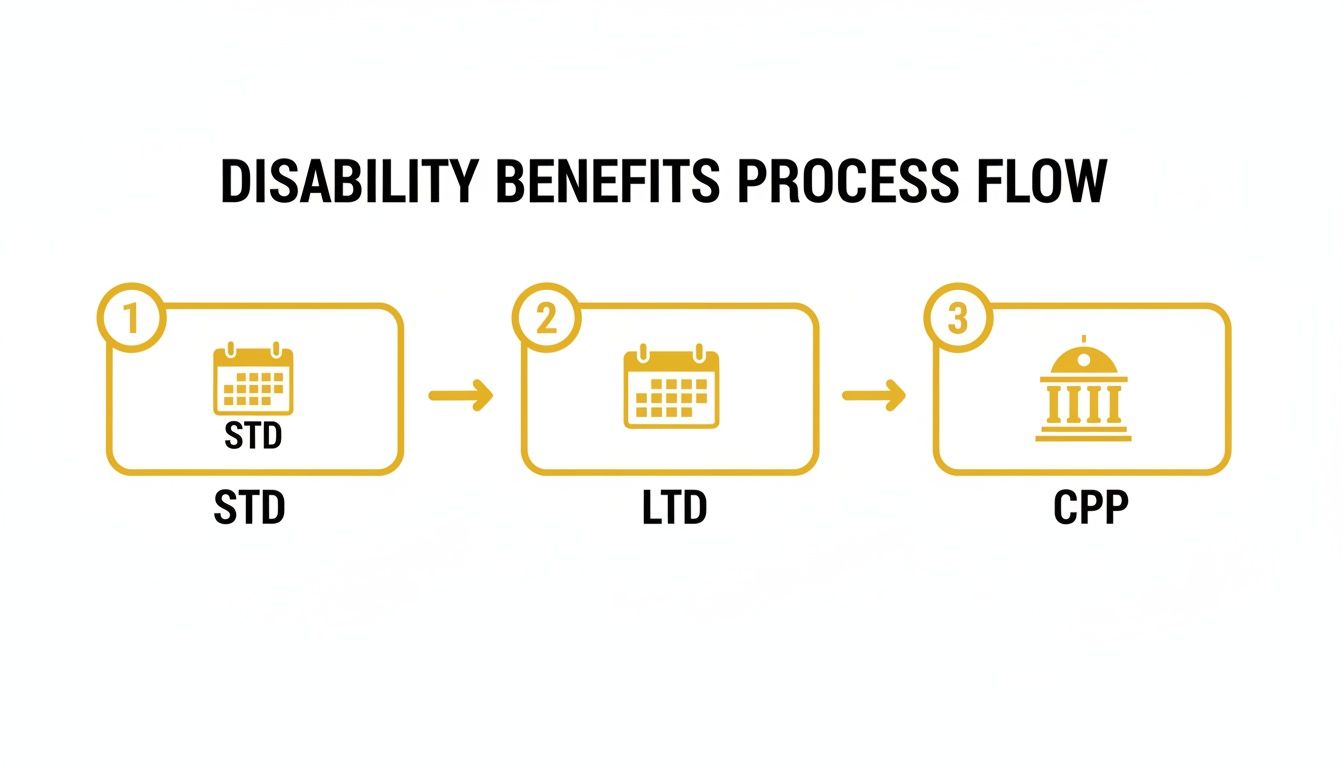
As you can see, the journey often starts with an employer-provided benefit (STD), then moves to longer-term insurance (LTD), and finally, if needed, the federal CPP safety net.
Step 3: Frame the Conversation and Make the Request
When you’re ready to make the request, keep your communication clear, professional, and—most importantly—in writing. An email is perfect because it creates a documented record of your request and the date you made it.
You are not required to disclose your specific diagnosis. Your medical information is confidential. You only need to give your employer enough information to understand that you require a medical leave of absence based on a doctor’s recommendation.
Sample Email Template:
Subject: Medical Leave of Absence - [Your Name]
Dear [Manager’s Name / HR Department],
Please accept this email as formal notification that I need to take a medical leave of absence, effective [Start Date]. This leave comes at the recommendation of my physician.
Based on my doctor’s advice, my anticipated return date is [End Date], though this may be subject to change depending on my recovery. I have a doctor’s note that I can provide upon request.
I am happy to discuss a plan to transition my duties before my leave begins. Please let me know the next steps for formally processing this request.
Sincerely,
[Your Name]
Unfortunately, stigma and fear are still major barriers for many employees. However, research on Canadian workers shows that having supportive figures—like a doctor, manager, or union representative—is crucial. Unions, for example, often guide members through the documentation process, offering both practical and emotional support that makes the whole process easier to navigate.
Knowing your rights and having a clear plan is the best way to handle the complexities of employment law in Ontario. By following these steps, you can confidently and effectively ask for the time you need to put your well-being first.
Planning Your Return to Work
Taking time off for your mental health is a massive step toward recovery, but the journey doesn’t stop there. How you come back to work is just as important as the leave itself. A well-thought-out plan can make the difference between a smooth, lasting return and a rocky one.
This isn’t about flipping a switch and jumping back into your old routine. Think of it more as a strategic and collaborative process, one designed to protect your well-being and get you back on track professionally for the long haul.
Easing Back In with a Gradual Plan
The best approach, almost always, is a gradual return to work (RTW) plan. This is simply a personalized schedule you build with your employer and your doctor. The goal is to ease you back into your role without overwhelming you and risking a setback.
A solid RTW plan might involve things like:
- Reduced Hours: Maybe you start with half-days or just a couple of days a week, slowly building back up to your full schedule over a few weeks.
- Modified Duties: High-stress projects or particularly demanding tasks could be temporarily handed off to a colleague, letting you focus on your core responsibilities first.
- Flexible Scheduling: Adjusting your start and end times can be a huge help, especially if you have ongoing therapy appointments or just need to manage your energy levels.
This kind of collaboration is key. According to a recent survey, 24% of Canadian employers are seeing more absenteeism because of mental health struggles. At the same time, a staggering 80% of employers don’t believe their staff would even tell them if they were having a mental health issue. That gap shows exactly why a clear, supportive RTW plan is so vital—it helps rebuild trust and sets you up for success. You can see more of these findings in Peninsula Canada’s survey on mental health in the workplace.
Your Employer’s Duty to Accommodate Doesn’t End
Here’s something crucial to remember: your employer’s legal duty to accommodate you under the Ontario Human Rights Code doesn’t just vanish once your leave is over. In fact, a gradual return plan is a perfect example of an accommodation. You have a legally protected right to a safe and supportive re-entry.
Accommodation isn’t a one-and-done deal. It’s an ongoing conversation. As you settle back in, your needs might shift, and your accommodation plan needs to be flexible enough to shift right along with you.
This ongoing support acknowledges a simple truth: recovery isn’t linear. Regular, informal check-ins with your manager or HR can help catch any new challenges early on. This allows everyone to tweak the plan as needed, ensuring your return to work sticks.
Getting Your Job Back
Don’t forget about your fundamental right to job security. When you come back from a job-protected leave, you are legally entitled to your old job back. If, for some reason, your exact position was eliminated, your employer must give you a comparable position—one with the same pay, benefits, and general responsibilities.
This protection is the backbone of taking a mental health leave in Ontario. It’s what gives you the peace of mind to step away and focus completely on your recovery, knowing your career will still be there for you when you’re ready to return.
Your Top Questions About Mental Health Leave Answered
Thinking about taking a mental health leave in Ontario often brings up a lot of pressing, practical questions. Let’s walk through some of the most common concerns to give you some clarity and peace of mind.
Can My Employer Fire Me for Taking a Mental Health Leave?
Absolutely not. Firing you for taking a job-protected leave under the ESA, or for asking for an accommodation for a mental health condition under the Ontario Human Rights Code, is illegal. Plain and simple.
Think of it this way: the law sees that as a reprisal or an act of discrimination. Your employer is legally required to reinstate you in your original role—or a comparable one—once your leave ends. Your focus should be on getting well, not worrying about your job security.
How Much Private Medical Information Do I Have to Disclose?
This is a big one, and the answer is reassuring: you are not required to share your specific diagnosis. Your medical privacy is paramount.
You only need to give your employer enough information to understand that you have limitations and need accommodation. A standard doctor’s note is usually all that’s required. It should confirm that you need a medical leave, provide an estimated duration, and mention any restrictions you might have when you’re ready to come back.
Your personal health details are confidential between you and your doctor. The goal is just to communicate the need for leave, not the nitty-gritty of your condition.
What if My Employer Denies My Request for Leave?
If your employer rejects a legitimate request for leave and can’t prove it would cause them “undue hardship” (a very high legal bar to meet), they could be violating your rights.
First things first: document everything. Get the denial in writing if you can. From there, it’s a good idea to speak with an Ontario employment lawyer to figure out your next steps. You might have options through the Human Rights Tribunal of Ontario or the Ministry of Labour, Family, Training and Skills Development.
While navigating this process, taking care of yourself is key. You might find these evidence-based mental health self-care tips to be a valuable resource for maintaining your well-being.
If your mental health leave in Ontario was denied, or you were pushed out after asking for time off, call UL Lawyers at 905-744-8888 or email info@ullaw.ca before you resign.
You can also book a free consultation or start on our employment law page.
Related UL Lawyers resources
- Leave from work for stress — doctor’s notes, EI sickness, and STD/LTD overlap.
- Employment law services — accommodation, reprisal, and return-to-work disputes.
- Is depression a disability in Ontario? — Human Rights Code coverage for mental health.