
If you’re an employer in Burlington, Mississauga, Toronto, Hamilton, or anywhere else in Ontario, there’s a good chance you’re revising hiring templates right now. If you’re an employee or job seeker, you’re probably noticing something different too. Job ads are starting to show pay information that used to stay hidden until late in the process.
That change isn’t cosmetic. It affects how employers draft postings, how candidates assess roles, and how both sides handle negotiation. The Ontario pay transparency job posting rules 2026 create new obligations for many employers and new practical advantages for workers who want a clearer picture before they apply.
2026 update: Ontario’s ESA job-posting rules are broader than pay transparency. For covered public postings, employers must address expected compensation, disclose AI use in screening/assessment/selection, state whether an existing vacancy exists, avoid Canadian-experience requirements, and follow interview-candidate notification rules. Job posting platforms also have obligations relating to fraudulent postings.
Table of Contents
- The 2026 Shift in Ontario Hiring
- Core Requirements of the Pay Transparency Act
- AI Disclosure and Ghost Job Rules in Ontario
- A Compliance Checklist for Ontario Employers
- Understanding Exemptions and Special Cases
- Enforcement and Penalties for Non-Compliance
- How Employees Can Use Their New Rights
The 2026 Shift in Ontario Hiring
At 8:30 on a Monday, a Burlington office manager is trying to post a sales role before interviews start that week. The hiring manager wants flexibility on compensation. Payroll has one number in mind, ownership has another, and the recruiter is about to copy an old posting that says “competitive salary.” In 2026, that routine scramble stops being a drafting problem and starts becoming a compliance problem.

Ontario’s Pay Transparency Act took effect on January 1, 2026, and it changes how covered employers advertise jobs to the public. As summarized in Robert Half’s overview of Ontario pay transparency rules, the law applies to employers with 25 or more employees, requires a public posting to include either a fixed salary or a salary range, and limits the width of that range to $50,000 annually, unless the top end exceeds $200,000 per year.
That matters because job ads are now part of the employer’s risk file. A rushed posting can create three separate problems at once: legal exposure, internal pay disputes, and candidate distrust. I have seen employers focus on the wording of the ad and miss the harder issue underneath, which is whether anyone internally has authority to approve the compensation band before the ad goes live.
Why this change matters
Ontario did not start from scratch in 2026. The province had an earlier pay transparency framework on the books that never came into force, and the current version is narrower than many practitioners expected. It still changes day-to-day hiring in a meaningful way because it forces compensation decisions earlier, before the first interview instead of after a preferred candidate appears.
It also brings Ontario closer to the direction other provinces have taken on pay disclosure. For employers hiring across provinces, the practical question is no longer whether to standardize posting language. It is how quickly they can do it without creating inconsistencies between HR, operations, and finance.
For small business owners, the trade-off is clear. Posting a salary range may feel like it reduces negotiating room, but refusing to set a range usually means the business has not settled its own pay practice. The Act exposes that gap.
For employees, the immediate benefit is also practical. A candidate can assess a posting on its face, decide whether the compensation fits, and raise concerns if a public ad appears to ignore the rules. That is one reason these rules often intersect with broader issues under Ontario pay equity legislation. Once compensation becomes visible, inconsistent pay practices become easier to spot.
Communications teams also need to separate legal compliance from employer branding. A job ad has to meet statutory requirements first. The later press release or onboarding update serves a different purpose. If your team handles both, a resource on drafting professional new hire announcements can help keep those documents distinct.
Core Requirements of the Pay Transparency Act
The Ontario pay transparency job posting rules 2026 are easiest to understand if you break them into three questions. Who is covered. What has to appear in the posting. What hiring conduct is now off-limits or restricted.

Which employers are covered
The main coverage point is straightforward. Employers with the required workforce size must follow the public posting rules when they advertise externally.
That sounds simple, but the practical issue is usually not the statute. It’s whether the business has a reliable way to know when the rule applies, especially if it hires through multiple departments or locations.
Covered employers can’t leave compensation blank in a public posting and fix it later in the interview process.
What must be disclosed
The central disclosure obligation is pay. A covered employer must include either a specific salary or a salary range in the public job ad. The range has to be narrow enough to fit within the statutory cap, except for the high-income exception discussed later.
What works in practice is disciplined wording. What doesn’t work is trying to preserve unlimited flexibility with language that defeats the purpose of transparency.
A useful internal drafting standard looks like this:
| Posting approach | Usually workable | Usually risky |
|---|---|---|
| Single salary | Clear annual amount for the role | Leaving compensation to be discussed later |
| Salary range | A defined range tied to the expected role level | A range drafted so broadly that it looks non-committal |
| Variable pay roles | Clear explanation of base pay and any expected non-discretionary earnings | Mixing guaranteed pay with purely discretionary rewards in a confusing way |
What employers should stop doing
A compliant posting isn’t only about adding numbers. It also requires employers to review habits that have been common in recruitment for years. One obvious example is using compensation secrecy as a screening tool. Another is relying on poorly controlled templates circulating across email, job boards, and recruiter accounts.
In practice, employers should train anyone who touches hiring copy. That includes owners, operations managers, recruiters, franchise managers, and marketing staff who sometimes post roles on social media without HR review.
For Canadian employers that want a broader business-side perspective on how pay disclosure rules affect recruiting processes, this guide for businesses on pay transparency is useful as a general operational read. The legal analysis, though, still has to be grounded in Ontario law and the Employment Standards Act framework that applies here.
AI Disclosure and Ghost Job Rules in Ontario
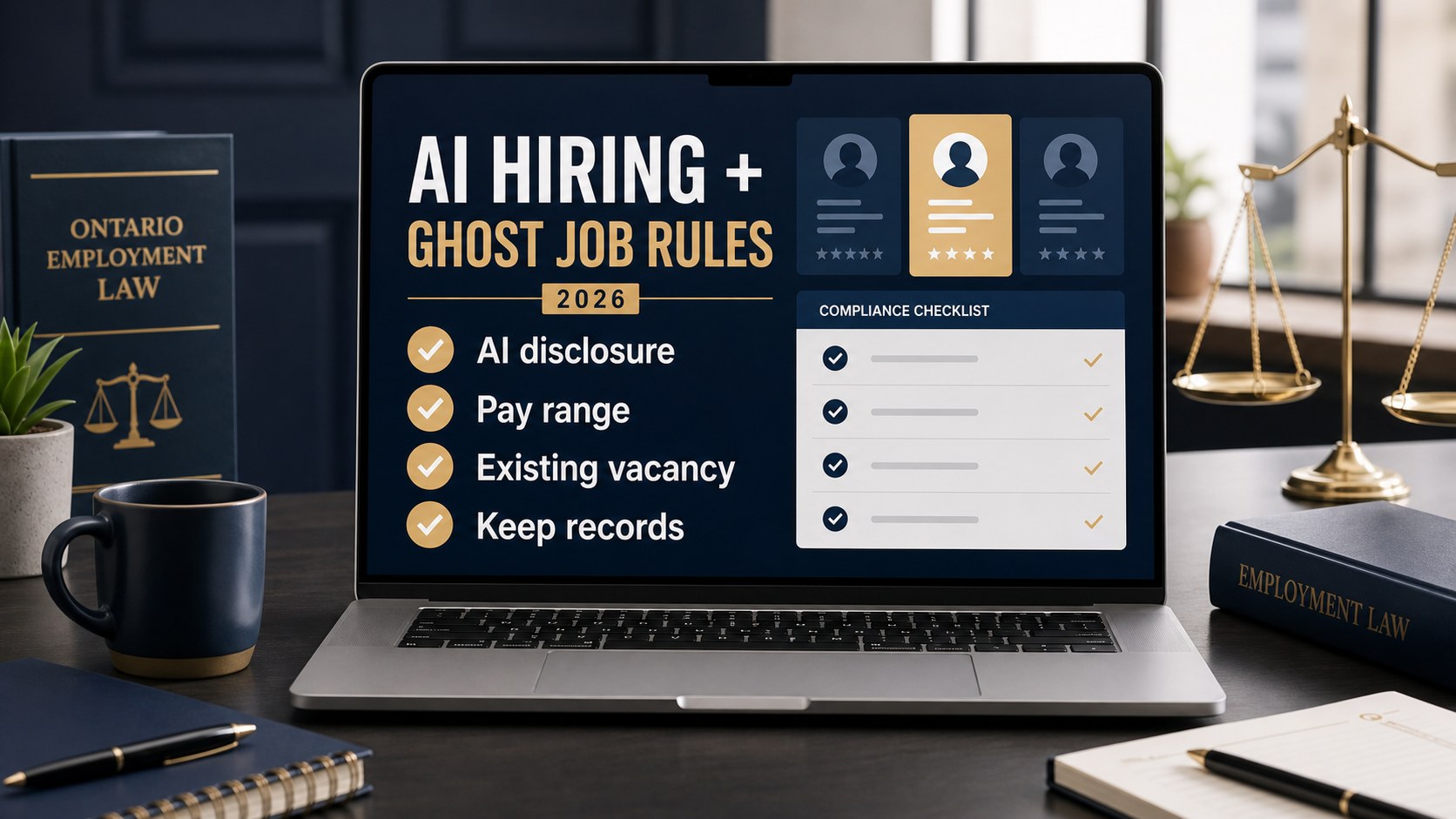
Ontario’s public job posting rules are not limited to salary ranges. As of January 1, 2026, covered employers must also disclose whether artificial intelligence is used to screen, assess or select applicants, and must state whether an existing vacancy exists for the advertised position. These requirements are aimed at two common sources of candidate frustration: hidden automated screening and postings that appear to advertise roles that are not actually open.
What counts as AI disclosure?
The Ontario ESA guide describes disclosure where artificial intelligence is used to screen, assess or select applicants. Employers should not bury this in internal policy only. The public posting should tell applicants, in plain language, if AI tools will be used at one of those hiring stages. If the employer is unsure whether a vendor tool uses AI, that uncertainty should be resolved before the posting goes live.
What is the “existing vacancy” statement?
The posting must indicate whether an existing vacancy exists. This is the rule job seekers often describe as the “ghost job” protection. It does not necessarily ban every talent-pipeline campaign, but it does require clearer disclosure when the posting is public and role-specific. Employers should avoid wording that makes a speculative pipeline role look like an immediately open job.
Practical employer checklist
- Confirm the employer has 25 or more Ontario employees on the posting date.
- Include expected compensation or a compliant compensation range.
- State whether AI is used to screen, assess or select applicants.
- State whether an existing vacancy exists.
- Remove Canadian-experience requirements from the public posting.
- Keep a copy of the final posting, platform, posting date, reviewer and approval record.
- Give required follow-up information to interviewed applicants within the required timeframe.
What applicants should save
If a posting appears non-compliant, save screenshots showing the employer, job title, platform, posting date, compensation language, AI/vacancy wording and any later edits. A screenshot is more useful than a memory of what the posting said before it changed.
A Compliance Checklist for Ontario Employers
A typical problem looks like this. A manager needs to hire quickly, copies an old posting, adds “competitive salary,” and pushes it live on three platforms before HR or payroll sees it. By the time anyone notices, the posting is already public and the compliance problem already exists.

The fix is not a complicated policy manual. It is a repeatable process that someone in the business can follow every time a role is posted. As noted earlier, the Ontario rules turn on a few practical details that are easy to miss under hiring pressure, including employee count on the posting date, compensation disclosure, and the content of public ads.
A Practical Compliance Checklist
-
Confirm whether the posting is covered before it goes live
Check whether the role will be advertised publicly and whether the business meets the employee threshold on the day of publication. Do not rely on last quarter’s headcount or a rough estimate from payroll. Use a current count and keep a record of who confirmed it. -
Use one approved template across every channel
Problems start when LinkedIn, Indeed, the company careers page, and a local manager’s social post all carry different wording. A single approved version should feed each public posting channel. That reduces the risk of one ad containing the salary information while another does not. -
Set compensation before recruiting starts
Hiring teams should decide the pay figure or range before the ad is drafted, not during interviews. The disclosed amount should line up with what the employer is prepared to offer for that role. If compensation depends in part on commission or another non-discretionary component, the posting should explain that clearly rather than blur guaranteed pay and variable earnings. -
Assign final review to one accountable person
Compliance breaks down when everyone assumes someone else checked the ad. In a small business, that person may be the owner or office manager. In a larger employer, it is usually HR, legal, or a designated recruiting lead. -
Keep the posting and the offer documents aligned If the ad says one thing and the employment agreement says another, the employer creates unnecessary disputes. It often makes sense to review posting language alongside an Ontario employment contract review, especially for roles with bonus plans, probation terms, or customized compensation structures.
Sample posting language
The safest drafting is usually the clearest drafting. These examples are not statutory wording, but they reflect the kind of language employers should be using.
Sample single figure: “Compensation for this role is $78,000 annually, plus eligibility for non-discretionary commission under the company plan.”
Sample range: “Expected compensation for this role is $60,000 to $85,000 annually, depending on experience, role scope, and internal compensation alignment.”
“Competitive salary” on its own does not solve the problem for a covered public posting.
Common mistakes that create avoidable risk
Some mistakes are obvious. Others show up in businesses that are trying to comply but have not tightened the process.
-
Posting first and checking later
Once the ad is public, the issue is already live. -
Using a range so broad that it says very little
Employers sometimes leave themselves bargaining room by posting a range that looks non-committal. That approach invites scrutiny and undermines the point of the rule. -
Letting separate locations or departments improvise
Multi-site employers need one review standard. A good policy at head office does not help if branch managers post their own versions. -
Treating the ad as marketing copy instead of a legal document
Job postings still sell the role, but they now also carry compliance consequences. That changes how they should be drafted and approved. -
Failing to document the decision-making
If a complaint is made, it helps to show who confirmed headcount, who approved the compensation wording, and which template was used.
What good compliance looks like in practice
Good compliance is usually quiet. Payroll, HR, and the hiring manager agree on compensation before the ad is posted. One person signs off. The same approved language appears everywhere the role is advertised.
Some employers will handle this through an applicant tracking system or payroll-linked workflow. Others will use a manual checklist and a shared template folder. Either method can work if responsibility is clear and the process is followed consistently. Businesses exploring operational tools sometimes also look at broader discussions about how AI streamlines legal work, but the legal judgment still has to be grounded in Ontario employment law and the wording of the actual posting.
One Ontario-focused option for legal guidance is UL Lawyers, which publishes employer resources on pay transparency and related hiring obligations. That review is most useful before the first public posting goes out, not after an employee or applicant raises a complaint.
Understanding Exemptions and Special Cases
A surprising number of pay transparency mistakes start with an employer assuming an exception applies, then building the posting process around that assumption. By the time someone asks whether the exemption was real, the ad has already gone live and applicants have seen it.
Employer size threshold
The first exemption question is usually headcount. If the employer is below the statutory threshold at the relevant time, the public posting requirement may not apply. That sounds simple, but smaller Ontario businesses often run into trouble where staffing changes month to month, operations are split across related companies, or the business relies heavily on people it calls contractors.
Classification can change the analysis. If some of those workers are legally employees rather than independent contractors, the employer may be counting too low. For that reason, businesses should review employee versus independent contractor status in Ontario before treating the size threshold as a safe exemption.
Employees should pay attention to this too. If a company says the rules do not apply because it is “too small,” but the business appears to have a larger regular workforce than the posting suggests, that is a point worth documenting if a complaint is later made.
High-income roles
Ontario’s compensation-based exception for certain higher-paying positions is narrower than many employers expect. It does not excuse every senior, specialized, or management role from disclosure rules. Title alone will not carry the analysis, and neither will the possibility of a large bonus that may or may not be earned.
The practical step is straightforward. Decide before posting whether the role fits the exception, record the basis for that decision, and keep that note with the hiring file.
Trying to justify the exemption after the ad is challenged is a weak position.
Public posting versus non-public recruitment
A second recurring issue is whether a posting is public. The rules focus on publicly advertised jobs, so the same role can be treated differently depending on how it is shared.
A public posting is one the general public can view, such as an ad on the company website, a job board, or a social platform. An internal posting circulated only to existing staff may fall outside that category. General brand advertising that says a company is hiring, without advertising a specific role, may also raise different issues than a true job posting.
The difficult cases are mixed-channel campaigns. A hiring manager sends an opening to staff first. A recruiter reposts it on LinkedIn. Marketing turns the same text into a public careers page ad. At that point, the safest approach is to assess the version that reached the public and make sure that version complies.
If a business recruits through several channels, assess the most public version of the ad and approve wording on that basis.
Some employers use workflow tools to manage that risk, especially where several people can edit or repost hiring content. The broader discussion around how AI streamlines legal work has some practical value here because hiring compliance often depends on version control, approval steps, and reliable recordkeeping. Technology can help catch inconsistencies. It does not replace legal judgment on whether an exception applies or whether a posting is public.
Enforcement and Penalties for Non-Compliance
A law without enforcement is mostly a suggestion. These rules aren’t suggestions.

When an employer publishes a non-compliant posting, the risk is legal, operational, and reputational at the same time. Operationally, the business may need to revise ads, retrain staff, and deal with confused candidates. Legally, the issue sits within the Employment Standards Act enforcement structure. Reputationally, a public-facing posting can circulate long after the original mistake.
How a complaint typically starts
For employees and applicants, the first step is usually practical rather than formal. Save the posting. Take screenshots. Record where it appeared and when you saw it. If the employer edits or deletes the ad later, your record may matter.
A complaint can then be raised through the appropriate Ontario employment standards process. The Ministry can investigate alleged non-compliance, request records, and assess whether the employer met its obligations in the public posting.
What employers face
The immediate concern for many employers is financial exposure. As noted earlier in the article, the rules can attract monetary penalties for non-compliance. But the larger legal mistake is thinking of this as only a fine issue.
The Ministry’s involvement can trigger a wider review of recruitment practices. If one posting is defective, investigators may look at whether the problem reflects a template issue, a training issue, or a systemic problem across departments. Employers dealing with repeated complaints often need more than a quick patch. They need a proper review by labour lawyers in Ontario who can assess hiring processes, records, and policy language.
What employees should expect
Employees should be realistic. Enforcement isn’t always immediate, and not every concern turns into a dramatic outcome. Still, formal reporting matters because it creates a record and gives the Ministry the opportunity to examine whether the employer is following the Act.
A saved screenshot is often more useful than a strong opinion about what the employer intended.
For employers, the lesson is simple. If your compliance plan depends on nobody noticing, you don’t have a compliance plan.
How Employees Can Use Their New Rights
For employees and job seekers, these rules are useful long before any complaint is filed. They change the opening position in the hiring conversation.
How to spot a problem posting
A compliant public posting should give you real compensation information if the employer is covered by the law. If the ad is public, role-specific, and still avoids pay details with wording like “competitive compensation” or “salary commensurate with experience,” that should raise a red flag.
Employees should also watch for postings that seem designed to obscure rather than disclose. If the compensation language is confusing, inconsistent across platforms, or obviously disconnected from the role being advertised, document it.
What to do next
Start with evidence. Save screenshots and note the date, employer name, platform, and job title. Then decide whether the issue is a poor draft or something you want to escalate.
If the concern forms part of a broader workplace problem, such as discriminatory pay practices or retaliation tied to compensation discussions, legal options may extend beyond the posting rules themselves. In some cases, workers also need guidance on filing a human rights complaint in Ontario, depending on the facts.
How this helps in negotiation
Pay transparency doesn’t guarantee fair pay. It does remove one old obstacle. When a posting states compensation openly, you can evaluate the role before investing time in applications, interviews, and tests. You can also compare the posted figure to the duties being described.
That makes salary discussions more grounded. Instead of asking what the employer has in mind, you can ask why your experience places you at one part of the posted pay structure rather than another.
The larger value is cultural. Hidden pay often benefits the party with more information. Visible pay doesn’t solve every inequity, but it gives employees a firmer place to stand.
Clarifying the Current Legal Requirements
As of 2026, Ontario employers are subject to new requirements regarding publicly advertised job postings. These rules are found in the Employment Standards Act, 2000 and its regulations, not under the 2018 Pay Transparency Act, which has not been fully proclaimed into force. The ESA public job posting requirements mandate that employers include the expected compensation or a range of compensation in any publicly advertised job posting. This is intended to promote transparency and help close the wage gap.
The 2018 Pay Transparency Act (Bill 3) received royal assent but most of its provisions—including broader reporting obligations and a prohibition on asking about salary history—have not yet been proclaimed. The current ESA rules are narrower in scope. Employers should ensure compliance with the ESA posting requirements, while staying informed about any future proclamation of the Pay Transparency Act. For more detailed guidance, refer to our updated resource on the 2026 rules. This summary is for general information and does not constitute legal advice.