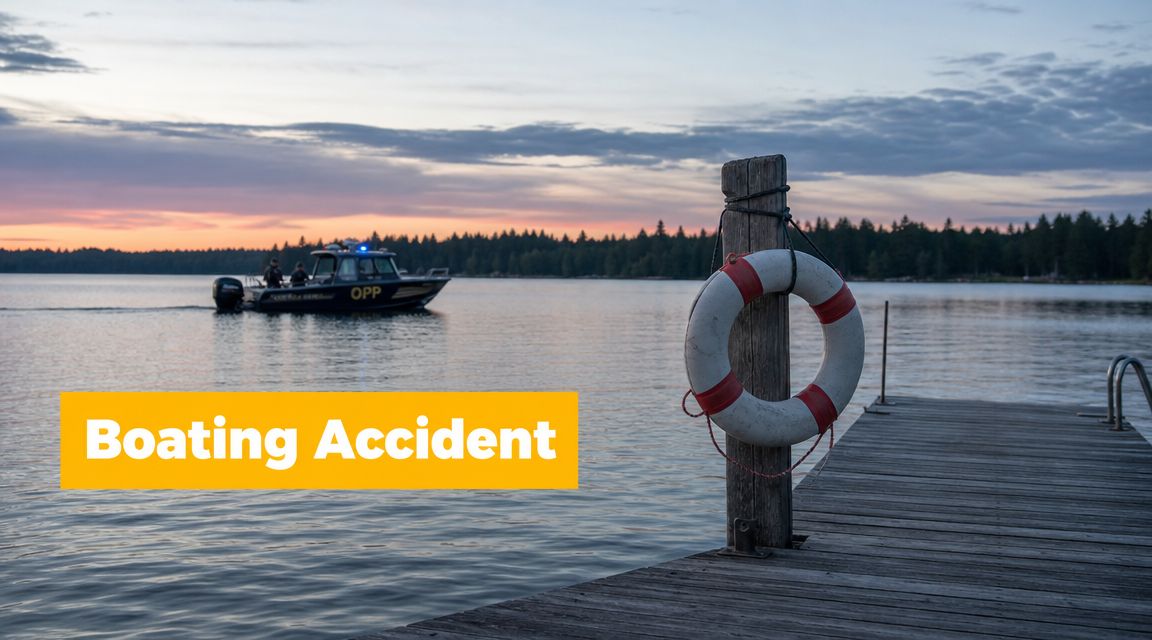
A lot of families find this page in the worst hour of their lives. The call has come from the lake, the OPP, or the hospital. Someone hasn’t come home from what was supposed to be an ordinary cottage weekend, and now every next step feels unreal.
In that first stretch of shock, people often swing between numbness and frantic decision-making. They worry about the boat, the police, the insurance company, the funeral, the children, the media, and whether saying the wrong thing will hurt a future claim. That kind of spiralling is common in grief, and it is important to steady yourself enough to deal with the urgent tasks in front of you.
What matters most right now is this: several different processes may begin after a boating fatality in Ontario, and they are not the same thing. The OPP investigation, the Coroner’s investigation, and any Transport Canada regulatory review can overlap. A civil wrongful death claim is separate again. Families are often told bits and pieces by different officials and come away thinking one process controls all the others. It doesn’t.
For a boating accident death Ontario cottage season 2026 case, the practical problem is rarely just proving that something terrible happened. The hard part is preserving evidence early, understanding who is investigating what, and protecting the family’s rights before statements, vessel repairs, insurance contact, and delay make the file harder to prove.
Table of Contents
- Navigating the Aftermath of a Tragic Boating Accident
- Immediate Actions in the First 24 Hours
- Understanding the Official Investigations
- Criminal Charges Versus Civil Wrongful Death Claims
- Navigating Insurance Policies and Critical Deadlines
- When to Contact a Personal Injury Lawyer
- Boating Safety and Prevention for the 2026 Season
Navigating the Aftermath of a Tragic Boating Accident
A fatal boating incident at a cottage rarely arrives as a clean, obvious “accident scene.” More often, it begins with confusion. Someone is overdue. A passenger is in the water. Another vessel is involved. There’s poor light, wind, noise, and several people trying to piece together what happened from fragments.
That confusion matters legally because early assumptions are often wrong. Families may be told it was a collision, then learn later that the central issue was ejection, capsizing, lighting, speed, lookout, overloading, or immersion after a vessel became unstable. Ontario reporting from the St. Lawrence River has also shown that fatal boating events on inland waterways are not limited to collisions. In one incident north of Grenadier Island, Leeds County OPP reported a capsized boat and a 41-year-old Ottawa resident who was recovered unresponsive and later pronounced dead, as reported by CityNews Ottawa on the St. Lawrence River fatality.
The practical reality families face
In the first days, relatives usually aren’t dealing with one issue. They are dealing with all of these at once:
- Identification and notification: Police, hospital staff, and next of kin contact can unfold quickly and unevenly.
- Possession of the vessel: The boat may be seized, secured, moved, or examined before the family understands why.
- Statements: Officers, insurers, and other parties may ask for information before the family has legal advice.
- Documents: Ownership papers, insurance policies, maintenance records, photos, and phone data can become important almost immediately.
Practical rule: Don’t assume the official process will automatically gather and preserve everything a civil case needs.
A seasoned lawyer looks at these files with two timelines in mind. The first is the public investigation into how the death happened. The second is the private legal work required to protect a family’s financial claim. Those timelines sometimes support each other, but they are not identical, and they don’t move at the same pace.
The first legal question isn’t fault
The first legal question is usually what evidence still exists, who controls it, and how quickly it may change. Boats are repaired. Electronics are overwritten. Witnesses talk to each other. Memories harden. Insurance adjusters begin building their version of events early.
Families don’t need to solve the case in a week. They do need a clear plan.
Immediate Actions in the First 24 Hours
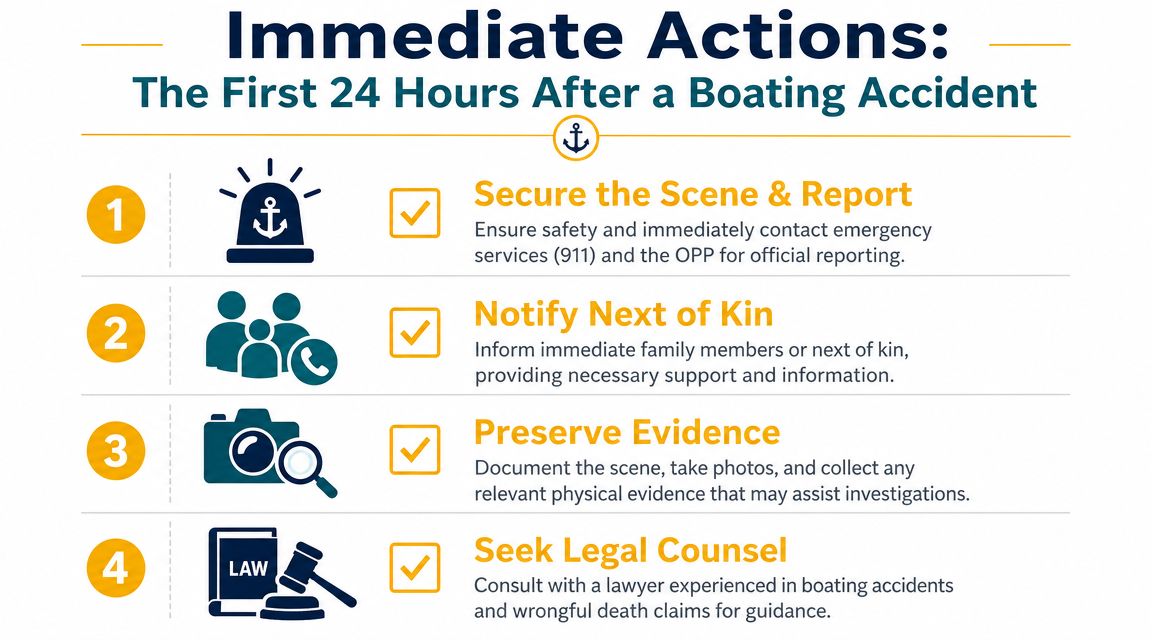
The first day after a fatal boating incident is about safety, reporting, and preservation. It’s not the time to debate liability on the dock or try to reconcile conflicting accounts.
At the scene and just after it
If the incident is still unfolding, call 911 and follow emergency direction. If there are survivors, get them out of immediate danger, account for every passenger if possible, and avoid creating a second emergency by sending unprepared people into dark or unsafe water.
Then focus on these priorities:
-
Make sure the OPP is notified
Fatal and serious boating incidents in Ontario need formal police involvement. If officers are already attending, cooperate calmly and identify the people who were on the vessel or nearby.
-
Don’t alter the boat or scene unless safety requires it
Families sometimes clean the vessel, move gear, or remove alcohol containers because they are distraught or embarrassed. That can create serious evidentiary problems later.
-
Write down what each person remembers separately
Keep it simple. Time, location, weather, lighting, direction of travel, speed estimates if known, seating positions, who wore a PFD, and what happened immediately before the incident.
-
Notify immediate family
Do this directly and carefully. It’s far better for close relatives to hear confirmed information from family or police than through social media or cottage community rumours.
For a practical post-accident mindset, many of the same evidence-preservation habits that apply after other serious incidents also apply here. UL Lawyers has a helpful Ontario-focused primer on what to do after a car accident, and the broad lessons about documentation, reporting, and early legal caution carry over well.
What to preserve before it disappears
Physical and digital evidence can change within hours.
- Photographs and video: Take them only if it’s safe and appropriate. Include the dock, shoreline, lighting conditions, visible damage, safety equipment, and weather.
- Witness names: Get full names and contact information. Cottage neighbours, anglers, marina staff, and nearby boaters may have seen more than they realise.
- Electronics and records: Don’t delete texts, location history, marine electronics data, dash-style boat camera footage, or phone photos.
- Personal effects: Wet clothing, footwear, PFDs, and damaged gear may later matter.
If you can’t gather evidence yourself, make a written list of what exists and where it likely is. That alone can help preserve a claim.
What doesn’t help in the first 24 hours is giving broad recorded statements to insurers, speculating about fault, or accepting anyone’s reassurance that “this was just a tragic accident” before the evidence is reviewed.
Understanding the Official Investigations
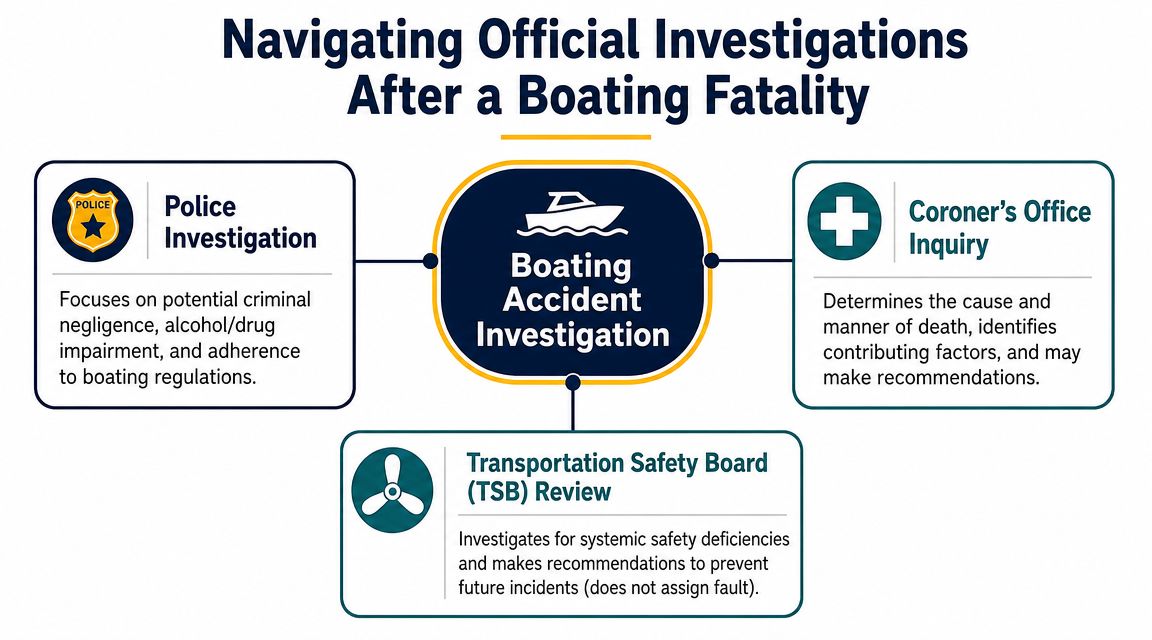
A family may hear from police, the Coroner’s office, and federal regulators within the same day. That often feels like one investigation repeating itself three times. It is not. Each body is dealing with a different part of the death, and families make better decisions when they know which process answers which question.
Why multiple officials may contact the family
The OPP usually controls the scene first. Officers gather statements, document vessel damage, secure physical evidence, and examine whether offences may have occurred, including impairment, speed, lighting, lookout, unsafe operation, or failures to follow boating rules. If there is a parallel criminal investigation, that work matters. It can also become important evidence later in a civil case, even though the police file does not prove the whole claim on its own.
The Office of the Chief Coroner for Ontario examines the death from a different angle. The Coroner does not decide civil fault. The office focuses on identity, medical cause of death, and manner of death, while collecting information that may help explain how the fatality happened and whether broader safety concerns exist.
Families are often confused by the medical terminology used in that process. The Office of the Chief Coroner for Ontario explains the distinction: the cause of death refers to the medical injury or condition that directly led to death, while the manner of death classifies how the death occurred — natural, accident, suicide, homicide, or undetermined. Understanding this framework can help families follow the Coroner’s findings more clearly.
Transport Canada may also become involved where there are questions about vessel compliance, required equipment, operator qualifications, registration, or marine safety rules. That review is regulatory. It is separate from the Coroner’s work and separate from any police decision about charges.
Those files can overlap. They do not serve the same purpose.
What each investigation is trying to answer
A useful way to approach this is to ask three separate questions. What happened on the water? What caused the death medically? Were boating laws or safety rules breached?
| Investigation | Main concern | What families usually notice |
|---|---|---|
| OPP | What happened, who did what, and whether charges may be considered | Interviews, scene control, vessel examination, requests for statements |
| Coroner | Medical cause and manner of death | Identification process, medical information, possible post-mortem steps |
| Transport Canada | Regulatory and safety compliance questions | Document requests, operational details, equipment and vessel review |
That distinction matters in real files. A collision case on a busy cottage lake and a capsizing case on a large river may both result in a fatality, but the evidence path is different. In one case, investigators may focus on speed, visibility, lighting, and operator conduct. In another, they may focus on stability, weather, safety equipment, occupancy, or what happened after the vessel entered the water.
Families should also understand what these investigations do not do. None of them exists to calculate the financial loss suffered by a spouse, child, parent, or estate. None of them starts a civil wrongful death claim for the family. Police and regulators may uncover facts that help a civil case, but their job is public investigation and enforcement, not compensation.
If police later consider an operation-related offence, the legal analysis still differs from civil liability analysis. Ontario families sometimes find it helpful to read a familiar road-based example of that split in this overview of a careless driving charge. The same broad principle applies on the water. A charge decision and a wrongful death claim are connected, but they are not the same proceeding and they do not rise or fall together.
Criminal Charges Versus Civil Wrongful Death Claims
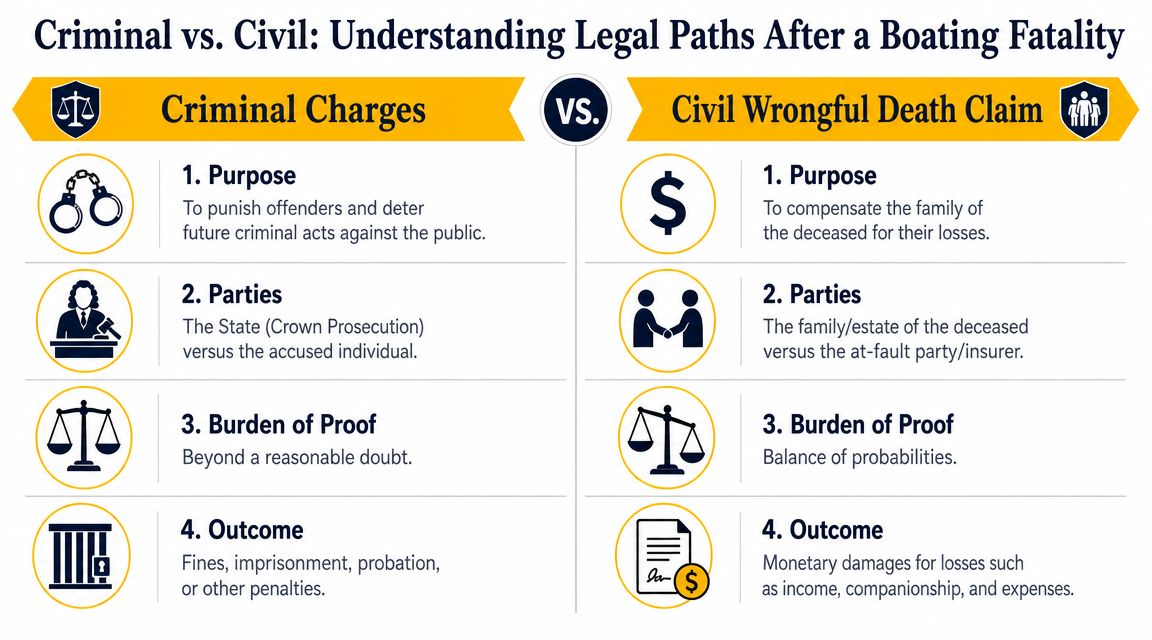
A family may spend days waiting for news of charges, believing that the legal case cannot begin until police make a decision. In Ontario, that assumption can cost time and evidence. A criminal file and a civil wrongful death claim often develop at the same time, but they serve different purposes and follow different rules.
Two legal tracks with different purposes
A criminal case belongs to the state. Police investigate. The Crown decides whether the evidence supports a prosecution. The question is whether an accused person committed an offence that can be proven beyond a reasonable doubt.
A civil wrongful death claim belongs to the estate and eligible family members. The question is different. The court asks whether a person, boat owner, marina, rental business, or another party was negligent and whether that negligence caused or contributed to the death.
Those differences matter because families often expect one process to answer everything. It does not. The OPP, the Coroner, and Transport Canada may each gather facts that become relevant later, but none of those bodies starts the family’s compensation claim, and none decides the family’s losses.
| Issue | Criminal proceeding | Civil wrongful death claim |
|---|---|---|
| Who starts it | Police and Crown | Family members and/or estate |
| Main purpose | Public accountability, sentencing, deterrence | Financial compensation for legally recognized losses |
| Standard of proof | Beyond a reasonable doubt | Balance of probabilities |
| Result | Charge, guilty finding, acquittal, stay, or no charge | Damages, settlement, dismissal, or judgment |
Why a civil case may proceed even without charges
This point often needs to be explained early. No charge is not the same thing as no civil case.
In boating death claims, liability may turn on facts that never produce a criminal prosecution. Operator inattention, unsafe speed for conditions, poor lookout, overloading, missing safety equipment, alcohol use, faulty maintenance, inadequate lighting, or a rental company’s poor instructions can all matter in civil court. A Crown attorney may decide that the evidence does not meet the criminal standard. A civil court can still find negligence on the same record, or on a fuller one developed through document production, expert review, and witness examinations.
The reverse is also true. A criminal charge does not automatically prove a civil claim. Families still need evidence that identifies the defendant, explains what went wrong on the water, and connects the death to compensable losses under Ontario law.
What compensation means in a wrongful death claim
Criminal courts do not calculate the family’s financial loss in the way a civil court does. A wrongful death claim examines the actual impact of the death on the people left behind. Depending on the facts, that can include loss of care, guidance, and companionship, income-related loss, funeral expenses, and other recognized heads of damage. This overview of pecuniary and non-pecuniary damages in Ontario civil claims gives a useful starting point for those categories.
The practical trade-off is straightforward. The criminal process is controlled by the state. The family has limited influence over timing, charges, plea discussions, and trial decisions. A civil case gives the family a direct path to seek records, preserve evidence, retain experts, and press the compensation claim without waiting for the criminal file to resolve.
That distinction is often one of the hardest parts for grieving families to absorb. It is also one of the most important.
Navigating Insurance Policies and Critical Deadlines
Insurance problems after a boating death are rarely about one single policy. Families may be dealing with the boat owner’s insurer, a separate liability insurer, life insurance, cottage or homeowner coverage, and sometimes additional policies that aren’t obvious at first glance.
Which policies may matter
Start by gathering every policy that could possibly touch the loss. That usually includes the vessel policy, any umbrella or excess liability coverage, the deceased’s life insurance, cottage insurance, homeowner’s insurance, and employment-related benefits if they exist.
Look for the declarations page, named insureds, exclusions, notice requirements, and any correspondence already sent by the insurer. If the vessel was borrowed, rented, shared among family members, or stored at a marina, coverage questions can become more complicated than people expect.
A simple working checklist helps:
- Boat or watercraft policy: Check liability coverage, ownership details, listed operators, and reporting conditions.
- Home or seasonal property policy: Some cottage-related liability issues may intersect with the property file.
- Life insurance and workplace benefits: These are separate from fault-based claims and should be reviewed promptly.
- Other available benefits: Depending on the facts, there may be additional benefit pathways worth examining.
For families trying to understand whether any no-fault style benefit issues could arise through an Ontario insurance framework in related circumstances, this plain-language guide to accident benefits in Ontario can help frame the broader insurance environment.
Deadlines, notice, and common mistakes
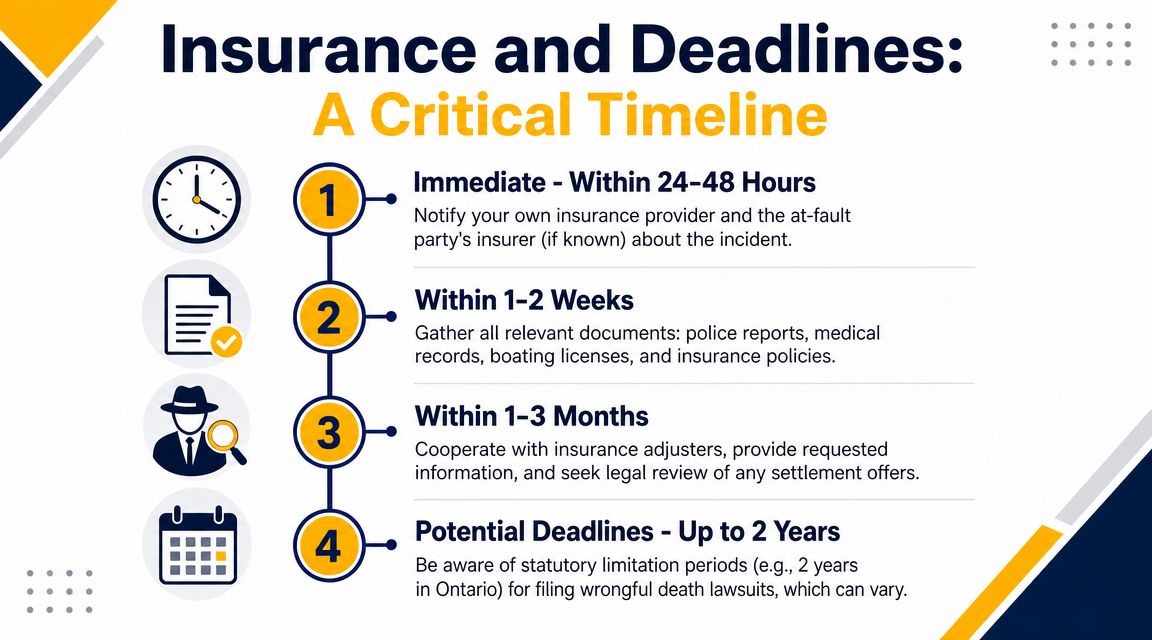
The most common insurance mistake is delay. The second is assuming one notice reaches every insurer. It usually doesn’t.
Keep a dedicated record with dates, claim numbers, adjuster names, and copies of every letter or email. If an insurer asks for a statement, authorisation, or settlement document, have it reviewed before signing.
Watch for these problems:
- Late notice: Policies often require prompt reporting.
- Recorded statements given too early: Families speak while distressed and incomplete facts get locked into the file.
- Informal assurances: A phone call saying “you’re covered” is not the same as a coverage determination in writing.
- Premature settlement discussions: Early offers may arrive before liability and full losses are understood.
Limitation periods can also affect wrongful death litigation in Ontario. Under Ontario’s Limitations Act, 2002, the general limitation period is two years from the date the claim was discovered, which in a wrongful death case is typically two years from the date of death. That may sound like a long window, but evidence preservation, insurance notice obligations, and the need to identify all potentially responsible parties often require action far sooner. Families should get legal advice quickly rather than trying to calculate deadlines from memory or internet summaries.
When to Contact a Personal Injury Lawyer
The right time to speak with counsel is usually much earlier than families expect. Not because a lawsuit must begin immediately, but because important mistakes tend to happen before one is started.
Early legal help changes the file
In a fatal boating case, early counsel can help preserve vessel evidence, identify additional records, manage insurer contact, and prevent the family from being pulled into avoidable statement-taking. That matters when the file may later depend on navigation lights, marine electronics, seat positions, weather, maintenance, ownership, or operator conduct.
A lawyer also helps separate grief from administration. Family members should not have to spend the first week arguing with insurers, chasing police information, or trying to guess which records need to be retained.
Good early counsel doesn’t inflame a file. It stabilises it.
What counsel actually does in the first days
A practical legal response often includes:
- Evidence preservation letters: Sent to insurers, owners, marinas, or others who may control the boat, data, or footage.
- Document review: Ownership papers, insurance policies, witness notes, police information, and coroner-related documents.
- Liability analysis: Identifying whether the issue appears to be operation, maintenance, equipment, environmental conditions, or a mix.
- Deadline control: Tracking limitation issues and notice obligations before they become a problem.
Many Ontario firms offer a no-upfront-fee consultation model for personal injury and fatal accident work. The point is not to pressure a family into litigation. It’s to let them understand the situation before making decisions. If you’re considering your options, this overview of working with a personal injury lawyer explains the basic role counsel can play.
One practical option in Ontario is UL Lawyers, which handles personal injury and wrongful death matters and offers consultations without upfront fees. Whether a family speaks to UL Lawyers or another Ontario injury firm, the key is to contact someone who understands fatal accident litigation, insurance disputes, and evidence preservation in complex negligence files.
Boating Safety and Prevention for the 2026 Season
The most important lesson from these cases is that prevention is usually less dramatic than the incident itself. It’s basic, disciplined boating. Proper lookout. Proper PFD use. Real respect for weather, temperature, vessel size, and light conditions.
What the Canadian fatality pattern actually shows
For Ontario lakes and cottage waterways, the national pattern is sobering. According to the Drowning Prevention Research Centre Canada’s review of recreational boating fatalities from 2008 to 2017, Canada averaged nearly 100 recreational boating deaths per year. Only 6% of fatalities came from collisions — capsizing accounted for 41% and falling overboard for 26%. Alcohol consumption and failing to wear a PFD were among the top contributing factors. Most fatal incidents involved small powerboats under 5.5 metres in length, according to the DPRC’s 2021 report on recreational boating-related fatalities in Canada.
That should change how people think about risk. The danger on an inland Ontario lake is not only a spectacular crash. It is the ordinary short outing in a small boat, with shifting weather, casual seating, no lifejacket worn, and a mistaken belief that the shore is close enough to make everything survivable.
What works on Ontario lakes
Families who want to reduce risk for the boating accident death Ontario cottage season 2026 period should focus on habits that are simple and repeatable:
- Wear the PFD instead of stowing it: In many fatal files, the issue isn’t whether a lifejacket was on board. It’s whether it was on the person.
- Treat alcohol and operation as incompatible: Impaired judgment on water is harder to recover from than many people think.
- Respect cold water even on warm days: Air temperature can be misleading. Immersion changes a person’s ability to move, think, and self-rescue very quickly.
- Match speed to sight distance and light: Especially at dusk, at night, near shore lighting, or in narrow channels.
- Don’t overload small boats: Weight distribution, wake, and sudden movement can destabilise a vessel fast.
- Check equipment before departure: Navigation lights, communication devices, engine condition, and required safety gear should be verified, not assumed.
- Protect communication devices properly: A phone is often the fastest way to call for help, but only if it stays usable. Keep devices in waterproof cases or dry bags rated for the conditions you expect on the water.
Prevention also means planning for the unglamorous moments. Who is the sober operator. Who has local water knowledge. Who knows where the PFDs are. Whether the boat light works. Whether everyone can get back aboard after an unexpected fall.
A tragedy on the water often looks sudden from shore. In the file, it usually has a chain of preventable choices behind it.
If your family is dealing with a fatal boating incident in Ontario, UL Lawyers can help you understand the investigation process, preserve evidence, review insurance issues, and assess a possible wrongful death claim. The firm serves Burlington, the GTA, and clients across Ontario, and offers consultations without upfront fees so families can get early legal guidance while they’re still trying to make sense of what happened.