Congratulations, you’re on the final stretch of your journey to becoming a Canadian citizen! The last major step is the citizenship test, which is simply a way to confirm you understand Canada’s history, values, and how things work here.
Think of it less as a daunting exam and more as a formal welcome—a chance to show you’re ready to embrace the rights and responsibilities that come with being Canadian.
Your Path to Passing the Canadian Citizenship Test
This guide is your roadmap to successfully navigating the test. We’re here to clear up any confusion and help you walk into that room with confidence, whether you’re in the heart of the GTA or a quieter part of Ontario.
Let’s start by breaking down what the test is all about.
What the Citizenship Test Covers
The good news is there are no surprises. The test isn’t meant to trip you up; every single question is pulled from the official study guide, Discover Canada: The Rights and Responsibilities of Citizenship.
You’ll be tested on a few key themes:
- Rights and Responsibilities: What are the fundamental freedoms and duties of every Canadian citizen?
- Canadian History: Who are the key figures and what are the major events that shaped the country we know today?
- Modern Canada: A look at our economy, geography, and diverse cultural fabric.
- How Government Works: Understanding the roles of federal, provincial, and municipal governments.
- National Symbols: Knowing the stories behind the Canadian flag, the coat of arms, and other symbols.
The citizenship test is more than just a quiz on facts and dates. It’s a confirmation of your readiness to participate fully in Canadian society and uphold the values that unite us from coast to coast to coast.
Who Needs to Take the Test
Not everyone who applies for citizenship has to write the test. This requirement specifically applies to applicants who are between the ages of 18 and 54 on the day they sign their application.
Of course, the test comes much later in the process. If you’re just starting your journey, you might find our guide on how to apply for permanent residence helpful, as that’s the crucial first step.
Ultimately, passing the citizenship test canada is a very achievable goal. With the right resources and a clear plan, you’ll be well-prepared to take this final, exciting step.
So, Do You Actually Need to Take the Test?
Before you start circling dates on your calendar and brewing pots of coffee for late-night study sessions, let’s figure out if you’re even required to take the citizenship test. It’s a common assumption that everyone has to write it, but that’s not the case. Knowing where you stand will clarify your unique path to becoming a Canadian citizen.
The biggest factor here is your age. The government uses the test to ensure a specific group of applicants has a solid understanding of Canada, but it doesn’t apply to everyone.
The Age Requirement: Who’s In and Who’s Out?
The rules are actually quite straightforward. You only need to take the Canadian citizenship test if you are between the ages of 18 and 54 on the day you sign your application. This is a firm rule that determines who needs to hit the books.
This age bracket is designed to ensure that most adult applicants can demonstrate they understand Canada’s history, values, government, and symbols. You can get a better sense of what’s expected by checking out the official test preparation materials from the government.
So, if you’re 17 or younger, or 55 and older, when you apply, you’re exempt. Simple as that.
Let’s put this into a real-world context.
A Quick Example: A Family Application Picture a family of four living in the GTA who are all applying for citizenship at the same time:
- Dad is 45.
- Mum is 42.
- Their daughter is 19.
- Their son is 15.
In this scenario, the father, mother, and daughter all fall within the 18-54 age range, so they’ll each need to write and pass the test. Their 15-year-old son, however, gets a pass because he’s under 18. This shows how the rules apply to each person individually, even when applying together as a family.
More Than Just Age: The Other Prerequisites
Meeting the age requirement is crucial, but it’s just one part of the equation. Before you even get an invitation to the test, an officer from Immigration, Refugees and Citizenship Canada (IRCC) will first make sure you’ve met all the other core requirements for citizenship. Think of these as the non-negotiable fundamentals.
You absolutely must have:
- Met the Physical Presence Requirements: This is a big one. You need to have been physically in Canada for at least 1,095 days (which is three years) within the five-year period right before you apply. It’s how you show you’ve made Canada your home.
- Proven Your Language Skills: You have to show you can communicate in either English or French. For most people, this means submitting results from an approved language test with their application.
- Filed Your Taxes: You must have filed income taxes in Canada for at least three of the five years before you apply, which should line up with your physical presence. This demonstrates you’re an active contributor to Canadian society.
You can think of these requirements as the foundation of your citizenship application. The test is like the final inspection that confirms you’re ready to fully participate as a new Canadian citizen.
Only after an IRCC officer is satisfied that you’ve ticked all these boxes will you get that official notice inviting you to take the test. If you’re feeling unsure about your eligibility or just need help navigating the paperwork, our guide to the Canadian citizenship application can walk you through the details.
What to Expect From the Canadian Citizenship Test
Walking into your citizenship test can feel a little nerve-wracking, but knowing exactly what’s coming is the best way to feel confident and prepared. Think of it less like a scary final exam and more like the last checkpoint on your journey to becoming a Canadian. It’s simply a way to confirm you understand the country you’re about to officially call home.
Let’s pull back the curtain on the test format so there are no surprises on the big day.
The Structure of the Exam
The test is straightforward by design. You’ll be presented with 20 multiple-choice questions and given 30 minutes to complete them. That works out to a minute and a half per question, which is plenty of time to read carefully and choose your answer without feeling rushed.
Every single question is drawn from the official study guide, Discover Canada: The Rights and Responsibilities of Citizenship. There are no curveballs or trick questions—if you know the guide, you know the test.
To pass, you’ll need to answer at least 15 out of 20 questions correctly, which is a 75% score.
To help you get a clear picture, here’s a quick summary of what the test looks like.
Canadian Citizenship Test At a Glance
| Component | Details |
|---|---|
| Number of Questions | 20 multiple-choice questions |
| Time Limit | 30 minutes |
| Passing Score | 15 out of 20 (75%) |
| Question Source | Discover Canada: The Rights and Responsibilities of Citizenship |
| Test Language | English or French |
This table neatly lays out the core facts, showing the test is designed to be a clear and manageable step in your application.
Key Test Day Details
When your test day arrives, you’ll need to bring a few specific documents with you. This usually includes your Permanent Resident (PR) card, two pieces of personal ID (like a driver’s licence or health card), and the official notice that invited you to the test.
It’s a small thing, but arriving a bit early can make a huge difference. It gives you time to find the room, check in, and catch your breath without feeling frazzled. A calm mind is a focused mind.
An official will greet you, walk you through the rules, and make sure you’re all set. Most tests are now done on a computer or tablet provided at the location, but paper-based tests are still occasionally used.
Not everyone has to take the test, of course. This flowchart helps clarify whether it’s a required step for you based on your age when you applied.
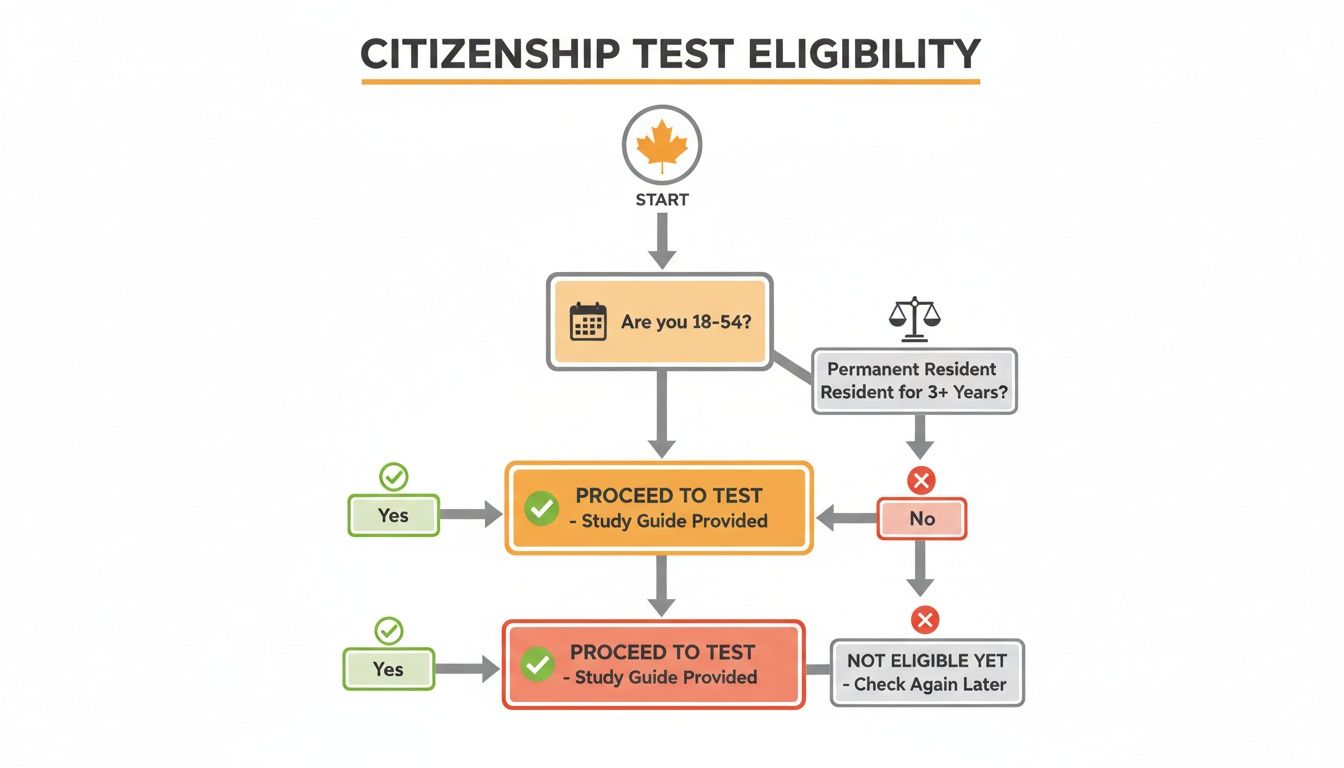
As you can see, the main requirement is being between 18 and 54 years old. If that’s you, the test is a mandatory part of your path to citizenship.
After You Submit Your Answers
Once you’ve answered the last question, you’ll find out your results pretty much right away. An immigration officer will go over them with you, and from there, your next steps depend on whether you passed.
Knowing what happens in either scenario can take a lot of the “what if” anxiety out of the equation.
What Happens if You Pass the Test
If you score 15 or higher, you’ve done it! Congratulations are in order because you’ve just cleared the final major hurdle.
The officer will confirm your successful result and tell you what to expect for the last step: the citizenship ceremony. You’ll later receive a notice with the date and time to take the Oath of Citizenship and officially become a Canadian.
What Happens if You Do Not Pass
Scoring less than 15 isn’t the end of the road, so don’t panic. You automatically get a second chance to write the test.
Immigration, Refugees and Citizenship Canada (IRCC) will schedule another test for you, usually a few weeks or months down the line. Use this extra time to your advantage. Go back to the Discover Canada guide, zero in on the topics you found tricky, and treat it as an opportunity to build even more confidence for your next attempt.
How to Build Your Study Plan for Success

Let’s be honest: passing the Canadian citizenship test isn’t something you can do by cramming the night before. It’s a test of understanding, not just memory. The best way to walk into that exam feeling confident is with a solid, consistent study plan. This transforms a pile of facts into a real, meaningful grasp of your new home country.
Your entire preparation journey revolves around one single document: the official guide, Discover Canada: The Rights and Responsibilities of Citizenship. Every question you’ll face is pulled directly from this book, so it needs to become your best friend.
Deconstructing Discover Canada
Think of Discover Canada as the test’s official blueprint. Rather than just reading it over and over, you’ll get much better results by zeroing in on the chapters that form the heart of the exam.
While you need to be familiar with the whole guide, make sure you really nail these key areas:
- Canada’s History: This is a big one. It covers everything from Indigenous peoples and the arrival of the French and British to Confederation and the major events that shaped the 20th century.
- Modern Canada: Get a good handle on Canada’s economy, its geography (know your provinces, territories, and capitals!), and its diverse cultural fabric.
- Government and Justice: You need to understand the three levels of government—federal, provincial/territorial, and municipal. The same goes for how we vote and how the justice system works.
- Rights and Responsibilities: This is what being a Canadian is all about. Know the rights guaranteed by the Charter and the responsibilities that come with them.
The key is to approach Discover Canada strategically. Don’t just memorize dates; focus on understanding the concepts behind them, like what democracy really means in Canada or the role of the Crown. This deeper comprehension is what will help you tackle any question they throw at you.
One powerful technique for locking in information is incorporating spaced repetition into your study plan. It’s a scientifically proven method where you review material at increasing intervals, which helps move knowledge from your short-term to long-term memory.
Your Actionable 4-Week Study Timeline
A structured schedule can make the whole process feel much less overwhelming. Here’s a sample four-week plan you can tweak to fit your own life, whether you’re in Burlington or anywhere else in the GTA.
Week 1: Laying the Foundation
- Goal: Read Discover Canada once, from beginning to end, to get the lay of the land.
- Action: Don’t stress about memorizing anything yet. Just get familiar with the topics and how the book is structured.
- Tip: Keep a highlighter handy. Mark any terms or ideas that are completely new to you.
Week 2: Deep Dive into Core Topics
- Goal: Really focus on the heavy-hitters: history and government.
- Action: Dedicate two or three days to each topic. Take notes, make flashcards for key people and dates, and maybe even draw a diagram to map out how the government is structured.
- Tip: Try explaining a concept, like how a bill becomes a law, to a friend or family member. If you can teach it, you know it.
Week 3: Expanding Your Knowledge and Testing
- Goal: Cover the remaining sections—like geography, symbols, and the economy—while starting to test yourself.
- Action: This is the week to start doing online practice tests. They’re fantastic for showing you where your weak spots are and getting you comfortable with the multiple-choice format.
- Tip: Every time you get a question wrong on a practice test, go find the answer in Discover Canada. Read the entire paragraph around it to get the full context.
Week 4: Final Review and Reinforcement
- Goal: Solidify everything you’ve learned and build up your confidence for test day.
- Action: Go over your notes and flashcards daily. Take at least one full, timed practice test each day to get used to the pressure.
- Tip: For the last couple of days, ease up. Do a light review of key facts, but avoid frantic cramming. You’ll perform much better with a well-rested brain.
The Surprising Truth About Preparation
Here’s something you might find interesting: being a permanent resident for a long time doesn’t automatically make the citizenship test Canada easier. In fact, the data tells a different story.
Statistics from Immigration, Refugees and Citizenship Canada (IRCC) show that immigrants who apply for citizenship within their first five years as a permanent resident have an impressive pass rate of over 83%. But for those who’ve been in Canada longer, that rate actually drops to between 70-75%.
This gap reveals a crucial lesson: it’s easy to get complacent. Newcomers are often diving headfirst into the formal study process, while some long-term residents might overestimate the knowledge they’ve picked up just by living here. No matter how long you’ve called Ontario home, dedicated, focused study is the only surefire path to passing the test.
Navigating Common Test and Application Hurdles
Even with the best preparation, the path to citizenship can sometimes throw a curveball your way. Knowing what these potential hurdles are and how to handle them is just as crucial as studying for the test itself. This is especially true for applicants across Ontario who might run into unique situations that need a clear, strategic response.
Let’s walk through some of the most common challenges, from a failed test to more complicated application snags, and outline the best way to tackle them.
What Happens if You Fail the Citizenship Test?
It’s natural to feel discouraged if you don’t pass the citizenship test Canada on your first go, but trust me, it’s not the end of the road. The system is designed with this possibility in mind. If you don’t get the required 15 out of 20 questions right, you’ll automatically get a second chance.
Think of it less as a failure and more as a do-over. Immigration, Refugees and Citizenship Canada (IRCC) will send you a notice with a new test date, usually a few weeks or months down the line. Use that extra time to your advantage. Go back to the Discover Canada guide and really dig into the topics you struggled with.
If the second attempt doesn’t work out, the process shifts to an in-person interview with a citizenship officer. This isn’t another written exam. Instead, the officer will ask you questions aloud to see if you understand the material in the study guide and can communicate effectively. If you can demonstrate your knowledge and language skills to the officer, your application can still proceed.
Addressing More Complex Application Issues
Sometimes, the challenge isn’t the test but something else in your application. IRCC might have questions about your eligibility and ask for more information. Two of the most frequent issues are the Residence Questionnaire and concerns about your physical presence in Canada.
A Residence Questionnaire (RQ) is a very detailed form that IRCC sends when they need more evidence that you’ve met the physical presence requirements. Getting one can feel daunting because it demands a lot of documentation to prove your time in Canada.
Think of a Residence Questionnaire not as an accusation, but as a request for clarification. IRCC is giving you an opportunity to build your case with hard evidence like rental agreements, job records, and hydro bills. A well-organized and thorough response is key.
Gaps in your physical presence can also raise red flags. For instance, if you’ve taken long trips outside of Canada or your travel dates aren’t well-documented, an officer might question whether you’ve actually spent the required 1,095 days in the country. This is why keeping meticulous records of every trip is your best line of defence. To get a better sense of how these requests can affect your application’s timeline, you can find out more about Canadian immigration processing times.
When You Should Seriously Consider Legal Help
While most people get through the citizenship process without any major issues, some situations really do call for professional legal support. This is particularly true for individuals in the GTA and across Ontario whose cases have an extra layer of complexity.
Here are a few scenarios where getting legal advice is a very good idea:
- You receive a Residence Questionnaire: A lawyer can help you pull together the strongest possible evidence and present it in a way that directly answers IRCC’s questions.
- You’re called for a citizenship interview: Having legal counsel to prep you can be a game-changer for your confidence and how well you handle the interview.
- You have past criminal charges: Even old or seemingly minor charges can complicate a citizenship application. A lawyer can advise you on admissibility and ensure everything is addressed correctly.
- Your application is refused: If your application is denied, a lawyer can review the decision, explain your options, and guide you through an appeal at the Federal Court of Canada.
Getting through these hurdles takes more than just knowing the study guide—it requires a solid grasp of Canadian immigration law. With the right support, you can face any challenge with confidence and keep your dream of becoming a Canadian citizen on track.
How Recent Changes in Canadian Law Affect Applicants
One thing you learn quickly about Canadian immigration law is that it never sits still. The rules are constantly being updated, and for anyone on the path to citizenship, staying on top of these changes isn’t just a good idea—it’s absolutely essential.
A new piece of legislation can completely change the game, sometimes creating new pathways to becoming a Canadian citizen that didn’t exist just a year ago. It can even mean bypassing the citizenship test altogether. For anyone in Ontario, from downtown Toronto to the wider GTA, understanding this shifting legal landscape is the key to a successful application.
A Major Shift in Citizenship by Descent
A perfect example is a recent, massive change affecting what are often called “Lost Canadians.” For a long time, Canadian citizenship could typically only be passed down one generation if a child was born abroad. This “first-generation limit” meant that if you were a Canadian born outside the country, your own children born abroad wouldn’t automatically get citizenship. It was a frustrating and heartbreaking rule for many families.
But that’s all changed. A recent law completely did away with the first-generation limit. This is a huge deal. This single law is expected to grant citizenship to hundreds of thousands of ‘Lost Canadians’ and their children across the globe. You can read more about how this is poised to reshape global demand for Canadian passports on immigration.ca.
While most of these individuals won’t need to take the standard citizenship test Canada, this development highlights a critical point: the law is not static. What was a dead end for your application yesterday could be a wide-open door tomorrow.
Why You Can’t Afford to Be Out of Date
Legal updates like this aren’t just isolated incidents; they’re a reminder that relying on old information can sink your application. The advice you got from a friend who became a citizen five years ago, a post you read on an old online forum—it could all be dangerously out of date.
Here’s why you absolutely have to stay current:
- Eligibility rules change constantly. New laws can tweak anything from how residency is calculated to language requirements or even tax filing obligations.
- Application processes get updated. Immigration, Refugees and Citizenship Canada (IRCC) is always refining its forms and procedures. Submitting an old version of a form is one of the fastest ways to get your application sent back.
- New opportunities might appear. Just like the citizenship by descent change, new laws can create shortcuts or entirely new routes to becoming a citizen that you’d otherwise miss.
Staying informed means you’re not just ticking the boxes; you’re giving yourself the best possible chance by using the most current—and often most favourable—rules.
How Legal Expertise Makes the Difference
Trying to keep track of every legal shift while you’re also studying for the test and pulling together documents can feel overwhelming. This is where getting professional guidance really pays off. A good legal team lives and breathes this stuff, tracking every amendment from Parliament and every policy memo from IRCC.
Working with an expert gives you a partner who can:
- Translate the legal jargon. They’ll explain what a new law actually means for you and your family, in plain English.
- Keep you compliant. You can be confident that your application is using the latest forms and follows the very latest set of rules.
- Spot new opportunities. An experienced professional can identify new pathways that might simplify your journey to citizenship or even speed it up.
For anyone with a more complex case, or simply for the peace of mind that comes with knowing it’s done right, professional help is invaluable. Learn more about our immigration law team. At the end of the day, being well-informed and well-advised is your strongest asset.
Answering Your Top Questions About the Citizenship Test
Alright, let’s tackle some of the most common questions we hear from applicants about the citizenship test Canada. As test day gets closer, it’s natural for a few last-minute uncertainties to pop up. Getting clear, straightforward answers can make all the difference.
We’ve covered a lot of ground, but these are the practical, “what if” questions that often come to mind.
What Happens if I Fail the Citizenship Test?
First off, don’t panic. If you don’t pass on your first try, it’s not the end of the road. Immigration, Refugees and Citizenship Canada (IRCC) will automatically give you a second chance. They’ll reschedule another test for you, typically within four to eight weeks.
If the second attempt doesn’t go as planned, the next step is an interview with a citizenship officer. Think of it as an oral exam where the officer will ask you questions to see if you meet the knowledge requirements. It’s only if you don’t pass this interview that your application could be refused, so you have multiple opportunities to succeed.
Can I Request Accommodations for the Test?
Yes, absolutely. IRCC provides accommodations for individuals with disabilities or conditions that might affect their ability to take the standard test.
You can request arrangements such as:
- A large-print version of the test booklet.
- Extra time to complete your answers.
- An oral test with an officer instead of a written one.
The key is to make this request when you first submit your citizenship application. You’ll need to provide supporting documents, like a formal letter from a doctor or another medical professional, to explain why the accommodation is necessary.
The only official study guide for the citizenship test is Discover Canada: The Rights and Responsibilities of Citizenship. While you’ll find countless practice tests online, remember that every single question on the real test comes directly from this guide. Stick to the official source—it’s your blueprint for success.
If you’re dealing with a more complicated situation or have questions about your eligibility, getting professional advice can be a game-changer. You can learn more about how an immigration lawyer in Toronto can help guide you through the process.
Navigating the final steps of your citizenship journey can feel overwhelming, but you don’t have to do it alone. If you have questions about the test, your application, or any potential hurdles, the team at UL Lawyers is here to help. Contact us for a consultation to ensure your path to becoming a Canadian citizen is as smooth as possible. Visit https://ullaw.ca to learn more.
Related UL Lawyers resources
If your situation is moving from general research to a real legal problem, these service pages may help you choose the next step:
- Immigration judicial review — focused service page.
- Work permit refusal help — focused service page.