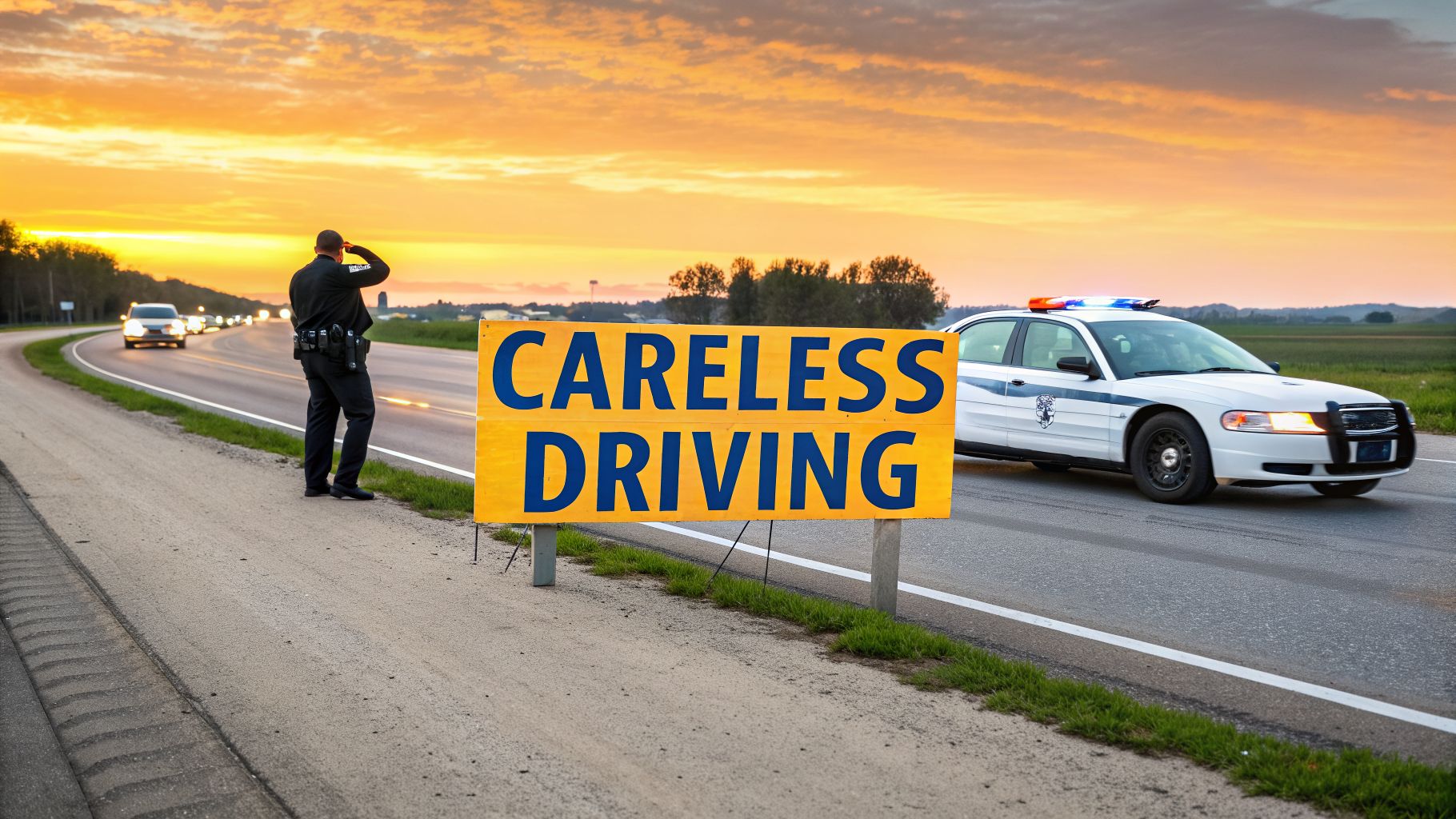
A careless driving charge in Ontario is Highway Traffic Act s. 130 — not a criminal record. Conviction can still mean a $400–$2,000 fine, six demerit points, and a licence suspension of up to two years.
Quick answer: Do not plead guilty to get it over with. Insurance can jump more than the fine. Charged already? Call 905-744-8888 or email info@ullaw.ca before you plead. You can also book a free consultation.
What Is a Careless Driving Charge?

So, what does “careless driving” actually mean? Section 130 of the Ontario Highway Traffic Act defines it as driving “without due care and attention or without reasonable consideration for other persons using the highway.”
That sounds a bit vague, right? It’s meant to be.
Think about navigating the Gardiner Expressway or the 401 during peak hours. You suddenly swerve into the next lane without signalling, narrowly avoiding a collision and forcing another driver to slam on their brakes. That moment of poor judgment is a textbook example of careless driving. It’s not about intending to cause harm; it’s about your actions falling below the standard of a careful, prudent driver.
This broad definition gives police a lot of leeway. It’s one of the most common—and most challenging—charges we see. In fact, in a recent year, police in Ontario handed out thousands of careless driving charges, which accounts for a significant percentage of all traffic tickets issued across the province.
Real-World Scenarios and Analogies
I often tell my clients to think of it like an “unsportsmanlike conduct” penalty in hockey. There isn’t a specific rule for every single poor decision, but the referee knows when a player’s actions are reckless and endanger others. The focus isn’t on one specific broken rule, like speeding, but on the overall quality of your driving at that moment.
Here are a few common scenarios we see in the GTA that can easily lead to a careless driving charge:
- Any form of distracted driving, from texting or eating to fumbling with the car’s infotainment system on a busy street like Yonge or Hurontario.
- Aggressive driving habits, like tailgating another car on the highway or weaving between lanes without checking your mirrors and blind spots.
- Failing to drive for the conditions, such as going the speed limit during a snowstorm or downpour when a slower speed is clearly needed.
The interpretation of what’s “careless” can vary, and it’s often helpful to see What actions constitute careless driving in other jurisdictions to understand the common patterns, though Ontario’s laws are what will apply in your case.
Distinguishing Careless Driving From Similar Offences
It’s easy to confuse careless driving with other serious offences like stunt driving or dangerous driving. But in the eyes of the law, they are very different. Knowing the distinction is critical because it impacts everything from the penalties you face to the strategy used to defend you.
Here’s a simple breakdown of how these charges differ in Ontario.
Careless Driving vs Similar Offences in Ontario
| Offence | Governing Law | Primary Focus | Typical Example |
|---|---|---|---|
| Careless Driving | Highway Traffic Act (Provincial) | A momentary lapse in judgment or attention that falls below the standard of a reasonably prudent driver. | Making an unsafe lane change that causes another vehicle to swerve violently. |
| Stunt Driving | Highway Traffic Act (Provincial) | Specific, high-risk actions, most often excessive speed (e.g., 40+ km/h over in an 80 km/h or less zone, or 50+ km/h over in higher zones). | Speeding excessively to race another car or performing donuts in a parking lot. |
| Dangerous Driving | Criminal Code of Canada (Federal) | Driving in a way that is a marked departure from the norm and is dangerous to the public. It is a criminal offence. | Weaving through heavy traffic at 150 km/h on the QEW, showing a blatant disregard for the safety of others. |
As you can see, careless driving is a provincial traffic offence, not a criminal one like dangerous driving. However, don’t let that fool you into thinking it’s not serious. A conviction can still have a massive impact on your life. If your charge involved a collision, you also need to be familiar with the general laws governing car accidents in Ontario.
Understanding the Severe Penalties You Face
A lot of people mistakenly think a careless driving charge is just another traffic ticket. It’s not. A conviction unleashes a whole set of penalties that can seriously disrupt your life for years. Think of it as a domino effect hitting your finances, your freedom to drive, and your future mobility. This is a serious legal problem, and it needs to be treated that way.
The penalties are deliberately harsh because the law sees careless driving as a major threat to public safety. A conviction immediately affects your wallet, your driving record, and your ability to even stay on the road. Getting a handle on what’s at stake is the first step to understanding why fighting this charge is so important.
The Immediate Financial Hit From Fines
Let’s start with the most obvious hit: the fine. The moment you’re convicted of careless driving, you’re facing a hefty financial penalty. The law in Ontario sets a very clear and punishing range, even for a basic offence where no one was hurt.
This isn’t a small fine you can just pay and move on from. For a standard conviction, you’re looking at:
- A minimum fine of $400.
- A maximum fine of $2,000.
- A mandatory victim fine surcharge, which gets tacked on top of the total.
Those numbers can be a real strain on any budget, but they’re honestly just the tip of the iceberg when it comes to the financial fallout.
A careless driving charge in Ontario carries hefty penalties that can derail your life, starting with a minimum fine of $400 for offences not causing harm, escalating to a maximum of $2,000. In serious cases involving bodily harm or death, fines soar to a minimum of $2,000 and up to $50,000, with potential jail time up to two years—numbers that underscore why this is one of the most severe Highway Traffic Act violations.
Demerit Points and Licence Suspension
Beyond the fines, a careless driving conviction automatically slaps six demerit points onto your Ontario driving record. That’s a huge number. To put it in perspective, accumulating just 15 points means an automatic licence suspension for a fully licenced driver. For new drivers with a G1, G2, M1, or M2 licence, the threshold is even lower, making the consequences that much more severe.
On top of that, the court has the power to suspend your licence for up to two years. Losing your ability to drive can make life incredibly difficult, affecting everything from your commute to work to simple things like grocery shopping or taking care of your family. A suspension isn’t just an inconvenience; it can put your job and your independence at risk. For anyone who drives for a living, a conviction can be professionally devastating. The complexities of losing your driving privileges are serious; you may also be interested in the separate penalties for driving without a valid license.
Crippling Insurance Rate Hikes
This is the one that really stings over the long term: the impact on your car insurance. A careless driving conviction stays on your record for three years for insurance purposes, and during that whole time, insurance companies will label you a high-risk driver.
So, what does that actually mean for your premiums?
- Skyrocketing Premiums: It’s not an exaggeration to say your insurance rates could easily double or even triple after a single conviction.
- Policy Cancellation: Your current insurance provider might just decide you’re too much of a risk and cancel your policy entirely. This forces you to find coverage from a high-risk insurer, which comes at an outrageous cost.
- Long-Term Financial Pain: These inflated rates will cost you thousands of extra dollars over that three-year period, making your car a massive upfront cost burden.
This “three-year sentence” of unaffordable insurance often ends up costing people far more than the original court fine. It’s the penalty that keeps penalizing you long after the ticket has been paid.
Your Step-by-Step Guide to the Court Process
So, you’re holding a careless driving ticket. That piece of paper does more than just ask for a fine; it pulls you right into the formal court system, and knowing the lay of the land is your best defence. It’s easy to feel overwhelmed, but let’s break down the journey step-by-step so you know exactly what to expect.
The clock starts ticking the moment that ticket is in your hand. You have just 15 days to choose one of the options on the back. A word of caution: simply paying the fine is the same as pleading guilty. It’s a quick decision with lasting consequences that are incredibly difficult to reverse. Your other options involve taking the matter to court.
Initiating the Court Process
Your first move, if you intend to challenge the ticket, is to file it with the court to request a trial date. This action officially tells the system you’re not rolling over on the careless driving charge. Once the court processes your request, your case is officially on the docket, and the real process begins.
It’s absolutely critical to stay on top of every deadline and scheduled appearance. Missing a court date is a serious misstep. You could be convicted automatically in your absence, or in some cases, a warrant could be issued. It’s worth understanding what happens if you miss court to see why we treat every date as mandatory, though procedures may differ here in Ontario.
The penalties don’t stop at the courthouse. They create a domino effect, as you can see below.
This is why fighting the charge is so important. A conviction triggers this chain reaction, starting with fines but quickly moving to demerit points and insurance rate hikes that can follow you for years.
Disclosure and Early Resolution
After filing for a trial, the next step is to request disclosure. Think of this as the prosecution’s entire playbook. It’s the complete file of evidence they plan to use against you, including the police officer’s notes, any witness statements, and collision reports. A skilled legal representative will comb through every page, looking for inconsistencies and weaknesses.
Armed with the disclosure, you’ll head to an Early Resolution Meeting. This is your first and best chance to negotiate directly with the prosecutor. The people in the room are:
- The Crown Prosecutor: The lawyer representing the government and arguing its case.
- Your Paralegal or Lawyer: Your advocate, there to fight for you and negotiate the strong outcome.
- The Justice of the Peace: This official oversees the meeting but won’t be deciding your guilt or innocence here.
The primary goal of this meeting is to resolve the case favourably without needing a full-blown trial. By pointing out holes in the disclosure, an experienced representative can often convince the Crown to withdraw the charge completely or reduce it to a much lesser offence, like “Follow Too Closely,” which comes with fewer points and a lower fine.
If you and the prosecutor can’t agree on a resolution, the final step is setting a date for trial. This is where both sides will present evidence and make arguments before a Justice of the Peace, who will then issue a final verdict. Preparing for trial is an intensive process, involving everything from prepping witnesses to crafting detailed legal arguments based on court procedure.
Proven Defences Against a Careless Driving Charge
Getting a careless driving ticket can feel like the end of the road, but a charge is just the beginning of a legal process—it’s not a conviction. The most important thing to remember is that in our justice system, the burden of proof is entirely on the Crown prosecutor. It’s their job to prove, beyond a reasonable doubt, that your driving was legally “careless,” a standard that is surprisingly subjective and often open to a strong challenge.
Fighting a careless driving charge successfully is all about finding the holes in the prosecution’s story. It means building a case, backed by evidence and legal arguments, that shows your driving was reasonable under the circumstances. We have several powerful ways to do this, and the right strategy always depends on the specific details of your situation.
Questioning the Officer’s Version of Events
The Crown’s case almost always starts and ends with the police officer’s testimony and notes. But an officer’s perception isn’t perfect. They’re human. They can make mistakes, misjudge a situation, or simply have a bad view of what actually happened.
A solid defence often starts by taking a hard look at the officer’s account:
- Obstructions: Was the officer’s view blocked by other cars, buildings, or even bad weather like heavy rain or sun glare?
- Distance: How far away were they? The farther away an officer is, the harder it is to accurately clock speed, judge distances, or see what a driver was actually doing inside their vehicle.
- Inconsistencies: Does the officer’s story in court match their original notes? Do their claims conflict with physical evidence or what other witnesses saw?
For instance, an officer might testify that you were weaving recklessly through traffic. But if we can show that you were carefully maneuvering around a series of deep potholes on a poorly maintained road, your actions suddenly look a lot more reasonable than reckless.
Arguing a Momentary Lapse of Attention
The law for careless driving is meant to punish driving that shows a real lack of care and attention, not a simple, split-second mistake. This is a critical distinction. The courts have repeatedly recognized that even the best drivers can have a brief lapse in concentration.
The heart of this defence is showing that your action was a single, isolated error, not a continuous pattern of bad driving. A momentary lapse is not the same as driving without due care for a sustained period.
Think about it: a driver has a sudden, unexpected sneezing fit and the car swerves for a second before they immediately regain control. While a swerve occurred, it was an involuntary reflex—a classic “momentary lapse”—not a deliberate disregard for safety. This defence works by separating a genuine, unfortunate accident from the kind of blameworthy behaviour a careless driving conviction requires.
The Due Diligence Defence
The “due diligence” defence is one of the most robust strategies we can use. Here, the argument isn’t about what happened, but about what you did to prevent it from happening. You argue that you took every reasonable step to drive safely and avoid an incident.
This defence is especially powerful when something completely unexpected and out of your control was a factor.
- Sudden Mechanical Failure: You can show that your brakes failed without warning, especially if you have service records proving your vehicle was regularly maintained.
- Unexpected Road Hazard: A massive piece of truck tire suddenly appears in your lane on the QEW, forcing you to swerve. That isn’t careless—it’s a reasonable reaction to a sudden danger.
- Medical Emergency: You experienced a sudden and unforeseen medical issue, like a dizzy spell, that you had no history of and no reason to expect.
To make this defence stick, you need to provide proof that you were acting responsibly. This could be anything from mechanic’s invoices to witness testimony or a doctor’s report. If a collision was involved, understanding how fault is assigned is key. You can learn more by reading about the laws governing car accidents in Ontario.
Identifying Charter Rights Violations
Every single person in Canada is protected by the Canadian Charter of Rights and Freedoms. If police violated your rights during the traffic stop or investigation, we can ask the court to exclude any evidence they gathered as a result. A successful Charter application can cause the Crown’s entire case to collapse.
Common violations include stopping you without a valid reason, searching your car illegally, or failing to inform you of your right to speak with a lawyer. An experienced legal professional knows how to spot these procedural mistakes and can use them to get a careless driving charge thrown out, sometimes before a trial even begins.
Immediate Steps to Take After Being Charged

The flashing lights are gone, and you’re left standing on the side of the road with a careless driving ticket in your hand. Your head is probably spinning. But what you do in these next few minutes and hours can make or break your case.
This isn’t the time to panic. It’s the time to be smart and methodical. The choices you make right now lay the groundwork for a successful defence.
Document Everything, Say Nothing
Your interaction with the police officer is crucial. Be polite, be cooperative, but say as little as possible. You have the right to remain silent, and you should exercise it. Never admit fault or try to explain what happened. Anything you say can—and often will—be used against you later in court.
Once the officer leaves, it’s time to become your own investigator. Think of yourself as a detective at a crime scene, because that’s essentially what this is. The evidence you gather now could be the key to poking holes in the Crown’s case down the road.
Use your phone to capture the scene from every angle. Your goal is to preserve a snapshot in time. Make sure you get:
- Photos and Videos: Take wide shots of the intersection or stretch of road. Capture traffic signs, lane markings, and the general flow of traffic.
- Road and Weather Conditions: Was the sun in your eyes? Were the roads wet? Are there massive potholes or faded lines that contributed to the situation? Document it.
- Witness Details: If anyone stopped and saw what happened, they could be your most valuable asset. Politely ask for their name and number. An independent witness statement carries a lot of weight.
This immediate documentation is your first line of defence. For a more comprehensive checklist on what to gather after a collision, see our detailed guide on what to do after a car accident.
Avoid The Biggest Mistake: Pleading Guilty
I’ve seen it countless times: people plead guilty to a careless driving charge just to make it go away. This is a massive mistake. A careless driving conviction isn’t like a simple parking ticket; it has serious, long-term consequences for your insurance and your right to drive.
Don’t just take my word for it. Each year, Ontario police lay thousands of careless driving charges, making it one of the most common serious offences on our roads. This isn’t a minor infraction, and the justice system doesn’t treat it like one.
The single most important step you can take after being charged is to get immediate legal advice from a professional who lives and breathes Ontario traffic law.
Don’t wait. The clock is already ticking. An experienced lawyer or paralegal can analyze the evidence against you, identify weaknesses in the officer’s report, and start building a defence strategy. They know the prosecutors and the court system, giving you the best possible chance to protect your licence and your driving record.
How an Experienced Legal Team Can Protect You
Trying to handle a careless driving charge by yourself is a huge gamble. The court system is complex, with its own unwritten rules and procedures. A single misstep can lead to some pretty severe outcomes. This is precisely where having an experienced legal professional in your corner isn’t just a good idea—it’s essential.
Don’t make the mistake of thinking this is just about paying a fine and moving on. A conviction for careless driving leaves a serious mark on your driving record. At UL Lawyers, we’ve seen firsthand how this affects people. We understand that this isn’t just a traffic ticket; it’s your licence, your insurance rates, and for many, your very livelihood on the line. You can meet our dedicated legal team to see the depth of experience we bring to every case.
Our Proven Defence Strategy
We don’t simply go through the motions. We build a robust, evidence-based defence from the ground up, designed to be successful at trial. Our approach is meticulous and proactive. From the moment you retain our services, we initiate a proven process that has delivered results for clients from Burlington to Ottawa and across the Greater Toronto Area.
Our strategy unfolds in several key stages:
- Dissecting the Evidence: The first thing we do is request the full disclosure package from the Crown prosecutor. This includes the police officer’s notes, any witness statements, and accident reports. We go over every detail, looking for inconsistencies, procedural errors, or weak points in the Crown’s case.
- Investigating the Scene: The police officer’s report is only one side of the story. We actively seek out and interview witnesses, search for video evidence, and sometimes even revisit the location of the incident to uncover facts that support your version of events.
- Negotiating from a Position of Strength: Once we have our facts straight, we can open a dialogue with the prosecutor. We don’t just ask for a deal; we present the weaknesses in their case, making it clear that getting a conviction at trial will be an uphill battle for them.
Our primary goal is always to have the careless driving charge withdrawn entirely. If that’s not achievable, our next objective is to negotiate a resolution to a lesser offence with fewer demerit points and a lower fine to protect your driving record.
Building Your Strongest Case
Fighting a careless driving charge successfully requires more than just showing up for your court date. It demands a sophisticated understanding of the Highway Traffic Act, court procedure, and the strategies prosecutors employ. Serving clients throughout Ontario, we know how to challenge the evidence against you and frame your case in the best possible light.
Your first step is our free consultation. It’s a no-pressure opportunity to get straight answers about your rights, understand the road ahead, and learn how a specialized legal team can shield you from the worst-case scenario.
Related UL Lawyers resources
If your situation is moving from general research to a real legal problem, these service pages may help you choose the next step:
- Motor vehicle accident services — service overview.
- Accident benefits support — focused service page.
- Personal injury settlement calculator — helpful calculator.
Frequently Asked Questions About Careless Driving
When you’re staring at a careless driving ticket, your mind is probably racing with a hundred questions. It’s a stressful, confusing situation. Getting clear, honest answers is the first step to getting things back under control. Let’s tackle some of the most common questions we hear from our clients in Burlington and across the GTA every single day.
Will a Careless Driving Charge Give Me a Criminal Record?
Let’s clear this up right away: no, a standard careless driving charge in Ontario does not lead to a criminal record. That’s because it’s a provincial offence under the Highway Traffic Act, not a federal crime under the Criminal Code of Canada.
But don’t let that fool you into thinking it isn’t serious. The consequences are designed to be a major wake-up call and can disrupt your life almost as much as a criminal conviction. We’re talking about a potential licence suspension for up to two years, six demerit points, and insurance premiums that can become completely unaffordable. This isn’t just a ticket; it’s a charge that can impact your job, your family, and your finances for years to come.
Can I Fight the Charge if an Accident Was Involved?
Absolutely. One of the biggest mistakes people make is assuming that because there was an accident, they must be guilty of careless driving. That’s just not how it works. An accident on its own does not equal carelessness in the eyes of the law.
The prosecutor has to prove that your standard of driving—your actual actions behind the wheel—fell below what a reasonably careful person would have done in the same situation. The focus is on your driving before the crash, not on the fact that a crash happened. A good legal team knows how to draw a clear line between an unfortunate accident and genuinely careless driving.
Think of it this way: if a deer suddenly bolts onto a dark, rural road and you hit it, is that automatically your fault? Of course not. The resulting collision doesn’t mean you were driving carelessly; you may have been driving perfectly for the conditions.
How Much Will My Insurance Go Up After a Conviction?
It’s impossible to give you an exact number, but you need to prepare for a severe and long-lasting financial hit. Insurance companies see a careless driving conviction as a massive red flag. For them, it signals a high-risk driver, and the financial consequences are often far more painful than the fine from the court.
If convicted, you can realistically expect one or more of the following:
- Massive Premium Hikes: Your rates could easily double or even triple. This isn’t a small jump; it could mean paying thousands of extra dollars every year for the next three years while the conviction is on your record.
- A Move to High-Risk Insurance: Many standard insurers won’t want to take on the risk. They may refuse to renew your policy, forcing you onto a “high-risk” or “facility” insurance plan with shockingly high premiums.
- Outright Policy Cancellation: In some situations, your insurer might just drop you. This can leave you scrambling to find any coverage at all, just to be able to legally drive your car.
This is a world away from a minor speeding ticket. A careless driving charge can make your vehicle unaffordable to insure. That’s why it’s so critical to fight the charge right from the start.
A careless driving charge puts your licence, your finances, and your future on the line. You don’t have to face it by yourself. The team at UL Lawyers has the experience needed to defend your rights and protect your driving record. We are based in Burlington and serve clients across Ontario, including the entire GTA.
Contact us today for a free, no-obligation consultation to understand your options and start building your strongest defence.