The penalty for driving without a license in Ontario is not a parking ticket. The out-of-court set fine for Highway Traffic Act s. 32(1) (drive motor vehicle — no licence) is $260. On conviction the court range is $200 to $1,000, plus a three-year MTO driving-record hit and an insurance hike.
Ontario quick answer: HTA s. 32(1) set fine is $260. Read the ticket before you pay it. Forgot a valid licence at home is usually fail to surrender licence. Never licensed is an HTA unlicensed-driving charge. Suspended or Criminal Code prohibited is more serious and can include jail. Charged already? Call 905-744-8888 or email info@ullaw.ca before you plead. You can also book a free consultation.
Charged with driving without a license in Ontario? Hire a motor vehicle / traffic lawyer: 905-744-8888 · info@ullaw.ca · Book a free consult. Do not plead guilty just to close the file. If the stop followed a crash, run the personal injury settlement calculator, then call.
The Real Cost of Driving Without a Licence in Ontario
Let’s be clear: getting behind the wheel in Ontario without a valid licence is a gamble with high stakes. If you’re charged, you’re not just dealing with a future court date; you’re facing immediate problems that can throw your life into chaos.
Imagine being pulled over for something minor, like a burnt-out taillight. The officer asks for your licence, and you don’t have one. That routine stop has just escalated into a significant legal issue.
Immediate Financial and Legal Penalties
The penalties under Ontario’s Highway Traffic Act are swift and severe. They aren’t warnings or suggestions—they happen right then and there.
Here’s what you can expect on the spot:
- Hefty Fines: The out-of-court set fine for HTA s. 32(1) is $260. If it goes to court, the conviction range is $200 to $1,000, plus victim surcharge and costs.
- Towing / impoundment: A first “never licensed” ticket does not automatically include a seven-day impound. A seven-day roadside impound is more likely if you were driving while suspended or Criminal Code prohibited. Read the section on the ticket.
- Possible Driving Prohibition: A conviction could also result in the court banning you from driving for a set period. This can seriously affect your ability to get to work, run errands, or manage your daily life.
To make it crystal clear, here’s a quick summary of what you’re up against for a first-time offence.
Immediate Penalties for Unlicensed Driving in Ontario (HTA)
| Penalty Type | Typical Range or Consequence |
|---|---|
| Set fine (s. 32(1)) | $260 (plus surcharge and costs) |
| Court fine | $200 to $1,000 |
| Vehicle impoundment | Not automatic for a first “never licensed” HTA ticket; more likely if the licence is suspended |
| Driving record | A conviction stays on your record for 3 years |
These are just the immediate consequences. The long-term effects can be even more damaging.
It’s a common misconception that driving without a licence is just a paperwork problem. In reality, the province views it as a serious public safety issue, leading to penalties that are immediate, expensive, and disruptive.
Understanding the Ripple Effects
The trouble doesn’t end after you pay the fine and get the car back. A conviction for driving without a licence stays on your driving record for three years, and you can be sure that insurance companies will see it.
This kind of conviction flags you as a high-risk driver. To see just how much traffic convictions can hurt your wallet, you can read more about how much insurance increases after an accident and similar offences. You could be facing sky-high premiums or even find that your insurer cancels your policy altogether, making it incredibly difficult and expensive to get back on the road legally.
Not All Charges Are Created Equal
When you hear “driving without a licence,” it’s easy to assume it’s a single, straightforward offence. But in the eyes of Ontario law, it’s not that simple. The phrase actually covers a whole spectrum of situations, and the penalties you might face depend entirely on why you didn’t have a valid licence on you.
Think of it like being unprepared for an exam. Forgetting your pencil is a minor hiccup, easily fixed. Not studying at all is a much bigger problem. And knowingly cheating after being warned? That’s in a completely different league. The legal system looks at unlicensed driving with a similar, layered logic.
This flowchart breaks down the potential consequences if you’re caught driving without a valid licence in Ontario.
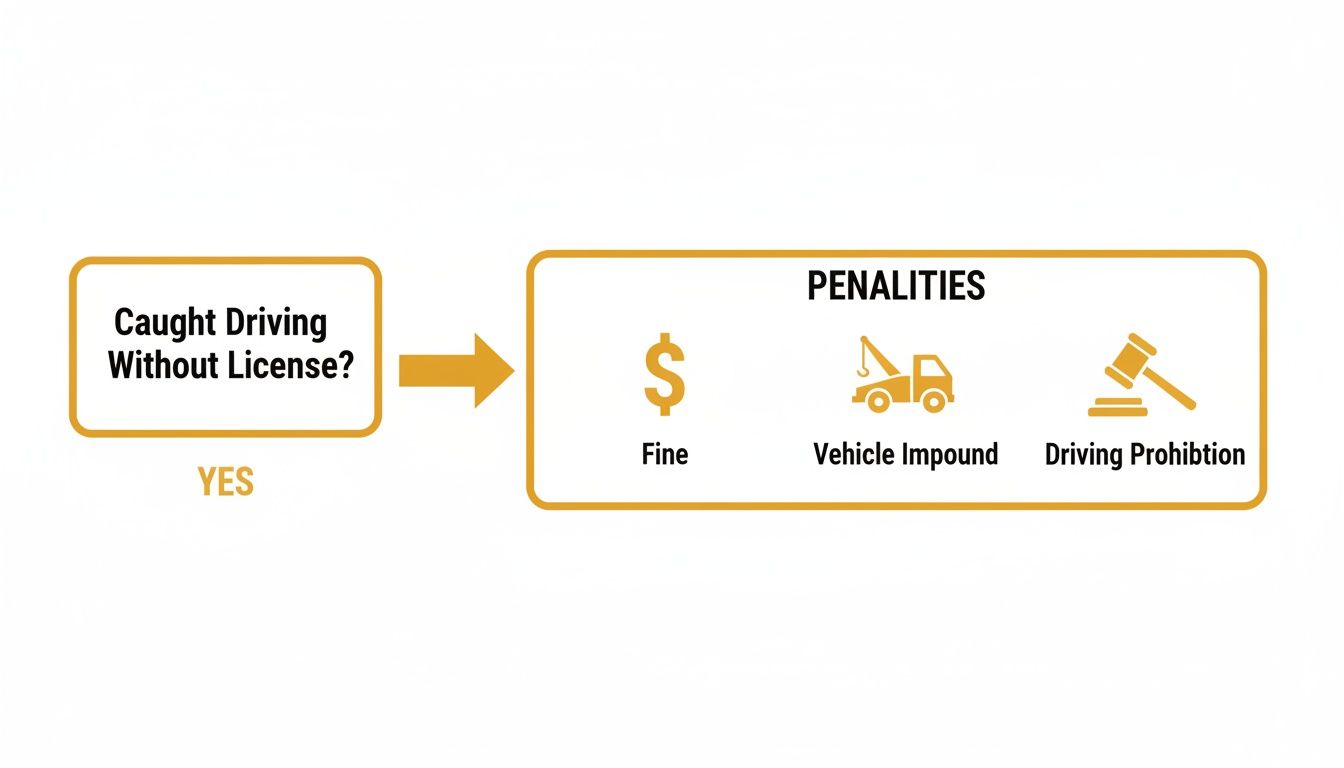
As you can see, the outcomes aren’t one-size-fits-all. They can range from a simple fine all the way to losing your vehicle and your right to drive.
Case 1: The Honest Mistake
Let’s start with the most common and least severe scenario: you just forgot your wallet at home. You have a perfectly valid, current Ontario driver’s licence, but you simply can’t produce it when the officer asks. This isn’t technically “driving without a licence.” It’s a much less serious offence called “Fail to Surrender Licence.”
The fix here is usually painless. In most cases, you can get the charge dropped by simply presenting your valid licence at a police station or to the prosecutor within a certain time. It’s treated as more of an administrative slip-up than a real driving offence.
Case 2: The Expired or Unlicensed Driver
Things get more serious in this category, which usually follows one of two paths. The first is driving on a licence that has recently expired. While it’s not as bad as never having had one, it still means you aren’t legally allowed to be behind the wheel.
The second path is for those who never got a licence in the first place. This tells the court you haven’t passed the mandatory tests that prove you can operate a vehicle safely by Ontario’s standards.
In either of these situations, you’re considered an unlicensed driver under the Highway Traffic Act, and the penalties ramp up quickly:
- Substantial Fines: Fines start at $200 and can climb to $1,000, and that’s before victim surcharges are added.
- Vehicle Impoundment: The car you are driving will be impounded on the spot for seven days. You’ll be on the hook for all the towing and storage fees.
- Insurance Woes: A conviction on your record will seriously affect your ability to get affordable car insurance down the road.
Case 3: The Most Serious Offence
By far, the most severe charge you can face is driving while your licence is suspended. The law sees this as a direct defiance of an order from a court or the Ministry of Transportation. It’s assumed you were properly notified of your suspension and made the conscious choice to drive anyway.
A licence can be suspended for many reasons—accumulating too many demerit points, a medical issue, or a penalty for a conviction like impaired driving. Make no mistake, the consequences for driving while suspended can be life-altering.
Driving on a suspended licence is not treated as a simple traffic ticket. It is a quasi-criminal offence that carries a mandatory minimum fine of $1,000 for a first offence and potential jail time of up to six months.
On top of that, a conviction automatically triggers an additional, mandatory six-month licence suspension. The penalties only get steeper for any subsequent offences, with fines potentially reaching $5,000 or more. If you’re facing a suspension, it’s critical to understand your appeal options. You can learn more about the process by reading up on the Ontario Licence Appeal Tribunal (LAT), the body that handles these specific cases.
When Your Ticket Becomes a Criminal Record
There’s a critical line in Ontario law that separates a serious traffic ticket from a life-altering criminal charge. It’s a distinction every driver needs to understand. While most cases of driving without a licence are handled under the provincial Highway Traffic Act (HTA), some situations cross that line, escalating the offence into the federal jurisdiction of the Criminal Code of Canada.
This is where the consequences jump from a hefty fine to a permanent criminal record.
So, when does this happen? The escalation almost always occurs when someone is caught driving while under a very specific kind of ban—one handed down by a criminal court. If your licence was suspended because of a previous Criminal Code conviction, like for impaired driving (DUI), getting behind the wheel again isn’t just a provincial infraction. It’s a federal crime.

From Provincial Offence to Criminal Charge
Think of it this way: driving on a licence that simply expired is like breaking a local rule set by the province. But driving while you’re prohibited from doing so by a criminal court order? That’s like openly defying a judge. The justice system takes a very dim view of this, seeing it as a direct challenge to its authority.
The charge you’d face is “Operation While Prohibited” under section 320.18 of the Criminal Code. This is a completely different beast than the HTA charge of “Driving While Under Suspension.” Though both involve driving without a valid licence, the criminal charge brings a whole new world of trouble.
A conviction for Operation While Prohibited leaves you with a permanent criminal record. This isn’t something that just goes away; it can haunt you for life, affecting your job prospects, your ability to travel internationally, and even your immigration status, unless you eventually get a record suspension (what used to be called a pardon).
For the Crown to secure a conviction, they have to prove beyond a reasonable doubt that you were not only driving, but that you knew a court had ordered you not to. This element of knowledge is what separates it from a simple administrative foul-up.
A Real-World Scenario Unpacked
Let’s walk through a common situation we see in the Greater Toronto Area to make this crystal clear. This is an anonymized example, but the facts are all too real.
- The Background: A year ago, Mark was convicted of impaired driving. As part of his sentence, the judge issued a one-year driving prohibition that was in effect across all of Canada. His Ontario driver’s licence was suspended as a direct result.
- The Incident: Mark had a big job interview in Mississauga. He thought enough time had passed and, feeling the pressure, decided to borrow his partner’s car. He got pulled over for a minor traffic violation in Burlington.
- The Escalation: When the officer ran his name, the computer didn’t just show a suspended licence. It flagged the active Criminal Code prohibition. Suddenly, this wasn’t about a ticket. Mark was arrested on the spot, charged with Operation While Prohibited, and his partner’s car was impounded.
The Consequences of a Criminal Conviction
Mark is now facing a legal fight where the stakes are incredibly high. The charge has moved far beyond a simple penalty for driving without a licence. A conviction under the Criminal Code carries penalties that dwarf anything under the HTA:
- Jail Time: Yes, a conviction can mean jail, even for a first-time offender.
- Extended Driving Ban: The court will issue a new driving prohibition that only starts once the current one is finished.
- Permanent Criminal Record: This is the big one. It creates massive roadblocks for employment, volunteering, and even simple things like crossing the border into the U.S.
- Hefty Fines: These fines are often in the thousands of dollars, far more than a standard traffic ticket.
If you’ve been charged with a driving offence and you’re not sure if it’s under the HTA or the Criminal Code, you need to get legal advice immediately. The potential outcomes are too severe to leave to chance. Protecting your future from the devastating impact of a criminal record requires a smart, strategic defence.
The Hidden Consequences That Follow You for Years
So, the court date is over, you’ve paid the fine, and you finally got your car back from the impound lot. It’s easy to think the whole ordeal is behind you. But in reality, the conviction is just the beginning of a much bigger problem.
The toughest consequences aren’t the ones on the ticket. They’re the hidden penalties that can quietly sabotage your finances, your career, and even your ability to stay in Canada for years to come.

The Insurance Nightmare Begins
Once that conviction hits your record, your insurance company will see you in a completely different light. You’re now officially a high-risk driver. That label is financial poison.
Your current provider might just drop you, cancelling your policy and forcing you to scramble for new, far more expensive coverage. And if they do keep you, get ready for your premiums to jump. We’re not talking a small bump—it’s common for rates to double or even triple. This isn’t a one-time hit; you’ll be paying thousands of extra dollars for the entire three years the conviction remains on your driving record.
A conviction for driving without a licence signals to insurers that you are willing to operate a vehicle outside the legal framework. This breach of rules makes you a significant liability, and your insurance premiums will reflect that elevated risk for years to come.
This constant financial pressure can be devastating. Many people get priced out of the insurance market completely, making it impossible to legally drive even after their licence is reinstated.
Your Immigration Status Could Be at Risk
For anyone in Canada who isn’t a citizen—permanent residents, foreign workers, international students—a driving conviction can create serious immigration headaches. A simple traffic ticket might not cause much trouble, but a conviction for driving without a licence is a different story.
If the charge is serious enough to be considered a criminal offence under the Criminal Code (like “Operation While Prohibited”), Immigration, Refugees and Citizenship Canada (IRCC) could deem you inadmissible for serious criminality.
This can lead to a cascade of devastating outcomes:
- Rejected Applications: Your bids for permanent residency, citizenship, or even a visa renewal could be flat-out denied.
- Inadmissibility: You could be blocked from entering or staying in Canada altogether.
- Deportation: In the worst-case scenario, you could face a removal order.
Even a conviction under the provincial Highway Traffic Act raises red flags for immigration officers. They review your entire history, and any conviction can paint a picture of someone who doesn’t respect Canadian laws. If you’re not a citizen, the stakes are incredibly high.
Career and Employment Roadblocks
That conviction can also slam the door on job opportunities. It’s not just about jobs that require you to drive a company car, either. A surprising number of employers now demand a clean driving record.
Think about it:
- Driving-Dependent Jobs: Roles like delivery drivers, sales reps covering a territory, or mobile tradespeople are immediately out of the question.
- Jobs Requiring Security Clearance: Many government and private sector jobs require background checks that dig into your driving abstract. A conviction could easily disqualify you.
- Professional Designations: Some licensing bodies might see a conviction as a black mark on your character, which could impact your ability to get certified or stay in good standing in your profession.
A conviction for a related criminal offence like “Operation While Prohibited” is even worse. It leaves you with a permanent criminal record that will pop up on every background check, limiting your career options for life unless you can get a record suspension.
A conviction for driving without a licence isn’t just a one-time penalty; it’s a long-term burden. It can follow you for years, affecting some of the most important parts of your life.
Table: Long-Term Impact of an Unlicensed Driving Conviction
| Area of Life Affected | Potential Long-Term Consequences |
|---|---|
| Financial Health | Dramatically increased insurance premiums for 3+ years. Difficulty securing affordable coverage, leading to ongoing financial strain. |
| Immigration Status | Denial of residency, citizenship, or visa applications. Potential inadmissibility to Canada or even deportation for more serious related offences. |
| Career & Employment | Disqualification from jobs requiring a clean driving record or security clearance. A criminal record can permanently limit professional opportunities. |
| Driving Privileges | Difficulty getting your full licence back. The conviction can make it harder to pass future tests or meet MTO requirements. |
| Future Legal Issues | A prior conviction can lead to much harsher penalties if you are ever charged with a subsequent driving offence, establishing a pattern of non-compliance. |
| Personal Freedom | The inability to drive legally can severely limit your mobility, independence, and access to essential services or activities, especially in areas with limited public transportation. |
These consequences are a stark reminder of how a single charge can create lasting problems. Understanding the full scope of potential legal issues is critical. For an in-depth look at other ways vehicle-related incidents can impact your life, you can read more about the law surrounding car accidents in Ontario.
Your First Steps After Being Charged
Getting pulled over and charged with driving without a licence is a nerve-wracking experience. Your mind likely jumps to the worst-case scenarios: massive fines, your car being towed, and what this means for your future. The single most important thing you can do in that moment is to take a breath and handle the situation methodically.
What you do in the first few hours and days is critical. It can genuinely change the outcome of your case. Acting strategically right from the start is your best shot at avoiding the harshest penalties.
Do Not Plead Guilty Immediately
It’s tempting to just pay the fine and move on, but this is one of the biggest mistakes you can make. Pleading guilty isn’t just about paying a ticket; it’s an admission that results in an automatic conviction on your driving record.
That conviction follows you. It can cause your insurance rates to skyrocket and could even create problems for your job or immigration status. By pleading guilty, you lose any opportunity to challenge the charge or negotiate for a lesser penalty. You need to know exactly what you’re up against before making any decisions.
Pleading guilty might feel like the easy way out, but it’s a permanent choice with serious, long-term ripple effects. You’re effectively agreeing to every single penalty—the obvious ones and the hidden ones—that come with that conviction.
Document Everything You Can Remember
As soon as you’re able, grab a pen and paper or open the notes app on your phone. Write down every single detail you can remember about the traffic stop. Our memories can be fuzzy, but those small details often become game-changers later.
Try to capture the following:
- Why were you pulled over? What was the initial reason for the stop? A broken taillight? Speeding? Or was it a random roadside check?
- What was said? Replay the conversation in your head. What questions did the officer ask? What answers did you provide?
- Where and when did this happen? Note the street, the nearest intersection, the time of day, and even the weather.
- Were there any witnesses? Was there anyone else in the car? Did you see pedestrians or other drivers nearby who might have seen what happened?
This information becomes the raw material for building your defence, giving your legal team a complete picture of the event.
Seek Professional Legal Advice Immediately
This is, without a doubt, the most crucial step. The Ontario Highway Traffic Act is a complex piece of legislation, and the fine print on your ticket matters. A legal professional can look at your charge, hear your side of the story, and lay out your real options in plain English.
An expert can spot procedural errors you’d never notice, assess the strength of your case, and stand up for you in court. This simple action shifts you from a position of reacting with uncertainty to acting with a clear plan. To understand how an expert can protect your rights and your future, connect with our team for a consultation to go over the details of your situation.
Building a Defence for Your Driving Charge
When you’re facing a charge for driving without a licence, it’s easy to feel like the case is already closed. But that’s rarely the truth. Getting a ticket doesn’t automatically mean you’ll be convicted. The reality is that Ontario’s traffic laws are incredibly complex, and a well-planned, strategic defence can make a world of difference for your driving record, your insurance rates, and your future.
Building this defence isn’t about coming up with excuses. It’s about a methodical, professional review of every single fact. A legal expert will dig into the details of the traffic stop and the charge itself, hunting for the specific legal and procedural angles that can form the foundation of a strong defence. This is all about making sure your rights are protected every step of the way.
Identifying Errors and Omissions
Often, the best place to start is by taking a hard look at how law enforcement and the prosecution handled things. Police officers have to follow very strict procedures when they pull someone over and issue a ticket. If they stray from those protocols, even slightly, it can be grounds for a challenge in court.
A thorough legal review gets into the nitty-gritty with critical questions:
- Was the traffic stop even legal? The officer needed a valid reason—what the law calls “reasonable and probable grounds”—to pull you over in the first place. Was there one?
- Were your rights upheld? For instance, were you properly informed of your rights under the Canadian Charter of Rights and Freedoms?
- Is the evidence airtight? You’d be surprised how often there are mistakes on the ticket itself. An incorrect name, a wrong date, or citing the wrong section of the Highway Traffic Act can all weaken the prosecutor’s case.
A seemingly small clerical error can sometimes be enough to get a charge thrown out. In the Ontario court system, these details truly matter.
Exploring Common Defence Strategies
Beyond picking apart procedural mistakes, there are several other effective ways to fight the penalty for driving without a licence. The best strategy really hinges on the unique details of your situation—everything from why you were behind the wheel to your personal history.
A successful defence is built on nuance. It’s about presenting the full context of your situation to the Crown prosecutor or the court, moving beyond the black-and-white text on the ticket to argue for a fair and reasonable resolution.
For example, a powerful defence can be built by showing you had a legitimate and honest belief that your licence was perfectly valid. Maybe the Ministry of Transportation made a communication error, or a suspension notice was mailed to an old address you never received. If you can prove you had no intention of breaking the law, it can be a very persuasive argument against the harshest penalties.
Negotiation and Resolution
Let’s be honest, the best outcome often happens outside of a courtroom trial. This is where skilled negotiation comes in. An experienced legal professional can open a direct line of communication with the Crown prosecutor for you. They can highlight mitigating factors—like a previously clean driving record or the immediate steps you’ve taken to fix the licence issue—to push for a better result.
This negotiation process can lead to a few different positive outcomes:
- Charge Withdrawal: If the Crown’s case has weaknesses or there are major procedural problems, they might agree to withdraw the charge entirely.
- Plea to a Lesser Offence: It’s often possible to negotiate a plea to a much less serious charge, like “Fail to Surrender Licence.” This kind of offence carries minimal penalties and keeps a major conviction off your record.
- Reduced Penalties: Even if a conviction is unavoidable, a good negotiator can often get the fine reduced or prevent a lengthy driving ban.
At the end of the day, building a defence is about making sure your side of the story is heard and argued effectively within the rules of Ontario law. It’s a proactive approach that can transform a potentially devastating charge into a far more manageable situation.
Common Questions About Unlicensed Driving Charges
Getting charged with a driving offence can feel like being thrown into a maze without a map. To help you find your way, we’ve put together answers to some of the most common and urgent questions we hear from people in Ontario.
What is the punishment for driving without a license in Canada?
It depends on the province and why you had no licence. In Ontario, a first Highway Traffic Act s. 32(1) “never licensed” conviction is typically a $200 to $1,000 fine and a three-year driving-record hit. A seven-day roadside impound is more likely if you were driving while suspended or Criminal Code prohibited. Other provinces set their own fines. Charged in Ontario? Call 905-744-8888 or email info@ullaw.ca before your court date.
What happens if you get pulled over without a license in Ontario?
The officer can charge you on the spot, issue a court date, and — depending on the exact offence — the vehicle may be towed. A first “never licensed” ticket does not automatically include a seven-day impound. If you left a valid licence at home, produce it before court — that is usually a different, lesser charge. If you never had a licence or it is suspended, do not plead guilty just to “get it over with.”
Can I Go to Jail for Driving Without a Licence in Ontario?
For a first-time offence of simply never having obtained a licence, the court usually leans towards a fine rather than jail time. It’s a possibility, but not the most common outcome.
However, the stakes get much, much higher if you’re caught driving while your licence is already suspended. If that suspension was for a Criminal Code offence like a DUI, then yes, driving while prohibited can absolutely land you in jail, even if it’s your first time being charged with it. Knowing the specifics of your charge is everything.
What Happens If I Just Forgot My Licence at Home?
This is a completely different, and far less serious, situation. The charge is called “Fail to Surrender Licence,” and it’s usually straightforward to resolve.
In most cases, all you need to do is show your valid driver’s licence at a police station or to the prosecutor before your court date. You might have to pay a small administrative fee, but taking this simple step often gets the charge completely withdrawn. This keeps a conviction, demerit points, and an insurance hike off your plate.
The law makes a clear distinction between an honest mistake—like leaving your wallet on the kitchen counter—and the serious offence of getting behind the wheel when you’re not legally allowed to drive. The penalties are worlds apart.
How Long Does This Stay on My Driving Record?
A conviction under Ontario’s Highway Traffic Act will show up on your official Ministry of Transportation (MTO) driving record for three years, starting from the day you were convicted. Insurance companies pull this record to calculate your premiums, so you could be paying for it for that entire time.
It’s a different story for a criminal conviction like “Operation While Prohibited.” That leaves you with a permanent criminal record. Getting rid of it requires a formal record suspension (what used to be called a pardon), which is its own long and complicated legal process. For a deeper dive into frequently asked questions about traffic law, you can explore our comprehensive FAQ page for more insights.
Will This Charge Affect My Immigration Status?
It certainly can. A basic traffic ticket is unlikely to derail your immigration plans, but a conviction for a more serious driving offence can create huge problems if you’re not a Canadian citizen.
A conviction under the Criminal Code could be flagged as serious criminality under Canada’s immigration laws. This could jeopardize your application for permanent residency or citizenship, and in the worst-case scenario, it could even make you inadmissible to Canada. If you have any concerns about your status, getting legal advice right away is absolutely critical.
Being charged with driving without a licence is a stressful experience, but you shouldn’t have to face it on your own. Do not plead guilty just to close the file — the section on the ticket changes the fine, the record, and (if you are not a citizen) immigration risk.
Call UL Lawyers at 905-744-8888, email info@ullaw.ca, or book a free, confidential consultation. We serve clients from Burlington across the GTA and Ontario.
Related UL Lawyers resources
If your situation is moving from general research to a real legal problem, these pages may help you choose the next step:
- Book a free consult — call 905-744-8888 or email info@ullaw.ca before you plead.
- Personal injury settlement calculator — estimate, then call a motor vehicle lawyer if the stop followed a crash.
- Motor vehicle accident services — for injury claims after a collision, not the ticket itself.