Finding yourself in a legal conflict can feel like you’ve been dropped into a dense, unfamiliar forest. Everything is confusing, and you’re not sure which way to turn. The first step toward finding a clear path is getting the right guide. A skilled civil litigation lawyer in Hamilton is that guide—an expert navigator who can steer you through non-criminal disputes to find a fair resolution.
This guide is your compass for the legal journey ahead in Ontario.
Navigating Your Legal Dispute in Hamilton
At its heart, civil litigation is simply the formal process we use to settle serious disagreements between people or companies. It’s not so much a battle as it is a structured, rule-based conversation overseen by the courts. This process handles a huge range of conflicts that don’t fall under criminal law.
Whether you’re in Hamilton, Burlington, or anywhere else in the GTA, these disputes usually boil down to fundamental questions of fairness, rights, and responsibilities. Getting a handle on this landscape is the first crucial step toward resolving your conflict.
What Does Civil Litigation Cover?
The world of civil law is vast, touching on many of the conflicts that pop up in our personal and professional lives. Your lawyer’s job is to manage the process and fight for your best interests.
Some of the most common issues we see in Ontario include:
- Contract Disputes: This happens when someone doesn’t hold up their end of a deal, whether it’s a business agreement or a personal contract.
- Property and Real Estate Issues: Think disagreements over property lines, who owns what, or problems that come up during a real estate sale.
- Employment Conflicts: These are cases dealing with wrongful dismissal, broken employment contracts, or harassment in the workplace.
- Personal Injury Claims: If you’ve been hurt because of someone else’s carelessness (like a slip and fall), this is the process for seeking compensation.
At its core, civil litigation provides a formal pathway to resolution when informal attempts have failed. Its purpose is to ensure that disputes are settled based on established legal principles and evidence, rather than power or intimidation.
Having an experienced legal guide by your side is absolutely essential. They take the complicated legal jargon and turn it into a clear, actionable strategy, making sure your rights are protected every step of the way. You can learn more about the different areas covered by litigation law in our detailed overview.
A good lawyer helps you move from a place of uncertainty to one of confidence by mapping out a clear path through Ontario’s legal system.
Unpacking the Civil Litigation Process in Ontario
Navigating a civil lawsuit in Ontario can feel daunting, but it’s not a chaotic free-for-all. It’s a structured journey with clear stages, almost like a roadmap. Understanding this path from the outset helps take the mystery out of the process, allowing you to work effectively with your civil litigation lawyer in Hamilton and know what’s coming next.
This isn’t about one big, dramatic courtroom showdown. Instead, it’s a series of methodical steps designed to bring a dispute to a fair conclusion.
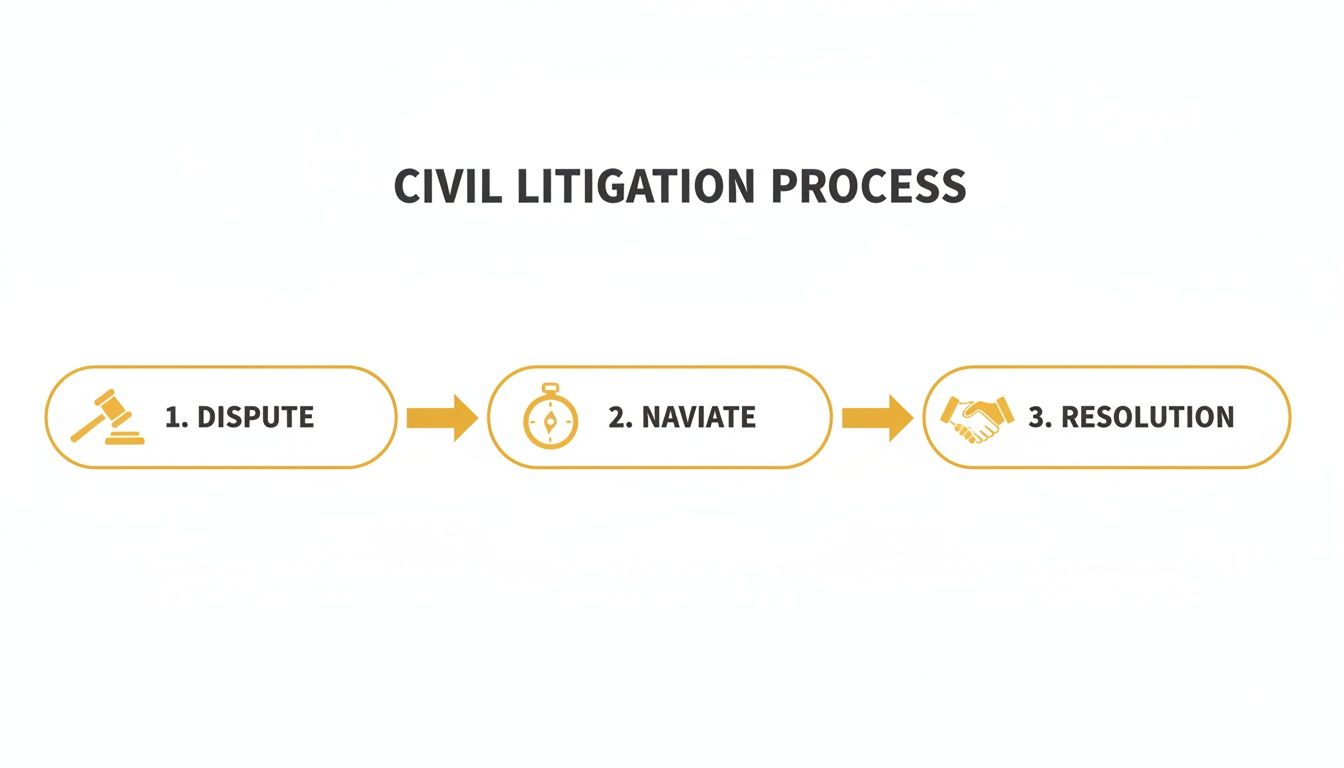
As you can see, the process is designed to move from conflict to resolution in a logical way, with plenty of opportunities to resolve things before ever seeing a judge.
Stage One: The Pleadings
The lawsuit officially kicks off with the Pleadings. Think of this as the formal, written opening where each side lays its cards on the table for the court record. It’s where the story of the dispute is officially told through specific legal documents.
It all starts when the person launching the lawsuit (the Plaintiff) files a Statement of Claim. This document is their official story, outlining what they believe went wrong, the legal grounds for their complaint, and what they want the court to do about it—usually, this means asking for financial compensation.
Once the other party (the Defendant) receives this document, the clock starts ticking. They have a limited time to file their response, called a Statement of Defence. This is their chance to officially push back, deny the allegations, and provide their side of the story. Sometimes, they might even file a Counterclaim, which is essentially a lawsuit in reverse, aimed back at the original Plaintiff.
Stage Two: The Discovery
With the initial positions established, the case moves into the Discovery phase. This entire stage is about one thing: getting all the facts and evidence out in the open. The goal here is to prevent any “gotcha” moments at trial by making sure both sides know the evidence the other holds, which helps everyone assess the true strengths and weaknesses of their case.
In Ontario, Discovery has two key parts:
- Affidavit of Documents: Each side must formally list and share every relevant document in their possession—the good, the bad, and the ugly. This can include everything from emails and text messages to contracts, internal reports, and financial records.
- Examination for Discovery: This is where things get more personal. It’s a formal, out-of-court meeting where lawyers get to question the opposing party under oath. A court reporter is present to transcribe every word, creating a sworn record that can be used as evidence later on.
The Discovery phase is often the longest and most intensive part of any lawsuit. It’s where the real detective work happens, and the evidence uncovered here is what truly shapes the direction of the case and often prompts a settlement.
For example, in a dispute over a broken contract, discovery might turn up emails that completely change how you interpret the original deal. Or, you might find internal notes proving one side never planned to honour their side of the bargain. Once this evidence is on the table, it becomes much easier to evaluate the available remedies for a breach of contract.
Stage Three: Mandatory Mediation
Before you can even think about getting a trial date in Hamilton and many other Ontario jurisdictions, you have to go through Mandatory Mediation. This is a critical step where both parties, along with their lawyers, sit down with a neutral third-party mediator. The entire meeting is confidential.
The mediator isn’t a judge; they can’t force anyone to agree to anything. Their job is to help facilitate a constructive conversation, poke holes in weak arguments, and guide everyone toward a resolution they can all live with. It’s a surprisingly effective process that helps settle a huge number of cases without the time, expense, and stress of a trial.
Stage Four: The Trial
If all else fails—mediation, settlement talks, negotiations—the final stop is the Trial. This is the classic courtroom scene people imagine: lawyers making arguments, witnesses being questioned, and a judge (or occasionally, a jury) making a final, binding decision.
But here’s the reality: getting to trial is actually quite rare. The Ontario court system is backlogged, creating a strong incentive for everyone involved to find a resolution earlier.
The numbers don’t lie. According to recent statistics from Ontario’s Superior Court of Justice, 75,561 new civil cases were filed, but only 3,539 of them actually went to trial. With over 67,000 cases ending in settlements or other judgments, it’s proof that the system is designed to favour resolution. This is why a great civil litigation lawyer in Hamilton has to be a master negotiator first and foremost, as their real value is often in winning the case for you long before anyone steps into a courtroom.
Understanding the True Cost of Justice in Ontario
Let’s have a frank conversation about the financial side of a lawsuit. Taking legal action involves a lot more than just emotional energy—it demands a clear-eyed view of the costs. This section pulls back the curtain on the financial realities of Ontario’s legal system so you can move forward with confidence and a solid plan.
Thinking about legal bills can be daunting, but knowledge is your best asset. When you understand how lawyers charge and what other expenses might pop up, you can have a much more productive and transparent conversation with any civil litigation lawyer in Hamilton.

Decoding Legal Fees: How Lawyers Charge
In Ontario, law firms generally use a few different billing models. There’s no one-size-fits-all approach; the right one depends entirely on the nature of your case.
- Hourly Rates: This is the most traditional method. Your lawyer bills for the actual time they spend working on your file, whether that’s making phone calls, drafting documents, or appearing in court.
- Contingency Fee Agreements: You’ll often see this in personal injury cases. Here, the lawyer’s fee is a percentage of the final settlement or court award. The big advantage? You don’t pay legal fees unless your matter resolves with a recovery, making it possible for people to seek justice who couldn’t otherwise afford it.
- Flat Fees: For straightforward, predictable tasks like drafting a standard will, a lawyer might charge a single, fixed price. This is less common in litigation, where the path forward is rarely predictable.
Grasping these differences is key. An hourly rate keeps you in direct control but can be hard to budget for, while a contingency agreement ties your lawyer’s success directly to your own.
The Real Price Tag: Beyond the Lawyer’s Bill
Legal fees are just one piece of the puzzle. Every civil lawsuit comes with other necessary expenses, known as disbursements. Think of these as the out-of-pocket costs your legal team pays on your behalf to keep your case moving.
Disbursements are essentially the operating costs of a lawsuit. They cover everything from court administration fees to the price of gathering the critical evidence needed to build your case.
These are separate from your lawyer’s fees and need to be factored into your budget from the start. Common disbursements in Ontario include:
- Court Filing Fees: The government charges set fees to officially file documents, like your initial Statement of Claim.
- Process Server Fees: This is the cost to have legal documents formally and professionally delivered to the opposing party.
- Expert Witness Reports: If your case needs an expert opinion—like a doctor’s report in an injury claim or a forensic accountant in a business dispute—their expertise and time come at a cost.
- Mediation Costs: You’ll also have to cover the fees for the neutral third-party mediator who helps facilitate a settlement conference.
For instance, in a personal injury claim, understanding the potential value of pain and suffering damages in your claim is crucial, and this often requires a detailed medical expert’s report—a significant disbursement.
The Rising Cost of Access to Justice
It’s no secret that hiring a lawyer in Ontario is a major investment, and for many, it’s a real barrier. The cost of legal help varies widely depending on a lawyer’s experience and track record. To give you a clearer picture, we’ve outlined some typical hourly rates you might encounter.
Estimated Hourly Rates for Ontario Civil Litigation Lawyers
This table provides a general overview of typical hourly billing rates based on a lawyer’s years of experience in Ontario.
| Lawyer Experience Level | Typical Hourly Rate Range (CAD) |
|---|---|
| Junior Lawyer (1-3 years) | $250 - $350 |
| Intermediate Lawyer (4-9 years) | $350 - $550 |
| Senior Lawyer / Partner (10+ years) | $550 - $750+ |
When you pair these figures with disbursements—an expert witness can easily cost $2,000 to $5,000 per day for their time—it’s easy to see how quickly the costs can add up. It’s a major reason why many civil litigants in Ontario courts end up trying to represent themselves, often putting them at a serious disadvantage. This financial reality highlights just how important it is to find a civil litigation lawyer in Hamilton who offers flexible fee options and gives you a clear, honest cost-benefit analysis of your case from the very beginning.
What Kinds of Legal Battles Are Fought in Hamilton?
The phrase “civil litigation” might sound a bit formal and distant, but it’s really just the legal term for the real-world conflicts people and businesses navigate every day. A good civil litigation lawyer in Hamilton does more than just argue about the law; they dive into the middle of tangible, often messy, disputes to protect a client’s rights and financial well-being. The variety is huge, covering everything from personal disagreements to professional conflicts and property squabbles.
Let’s break down some of the most common types of cases that land on a lawyer’s desk in Hamilton. Seeing these practical examples makes it much easier to figure out if the problem you’re facing falls into the world of civil law.
Contract Disputes and Business Conflicts
Think of a contract as the bedrock of a business relationship—it’s a legally binding promise. When someone breaks that promise, the fallout can be disastrous, leading to lost money and operational chaos. This is precisely when a sharp litigator is needed most.
Contract disputes can show up in all sorts of ways. Maybe a supplier didn’t deliver crucial materials on time, causing your business to miss its own deadlines. Or perhaps a partner in a joint venture failed to put in their share of the money. It could even be a service provider whose work was sloppy or completely unfinished.
In these scenarios, a lawyer’s first job is to pore over the contract, collect proof of the breach, and figure out the best way forward. Often, this starts with negotiating a settlement to make things right, but if that doesn’t work, filing a lawsuit to recover financial damages is the next logical step.
Real Estate and Property Litigation
Our homes and property are deeply personal, which is why disputes over real estate can get so heated. These aren’t just minor tiffs between neighbours; they often involve massive financial stakes and fundamental rights. Resolving them requires a steady, experienced legal hand.
A classic example is a boundary dispute, where two neighbours can’t agree on where one property ends and the next begins. Another all-too-common issue is undisclosed defects in a home sale—the buyer moves in and discovers a cracked foundation or a leaky roof the seller conveniently forgot to mention. A civil litigation lawyer jumps in to defend their client’s position, whether that means legally establishing a property line, making a seller pay for repairs, or clearing up issues with the property’s title.
Real estate litigation is ultimately about defending one of the biggest investments you’ll ever make. It’s about ensuring your ownership rights are upheld and that contracts are respected, giving you security in a competitive market like Hamilton’s.
Employment Law Disputes
In Ontario, the relationship between an employer and an employee is governed by a thick rulebook of laws. When that relationship sours, it can throw an employee’s career and finances into a tailspin. Civil court is often the only place for a worker to find justice when they feel their rights have been trampled.
Some of the most common employment battles include:
- Wrongful Dismissal: This is when an employee is let go without a legitimate reason (“just cause”) or without being offered the proper notice or severance pay required by law.
- Constructive Dismissal: This is a bit more subtle. It’s when an employer unilaterally makes a huge negative change to someone’s job—like slashing their pay or demoting them—essentially forcing them to resign.
- Breach of Employment Contract: This happens when an employer doesn’t pay out promised bonuses, commissions, or other benefits that were part of the deal.
Personal Injury and Negligence Claims
Civil law isn’t just about business and property; it also covers situations where one person’s carelessness harms another. These personal injury cases are all about getting compensation to help someone recover from the physical, emotional, and financial wreckage left behind. Car accidents are a big part of this, but the field is much broader.
For instance, if a store owner doesn’t salt an icy sidewalk and a customer slips and breaks their arm, a lawsuit could follow. If you ever find yourself in a situation like that, a specialized slip and fall lawyer in Hamilton can walk you through your rights and what’s needed to build a strong case. The core of these claims is proving that the property owner was negligent—that they failed in their duty to keep people safe—which is exactly what a personal injury litigator is trained to do.
How to Choose the Right Legal Advocate
Picking the right lawyer is probably the single biggest decision you’ll make when you’re facing a legal battle. It’s not just about finding someone with a law degree; it’s about finding a partner who gets it. You need someone who will guide you, fight for you, and actually keep you in the loop.
Let’s cut through the generic advice. Here’s a practical guide to help you find a top-notch civil litigation lawyer in Hamilton who understands both the local legal scene and what you’re up against.

Researching Potential Lawyers
Your search starts where most do these days: online. A law firm’s website is their digital handshake, and it tells you a lot about their professionalism, what they specialize in, and how they treat their clients. First impressions matter.
A little know-how can help you sort the good from the bad. For example, understanding the basics of optimizing Google Business Profiles for local services can help you identify firms that are serious about their local reputation and genuinely part of the Hamilton community.
When you’re browsing a lawyer’s site, keep an eye out for:
- Specific Experience: Do they talk about cases just like yours? Look for clear mentions of contract disputes, real estate litigation, or whatever your issue is.
- Lawyer Profiles: Read the bios. Who are these people? You’re looking for focused experience, not just a list of credentials.
- Testimonials and Case Results: Real stories from past clients are gold. They show you what the firm is capable of and how they work with people.
Why Local Hamilton Experience Matters
Sure, any lawyer licensed in Ontario can technically take your case. But trust me, there’s a huge advantage to working with someone who knows the Hamilton court system inside and out. That local knowledge is a game-changer.
A lawyer who is a regular at the Hamilton courthouse knows the unwritten rules. They’re familiar with the judges’ quirks and have working relationships with the court staff and even the lawyers on the other side. This kind of familiarity can make the whole process smoother and give you a strategic edge an out-of-towner just won’t have.
Choosing a lawyer is not just about finding legal expertise; it’s about finding a trusted advisor. You need someone whose judgment you respect and whose communication style gives you confidence, not confusion.
At the end of the day, that local insight can save you a ton of time, money, and stress.
Your Initial Consultation Checklist
Think of the first meeting as your interview—you’re vetting them just as much as they’re assessing your case. Come prepared with questions. This is your chance to get a feel for their expertise, their approach, and how they communicate.
Ontario has a massive legal community, with over 55,000 licensed lawyers. That’s a lot of options, which means you have to be selective. A good lawyer will be straight with you from the start about potential challenges, like court backlogs that can frustrate the process.
To make sure you cover all your bases, I’ve put together a checklist for that first meeting. It will help you guide the conversation and get the answers you need before you sign anything.
Checklist for Your Initial Lawyer Consultation
| Category | Question to Ask |
|---|---|
| Experience & Expertise | Have you handled cases similar to mine before? What were the outcomes? |
| Case Strategy | Based on what you know, what is your initial assessment of my case’s strengths and weaknesses? |
| Communication | How will you keep me updated on my case? Who is my main point of contact? |
| Billing & Costs | Can you provide a clear breakdown of your fees and an estimate of total costs? |
| Your Role | What will you need from me to help you build the strongest possible case? |
Asking these direct questions helps you make a choice you can feel good about. The right civil litigation lawyer in Hamilton will not only have solid answers but will also make you feel heard and respected from that very first conversation.
Your Next Step on the Path to Resolution
You’ve now seen the roadmap for civil litigation in Ontario. What might have seemed like a confusing maze of procedures now has clear stages, from the first filing to a final judgment. We’ve untangled the costs, timelines, and the crucial process of finding the right legal partner in Hamilton. While it’s a detailed journey, it’s a structured one, designed to bring order to disputes.
Ultimately, the most critical factor in your success isn’t just the strength of your case—it’s the quality of the guide you choose to navigate the path with you. A skilled Hamilton civil litigation lawyer does more than just handle paperwork; they build a strategy, bring clarity to the chaos, and give you the confidence to press forward.
From Uncertainty to Action
It’s completely normal to feel overwhelmed when faced with a legal conflict. But you don’t have to let that feeling keep you stuck. You have the power to move from a place of anxiety to one of action. The journey to resolving your dispute, whether it’s a partnership fallout, a real estate issue, or a contract breach, starts with one simple, decisive step.
The legal system can look intimidating from the outside, but at its core, it’s a powerful tool for fairness. Taking that first step to engage with it is an act of empowerment—it’s you taking back control.
This is your chance to get professional advice and see your options laid out clearly. Don’t let the “what-ifs” prevent you from finding a real solution.
Often, the most important step is the easiest one to take. To start protecting your interests and moving toward a resolution, your next move is to simply start a conversation. We invite you to connect with our legal team for a consultation and take that first step, knowing you have knowledgeable allies ready to listen.
Common Questions About Civil Litigation
If you’re facing a civil dispute, it’s completely normal to have a lot of questions. The legal system can feel like a maze, but getting straight answers is the first step to feeling in control. Here are some of the most common questions we get from clients in Hamilton and across Ontario.
How Long Does a Civil Lawsuit Actually Take?
This is the big question, and the honest answer is: it depends. A relatively straightforward case that settles early on through negotiation could be wrapped up in a matter of months.
However, if a case is more complex and has to go all the way through the court system, you could be looking at a two to three-year timeline, or even longer. Unfortunately, backlogs in the Ontario courts can stretch things out. A good lawyer can give you a more realistic estimate once they understand the specifics of your situation.
What’s the Difference Between “Simplified” and “Ordinary” Procedure?
In Ontario, the path your lawsuit takes often comes down to the amount of money involved. Think of it as two different tracks for getting to the same destination.
- Simplified Procedure: This track is for claims of $200,000 or less. Just as the name implies, it’s designed to be faster and less expensive, with fewer formal steps along the way.
- Ordinary Procedure: This is the track for claims over $200,000. It’s a more formal and detailed process, which includes more in-depth evidence gathering (what we call “discovery”).
A civil litigation lawyer in Hamilton will carefully evaluate your claim’s value to make sure your case gets on the right track from the start.
If I Win My Case, Does the Other Side Pay My Legal Bills?
It’s possible, yes. In Ontario, the winning party is typically entitled to have the losing party cover a portion of their legal fees. This is known as an award of “costs.”
But here’s the crucial part: it is extremely rare to get 100% of your money back. A judge will usually award what’s called partial indemnity costs, which often covers about 50-60% of what you actually paid your lawyer. The final amount is up to the judge and can be influenced by how reasonably each side behaved throughout the lawsuit.
The goal of a costs award isn’t to make the winner whole again. It’s to provide partial compensation and, just as importantly, to discourage people from dragging out a fight unnecessarily.
Do I Really Have to Go to Court?
Not always. In fact, most civil cases in Ontario never see the inside of a courtroom. The system is actually built to help people settle their disputes before it gets that far.
Mechanisms like direct negotiation between lawyers and mandatory mediation sessions are standard parts of the process. They’re designed specifically to help both sides find a middle ground and reach an agreement without a judge having to decide for them.
Navigating a civil dispute takes skill, experience, and a firm grasp of Ontario law. At UL Lawyers, our team is dedicated to providing clear-headed guidance and strong representation. If you need a civil litigation lawyer in Hamilton or the surrounding GTA, we’re here to help you find the best path forward.