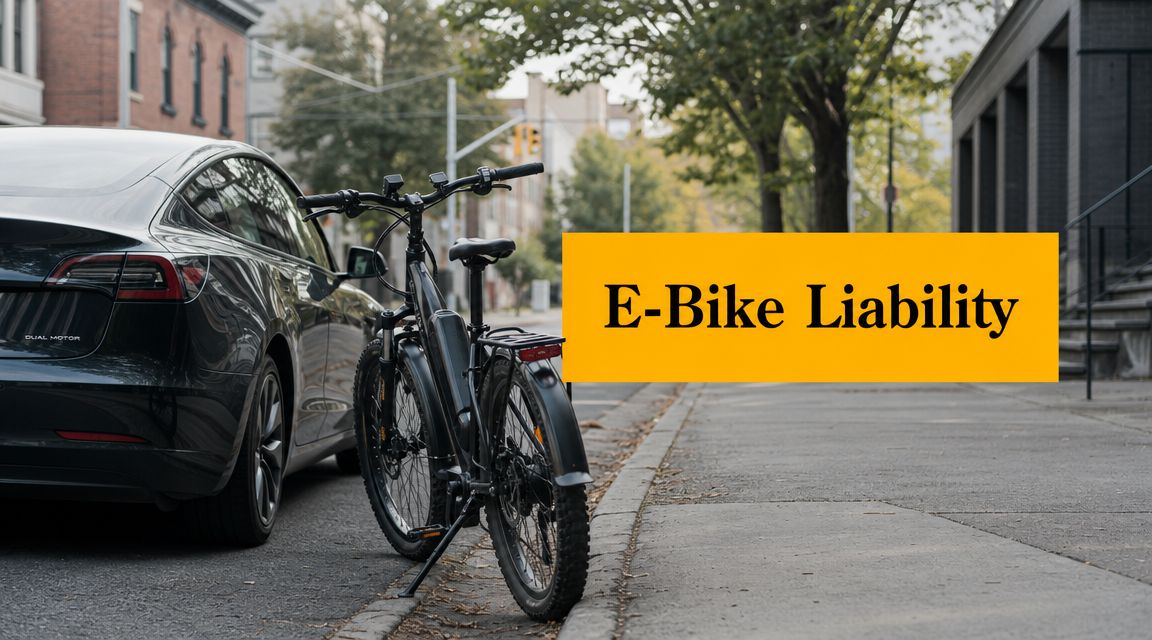
E-bike accident Ontario who is liable usually turns on one fact: was a motor vehicle involved? If a car, bus, or truck was part of the crash, SABS accident benefits may apply even if you were on the e-bike. If it was e-bike vs pedestrian or a solo crash, coverage can look very different.
Quick answer: Do not assume the first insurer explanation is complete. Classification (pedal-assist vs a motorized vehicle), fault, and who pays medical bills can all shift. Call 905-744-8888 or email info@ullaw.ca. You can also book a consultation.
You’re riding home through Burlington, Mississauga, or downtown Toronto. A car turns across your lane. Or you swerve to avoid a door opening into traffic and go down hard. Or a pedestrian steps into a shared path and both of you end up injured. In the first few minutes after an e-bike crash, a common question arises in different ways: who pays for this, and who is legally responsible?
That question sounds simple. In Ontario, it usually isn’t.
With e-bike claims, liability often turns on one practical issue that many people miss at the start: was a motor vehicle involved, or not? That single fact can change the path of the entire case. It can determine whether accident benefits may be available, whether you’re likely looking at a negligence claim, whether your own insurance matters, and whether there’s a serious coverage gap from the outset.
If you searched for e-bike accident Ontario who is liable, you’re probably not looking for a theoretical answer. You want to know what happens in real life. You want to know whether your injuries are covered, whether the other side’s insurer is involved, and what evidence matters when the facts are disputed.
Table of Contents
- Navigating the Aftermath of an Ontario E-Bike Accident
- Is It Legally an E-Bike? Ontario’s Critical Distinction
- How Insurance and Accident Benefits Apply in Ontario
- Common E-Bike Accident Scenarios and Liability
- Critical Steps to Take After an E-Bike Crash
- Understanding Legal Timelines and Limitation Periods
- When to Contact an Ontario Personal Injury Lawyer
Navigating the Aftermath of an Ontario E-Bike Accident
The first day after an e-bike collision is usually a blur. Your bike may be damaged. You may be dealing with road rash, a wrist injury, back pain, or symptoms that didn’t fully appear until hours later. Meanwhile, someone is already asking for a statement, an insurer is calling, or the other side has started giving their version of events.
That’s when confusion sets in. Many injured riders assume every road crash works like a car accident. Many pedestrians assume an e-bike must carry the same insurance as a car. Neither assumption is safe.
In Ontario, the legal analysis starts with the nature of the vehicles involved and the status of the e-bike itself. A crash involving a car and a compliant e-bike can follow one route. A crash involving only an e-bike and a pedestrian can follow a very different one. A single-rider wipeout caused by a road hazard may raise yet another set of issues.
Practical rule: In e-bike cases, the answer to “who is liable?” and the answer to “where does compensation come from?” are often related, but they aren’t the same question.
That distinction matters because people often focus only on fault. Fault matters, especially in a tort claim. But the immediate financial question is often broader. Is there an accident benefits route? Is there a personal liability policy in play? Is there a product issue? Is there a municipal maintenance issue? Those are different doors, and not every door is open in every e-bike case.
For injured riders and families across Burlington, the GTA, and the rest of Ontario, the right approach is to slow the analysis down and sort the claim in the right order. First, identify what the machine legally was. Then identify whether a motor vehicle was involved. Then identify which insurance and legal routes are available.
Is It Legally an E-Bike? Ontario’s Critical Distinction
Before anyone can sensibly assess an Ontario e-bike claim, they need to answer one threshold question: was the vehicle legally a power-assisted bicycle under Ontario’s framework, or was it something else?
That isn’t a paperwork issue. It’s a machine issue.

The legal checklist Ontario uses
Ontario’s e-bike rules rely on objective hardware and performance thresholds. According to Grillo Law’s discussion of Ontario e-bike requirements, the key indicators include a maximum motor output of 500 watts, a top assisted speed of 32 km/h, and operable pedals. If those criteria aren’t met, the device may be treated differently in a liability analysis.
Think of this like a legal checklist used at the roadside and later by insurers. A rider may believe they own a normal e-bike, but belief doesn’t decide the issue. The actual build matters. The motor, speed capability, and pedal function matter. If the bike has been modified, that can become a central dispute.
Here’s the practical takeaway:
- Motor output matters. If the machine exceeds the permitted power threshold, it may not be treated as a standard e-bike.
- Assisted speed matters. A bike that can assist beyond the permitted top speed raises classification problems.
- Pedals matter. If the pedals aren’t operable, the device may not fit the legal definition relied on in many claims.
For riders trying to understand the broader regulatory environment, this comprehensive guide to e-bike laws can be a useful comparative starting point, though any Ontario claim must be assessed under Ontario law and local rules, not foreign standards.
Why classification changes the whole claim
This classification question affects more than a ticket or a technical argument. It can affect insurance access, the way fault is framed, and how the other side argues your case. The source above also notes that tampering can undermine accident-benefit entitlement and may expose a rider to broader legal and insurance consequences.
In practice, that means lawyers and insurers often want to inspect:
- The bike itself
- Purchase records or product specifications
- Photos showing any modifications
- Repair invoices or aftermarket changes
- App settings or speed adjustment features, if relevant
A compliant e-bike and a modified high-powered device may look similar in traffic. Legally, they can be very different.
If there’s any doubt about the bike’s status, preserve the machine. Don’t authorize repairs too quickly. Don’t dispose of damaged components. And don’t assume the label on the frame settles the issue.
If you’re also trying to understand the insurance side that sometimes follows motor-vehicle collisions, Ontario’s no-fault insurance system is worth reviewing because that concept often becomes important once a motor vehicle enters the picture.
How Insurance and Accident Benefits Apply in Ontario
The largest financial divide in Ontario e-bike cases is often not the severity of the injury. It’s whether the crash involved a motor vehicle. That fact can open one compensation path and close another.

When accident benefits may be available
In Ontario, a legally compliant e-bike is generally treated differently from a car for licensing and insurance purposes. But if an injured rider is struck by a car, bus, or truck, the claim usually routes through the Statutory Accident Benefits Schedule, or SABS, because the presence of a motor vehicle triggers the no-fault accident-benefits system, as explained in A H Injury Law’s overview of e-bike accidents and insurance implications in Ontario.
That point is easy to miss. Many riders assume that because they were on an e-bike, they must need e-bike insurance first. In many Ontario motor-vehicle collisions, that isn’t the starting point. The motor vehicle’s involvement changes the route.
The same Ontario framework also means that if the rider has no auto policy of their own, the claim may fall to the vehicle insurer involved, or in some circumstances to the Motor Vehicle Accident Claims Fund, as described in the same source. The practical lesson is simple. Don’t assume you have no access to benefits merely because you weren’t driving a car.
A useful next step for anyone trying to sort out treatment, forms, and insurer obligations is to review Ontario accident benefits information, because timing and paperwork can matter early.
When there is no motor vehicle in the crash
Now consider the other side of the line. An e-bike collides only with a pedestrian. An e-bike rider falls after hitting debris. Two cyclists collide. In those situations, the automatic accident-benefits route that people associate with car crashes usually isn’t there.
That gap has real consequences. Without the motor-vehicle trigger, the injured person may need to look at a tort claim, a personal liability policy, optional coverage, or the at-fault person’s own assets. That can be slower, more contested, and less predictable than a claim involving SABS.
Expectations often need to be reset. People hear “no-fault” and assume Ontario will have a broad safety net for any roadway injury. That’s not how these claims work. In e-bike-only incidents, coverage can be much thinner.
The motor vehicle is often the switch that turns accident benefits on. Without it, many injured people are left to prove negligence and chase a different source of recovery.
If you’re trying to understand private market options in general terms, this resource to compare e-bike insurance may help frame the kinds of coverage riders sometimes explore. It doesn’t replace Ontario legal advice, but it highlights why relying on assumptions about insurance can be risky.
Common E-Bike Accident Scenarios and Liability
Individuals don’t need an abstract lecture on negligence. They need to map their crash onto a real-life category and understand what usually follows. The table below gives a high-level starting point.
| Accident Scenario | Potentially Liable Party | Primary Compensation Source |
|---|---|---|
| Collision with a car, bus, or truck | Driver, and sometimes other negligent parties depending on the facts | Accident benefits may be available because a motor vehicle is involved, with a tort claim also possible depending on the case |
| E-bike rider hits a pedestrian | E-bike rider, sometimes with shared fault issues | Personal liability coverage if available, or a tort claim |
| Single-vehicle e-bike crash | Possibly no one, or another responsible party such as a road authority depending on the cause | Usually personal insurance or a tort claim rather than standard accident benefits |
| Defective part or mechanical failure | Manufacturer, distributor, retailer, repairer, or others depending on the defect evidence | Product liability claim, sometimes combined with other claims |
Collision with a car, bus, or truck
This is the scenario people most readily understand. A driver turns left across an e-bike rider’s path. A bus changes lanes without enough room. A truck opens into a bike lane or forces a rider off the road. In these cases, liability usually centres on ordinary negligence principles such as lookout, right of way, lane use, and reasonable driving conduct.
The financial path is often different from a pure cyclist or pedestrian collision because a motor vehicle is in the mix. That can make accident benefits part of the picture, even before fault is fully sorted out. Fault still matters for any tort claim, but treatment and income issues may need immediate attention.
An e-bike rider hits a pedestrian
This type of case is often more personal and more uncomfortable. The pedestrian may have suffered a serious fall at relatively low speed. The rider may also be injured. There is no automatic assumption that one party is wholly right and the other wholly wrong.
The legal questions usually include speed, visibility, warnings, path design, pedestrian behaviour, and whether the rider was operating a compliant machine in a prudent manner. If there is no motor vehicle involved, the case usually doesn’t follow the standard accident-benefits route. The pedestrian may need to pursue the rider directly, or through whatever personal liability coverage may exist.
Single-vehicle e-bike crash
This is the gap many public discussions skip over. An e-bike rider goes over the handlebars after hitting a pothole. A front fork fails. A tire slips on a hazard. No car is involved. No one else is immediately obvious as the defendant.
As Gluckstein Lawyers notes in its discussion of e-bike and e-scooter accidents, Ontario law treats e-bikes as not being motor vehicles, so standard motor-vehicle accident benefits generally do not apply unless a motor vehicle is involved, leaving riders to rely on tort claims or personal insurance. That’s often the hardest conversation with injured riders because they expect the same insurance safety net that exists in many car cases.
Possible defendants in a single-vehicle case may include:
- A municipality, if a road or path defect played a provable role
- A contractor or property occupier, depending on where the incident happened
- A repair shop, if poor maintenance work caused the loss of control
- No outside party at all, if the evidence doesn’t support negligence by someone else
Defective part or mechanical failure
Some e-bike files are really product cases wearing cycling clothes. The rider says the brakes failed, the battery system malfunctioned, the fork snapped, or the throttle engaged unexpectedly. Those cases depend heavily on preserving the bike and obtaining a proper inspection.
In practice, what doesn’t work is repairing the bike immediately and throwing away the failed part. What does work is preserving the full assembly, taking detailed photographs, and documenting every prior service or complaint. Product claims can involve manufacturers, sellers, distributors, or repairers, but only if the evidence supports that route.
Where the bike itself may be part of the problem, evidence disappears fast. Preservation is often more important than argument in the first week.
Critical Steps to Take After an E-Bike Crash
The right first steps protect both your health and your legal position. People often do one and neglect the other. That creates avoidable problems later.

What to do at the scene
Start with safety. Move out of immediate danger if you can do so without worsening an injury. If anyone may have a serious injury, call emergency services.
Then gather what disappears first:
- Photograph the scene. Get the road layout, lane markings, damage, skid marks, debris, weather, lighting, and the position of every vehicle or bike.
- Identify everyone involved. Names, phone numbers, licence plates, insurer details, and witness contact information matter.
- Photograph the e-bike closely. Capture the controls, pedals, motor area, display, and any visible modifications or damage.
- Report the incident where appropriate. A formal report can become important later, especially when facts are disputed.
Don’t downplay pain at the roadside. Adrenaline masks symptoms. A “small” crash can still produce a concussion, fracture, soft tissue injury, or delayed neurological symptoms.
What to protect in the days that follow
The next few days shape the claim. Seek medical attention and follow through. If symptoms worsen, return for reassessment. Gaps in treatment create problems later because insurers often argue that an injury couldn’t have been significant if the person didn’t seek timely care.
Keep a simple file with:
- Medical records and appointment dates
- Photographs of bruising, abrasions, swelling, and healing
- Receipts for medication, travel, bike storage, and replacement items
- Notes on missed work, reduced duties, and daily limitations
- All insurer correspondence
If a car was involved, the practical checklist in this Ontario guide on what to do after a car accident is still helpful because many of the evidence and reporting issues overlap when an e-bike rider is hit by a motor vehicle.
One more caution. Don’t rush into a detailed recorded statement without understanding who is asking and why. Early statements made while injured, medicated, or confused often become Exhibit A in a later dispute.
Understanding Legal Timelines and Limitation Periods
People lose viable claims by waiting. Not because the facts were weak, but because the clock ran out or essential notice was missed.
Why delay creates real risk
In Ontario personal injury matters, there is often a general two-year limitation period to start a lawsuit. That can sound generous when you’re focused on healing, work, and family. In practice, it isn’t. Evidence fades quickly. Witnesses stop answering. Bikes get repaired. Scene conditions change. Video footage disappears.
Some claims also involve shorter notice requirements. Municipal claims are a common example. If a roadway defect, pothole, or maintenance issue played a role in the crash, delay can create major problems long before a general limitation deadline is reached.
That’s why waiting to “see how things go” is risky. It may feel reasonable. Legally, it can be expensive.
A limitation period isn’t just a scheduling issue. It can determine whether the court will hear the case at all. If you’re unsure how Ontario deadlines work, this overview of the statute of limitations in Canada is a helpful starting point, but e-bike claims should be assessed on their own facts because notice and preservation issues can arise very early.
When to Contact an Ontario Personal Injury Lawyer
Some e-bike crashes are straightforward only on the surface. Once you look closer, there may be a dispute about whether the machine was compliant, whether a motor vehicle triggered accident benefits, whether a pedestrian shared fault, or whether a municipality or product manufacturer needs to be investigated. That’s why early legal advice often matters more in e-bike cases than people expect.
As noted by Bergel Magence LLP’s discussion of e-scooters and e-bikes in Toronto, Ontario’s framework for e-bike crash liability is built around whether a motor vehicle was involved, and SABS can apply even when the injured person is an e-bike rider if a motor vehicle was part of the collision. That single distinction can shape the entire claim from day one.
Signs the case needs legal help early
You should consider speaking with counsel promptly if any of the following apply:
- You suffered more than a minor injury. Ongoing symptoms, time off work, fractures, head injuries, or serious mobility problems need proper claim planning.
- Fault is disputed. If the other party says you caused the collision, the evidence needs to be organized early.
- Your bike may be non-compliant or modified. Classification issues can affect both liability and insurance arguments.
- A municipality, commercial vehicle, or product defect may be involved. These files usually need quicker evidence preservation.
- An insurer is already pushing for a statement or position. Early advice helps avoid preventable admissions.
For readers trying to understand deadline concepts generally, this plain-language piece on the personal injury statute of limitations can be useful background, but Ontario-specific advice is still essential because local rules and notice issues control the outcome.
If you need Ontario-specific help, speaking with an Ontario personal injury lawyer is often the most efficient way to sort out whether your case is really about accident benefits, a negligence claim, a product issue, or several of those at once. UL Lawyers is one Ontario firm that handles personal injury matters involving injured riders, cyclists, pedestrians, and accident-benefit disputes across Burlington, the GTA, and the province.
If you were injured in an e-bike crash in Ontario and you’re not sure who is liable, call UL Lawyers at 905-744-8888 or email info@ullaw.ca. A prompt consultation can help preserve evidence, protect deadlines, and clarify whether your claim involves accident benefits, a tort action, personal insurance, or a product or municipal liability issue.
You can also book a consultation.
Related UL Lawyers resources
- Bicycle accident lawyer — cyclist claims, SABS, and tort.
- Accident benefits in Ontario — OCF forms, treatment denials, LAT.
- What to do after a car accident in Ontario — first-week evidence and insurer steps.