
How to apply for disability in Canada depends on the program. CPP-D is federal income replacement through Service Canada. ODSP is Ontario income support. The Disability Tax Credit is a CRA tax credit, not a monthly cheque. A diagnosis alone is not enough—you have to show how the condition limits work or daily life.
Quick answer: Match the program first, then gather consistent medical evidence. CPP-D reconsideration is generally 90 days from the denial letter. ODSP medical decisions go through the Disability Adjudication Unit. Denied or stuck? Call 905-744-8888 or email info@ullaw.ca. You can also book a consultation.
Understanding Canadian Disability Benefits Before You Apply

The first thing to get straight is that there isn’t just one “disability benefit” in Canada. It’s actually a network of different federal and provincial programs. Each one has its own specific purpose, its own set of eligibility rules, and its own unique application process. Pinpointing the right one for you is the real first step, and it’s where a successful claim begins.
As a firm based in Burlington that helps people across the GTA and all of Ontario, we’ve seen firsthand how confusing this can be. Taking the time to understand the landscape now can save you from common mistakes that lead to frustrating denials or long delays down the road.
Key Federal and Provincial Programs
Most people will be looking at one of three main programs: the Canada Pension Plan Disability (CPP-D) benefit, the Disability Tax Credit (DTC), or, if you’re in Ontario, the Ontario Disability Support Program (ODSP).
To help you see the differences more clearly, here’s a quick breakdown of the major disability programs available to Canadians.
Key Canadian Disability Programs at a Glance
| Benefit Program | Primary Purpose | Who It’s For | Type of Support |
|---|---|---|---|
| Canada Pension Plan Disability (CPP-D) | Income replacement | Individuals who have contributed to the CPP and have a disability preventing any regular work. | Monthly payment. |
| Disability Tax Credit (DTC) | Tax relief | Individuals with a severe and prolonged impairment, to reduce their income tax payable. | Non-refundable tax credit. |
| Ontario Disability Support Program (ODSP) | Financial and employment support | Ontario residents in financial need with a substantial and long-term disability. | Monthly income support and benefits. |
This table is just a starting point, but it highlights how each program serves a distinct need. Let’s look a bit closer at what they do.
-
Canada Pension Plan Disability (CPP-D): This is a federal program that replaces a portion of your income. To qualify, you need to have made enough contributions to the Canada Pension Plan while you were working. The key here is proving that your physical or mental disability prevents you from regularly holding down any job, not just the one you used to have.
-
Disability Tax Credit (DTC): This is also federal, but it’s a non-refundable tax credit. It’s designed to lower the amount of income tax that you, or a family member supporting you, might have to pay. It’s for people with a severe and prolonged impairment, and getting approved for the DTC can often unlock eligibility for other related benefits.
-
Ontario Disability Support Program (ODSP): This is a provincial program just for residents of Ontario. It offers both income and employment supports if you have a significant physical or mental disability that’s expected to last a year or more. It makes it hard to work, care for yourself, or be involved in your community. Because it’s a needs-based program, it’s often considered a program of last resort.
It’s crucial to recognize that these programs serve different functions. CPP-D replaces income, the DTC reduces your tax burden, and ODSP provides financial assistance based on need. You may be eligible for one, two, or all three, and they often interact.
The New Canada Disability Benefit
There’s a major new addition to this landscape: the Canada Disability Benefit (CDB). The application process is set to begin in mid-2025, and this new federal benefit is designed to supplement the income of low-income Canadians with disabilities.
The government has committed $6.1 billion over the next six years to fund the program. It will provide up to $2,400 per year to eligible individuals between the ages of 18 and 64. It’s a significant step aimed at improving the financial stability of more than 600,000 people. You can read more about the Canada Disability Benefit details and its impact on HRReporter.com.
Each application requires a different strategy, so knowing these distinctions is essential. If you’re trying to get a handle on the overall process, our guide on how to apply for disability benefits in Canada is a great place to start.
Building Your Case with Strong Medical Evidence
When you’re applying for disability benefits in Canada, your medical records are everything. It’s a common mistake to think that just getting a diagnosis is the finish line. The truth is, the people reviewing your file at Service Canada need to see a clear, detailed, and consistent story of how your condition physically and mentally stops you from being able to work.
Think of it less as a single doctor’s note and more like a detailed journal of your health journey. You’re building a file that leaves no doubt about how severe your disability is and why it’s a long-term problem. This isn’t about one piece of paper; it’s about the whole picture.
Gathering Your Essential Medical Documents
First things first, you need to become a bit of a detective and gather every piece of medical information related to your condition. The goal is to paint a complete picture, showing not just the diagnosis, but how it’s changed over time, what treatments you’ve tried, and what happened next. Vague information is your worst enemy here.
Your collection of documents should definitely include:
- Diagnostic Reports: The official papers from when your condition was first diagnosed.
- Specialist Consultations: Every note and report from specialists like rheumatologists, neurologists, psychiatrists, or cardiologists.
- Imaging and Test Results: This means MRIs, CT scans, X-rays, bloodwork, and any other objective medical tests that back up your diagnosis.
- Treatment Records: A full history of every treatment—medications, physiotherapy, counselling, surgeries—and whether they actually helped (or didn’t).
For instance, if you’re dealing with something complex like treatment-resistant depression, it’s critical to show all the different treatments you’ve attempted. You need to prove you’ve followed medical advice and that you’re still unable to function in a work environment.
The Crucial Role of Your Medical Team
Your family doctor or main specialist is your most important partner in this process. They aren’t just signing a form; they’re giving their professional medical opinion on what you can and can’t do. Their report, often the Medical Report (ISP2519) for CPP-D, carries a huge amount of weight with decision-makers.
It’s absolutely vital that your doctor understands what the application is asking for. These forms don’t just ask for a diagnosis; they ask for specific details about your ability to do things like sit, stand, lift, concentrate, and get along with others. A generic note saying “patient has chronic pain” won’t cut it. It’s far more powerful to have a detailed explanation of how that pain stops you from sitting at a desk for more than 20 minutes at a time.
Your doctor’s report must connect the dots between your diagnosis and your inability to work. It needs to explain the “why”—why your specific symptoms make any kind of gainful employment impossible.
To get the best possible report from your doctor, you need to go into your appointment prepared. Bring a written summary of your symptoms and a list of daily activities you can no longer do easily. Make it clear how these challenges would impact your ability to do any job, not just the one you had before.
Communicating Effectively with Your Doctor
A good, open conversation with your medical team is key. Before they even look at the forms, talk to them about why you’re applying. Explain that you need them to focus on your functional limitations.
Here are a few tips to make that conversation more productive:
- Be Specific About Your Limitations: Instead of saying, “My memory is bad,” try, “I can no longer follow multi-step instructions and often forget important tasks, which caused serious errors at my last job.”
- Discuss All Your Symptoms: Don’t downplay anything. Talk about the side effects from your medication, the toll this has taken on your mental health, and what your worst days really look like.
- Give Them Context: Remind your doctor about your work history and what those jobs required, both physically and mentally. Then explain exactly why you can no longer meet those demands.
Ultimately, your goal is to make sure your doctor’s report is detailed, accurate, and speaks directly to the criteria used by programs like CPP-D. As you think about this, it can also be helpful to understand what qualifies for long-term disability in Ontario, as the principles for documenting your limitations are very similar. A well-supported medical file is the foundation that every successful disability claim is built on.
A Practical Walkthrough of the CPP Disability Application
Let’s be honest: tackling the Canada Pension Plan Disability (CPP-D) application package can feel overwhelming. It’s a stack of detailed forms, and every single section carries a lot of weight. This is where we’ll move from theory to practice, breaking down the essential documents to help you build the strongest case possible.
The two forms that will make or break your application are the Application for Canada Pension Plan Disability Benefits (ISP1151) and the Medical Report (ISP2519). Think of the first as your personal story, told in your own words. The second is the crucial medical evidence from your doctor that validates that story. You absolutely need to get both right.
This diagram lays out the basic workflow for a successful application.
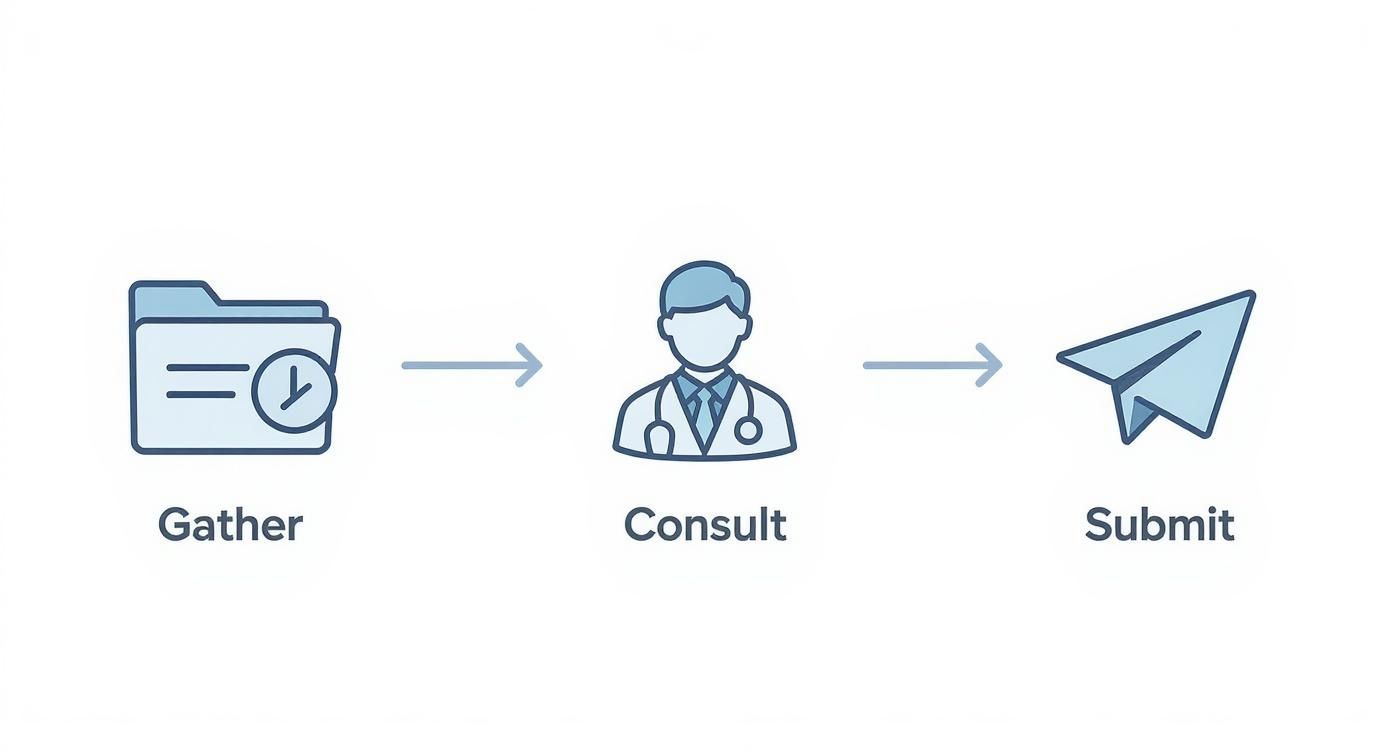
It seems simple—gather records, see your doctor, and submit the package. But as we’ll see, the details within each step are what truly matter.
Getting the Main Application Form (ISP1151) Right
The main application form, ISP1151, is your direct line to the decision-maker at Service Canada. It’s much more than just your personal details; it’s where you lay out the full narrative of your condition, your work life, and how your disability has fundamentally changed your ability to earn a living.
This is not the place for vague, one-word answers. You need to paint a vivid picture with specific, real-world examples of your limitations. For instance, when the form asks how your condition impacts daily activities, don’t just write “trouble walking.”
A much more powerful answer looks like this:
“Due to severe osteoarthritis in my knees, I can only walk for about 100 metres before the pain becomes too intense, forcing me to stop and rest for 10-15 minutes. I cannot climb a flight of stairs without help and am unable to stand for longer than 5 minutes at a time.”
See the difference? This level of detail gives the adjudicator a concrete understanding of your functional capacity. It translates a medical diagnosis into the real-world limitations they need to see to approve a claim.
Connecting Your Medical Conditions to Your Work History
One of the most critical sections of the application is where you draw a clear line between your medical condition and your inability to work. You’ll need to list your conditions and pinpoint the date they stopped you from working. This date is incredibly important, as it can affect both your eligibility and any potential back payments.
Be meticulous when describing your work history. You should list every significant job you’ve held over the last 10 to 15 years. For each one, you need to describe not just the duties but the actual physical and mental toll.
- Physical Demands: Did you lift heavy boxes, stand all day, or perform repetitive tasks like typing or assembly?
- Mental Demands: Did the job require intense focus, complex problem-solving under pressure, or hitting strict deadlines?
By detailing these demands, you can then show exactly why your medical condition makes it impossible to perform those tasks—or any other job for that matter. For example, if you have severe fibromyalgia and your last job was a desk job requiring you to sit for 8 hours, you can explain how widespread pain and “fibro fog” make it impossible to maintain the posture and concentration needed. For a deeper dive into this part of the process, our guide explains in detail how to apply for CPP disability.
Your Doctor’s Crucial Role: The Medical Report (ISP2519)
While you’re working on your part of the application, your doctor or specialist will be filling out the Medical Report (ISP2519). In my experience, this is often the single most influential document in your entire file. It gives Service Canada a professional, objective medical opinion on your diagnosis, prognosis, and limitations.
Your doctor must provide specific, measurable details. Their report should clearly outline:
- Clinical Findings: Objective medical proof like MRI results, blood tests, or notes from a physical examination.
- Treatment History: A comprehensive list of every treatment you’ve tried and how you responded to them.
- Functional Limitations: Clear, unambiguous statements about what you can and cannot do—sitting, standing, walking, lifting, concentrating, and even interacting with others.
A common reason for denial is a medical report that simply confirms a diagnosis without explaining its impact. A strong report will explicitly state that your condition is “severe and prolonged” and directly connect your symptoms to your inability to hold down any type of gainful employment.
You can help your doctor write a more powerful report. Give them a copy of your work history and a short, written summary of your daily struggles. This extra context can make all the difference, empowering them to paint a full and accurate picture of your reality.
Getting Approved for the Disability Tax Credit
The Disability Tax Credit, or DTC, is one of the most important—and misunderstood—parts of Canada’s disability support system. It’s not a monthly cheque like CPP-D. Instead, the DTC is a non-refundable tax credit that lowers the amount of income tax you or a family member pays. It’s designed to offset some of the extra costs that come with having a severe and prolonged impairment.
Applying for the DTC is a totally separate process from your CPP disability claim, but I can’t stress its importance enough. Getting approved for the DTC is often the key that unlocks other major federal and provincial supports, like the Registered Disability Savings Plan (RDSP) and the new Canada Disability Benefit.
The T2201 Form is Everything
Your entire DTC application comes down to one critical document: Form T2201, the Disability Tax Credit Certificate.
The form is split into two parts. You’ll handle Part A, which is just your basic personal information. Part B is the crucial section—it must be filled out and certified by a qualified medical practitioner who can detail exactly how your impairment affects you.
The Canada Revenue Agency (CRA) runs the DTC program, and their criteria are incredibly specific. They aren’t looking for a diagnosis on its own; they need to understand how severely your condition restricts your ability to handle basic, everyday activities. This is the hurdle where so many applications fail.
To get approved, the effects of your impairment must fit one of these scenarios:
- You are blind.
- You are “markedly restricted” in at least one basic activity of daily living.
- You are “significantly restricted” in two or more basic activities, and the combined effect is equal to a marked restriction.
- You need life-sustaining therapy on a regular basis.
What Does “Marked Restriction” Actually Mean?
That term, “marked restriction,” is the absolute core of a successful DTC claim. It means that even with all your therapy, medication, and any assistive devices you use, you still can’t perform a basic daily activity—or it takes you an incredibly long time (roughly three times longer than the average person).
And here’s the kicker: this restriction has to be present all or nearly all of the time. The CRA defines this as 90% of the time.
For instance, it’s not enough for your doctor to just write “severe arthritis in hands.” To get your application approved, they need to certify on Form T2201 that, 90% of the time, you are unable to feed or dress yourself within a reasonable timeframe. It’s that specific.
A successful application paints a clear picture for the CRA, showing that your limitations aren’t just occasional issues. They need to see, certified by a medical professional, a persistent and severe impairment that fundamentally disrupts your daily life.
It’s a high bar, which unfortunately means many people who should qualify never even apply. The numbers are shocking. Recent data shows that around 84 percent of Canadians with disabilities didn’t claim the DTC or receive CPP/QPP benefits. For those with severe disabilities, only about 14 percent claimed the DTC. If you’re interested in the details, you can read the full research on disability benefit uptake from Statistics Canada.
Practical Tips for a Stronger T2201 Form
Your job is to arm your medical practitioner with the details they need to fill out Part B accurately. Never assume they already know the full picture of your day-to-day struggles just from your appointments.
Here’s how you can help them build the strongest possible case for you:
- Give Them Concrete Examples: Don’t just say, “I get tired.” Instead, write down exactly what happens. For example: “After walking just 50 metres, I’m hit with debilitating fatigue and have to sit and rest for at least 20 minutes before I can move again.”
- Highlight the “When” and “How Bad”: Constantly bring it back to the fact that your limitations are present “all or substantially all of the time.” Your doctor also needs to certify the start date of the impairment, which is absolutely vital if you want to make a retroactive claim.
- Talk About Backdating Your Claim: If your condition has impacted you for years, make sure to bring this up with your doctor. A successful DTC application can often be backdated for up to 10 years. This could lead to some significant tax refunds for you or a family member who has been supporting you.
When you walk into your appointment with this information prepared, you give your doctor the precise, detailed evidence the CRA is looking for. It makes all the difference in getting your Disability Tax Credit application approved.
What to Expect After You Submit Your Application

You’ve gathered the documents, filled out the forms, and finally hit ‘submit’ on your disability application. That’s a huge step, but now comes the hard part: the waiting game. This period can be filled with a lot of uncertainty, so knowing what’s coming next can make a world of difference for your peace of mind.
The key takeaway here is to be patient. Both Service Canada (for CPP-D) and the Canada Revenue Agency (for the DTC) have an incredibly thorough review process. A wait of several months isn’t just common; it’s a standard part of the system.
Understanding the Typical Timelines
Once your application is officially in the system, the review process begins. While every person’s situation is different, there are some general timelines that can help you set realistic expectations.
- CPP Disability (CPP-D): The official service standard from Service Canada is a decision within 120 calendar days—that’s roughly four months. Keep in mind, this can stretch out longer if your case is particularly complex or if they need to chase down more medical records.
- Disability Tax Credit (DTC): The CRA is generally a bit quicker, often processing applications in about eight weeks. Pro tip: submitting online through your CRA My Account can sometimes speed things up.
During this waiting period, your file is being carefully examined. Adjudicators are weighing your medical evidence against your work history and personal statements to see if you meet the strict eligibility criteria for support.
Responding to Requests for More Information
Don’t be surprised if you get a letter or a phone call asking for more details. It’s actually quite common for an adjudicator to need clarification on your work duties or to request an additional medical report.
If this happens, try not to panic. This can be a good sign—it means a real person is actively working on your file and taking your claim seriously. The most important thing you can do is respond as quickly and thoroughly as you can. Any delay on your end will, unfortunately, just extend the time it takes to get a final decision.
A request for more information is an opportunity, not a setback. It gives you a chance to strengthen any weak points in your application and provide the specific evidence the decision-maker needs to approve your claim.
Facing the Reality of a Denial
Now for the tough part. It’s a difficult truth that a large number of initial disability applications are denied. Getting that denial letter can feel like a punch to the gut, but it is absolutely critical to know that this is not the end of the road. For many people who are ultimately successful, an initial denial is just part of the journey.
You have the right to appeal, and the first step in that process is called a reconsideration. For a CPP-D denial, you have to request this within 90 days of receiving the decision letter. This is a firm deadline, so you need to act fast.
During a reconsideration, your file is handed to a different Service Canada staff member—someone who had no involvement in the first decision. They will review your entire application again, along with any new evidence you provide.
If the reconsideration is also unsuccessful, the next step is to appeal to the Social Security Tribunal of Canada. While it’s a more formal process, it gives you another chance to make your case. If your long-term disability claim has been denied, understanding the appeals system is the best tool you have for getting the decision overturned.
Common Application Mistakes to Avoid
A denial letter is a gut punch, especially after putting weeks into the application. In our work with clients across Ontario, we have seen that a large share of denials are avoidable. They almost always come down to a small set of preventable mistakes. Knowing what not to do is at least as important as knowing how to apply.
Mismatching Your Evidence to the Legal Test
This is the single biggest reason claims are rejected. It is not enough for your doctor to name your condition. The medical evidence has to directly prove you meet the specific legal definition of disability for the program you are applying to. For CPP-D, that means showing the disability is both “severe and prolonged.”
A common mistake is filing a thick medical record full of diagnoses without explaining how those conditions stop you from working. The adjudicator will not connect those dots for you.
A note that says “patient has fibromyalgia” is weak. A note that says “due to fibromyalgia, the patient experiences chronic pain and fatigue that prevents them from sitting for more than 30 minutes or concentrating on complex tasks for more than an hour” is powerful. It speaks to the legal test — the inability to hold a job.
Before you submit, have a frank conversation with your doctor. Show them the program’s definition of disability and ask them to write their opinion in language that directly answers that test.
Inconsistent Information Across Forms
When you are juggling many forms, small contradictions slip in. You may describe your day one way on the main application and slightly differently on a supplemental form. Adjudicators are trained to spot these inconsistencies and treat them as red flags.
For example, if your Activities of Daily Living form says you can handle light housekeeping but your personal statement says you cannot do any chores at all, the file reads as unreliable.
- Review everything before mailing. Read every page as if you were the decision-maker. Does it paint one consistent picture?
- Be specific and honest. It is fine to describe your good days and bad days — but the overall story needs to line up.
- Keep a complete copy of your submission. If questions come up later, you will know exactly what they have.
Underreporting or Misreporting Financials for ODSP
For ODSP, the entire process kicks off with a strict financial assessment. Errors or omissions here stop the application dead — the ministry will not even look at the medical file. People are routinely denied for forgetting a small savings account, missing a tiny side income, or getting an asset value wrong.
Be meticulous. Pull all bank statements, pay stubs, and asset information together before you start. Over-disclosing is always safer than letting the ministry discover something later, which can lead to denial and an overpayment investigation. If your long-term disability claim is denied along the way, our guide on what to do when your long-term disability claim is denied walks through the appeal steps.
Common Questions About Applying for Disability in Canada
Going through the disability application process can feel like you’re navigating a maze. Even with a clear path forward, it’s easy to get turned around by specific rules and what-ifs. Let’s tackle some of the most common questions we hear from people across Ontario to give you some straightforward answers.
Can I Still Work While Receiving CPP Disability Benefits?
Yes, you can, and it’s a common concern. The Canada Pension Plan Disability (CPP-D) program is designed with a “work-test” provision in mind. It allows you to try returning to the workforce without the fear of immediately losing your financial support.
For 2024, you’re allowed to earn up to roughly $6,800 a year (before taxes) without it impacting your benefits. If you make more than that, it doesn’t mean your benefits will be automatically cut off. It simply signals to Service Canada that they should take a closer look at your file. The key is to be upfront and report any income you earn while on CPP-D.
How Long Does It Take to Get a Decision?
This is where you’ll need a good deal of patience. Officially, Service Canada aims to make a decision within 120 calendar days—that’s about four months. Keep in mind, that clock only starts ticking once they have your complete application in hand.
In reality, the wait can vary quite a bit. Several things can influence the timeline:
- A Complex Case: If you have multiple medical conditions or a less straightforward work history, the review will naturally take longer.
- Missing Information: If Service Canada needs to chase down more medical records from your doctors, everything gets put on hold until they arrive.
- Application Backlogs: Sometimes, it’s just a matter of volume. A high number of applications can slow the whole system down.
What Happens if My Disability Application Is Denied?
Getting a denial letter is tough, no question. But it’s absolutely critical to understand that this is not the end of the road. In fact, many successful claims are denied at first. The system has a built-in appeals process for this very reason.
Your first move is to request a reconsideration. You have 90 days from the date on your denial letter to do this. Your file will be passed to a different staff member at Service Canada for a completely fresh review, and you can add new medical evidence to strengthen your case. If that also comes back as a denial, the next step is an appeal to the Social Security Tribunal.
A denial isn’t a comment on your illness or injury. It often just means the adjudicator didn’t see the specific type of evidence they needed in the initial paperwork. The appeal is your opportunity to fill in those gaps.
Do I Need a Lawyer to Apply for Disability?
Legally, no, you don’t need a lawyer to apply for disability benefits. Plenty of people handle the application on their own by being meticulous with the forms and thorough with their medical records.
However, getting a legal expert involved can be a game-changer, especially in certain situations. A disability lawyer can be particularly valuable if:
- Your medical situation is complicated or involves several different diagnoses.
- You’ve already been denied and are heading into the appeals process.
- You simply feel overwhelmed by the paperwork and want a professional to handle it correctly from the start.
A lawyer who lives and breathes this area of law knows exactly what the decision-makers are looking for. They can help shape your application to give it the best possible chance of success. For more detailed answers, feel free to browse our firm’s extensive FAQ page.
Related UL Lawyers resources
If your disability application was denied or you are not sure which program to file, call UL Lawyers at 905-744-8888 or email info@ullaw.ca. You can also book a free consultation.
- CPP disability services — service overview for CPP disability applications and appeals.
- Disability Adjudication Unit — ODSP medical decisions and the 30-day Internal Review.
- CPP disability appeal support — focused service page for appeal problems.
- Long-term disability services — service overview for denied or delayed LTD claims.
- CPP disability calculator — helpful calculator for estimating CPP disability benefits.