
Struggling with your mental health can feel incredibly isolating, but it’s important to know that in Canada, your fight is not invisible. In Ontario, conditions like depression, anxiety, and PTSD are legally recognized as disabilities. This isn’t just a label; it’s a powerful acknowledgment that grants you specific rights and unlocks access to crucial support, from workplace accommodations to financial aid.
Quick answer: Depression, anxiety, PTSD and addiction-related conditions can be disabilities under Ontario human rights law. An LTD insurer should not deny a claim simply because the illness is “invisible.” The strongest response focuses on functional limits: concentration, stamina, attendance, stress tolerance, decision-making, medication side effects, treatment history and why those limits prevent reliable work under your policy.
The Reality of Mental Health and Disability in Ontario

For so many people across Ontario, from Toronto to Burlington, the line between mental health and disability isn’t just a concept—it’s a daily reality. While a broken bone is easy for others to see and understand, the impact of a mental health condition can be just as debilitating, if not more so.
Think of it this way: a physical injury might stop you from lifting a heavy box, but severe anxiety can stop you from concentrating in a meeting, communicating clearly with your team, or even leaving your house. Both situations prevent you from doing your job.
Your Struggle Is Validated by Law
Here’s the most important thing to understand: Ontario law agrees. Your experience isn’t just a personal hurdle; it’s a protected ground under human rights legislation. This is far more than a symbolic gesture—it has real-world power.
The legal recognition of mental health conditions as disabilities is the foundation upon which all your rights are built. It means you are entitled to the same protections and supports as someone with a visible, physical disability.
This validation is what empowers you to take action. It provides the legal standing you need to:
- Request workplace accommodations: This could mean asking for modified hours, a change in your duties, or taking a mental health leave.
- Apply for disability benefits: You have a right to file claims for Short-Term Disability (STD), Long-Term Disability (LTD), and Canada Pension Plan Disability (CPP-D).
- Protect yourself from discrimination: Your employer cannot legally fire you, demote you, or otherwise penalize you because of your mental health disability.
Understanding the Bigger Picture
Gaining a full perspective on mental health often means recognizing how treatment itself has evolved. For example, many forward-thinking healthcare providers now apply trauma informed care principles when working with patients. This approach is built on compassion and acknowledges that past trauma can have a profound effect on a person’s current mental state.
Our goal here is to give you a clear roadmap. We want to help you navigate everything from the Ontario Human Rights Code to the fine print in an LTD policy. We’re here to help you move from a place of uncertainty to one of clarity and control. This guide is your ally, built to help you understand the systems in place and how to make them work for you.
Understanding Your Legal Protections in Ontario
When you’re dealing with a mental health condition, it’s easy to feel like it’s a personal battle you have to fight alone. But in Ontario, it’s not just a personal struggle; it’s a matter of your legal rights. A powerful set of laws is in place to protect you from discrimination and ensure you’re treated fairly. Getting to know these laws is the first real step toward advocating for yourself, both at work and when you’re seeking benefits.
The cornerstone of these protections is the Ontario Human Rights Code. The Code is crystal clear: it prohibits discrimination and harassment based on disability. And its definition of “disability” is intentionally broad, covering a wide spectrum of mental health conditions, from anxiety and depression to PTSD and bipolar disorder. You don’t need to be on disability benefits for your condition to be legally recognized as a disability under the Code.
The Duty to Accommodate Your Mental Health
This legal recognition isn’t just symbolic—it places a serious, non-negotiable obligation on employers. It’s called the duty to accommodate. In simple terms, your employer must take reasonable steps to adjust your job or your work environment to account for the effects of your disability, right up to the point of “undue hardship.”
Think of it this way: your job is a path you walk every day. A mental health condition can feel like a massive, unmovable boulder blocking that path. An accommodation is the tool—a ramp, a detour, or a helping hand—that your employer is required to provide so you can get around that boulder and keep moving forward.
Accommodations for mental health aren’t one-size-fits-all. They can include things like:
- Flexible work hours to manage symptoms or get to appointments.
- Modified job duties to dial down specific stressors.
- A quieter workspace to help with focus and concentration.
- Taking medical leave so you can focus on treatment and recovery.
An employer can only refuse an accommodation if it causes undue hardship, and that’s an extremely high legal bar to clear. It means the request would create massive costs or a serious health and safety risk. A little inconvenience or a minor expense just doesn’t cut it. For a closer look at this, you can read our guide on whether depression is a disability.
Systemic Barriers and Broader Protections
Even with these strong legal rights, the reality on the ground can be tough. Shocking statistics from the Ontario Human Rights Commission (OHRC) show that 54% of working-age Ontarians with mental health and addiction disabilities are completely out of the labour force. Their unemployment rate is 22.6%—more than double that of people with other types of disabilities.
These numbers tell a stark story: having rights on paper doesn’t always translate into equal opportunity in the real world. That’s why it’s so critical to understand every tool you have available.
Beyond the individual focus of the Human Rights Code, the Accessibility for Ontarians with Disabilities Act (AODA) also plays a vital role. While the Code deals with accommodating one person at a time, the AODA’s goal is to tear down the systemic barriers that exist across the province. It sets clear accessibility standards that organizations must follow to make Ontario more inclusive for everyone.
The AODA requires organizations to have accessibility policies and to train their staff on how to serve people with disabilities. To make sure your rights are being met, it helps to know what’s required, and an AODA compliance checklist can be a useful resource.
Together, the Code and the AODA create a legal safety net designed to protect your dignity, support your ability to work, and confirm that your mental health is taken seriously.
Navigating Financial Support and Disability Benefits
When you can’t work because of your mental health, the financial pressure can feel suffocating. The worry about lost income only adds to the weight you’re already carrying. The good news is that there are financial safety nets in Ontario designed specifically to give you breathing room so you can focus on getting better.
Figuring out disability benefits can feel like trying to solve a puzzle with no picture on the box. But once you understand the pieces, it starts to make sense. Let’s break down where your financial support might come from.
Your Options for Financial Support
If a mental health condition has put your work life on hold, your income replacement will typically come from one of three places: your employer’s group insurance plan or the federal government.
The main sources are:
- Short-Term Disability (STD): Think of this as your first line of support. It’s an insurance benefit offered through your employer that usually covers a portion of your salary for a set period, often from a few weeks up to six months.
- Long-Term Disability (LTD): If your condition means you can’t return to work after STD runs out, you’ll likely apply for LTD. This is also part of a group insurance plan and can provide income for several years, sometimes all the way to age 65.
- Canada Pension Plan Disability (CPP-D): This is a federal program for people who have contributed enough to the Canada Pension Plan. It’s designed for those with a disability that is both “severe and prolonged,” meaning it prevents you from working at any job on a regular basis.
This flowchart maps out the first few steps you might take when your mental health starts to affect your ability to work.

As you can see, the process often begins with asking for accommodations. If that doesn’t resolve the issue or your employer isn’t responsive, getting legal advice is a critical next step.
To help you get a clearer picture of these options, here is a table comparing the key features of each benefit.
Comparison of Disability Benefits in Ontario
| Benefit Type | Source | Typical Duration | Disability Definition | Key Challenge for Mental Health Claims |
|---|---|---|---|---|
| Short-Term Disability (STD) | Employer’s Group Insurance | 15 to 26 weeks | Unable to do your own job. | Documenting the initial onset and severity of symptoms. |
| Long-Term Disability (LTD) | Employer’s Group Insurance | 2 years to age 65 | Changes from “own occupation” to “any occupation” after 24 months. | Proving you cannot work at any suitable job after the 2-year mark. |
| Canada Pension Plan (CPP-D) | Federal Government | Until age 65 or recovery | Disability must be “severe and prolonged” and prevent any regular, gainful work. | The “severe and prolonged” definition is extremely strict. |
Understanding which benefit you qualify for is a huge first step, but it’s just the beginning. The next hurdle is proving you meet the definition of disability.
What “Disability” Really Means to an Insurer
Here’s something that trips up a lot of people: your doctor’s diagnosis isn’t enough. For an insurer, “total disability” is a contractual term, not just a medical one. This is especially true for invisible illnesses like depression, anxiety, or PTSD.
You’ll almost always run into one of two definitions in an LTD policy:
- Own Occupation: For the first two years of your claim, you generally have to prove that your condition stops you from doing the key duties of your specific job.
- Any Occupation: After the two-year mark, the goalposts move. You now have to prove that you’re unable to do any job for which you have the right education, training, or experience.
This shift to the “any occupation” definition is where a huge number of legitimate mental health claims get denied. The insurance company might say, “Okay, your anxiety means you can’t handle your sales job, but you could definitely be a data-entry clerk.”
Successfully passing the “any occupation” test means your medical records need to be rock-solid. They must clearly explain your functional limitations—not just your diagnosis. You need evidence showing how symptoms like poor concentration, memory lapses, or crippling fatigue prevent you from working in any suitable role.
Applying for these benefits means paperwork from you, your employer, and your doctor. For STD and LTD, you’ll deal directly with the insurer. For CPP-D, you’ll apply through Service Canada. Be meticulous with your application; insurers scrutinize every detail, particularly when it comes to mental health.
We’ve put together a full breakdown of the process to help you get started. Take a look at our guide on how to apply for disability benefits for a step-by-step walkthrough.
How to Build a Strong Medical Case for Your Claim

When it comes to a disability claim, your medical evidence is everything. This is doubly true for mental health conditions. Insurance companies and government agencies like Service Canada need to see more than just a diagnosis—they need to understand precisely how your condition stops you from being able to work.
Think of it like this: your diagnosis is just the blueprint for your claim. The actual structure is built with every piece of objective medical evidence you can provide. Notes from your psychiatrist, reports from your psychologist, and records from your family doctor are the steel beams that give your claim the strength to stand up to scrutiny.
Without that solid framework, your claim is likely to crumble under the first bit of pressure from an insurance adjuster.
Documenting Your Functional Limitations
The most critical part of your medical case isn’t your diagnosis—it’s your functional limitations. These are the concrete, real-world ways your symptoms impact your ability to function day-to-day. An insurer doesn’t deny a claim because they don’t believe you have depression; they deny it because they don’t see proof of why that depression makes you unable to do your job.
Your doctors are your most crucial allies here, but you need to guide them. Be direct and clear about what you need documented. When you meet with your doctor, psychiatrist, or therapist, ask them to make specific notes answering questions like:
- How does your condition affect your ability to concentrate or focus for long periods?
- Do your symptoms make it difficult to manage stress or meet deadlines?
- Can you reliably and consistently interact with coworkers, supervisors, or the public?
- Do you have trouble with memory, organization, or making decisions?
An insurer is weighing risk and liability. A medical note that says, “Patient is unable to concentrate for more than 15 minutes due to severe anxiety” has a much greater impact than one that simply states, “Patient has anxiety.” You need to be specific, and you need to ask your doctor to be specific, too.
The Power of Supporting Evidence
Beyond what your doctor writes in their clinical notes, other types of evidence can add powerful context to your claim. These additional records help paint a complete picture of your daily struggles, making your limitations real and undeniable to the person reviewing your file.
Try to gather supplementary documents, including:
- A Personal Journal: Make a habit of writing down your symptoms, how they affected your daily activities, and any side effects from your medication. This creates a detailed, chronological account of your experience from your own perspective.
- Statements from Others: Ask a spouse, a trusted friend, or even a former coworker to write a letter. They can describe the changes they’ve seen in you and how your condition affects your life from their point of view.
- A List of Treatments: Keep a clear log of every medication, therapy, and treatment you’ve tried. Note what worked, what didn’t, and why. This shows that you are actively trying to get better, which is a key factor for insurers.
The need for this detailed proof is highlighted by the hard facts about mental health disabilities in Canada. Statistics show that 73.8% of individuals with a mental health or addiction disability describe it as severe or very severe. On top of that, a staggering 90.5% of those with mental health issues also report having another disability. You can learn more from the Ontario Human Rights Commission’s statistical profile. This high rate of severity and co-occurring conditions makes thorough documentation absolutely essential.
Building a strong medical case can feel like a monumental task, especially when you’re not well. For a step-by-step breakdown of what’s required for federal programs, our guide on how to apply for CPP disability can help clear up what you need for that specific benefit.
Common Reasons Mental Health Claims Are Denied
Getting that denial letter in the mail feels like a punch to the gut. When you’re already battling your mental health, a rejection from your insurance company can feel deeply personal and unjust, leaving you feeling lost and completely overwhelmed. But here’s the thing: understanding why insurers say no is your first real step toward fighting back and winning your appeal.
Let’s be clear: insurance companies are businesses built on managing risk. Their default setting, especially for invisible illnesses like depression or anxiety, is often scepticism. They’re trained to look for any crack, any gap, or any inconsistency in your story that they can use to justify a denial.
Your Medical Evidence Isn’t Telling the Whole Story
By far, the most common reason for a denial is that the insurer decides your medical evidence just isn’t strong enough. It’s not that they doubt you have a diagnosis—it’s that they don’t see clear, objective proof of how your symptoms stop you from being able to work.
A file that just states a diagnosis of “anxiety disorder” or “major depression” won’t cut it. The insurer needs to see the real-world impact. They’re looking for detailed clinical notes from your doctor or therapist that describe your specific functional limitations—things like an inability to focus for more than 20 minutes at a time, memory lapses that derail your tasks, or social anxiety so crippling you can’t face colleagues in a meeting.
This problem is made even worse by the very real gaps in our healthcare system. In Ontario alone, an estimated 40% of adults with a diagnosed mental illness reported that their need for care was only partially met or not met at all. When you’re stuck on a year-long waitlist for a psychiatrist or can’t access consistent therapy, the insurer might use this against you. They’ll argue that you aren’t “actively managing” your condition, so it must not be that severe. You can learn more about this systemic problem directly from the data provided by CAMH.
The Insurer’s “Paper Doctor” Disagrees
Insurance companies almost always have their own doctors and medical consultants review your claim. We often call them “paper doctors” because they form a medical opinion about your health without ever meeting you, speaking to you, or examining you. Unsurprisingly, these paid consultants often conclude that your condition isn’t nearly as debilitating as your own doctors believe.
An insurer’s medical opinion is not the final word on your health. It is an opinion bought and paid for by the company denying your claim, and it can be challenged with stronger evidence from your own treating medical team.
Your family doctor, your psychologist, and your psychiatrist—the people who see you month after month—have a far deeper and more accurate understanding of your condition. When documented correctly, their opinions hold tremendous weight in any legal challenge.
They’re Watching You: Surveillance and Social Media
It might sound like something from a movie, but insurers absolutely use surveillance to challenge disability claims. This can range from hiring a private investigator to film you running errands to having an analyst meticulously comb through your social media accounts.
They’re looking for anything that seems to contradict your reported limitations. That one photo of you smiling at a family barbecue? That Facebook post about having a “good day”? They will take it completely out of context and present it as “proof” that you aren’t really disabled.
The Two-Year Hurdle: From ‘Own’ to ‘Any’ Occupation
This is a make-or-break moment for most long-term disability (LTD) claims. The vast majority of LTD policies will cover you for the first 24 months as long as your condition prevents you from performing the key duties of your own occupation. But after that two-year mark, the goalposts move.
Suddenly, the definition of disability changes. To keep receiving benefits, you must prove you’re unable to perform any occupation for which you are reasonably suited by your education, training, or experience. This is where countless mental health claims are cut off.
The insurer will argue that while your anxiety prevents you from returning to your job as a high-stress project manager, you’re perfectly capable of working as, say, a part-time data entry clerk in a quiet office.
To get past this, your medical evidence has to be iron-clad. It needs to go beyond your old job and explain precisely why your cognitive and emotional symptoms—like brain fog, memory issues, or emotional dysregulation—would prevent you from reliably holding down any kind of job, even a simple one.
LTD Denied for Depression or Anxiety in Ontario: What Insurers Look For
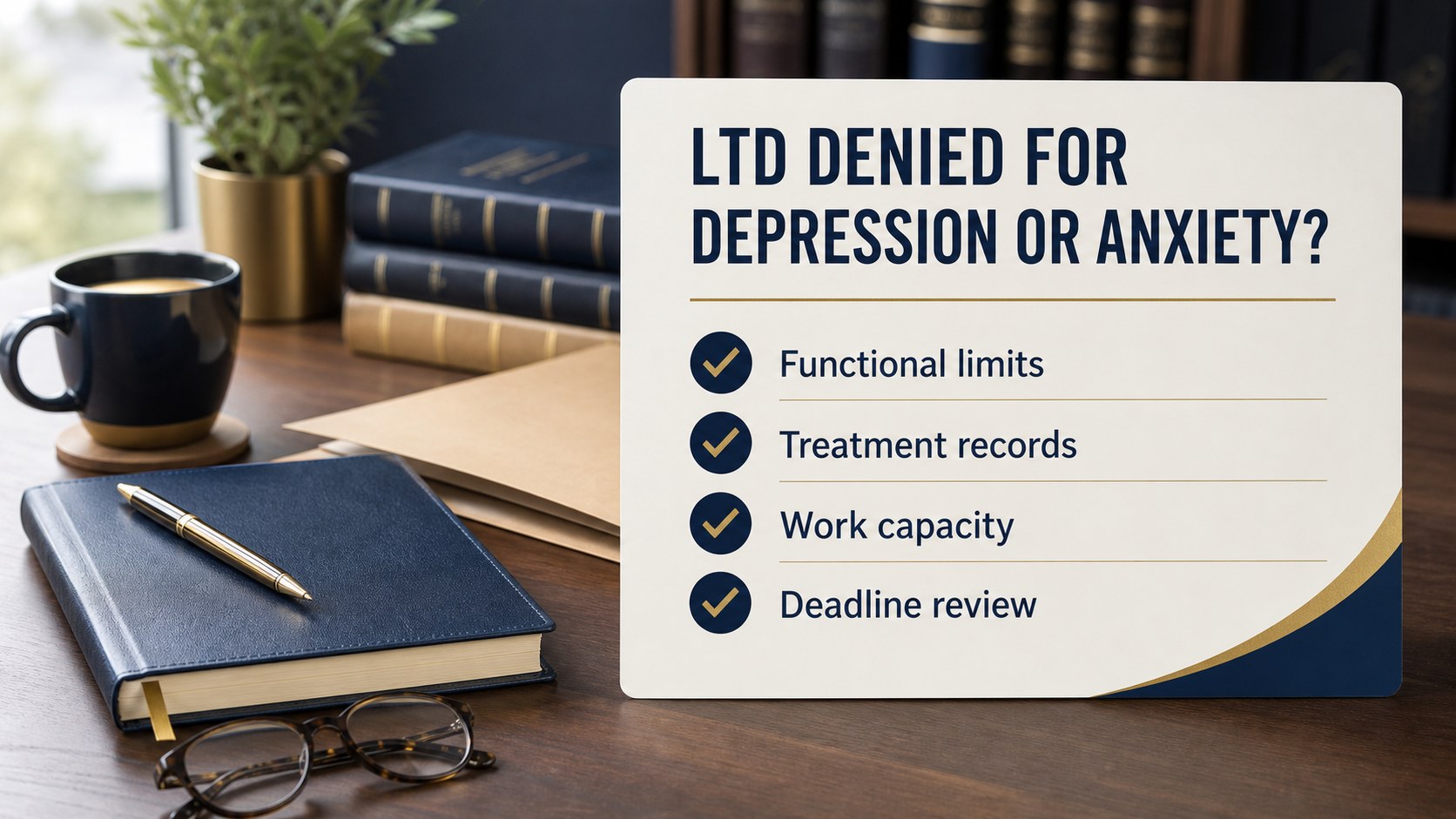
When an LTD denial involves depression, anxiety, PTSD, burnout or another mental health condition, the dispute is usually not about whether the diagnosis exists. The dispute is about whether the medical and practical evidence proves you cannot reliably perform the duties required by the policy. Ontario’s workplace guidance recognizes that mental health disabilities and addictions are protected disabilities and that employers have a duty to accommodate disability-related needs unless doing so would cause undue hardship. Disability insurers, however, often focus on the narrower policy definition and look for gaps in treatment, function and consistency.
Evidence that can strengthen a mental health LTD claim
- Functional medical notes: ask treating providers to describe concentration, memory, pace, stress tolerance, attendance, social interaction, sleep disruption and medication side effects.
- Treatment history: keep records of therapy, psychiatry, family doctor visits, medication changes, referrals, waitlists and reasons for any treatment gaps.
- Workplace evidence: preserve accommodation requests, modified duties, performance changes, sick notes, return-to-work attempts and communications with HR.
- Daily-life evidence: a symptom journal, family observations and examples of missed tasks can help explain why the condition affects reliability, not only mood.
- Policy language: compare the evidence to the LTD definition: own occupation, any occupation, elimination period, treatment compliance and proof-of-loss requirements.
Common insurer arguments in depression and anxiety denials
Insurers often argue that symptoms are subjective, treatment is not aggressive enough, the person could do a quieter or less stressful job, or social media/surveillance shows more function than the claim suggests. Those arguments can be challenged, but the response should be specific. A note that says “unable to work due to anxiety” is usually weaker than a report explaining why anxiety attacks, impaired sleep, medication side effects and cognitive fatigue prevent predictable attendance and task completion.
Internal appeal or lawsuit?
An internal appeal can sometimes fix a missing-record problem, but it can also consume time while the limitation period keeps moving. Before appealing, review the denial letter, policy wording, limitation date and missing evidence. If the insurer has already taken a firm position despite strong treating-provider evidence, legal action may be more effective than repeatedly asking the same insurer to reconsider its own decision.
What to Do When Your Disability Claim Is Denied
That letter in the mail denying your disability claim can feel like a punch to the gut. It’s a confusing, frustrating, and frankly, terrifying moment when you’re already dealing with a health crisis. But the most important thing to know is this: a denial is almost never the final word. It’s simply the beginning of the real process.
In Ontario, you have two main options after a denial: you can start an internal appeal with the insurance company, or you can begin legal action against them.
Why Internal Appeals Can Be a Trap
The insurance company will always point you toward their internal appeal process. On the surface, it seems like the easiest and most logical next step. But from an experienced perspective, walking into an internal appeal by yourself can be a strategic mistake.
Think of it this way: the insurer is inviting you to play a game where they make all the rules. This process allows them to control the timeline, ask for mountains of additional paperwork, and then have their own team review the claim again—often leading to the same denial. All the while, the clock is ticking, and you could be unknowingly weakening your case for an actual lawsuit down the road.
An insurance company’s denial isn’t an objective medical opinion. It’s a financial decision made by a for-profit business. The most powerful response isn’t to play their game; it’s to change the rules by bringing in a legal expert.
The Power of Immediate Legal Action
The single most effective step you can take after getting a denial notice is to speak with an experienced Burlington disability lawyer right away. This doesn’t mean you’re signing up for a stressful, multi-year court battle. In reality, that’s incredibly rare in Ontario.
The vast majority of disability lawsuits are settled through negotiation long before a judge ever gets involved. Filing a Statement of Claim, which is the document that officially starts a lawsuit, is a powerful first move. It sends a clear signal to the insurance company that you’re serious, you have professional representation, and their decision is about to be challenged properly.
A disability lawyer immediately takes the weight off your shoulders. They will:
- Handle all communication: You no longer have to deal with stressful calls or confusing letters from adjusters. Your lawyer becomes the single point of contact.
- Gather the right evidence: They know exactly what medical proof and expert opinions are needed to build a strong case and counter the insurer’s reasons for denial.
- Negotiate from a position of strength: Insurers treat a formal legal claim far more seriously than they do an internal appeal from an individual.
Filing a lawsuit flips the power dynamic. It takes you out of a vulnerable position and puts you in control, demonstrating that you are ready to fight for the benefits you are owed. If you’ve just received a denial, you can learn more about why your long-term disability claim was denied and how to best prepare for what comes next.
Your Top Questions About Ontario Disability Claims Answered
When your mental health makes it impossible to work, the last thing you need is a confusing legal system. The rules, deadlines, and jargon can feel like another mountain to climb. We get it. To give you some clarity, here are straightforward answers to the questions we hear most often from people in Ontario facing this exact situation.
Can I Be Fired for Taking a Mental Health Leave in Ontario?
In a word, no. Your employer cannot legally fire you simply because you need to take a medically-supported leave for your mental health. The Ontario Human Rights Code protects you, classifying your condition as a disability. Firing you for it is discrimination, plain and simple.
In fact, your employer has a legal “duty to accommodate” your disability. This includes giving you reasonable time off to recover. If you are fired during or immediately after a mental health leave, it’s a major red flag. You should speak with a lawyer right away, as you could have a case for both wrongful dismissal and a human rights violation.
How Long Do I Have to Sue After an LTD Denial in Ontario?
This is where things get serious. In Ontario, you are working against a strict two-year limitation period. This means you have exactly two years from the day your long-term disability benefits were clearly denied or cut off to file a lawsuit against the insurance company. This isn’t a flexible guideline.
If you miss this two-year window, you will almost certainly lose your right to sue and recover the benefits you are owed—forever. This is why it is absolutely critical to consult with a disability lawyer the moment you receive a denial letter. They can act quickly to protect your legal options.
Can LTD be denied for depression or anxiety even with a diagnosis?
Yes. A diagnosis matters, but insurers usually decide LTD claims based on function and policy wording. The file should explain how symptoms prevent reliable work, not only name the condition.
What if I cannot access a psychiatrist quickly in Ontario?
Document the waitlist, referrals, family doctor follow-up, therapy attempts, medication changes and any barriers to care. Treatment gaps should be explained rather than ignored.
Can my employer fire me because of a mental health disability?
Ontario says employers cannot fire, refuse to hire or deny promotion because of a mental health issue or other disability. Employers also have a duty to accommodate disability-related needs unless undue hardship is established.
Do I Have to Pay Legal Fees Upfront to Fight a Denial?
No, you don’t. This is a common worry, but the good news is that you can get focused legal help without paying out of pocket. Most reputable disability law firms in Ontario, including ours, work on a contingency fee basis. You might have heard it called a “contingency fee” agreement.
It means exactly what it sounds like: you pay no legal fees unless your matter resolves with a recovery, whether through a settlement or a court decision. The fee is simply a pre-arranged percentage of your settlement. This system is designed to ensure that everyone has access to justice, especially when a disability has cut off their income.
Facing a denied claim or an uncooperative employer can feel isolating, but you don’t have to go through it alone. The team at UL Lawyers is committed to advocating for individuals across the GTA and Ontario, offering both compassionate support and expert legal representation. To discuss your situation and understand your rights, visit us at ullaw.ca for a free consultation.