
Facing a legal dispute in Ontario is stressful enough without also having to answer one of the hardest questions in the law: should I sue, or should I settle? There is no universal right answer. The better path depends entirely on the strength of your evidence, the conduct of the other side, the type of injury or loss you suffered, and what you are ultimately trying to achieve.
What most people do not realize is that suing and settling are not mutually exclusive choices you make at the outset. A lawsuit does not rule out a settlement — in fact, the vast majority of Ontario civil cases that are filed eventually resolve through negotiation, mediation, or settlement before a judge ever delivers a verdict. The real question is not whether to settle, but when, for how much, and from what position of strength.
This guide walks you through the key factors Ontario courts, mediators, and experienced litigators weigh when advising clients on this decision. Whether you are dealing with a personal injury claim, a contract dispute, or another civil matter, understanding both paths before you commit can be the difference between a fair outcome and a costly mistake.

Table of Contents
- Is It Better to Sue or Settle in Ontario?
- Suing and Settling Are Not Opposites
- When Settlement Is Usually the Better Option
- When Suing Is Usually the Better Option
- Motor Vehicle Injury Claims Often Need More Than a Quick Settlement
- The Risk of Settling Too Early
- The Risk of Refusing a Fair Settlement
- Should You Accept the Insurance Company’s First Offer?
- How a Lawyer Evaluates a Settlement Offer
- Why Do People Settle Instead of Going to Court?
- The Best Outcome: A Fair Settlement Built on Strong Evidence
Is It Better to Sue or Settle in Ontario?
The honest answer is: it depends — and the two options are not opposites.
Settlement means reaching a negotiated agreement with the other party, often without ever stepping inside a courtroom. Suing means commencing a formal proceeding under Ontario’s court rules and civil procedure, which can include the Superior Court of Justice or the Small Claims Court depending on the amount in dispute. Filing a lawsuit does not mean you are refusing to settle — it means you are serious, and it often creates the leverage that produces a fair settlement offer.
What “Better” Actually Means
Before weighing the options, define what success looks like for you:
- Full financial compensation for your losses, pain, and future needs
- Speed — resolving the matter before it drains more time and energy
- Privacy — keeping the dispute out of the public record
- Accountability — a court judgment that publicly establishes wrongdoing
- Certainty — knowing today what you will receive, rather than gambling on a verdict
Neither suing nor settling automatically delivers all five. A thoughtful litigation strategy, guided by experienced legal counsel, tries to position you to achieve as many of these goals as possible given the specific facts of your case.
The Legal Landscape in Ontario
Ontario’s civil justice system, governed by the Rules of Civil Procedure and the Courts of Justice Act, actively encourages parties to resolve disputes without trial. Mandatory mediation applies in Toronto, Ottawa, and Windsor. Costs consequences — where a party who refuses a reasonable settlement offer may be ordered to pay the other side’s legal fees — create real financial pressure to negotiate in good faith. This structure means that refusing a fair settlement can be just as costly as accepting an unfair one.
Suing and Settling Are Not Opposites
One of the most common misconceptions prospective clients carry into a first legal consultation is the belief that they must choose, right now, between suing and settling — as though the two paths diverge immediately and permanently.
They do not.
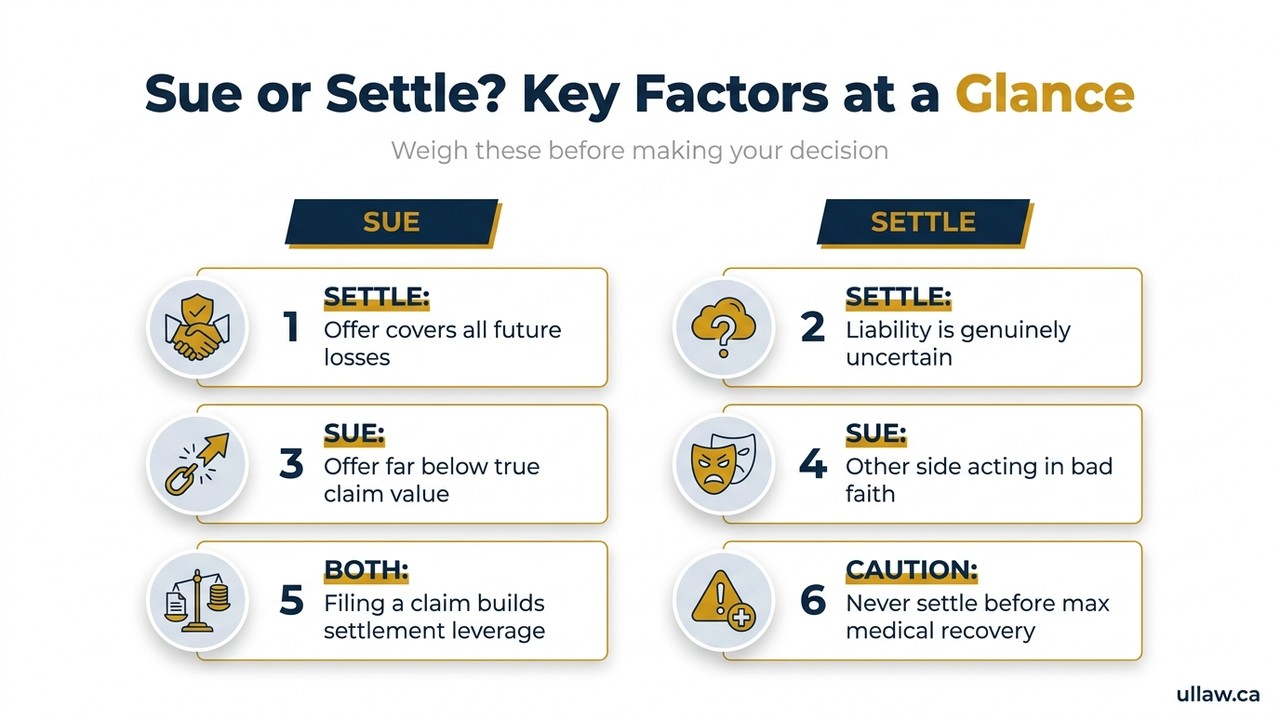
Filing a Statement of Claim is often the first step toward a better settlement. Once you commence litigation, several things happen that shift the dynamics in your favour:
- The other side (and their insurer) faces real legal costs if the matter proceeds to trial
- You gain access to the discovery process — examinations for discovery and document production — which can uncover evidence that strengthens your position
- Limitation periods are stopped, protecting your right to compensation
- Deadlines and court appearances create urgency that informal negotiations lack
In Ontario, the general limitation period under the Limitations Act, 2002 is two years from when you knew or ought to have known you had a claim. Missing that deadline can permanently bar your case, regardless of how strong it is. Commencing an action protects that right while negotiations continue.
Think of litigation and settlement as a spectrum, not a fork in the road. Most cases travel along that spectrum — from demand letter, to filed claim, to discoveries, to mediation, to settlement — without ever reaching a trial. The goal is to negotiate from strength, and sometimes you need a filed lawsuit to build that strength.
When Settlement Is Usually the Better Option
Settlement tends to be the smarter path when several factors align:
1. The Offer Reflects Your True Losses
A fair settlement accounts for all reasonably foreseeable damages: past and future income loss, medical and rehabilitation expenses, out-of-pocket costs, and in personal injury cases, general damages for pain and suffering. If the number on the table genuinely covers those heads of damage — even if it is not everything you hoped for — settling avoids the time, cost, and emotional toll of trial.
2. Liability Is Contested or Uncertain
If there is a realistic chance a court could find you partly or fully responsible for the incident, a negotiated outcome locks in recovery you might otherwise lose entirely. Ontario’s Contributory Negligence Act allows courts to apportion fault, which can reduce your award significantly.
3. You Need Funds Quickly
Trials in Ontario’s Superior Court can take two to four years from the date of filing, sometimes longer. If you are facing mounting medical bills, mortgage payments, or lost income, a timely settlement may be more valuable in practical terms than a theoretically larger verdict years down the road.
4. Privacy Matters to You
Court proceedings are generally public. A settlement can include confidentiality terms, keeping the details — and any admission of wrongdoing — out of the public record.
5. The Relationship Has Value
In commercial disputes between ongoing business partners or family members, preserving the relationship may outweigh winning every legal point. Litigation is adversarial by nature and often permanently damages working relationships.
When Suing Is Usually the Better Option
There are situations where commencing and pursuing a lawsuit — even to trial — is the right decision:
1. The Other Side Is Acting in Bad Faith
If an insurer or defendant is making unreasonably low offers, dragging its feet, disputing clear liability, or simply refusing to engage in meaningful negotiation, filing a claim and advancing through the litigation process sends a clear message that you are prepared to go the distance.
2. The Offer Dramatically Undervalues Your Claim
Insurers and opposing parties routinely make opening offers that reflect a fraction of fair value. If the gap between what is offered and what your claim is genuinely worth is large, you may recover significantly more by litigating — particularly once examinations for discovery reveal the full picture.
3. You Need to Establish Accountability
In some cases — particularly those involving serious negligence, workplace misconduct, or discrimination — a court finding of liability matters beyond the dollars. A judgment creates a public record and may deter similar conduct in the future.
4. There Is a Principle Worth Establishing
Sometimes a matter involves a contractual term, a rights violation, or an interpretation question that affects not just you but others in similar circumstances. In those cases, a court ruling may be worth more than a private settlement.
5. The Limitation Period Is the Only Deadline Looming
If negotiations are stalling and the two-year limitation period is approaching, commencing an action is often the only way to preserve your legal rights while talks continue.
Motor Vehicle Injury Claims Often Need More Than a Quick Settlement
Personal injury claims arising from motor vehicle accidents in Ontario operate under a unique and complex regime. The Insurance Act and the Statutory Accident Benefits Schedule (SABS) govern accident benefits — income replacement, medical and rehabilitation funding, attendant care, and more — separately from your tort claim against the at-fault driver.
Insurers handling these claims are experienced, well-resourced, and motivated to close files quickly and cheaply. That creates specific risks for injured Ontarians:
- Early offers rarely account for long-term consequences. A whiplash injury that seems manageable in the first few weeks may evolve into chronic pain, cognitive difficulties, or psychological trauma over months. Settling before your condition has stabilized can leave you without compensation for future care needs.
- The deductible and threshold rules in Ontario tort claims mean that for minor injuries, damages for pain and suffering may be subject to a statutory deductible that effectively reduces — or even eliminates — smaller awards. Understanding how these rules apply to your specific injuries is critical before accepting any offer.
- Independent Medical Examinations (IMEs) arranged by the insurer are designed to minimize your claim. Their conclusions are not neutral. Your own medical team’s documentation, gathered over time, is equally important evidence.
For accident victims, the Financial Services Regulatory Authority of Ontario (FSRA) oversees auto insurance regulation, and disputes over accident benefits can be taken to the Licence Appeal Tribunal (LAT). Knowing these pathways exist — and using them — can significantly increase your total recovery compared to accepting the insurer’s first offer.
The Risk of Settling Too Early
Settling too quickly is one of the most common and costly mistakes injured Ontarians make. Here is why:
Your damages are not fully known yet. In the days or weeks after an accident or harmful event, you — and your doctors — may not fully understand the extent of your injuries, how long recovery will take, or what ongoing treatment you will need. A settlement releases the defendant forever. Once signed, you generally cannot go back for more money, even if your condition worsens dramatically.
You may be negotiating without key evidence. Before discoveries and document production, you may not know about internal communications, prior incidents, or other evidence that would significantly increase the value of your claim.
Psychological pressure is real. Financial stress, exhaustion from the legal process, and the desire to move on with your life can push people toward accepting less than they deserve. Recognizing this pressure — and having a lawyer act as a buffer — is one of the most practical benefits of legal representation.
A release is final. Ontario courts very rarely set aside signed settlement agreements and releases. The bar for doing so — fraud, misrepresentation, unconscionability — is high. Treat any release as permanent.
The general rule of thumb used by experienced personal injury lawyers: do not settle until your condition has reached maximum medical improvement, or until you have a clear prognosis from your medical team about long-term needs.

The Risk of Refusing a Fair Settlement
The risks cut in both directions. Refusing a reasonable settlement offer carries its own serious consequences under Ontario’s litigation rules.
Costs Consequences Are Real
Under Ontario’s Rules of Civil Procedure, if a defendant makes a formal Offer to Settle under Rule 49 and you ultimately receive less at trial than what was offered, the court may order you to pay the defendant’s full indemnity legal costs from the date of the offer. In a complex case, those costs can reach tens of thousands of dollars — potentially wiping out or exceeding your trial award.
Trials Are Expensive and Uncertain
Even a well-prepared case can lose at trial. Witnesses may be unconvincing. Documents may be excluded. A judge or jury may assess credibility differently than you expect. Every trial is a gamble, and no lawyer can guarantee a result.
Emotional and Physical Toll
For injured plaintiffs, enduring years of litigation — including cross-examination about your injuries, lifestyle, and credibility — can be re-traumatizing and physically exhausting.
The Time Value of Money
A dollar received today is worth more than a dollar received in three years. When comparing a current settlement offer to a potential trial verdict, factor in the delay, the legal fees that will be incurred between now and judgment, and the uncertainty of the outcome.
Should You Accept the Insurance Company’s First Offer?
Almost universally, the answer is no — at least not without first having it reviewed by an independent lawyer.
Insurers have claims adjusters, in-house lawyers, and decades of data on what cases are worth. Their first offer is a starting point designed to close your file at the lowest reasonable cost to them — not to make you whole. That is not a moral judgment; it is simply how the system works.
Here is what a first offer typically does not account for:
- Future income loss if you cannot return to your pre-accident occupation
- Future medical and rehabilitation costs, including physiotherapy, psychology, specialist care, or home modifications
- Housekeeping and caregiving costs you may need permanently
- The full range of general damages for pain, suffering, and loss of enjoyment of life
- Interest on damages that accrues during litigation
Before responding to any offer — and certainly before signing a release — have the offer reviewed by a lawyer who understands Ontario personal injury and civil litigation law. Most plaintiff-side lawyers offer free initial consultations, and many work on contingency, meaning no fees unless you recover. The cost of getting a second opinion is almost always zero; the cost of not getting one can be your entire future financial security.
How a Lawyer Evaluates a Settlement Offer
When you bring a settlement offer to an experienced Ontario litigator, here is the analytical framework they typically apply:
Step 1: Quantify the Full Damages
A proper valuation covers all heads of damages: general damages (pain and suffering), special damages (out-of-pocket losses), past and future income loss, future care costs, and Family Law Act claims if applicable. This often requires expert reports from economists, occupational therapists, or medical specialists.
Step 2: Assess Liability Risk
How strong is the evidence of fault? Are there credibility issues? Is there any contributory negligence that could reduce recovery? The stronger the liability case, the more leverage you have in negotiations.
Step 3: Apply the Costs/Benefit Analysis
What will it cost — in legal fees, disbursements, expert costs, and time — to take the case to trial? What is the realistic range of outcomes at trial? How does the offer compare to the low end of that range, net of future costs?
Step 4: Consider the Rule 49 Exposure
Has a formal Offer to Settle been made? If so, what are the costs consequences of proceeding and not beating it at trial?
Step 5: Account for Client Goals and Circumstances
A client in acute financial hardship may rationally value a certain settlement more highly than a larger but uncertain future award. A client with a strong support system and stable finances may be better positioned to hold out for full value.
This is precisely why having dedicated litigation counsel in your corner matters so much — not just to argue your case, but to give you the clearest possible picture of what your case is actually worth and what risks you are taking.
Why Do People Settle Instead of Going to Court?
This is one of the most-searched questions on this topic, and the answer reveals a lot about how Ontario’s civil justice system actually functions.
The overwhelming majority of lawsuits — often cited as more than 95% of civil cases — settle before trial. People settle because:
- Certainty has real value. A specific outcome, even at a modest discount to the possible trial verdict, often makes rational sense.
- Legal costs are substantial. A multi-day Superior Court trial can cost tens of thousands of dollars in legal fees and disbursements on each side. Even winning parties often do not fully recover their costs.
- Trials take years. The Ontario court system, while improving, still involves significant delays. Mediation and negotiation can resolve matters in months.
- Evidence cuts both ways. Discoveries sometimes reveal that your own case has weaknesses you did not anticipate. Settlement allows both sides to avoid that risk.
- Mediation works. Ontario’s mandatory mediation program in Toronto, Ottawa, and Windsor — and the option to mediate in other jurisdictions — creates a structured, neutral environment where settlements frequently happen. The Ontario Ministry of the Attorney General oversees mandatory mediation requirements.
Settling is not giving up. Done right — from a position of strength, with full information, and after a thorough valuation — settlement is often the smartest resolution available.
The Best Outcome: A Fair Settlement Built on Strong Evidence
Here is the strategic truth that the best Ontario litigators understand: the path to a fair settlement usually runs through serious litigation preparation.
Insurers and defendants pay fair money when they believe you are prepared to take the case to trial and win. That belief is built through:
- A complete and compelling Statement of Claim that properly pleads your damages
- Medical evidence that documents the full extent and prognosis of your injuries
- Expert reports — economic loss, future care cost, vocational — that quantify your losses with precision
- Strong examinations for discovery that lock in the other side’s evidence and expose weaknesses in their position
- A lawyer with a track record of taking cases to trial when necessary, so the other side knows you are not bluffing
This is the paradox of civil litigation: the clients who prepare most thoroughly for trial are often the ones who end up settling — because the other side recognizes the strength of their position and offers fair value to avoid the risk.
If you are weighing whether to sue or settle, the best first step is not to make that decision alone. Speak with an Ontario litigation lawyer who can assess your specific facts, identify the full value of your claim, and map out a strategy — whether that strategy ends at the settlement table or in a courtroom.
For a fuller picture of how Ontario civil lawsuits work from filing to resolution, our guide on litigation law covers the full landscape of your options.
How to Recognize a Good Settlement Offer: Practical Criteria
Knowing when to settle is only half the equation — you also need to know whether the specific number on the table is genuinely good. Ontario courts and experienced litigators look at several concrete criteria when evaluating financial adequacy.
Financial Adequacy: Does the Offer Cover All Heads of Damage?
A strong offer should address every recognized category of loss, not just the most obvious ones:
| Head of Damage | What to Check |
|---|---|
| Past income loss | Verified against pay stubs, tax returns, and employment records |
| Future income loss / loss of competitive advantage | Supported by medical and vocational evidence |
| Past medical and rehabilitation expenses | Receipts and treatment records reconciled |
| Future care costs | Ideally backed by a formal future care cost report |
| General damages (pain and suffering, loss of enjoyment of life) | Benchmarked against comparable Ontario decisions |
| Out-of-pocket expenses | Travel, homecare, medication, assistive devices |
If the offer ignores or substantially undervalues any single category, the headline number can be misleading even if it sounds large.
Insurer or Opposing Party Behaviour: Is the Offer Made in Good Faith?
Bad-faith indicators that should make you cautious include:
- Artificial urgency — a “take it or leave it” deadline with no legitimate legal basis
- Lowball anchoring — an opening offer far below any defensible range, designed to reset your expectations downward
- Withholding information — delays in producing medical assessments, accident benefit records, or liability documents before asking you to sign a release
- Broad release language — a release drafted to extinguish claims you may not yet know you have (for example, future complications from an injury)
A genuine offer from an insurer or defendant acting in good faith typically comes with reasonable time to respond, full disclosure of relevant records, and release terms proportionate to the dispute.
Timeline Pressure: Urgency You Control vs. Urgency Imposed on You
There is a meaningful difference between:
- Legitimate urgency — your limitation period under the Limitations Act, 2002 is genuinely approaching, or financial hardship makes early resolution a rational choice you have made
- Manufactured urgency — the other side claims the offer expires in 48 hours to prevent you from obtaining an independent legal opinion
When settlement pressure is externally imposed without justification, courts and legal counsel treat it as a red flag about the offer’s underlying adequacy.
Hidden Costs of Accepting: What Happens After You Sign?
A release ends your legal claim permanently. Before signing, confirm:
- Disbursements and legal fees are accounted for so you understand your net recovery
- Accident benefits repayment obligations (under the Insurance Act and SABS regulations) are factored in if applicable to your file
- Collateral benefits deductions (such as long-term disability payments) have been properly calculated
- Tax implications, if any, have been considered — most personal injury general damages are non-taxable in Canada, but structured settlement income components may differ
- The scope of the release does not inadvertently bar related claims (e.g., a product liability claim alongside a tort claim)
The Rule 49 Benchmark
Under Rule 49 of the Rules of Civil Procedure, if a defendant makes a formal written offer to settle and you proceed to trial but fail to obtain a judgment more favourable than that offer, you may be ordered to pay the defendant’s partial indemnity costs from the date of the offer onward. This cost exposure can be substantial in a lengthy civil action. A good offer, assessed honestly, should account for what a court is realistically likely to award after costs risk is factored in — not just the gross damages figure.
A Quick Self-Assessment Checklist
Before accepting or rejecting any offer, ask your lawyer to walk through these questions with you:
- Have all heads of damage been independently quantified?
- Does the offer meet or exceed the low end of a realistic damages range?
- Are future medical and care costs fully addressed?
- Has liability risk been honestly assessed, including contributory negligence exposure?
- Is the release narrowly tailored to the claims actually in dispute?
- Have costs consequences under Rule 49 been modelled?
- Is any urgency legitimate, or is it pressure manufactured by the other side?
No checklist replaces individualized legal advice, but working through these criteria gives you a disciplined framework to evaluate any figure placed in front of you.
Talk to a UL Lawyers Team Member
Every lawsuit is different, and the right choice — sue, settle, or negotiate from a filed position — depends on facts only a lawyer who knows your case can properly assess. The team at UL Lawyers offers free consultations for Ontario residents facing civil disputes and personal injury claims. There is no obligation, no upfront cost, and no pressure. Reach out today to get a clear-eyed view of your options before you make a decision that could affect your financial future for years to come.