
Going to trial is expensive, time-consuming, and stressful. In Ontario, the civil justice system offers a powerful alternative for disputes where the key facts are not genuinely in doubt: the summary judgment motion. Rather than waiting years for a trial date, a party can ask a judge to decide the case — or a key part of it — on the written record, without calling witnesses or sitting through weeks of court proceedings.
Summary judgment is not a loophole or a shortcut for weak cases. Courts grant it only when the evidence demonstrates there is no genuine issue requiring a trial. Used strategically, however, it can save your business or your livelihood from the crushing cost of full litigation. Used poorly, it can backfire — wasting resources and hardening the other side’s position.
This guide explains exactly how summary judgment works in Ontario, what the legal test requires, what evidence you need, and how courts exercise their broad powers under Rule 20 of the Rules of Civil Procedure. Whether you are a plaintiff trying to collect what you are owed or a defendant seeking early dismissal of a claim against you, understanding this tool is essential before you decide how to litigate.

Table of Contents
- What Is a Summary Judgment Motion in Ontario?
- When Can You Bring a Summary Judgment Motion?
- What Is the Legal Test for Summary Judgment in Ontario?
- What Evidence Is Required for a Summary Judgment Motion?
- How Do Courts Decide Summary Judgment Motions?
- What Are the Grounds for Summary Judgment?
- What Are the Advantages — and Disadvantages — of Summary Judgment?
- What Is a Partial Summary Judgment?
- How Do You File for a Summary Judgment Motion in Ontario?
- Can Summary Judgment Be Used in Employment Law Disputes?
- What Is a Summary Trial — and How Is It Different?
- Can You Appeal a Summary Judgment in Ontario?
What Is a Summary Judgment Motion in Ontario?
A summary judgment motion is a formal request to a Superior Court of Justice judge to resolve a claim — or a specific issue within a claim — without a full trial. It is governed by Rule 20 of Ontario’s Rules of Civil Procedure, which you can find on Ontario e-Laws.
The underlying idea is simple: not every dispute genuinely needs a trial. A trial is designed to resolve competing versions of the facts by hearing live witnesses and testing credibility. When the material facts are not truly disputed, or when one party’s legal position is simply untenable on the undisputed facts, a trial wastes court resources and the parties’ money.
Either party — the plaintiff or the defendant — can bring a summary judgment motion. A plaintiff might move for judgment because the defendant has no real defence. A defendant might move to have the claim dismissed because the plaintiff cannot produce evidence to support an essential element of the case.
Summary judgment is not the same as a regular motion (such as a motion to strike a pleading). Regular motions deal with procedural or interlocutory matters; a summary judgment motion goes to the merits of the claim itself and can result in a final judgment — ending the litigation entirely, or carving off part of it.
When Can You Bring a Summary Judgment Motion?
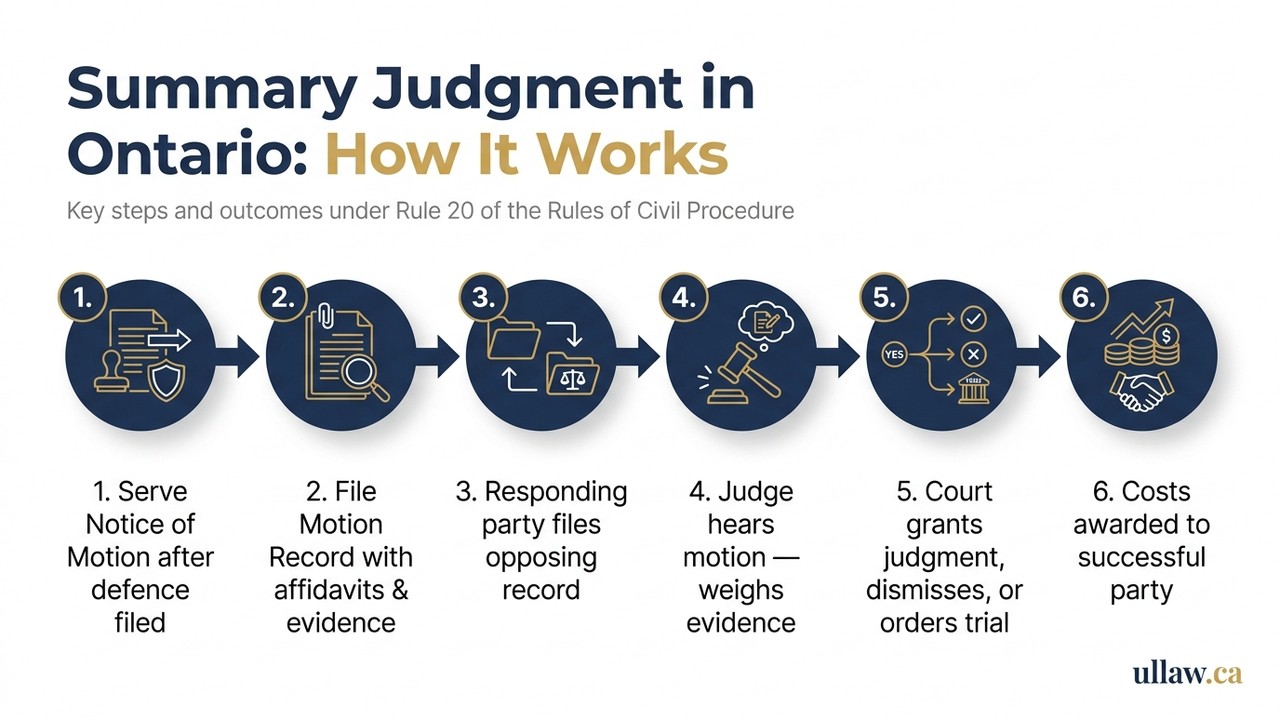
Under Rule 20, a party may move for summary judgment after the defendant has delivered a defence. This timing requirement exists because the court needs to see the full shape of the dispute before deciding whether a trial is necessary.
There is no hard deadline for bringing the motion during the litigation, but courts and litigants must comply with any case timetable or scheduling order set by the court. In practice, summary judgment motions are most commonly brought:
- Early in the proceeding, after pleadings close but before costly examinations for discovery, when one side believes the other has no viable claim or defence;
- After examinations for discovery, once the moving party has gathered enough evidence to demonstrate that the opposing party cannot support its position; or
- As part of a consent timetable, where both parties agree that summary judgment is the most efficient path.
Courts have repeatedly cautioned against bringing premature motions before the evidentiary record is sufficiently developed. A motion brought too early — before relevant documents and examinations are complete — risks being dismissed on the ground that there are genuine issues that proper discovery might resolve. Timing, strategy, and a realistic assessment of your evidence all matter enormously.
What Is the Legal Test for Summary Judgment in Ontario?
The governing legal test under Rule 20 asks: Is there a genuine issue requiring a trial?
This deceptively simple question has been refined significantly by the courts. The threshold is not whether the moving party is likely to win at trial — it is whether the record before the motion judge is sufficient to fairly and justly resolve the dispute without a trial.
Motion judges have broad enhanced fact-finding powers that go well beyond the old paper-only approach:
- They may weigh evidence (not just determine whether any evidence exists);
- They may draw reasonable inferences from the evidence;
- They may assess credibility where necessary.
These powers exist precisely to allow judges to distinguish a genuine factual dispute from a manufactured or speculative one. A party cannot defeat summary judgment simply by filing an affidavit that contradicts itself, makes bald assertions without supporting facts, or relies on speculation.
The Proportionality Principle
Courts also apply a proportionality lens: even where some issue might theoretically require a trial, if the cost and delay of a full trial are disproportionate to the issues at stake, summary judgment may still be the just outcome. The goal, as Ontario courts have recognized, is timely, affordable, and proportionate access to justice — a value embedded in the Ontario Rules of Civil Procedure.
What Evidence Is Required for a Summary Judgment Motion?
A summary judgment motion lives or dies on its evidentiary record. Unlike a trial, there are no live witnesses. Instead, both parties put their best evidence before the judge through:
- Affidavits — sworn statements of fact, often from the parties themselves or knowledgeable witnesses;
- Exhibits attached to affidavits — contracts, emails, invoices, medical records, corporate records, and other documentary evidence;
- Transcripts of examinations for discovery, if discoveries have been completed;
- Agreed statements of fact, where parties agree on certain undisputed facts;
- Expert reports, when technical or specialized evidence is relevant.
Key Rules About Affidavit Evidence
- Affidavits must be based on personal knowledge of the facts, not hearsay (with limited exceptions).
- The responding party cannot rest on bare denials. Rule 20 requires the responding party to put their best foot forward — if you have evidence, you must produce it.
- If a party has relevant evidence but withholds it, the court may draw an adverse inference.
Examinations on Affidavits
Each side has the right to cross-examine the opposing party’s affiants on their affidavit evidence. This is often the most critical strategic moment in a summary judgment motion — a witness who contradicts their own affidavit, or who admits key facts under cross-examination, can determine the outcome.
How Do Courts Decide Summary Judgment Motions?
A summary judgment motion is heard by a Superior Court judge (not a master, in most cases) on a return date set by the court. The hearing is typically conducted in writing, supported by factums (written legal arguments), records of evidence, and book of authorities containing relevant cases.
The judge considers the entire record — affidavits, cross-examination transcripts, documentary exhibits — and asks whether, viewing the evidence as a whole and applying the enhanced powers available under Rule 20, the matter can be fairly resolved without a trial.
The Judge’s Options
After hearing the motion, the judge may:
- Grant judgment in favour of the moving party — resolving the claim or issue finally;
- Dismiss the motion — finding there is a genuine issue requiring a trial;
- Grant partial summary judgment — deciding some issues while sending others to trial;
- Order a summary trial under Rule 20.05 — a condensed hearing where oral evidence may be permitted when affidavit evidence alone is insufficient but a full trial is unnecessary.
Costs
Costs follow the outcome. A successful moving party will generally receive a costs award. A party who brings a summary judgment motion and loses — particularly if the motion was premature or without merit — can face a substantial adverse costs order. Courts have made clear they will not tolerate summary judgment motions used as a litigation tactic to exhaust the other side.
What Are the Grounds for Summary Judgment?
There is no closed list of grounds for summary judgment. Courts look at the overall record and ask whether a genuine dispute exists. That said, the most common grounds include:
Grounds in Favour of a Plaintiff
- The defendant has admitted all material facts needed to establish liability;
- The defendant’s defence is a pure question of law that the court can resolve on the undisputed facts;
- The defendant’s evidence is speculative, contradictory, or unsupported and cannot raise a genuine issue.
Grounds in Favour of a Defendant
- The plaintiff cannot produce any admissible evidence supporting an essential element of the claim (e.g., damages, causation, breach);
- The plaintiff’s claim is statute-barred by the Limitations Act, 2002 and the limitation period issue can be decided on the record;
- The plaintiff’s position relies on speculation rather than facts;
- There is no genuine dispute about a contract term or its meaning, and on the undisputed interpretation the defendant is not liable.
The key insight is that summary judgment is not about which party is more credible — that is a trial function. It is about whether any genuine factual dispute exists at all that would actually change the legal outcome.
What Are the Advantages — and Disadvantages — of Summary Judgment?
Advantages
- Speed: A summary judgment motion can resolve a case in months rather than the years a trial can take.
- Cost savings: Avoiding a multi-day or multi-week trial dramatically reduces legal fees for both parties.
- Certainty: A final judgment ends the uncertainty and allows parties to move on.
- Leverage: Even a failed motion can clarify the issues, narrow the dispute, and encourage settlement.
- Proportionality: For smaller or mid-sized claims, the cost of a trial may be entirely disproportionate to the amount at stake.
Disadvantages
- Cost risk: If the motion fails, you will likely pay the other side’s costs and still face a trial.
- Evidentiary demands: You must put your best evidence forward now — you cannot hold anything back for trial.
- No live witnesses: Credibility findings are harder without cross-examination at trial; affiants can sometimes appear more credible in person.
- Partial outcomes: A judge may grant judgment on some issues but send others to trial, leaving the dispute only partially resolved.
- Premature motions backfire: A motion brought before the record is ready gives the other side an opportunity to demonstrate that discovery is needed — and may cost you both money and goodwill with the court.
What Is a Partial Summary Judgment?
Not every summary judgment motion needs to resolve the entire case. A partial summary judgment disposes of one or more discrete issues or claims while leaving others to proceed to trial.
For example, a court might grant partial summary judgment:
- Finding that liability is established, leaving only the quantum of damages for trial;
- Dismissing one of several causes of action while allowing others to proceed;
- Resolving a limitation period issue in favour of the defendant on one claim while allowing another claim to continue.
Partial summary judgment can be a powerful tool — it narrows the issues, reduces trial length and cost, and sometimes puts enough pressure on a party to settle the remaining issues. However, courts have cautioned against granting partial summary judgment where doing so would fragment the litigation and create inefficiency rather than reducing it. A motion judge will consider whether deciding the issue separately genuinely advances the litigation or simply multiplies proceedings.
How Do You File for a Summary Judgment Motion in Ontario?
The procedural steps for bringing a summary judgment motion in Ontario follow the standard motion procedure under the Rules of Civil Procedure, with some additional requirements specific to Rule 20.
Step-by-Step Overview
- Serve a Notice of Motion on all parties, setting out the relief you are seeking and the grounds;
- Serve and file your Motion Record, which includes:
- The Notice of Motion;
- Your supporting affidavit(s) with all exhibits;
- Any transcripts from examinations;
- A factum (written legal argument);
- A book of authorities (relevant cases and statutes);
- Allow the responding party time to serve their record and factum — typically at least 10 days before the hearing (always verify current timelines under the Rules);
- The responding party serves their responding record, factum, and any cross-examination transcripts;
- Attend the motion hearing before a Superior Court judge;
- Receive the judge’s endorsement or written reasons, which constitute the court’s decision.
Consult an experienced litigation lawyer early — the motion record is the heart of your case, and errors in affidavit drafting, disclosure, or sequencing can be fatal to the motion. Our litigation practice team regularly prepares and responds to summary judgment motions across Ontario.
Can Summary Judgment Be Used in Employment Law Disputes?
Yes — and it is used frequently. Summary judgment is a common tool in Ontario employment litigation, including:
- Wrongful dismissal claims, where the key issues (reasonable notice period, just cause) are often pure questions of law or turn on undisputed facts;
- Enforceability of termination clauses, where a court can decide on the written contract alone whether the clause complies with the Employment Standards Act, 2000, available through Ontario e-Laws;
- Non-compete and non-solicitation clause disputes;
- Constructive dismissal claims, where the facts of the employer’s conduct are largely documented.
Employment summary judgment motions have become particularly common after courts recognized that employment disputes — especially between individual employees and large employers — are precisely the kind of case where the cost of a full trial is disproportionate to the issues.
That said, employment cases involving bad faith, human rights allegations under the Ontario Human Rights Code, or Wallace damages often raise credibility issues that require a trial. Whether summary judgment is appropriate depends entirely on the specific facts and evidence in your case. For a detailed look at wrongful dismissal, see our guide to what wrongful dismissal means in Ontario. Our litigation team can assess whether your employment dispute is a candidate for this motion.
What Is a Summary Trial — and How Is It Different?
A summary trial under Rule 20.05 is a distinct (though related) procedure that sits between a full summary judgment motion and a full trial. Where the motion judge determines that oral evidence is needed — but a complete trial is disproportionate — the judge may order a summary trial.
In a summary trial:
- Witnesses may give oral testimony (unlike a standard summary judgment motion, which relies on affidavits);
- The hearing is typically compressed — shorter than a full trial, with stricter time limits;
- The judge can still make final findings of fact and credibility and issue a binding judgment.
A summary trial is particularly useful in cases where the facts are largely known but one or two key witnesses need to be heard. It preserves the efficiency benefits of summary judgment while giving the court the tools it needs to assess credibility. Courts will order a summary trial only where it is a just and efficient way to resolve the dispute — not simply because one party prefers a shorter hearing.
Can You Appeal a Summary Judgment in Ontario?
Yes. A summary judgment is a final order of the Superior Court, which means it is generally appealable to the Court of Appeal for Ontario. Leave (permission) to appeal is not required for final orders on summary judgment.
However, appeals of summary judgments face a demanding standard of review:
- Questions of law are reviewed on a correctness standard — the appeal court asks whether the motion judge got the law right;
- Findings of fact and mixed fact-and-law are reviewed on a palpable and overriding error standard — a high bar that requires the appellant to show the judge made a clear mistake that affected the outcome.
The enhanced fact-finding powers of the motion judge — including weighing evidence and assessing credibility — are given considerable deference on appeal. Simply disagreeing with how the judge weighed the evidence is almost never enough to succeed on appeal.
Appeals are expensive and time-consuming. Before deciding to appeal, litigants should carefully consider the strength of the grounds, the standard of review, and the realistic cost-benefit of continuing the dispute. Always seek legal advice promptly — appeal deadlines in Ontario are strict under the Courts of Justice Act.
Talk to a UL Lawyers Team Member
If you are facing a civil dispute in Ontario and wondering whether summary judgment could resolve it faster and more affordably, speaking with a litigation lawyer early makes a real difference. The strength of your motion record — the affidavits, the documents, the strategy — is built from the very start of the case. Contact UL Lawyers today for a free consultation to discuss whether a summary judgment motion is right for your situation.