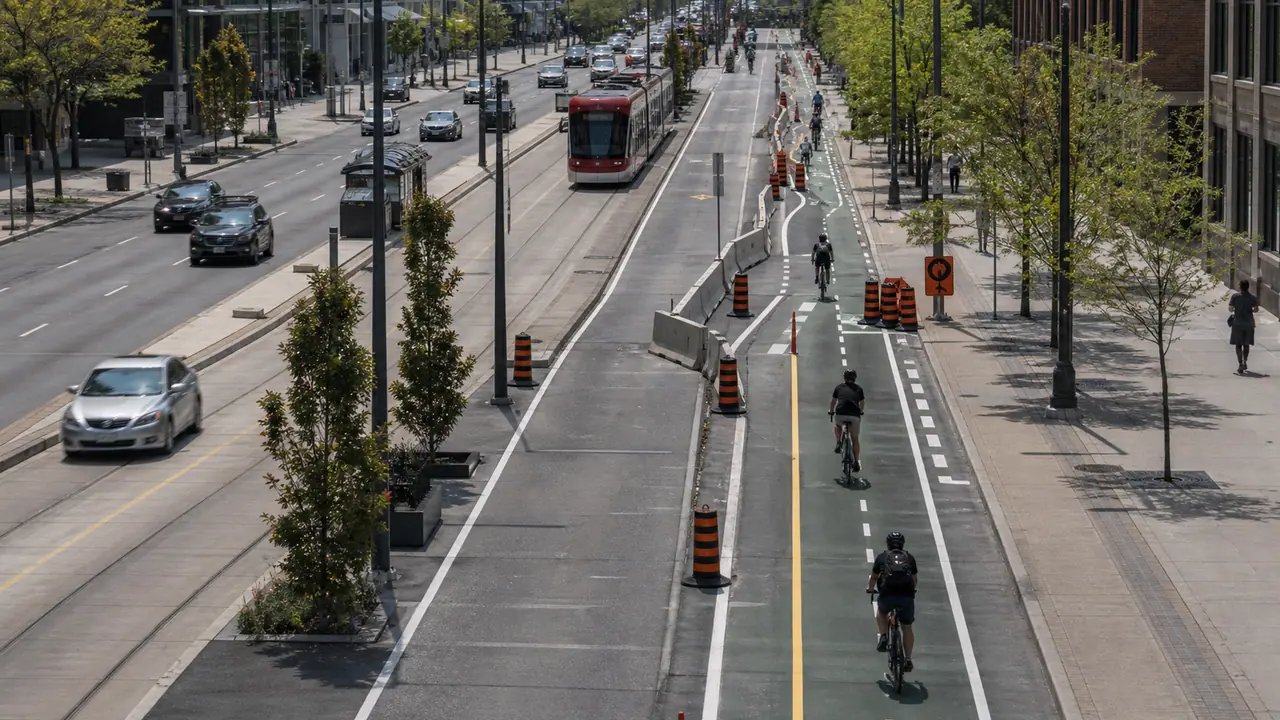

This ruling reinforces the precedence of legislative action over judicial interpretation in urban planning.
In a significant legal decision, the Ontario Court of Appeal has unanimously overturned a controversial lower court ruling that had declared a Charter right to bike lanes in Toronto. This decision gives the Ford government the green light to proceed with its plan to remove certain bike lanes that were deemed problematic for traffic flow. The case originated when cycling advocates challenged a 2024 law — the Reducing Gridlock, Saving You Time Act — which aimed to eliminate bike lanes on key Toronto streets, including Bloor St., Yonge St., and University Ave. These lanes were criticized for causing congestion.
Justice Paul Schabas, the judge in the initial ruling, had controversially stated that removing these lanes violated the Charter, a decision now overturned by appeal court Justices Fairburn, Huscroft, and Zarnett. UL Lawyers Legal Team
Key Takeaways
Ontario Court of Appeal overturns Charter ruling on bike lanes.
Ford government can remove bike lanes on major Toronto streets.
Decision affects traffic flow and cycling infrastructure in Toronto.
UL Lawyers Insight
The overturning of the bike lane ruling has significant implications for both Toronto residents and commuters. For motorists experiencing congestion on major roads like Bloor St. and Yonge St., this decision may ease traffic by allowing the removal of certain bike lanes. However, it also impacts cyclists who rely on these lanes for safe commuting. The ruling underscores the complexity of balancing urban planning with legal interpretations of rights.
As the city moves forward, understanding how this decision affects urban policies will be crucial for residents and commuters alike. For those involved in urban development or city planning, the ruling highlights the importance of considering both traffic efficiency and sustainable transportation options.
Action Checklist
What You Should Do
Stay updated on municipal decisions about bike lanes
Understanding local government plans helps you adapt to changes.
Participate in city consultations or town hall meetings
Engage in discussions about urban infrastructure policies.
Consider alternative routes if bike lanes are removed
Plan your commute to ensure safety and efficiency.
Advocate for safe cycling infrastructure
Join local groups or initiatives promoting sustainable transport.
Consult legal professionals for clarification on rights
Get advice on how urban planning decisions affect you legally.
Your Rights and Options
For Toronto residents and cyclists, this ruling clarifies that there is no Charter right specifically guaranteeing bike lanes. This means that while bike lanes remain a valuable part of urban infrastructure, their implementation or removal will be guided by legislative and urban planning decisions rather than constitutional rights. The decision sets a precedent for how similar cases might be interpreted in the future, emphasizing the role of government legislation over judicial interpretations in urban planning matters.
If you have concerns about how this might affect your daily commute or cycling routes, understanding the municipal decision-making process can be beneficial. For further guidance, consulting with legal professionals can provide clarity on how local bylaws and policies impact your rights and options.
Common Questions Answered
How UL Lawyers Can Help
Navigating changes in urban infrastructure can be challenging, especially when they affect your daily life. At UL Lawyers, we understand the complexities involved in urban planning and how they intersect with legal rights. Our team stays informed on legal developments across Ontario to provide you with up-to-date advice and support. If you're concerned about how this ruling affects your commute or cycling routes, we offer consultations to discuss your situation and explore your options. Reach out to us for a free consultation to understand how these changes may impact you.
Concerned about urban planning changes affecting you? Let's discuss your rights and options.
About this article:
Summary prepared with AI assistance from the linked source's reporting. Edited by UL Lawyers for Ontario context.
Accompanying images are AI-generated illustrations, not photographs of actual events or persons.
Important Legal Disclaimer
This page provides general information and does not constitute legal advice. Consult a legal professional for advice specific to your situation.
Source: TheTorontoSun
Named in this article? Request content removal