When the Supreme Court of Canada speaks, the law across the country listens. On May 15, 2026, the Court handed down its decision in Ahluwalia v. Ahluwalia, 2026 SCC 16, and it changed the legal landscape for survivors of abuse in a way that has been a long time coming.
In a 6–3 ruling, Canada’s highest court recognized a brand-new common law tort: the tort of intimate partner violence. For the first time, survivors in Ontario—and across Canada—have a dedicated civil claim that names the harm for what it really is. Not a series of disconnected incidents. Not a personality conflict. A pattern of coercive control that deserves both a name and a remedy.
If you have lived through an abusive relationship, or you are helping a family member who has, this decision matters. Here is what the Court said, why it matters, and how it could shape your options going forward.
The Story Behind the Case
The case involved a couple who had been married for 16 years. Throughout the marriage, the husband subjected his wife to a long pattern of physical and emotional abuse, isolation, and control over the choices she could make in her own life. When the marriage ended, she didn’t just want a divorce. She wanted accountability for the harm she had endured (SCC case brief).
The trial judge agreed and created a new tort she called “family violence,” awarding $150,000 in damages. The Ontario Court of Appeal disagreed, holding that existing torts like assault and intentional infliction of emotional distress were already enough (Court of Appeal decision summary).
The Supreme Court took a different view. Writing for the majority, Justice Kasirer recognized a new, narrower, and more carefully defined tort: the tort of intimate partner violence (SCC case brief).
What Is the New Tort of Intimate Partner Violence?
Think of a tort as a civil wrong. It is a way for one person to ask the court for money damages because another person caused them harm. Battery, assault, negligence—these are all torts you may have heard of.
The new tort of intimate partner violence is its own distinct civil claim. It exists because the Supreme Court accepted what survivors and advocates have been saying for years: abuse in an intimate relationship is rarely a single, isolated act. It is a pattern. And it is the pattern itself—the steady erosion of a person’s dignity, autonomy, and equality—that the law must be able to recognize.
In the Court’s own words:
The new tort of intimate partner violence fills a gap in the common law by properly recognizing that conduct objectively resulting in domination and control of an intimate partner is a qualitatively distinct wrong from those wrongs redressable through existing torts ([Luke’s Place summary, quoting Ahluwalia (SCC) at para. 182](https://lukesplace.ca/supreme-court-of-canada-recognizes-tort-of-intimate-partner-violence/)).
In plain language: existing torts handle pieces of the harm. This new tort handles the whole picture.
The Three Elements You Need to Prove
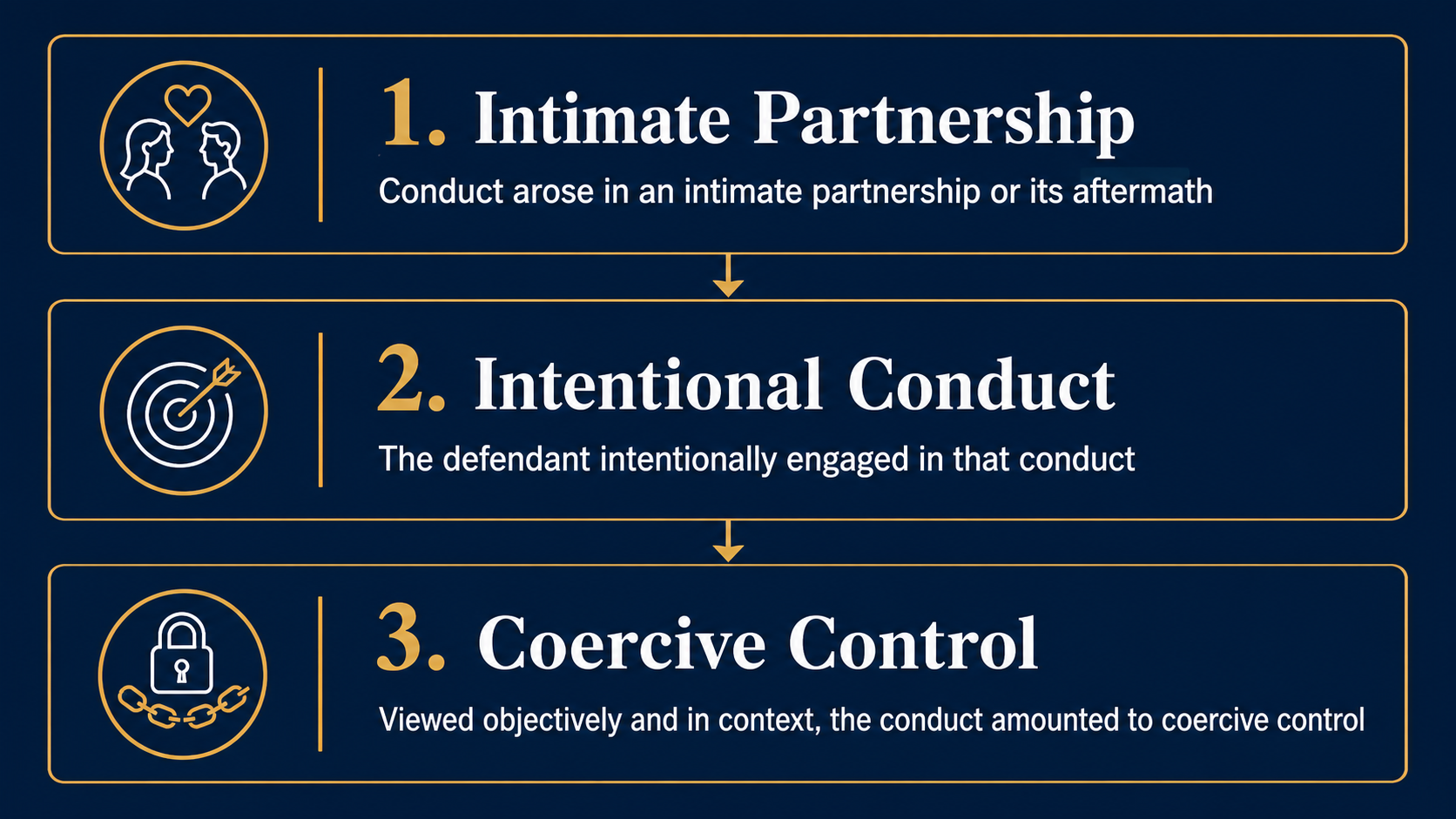
To succeed under the new tort, a plaintiff must establish three things (Demas Schaefer Family Law analysis):
- The conduct happened in an intimate partnership, or after it ended. An intimate partnership is a close personal relationship sustained over time, marked by interdependence, care, commitment, or emotional, financial, or physical intimacy. Notably, abuse that continues after the relationship ends still counts.
- The defendant acted intentionally. You only have to show the defendant meant to do the acts. You do not have to prove they consciously set out to “control” or “dominate” you.
- The conduct, viewed in context, amounted to coercive control. This is an objective test. Would a reasonable person, fully aware of the relationship, view the pattern of behaviour (looked at cumulatively, not in isolation) as an assertion of control that stripped the plaintiff of dignity, autonomy, and equality?
There is one more critical point: once you prove these three elements, you do not have to separately prove a specific psychological injury or “visible illness.” The harm is presumed to flow from the coercive conduct itself (Demas Schaefer Family Law analysis). This is a meaningful change from how courts have treated emotional harm in the past.
How This Is Different From Assault and Other Existing Torts
This is the part many readers find most useful. The Supreme Court did not say the existing torts were wrong. It said they were incomplete.
Here is how the new tort fills the gap:
| Tort | What It Captures | What It Misses |
|---|---|---|
| Battery | Unwanted physical contact. | The cumulative harm of non-physical control. |
| Assault | The fear of imminent physical harm. | Long-term fear, isolation, surveillance, and patterns of intimidation that don’t centre on a single imminent threat (UNBLJ analysis). |
| Intentional Infliction of Emotional Distress | “Flagrant or outrageous” conduct that causes a “visible and provable illness.” | Quieter, persistent forms of psychological and financial abuse that may not produce a diagnosable illness but still cause profound harm. |
| Intimate Partner Violence (new) | The full pattern: physical violence, emotional abuse, isolation, financial control, sexual coercion, surveillance, humiliation, and intimidation—viewed cumulatively as coercive control. | — |
Justice Kasirer was clear that intimate partner violence “is not confined to conduct that inflicts physical or psychological injury” (Demas Schaefer Family Law analysis). The law now sees the system of abuse, not just its individual symptoms.
Coercive Control, Isolation, and Financial Abuse Are Now Actionable
This is the heart of the decision and, for many survivors, the most important takeaway.
For years, people who experienced emotional and financial abuse without significant physical violence often felt the legal system had no place for them. The bruises were invisible. The harm was real, but the law struggled to name it.
The Supreme Court has now named it. The kinds of conduct that can constitute coercive control include (SCC case brief, Demas Schaefer Family Law analysis):
- Physical and sexual violence
- Emotional and psychological abuse, including verbal abuse, humiliation, and denigration
- Isolation from family, friends, and support networks
- Financial control, including restricting access to money, employment, or education
- Surveillance, stalking, and monitoring
- Threats—including threats to harm children, remove children, or commit suicide
- Sexual coercion and intimidation
- Litigation abuse—the misuse of court proceedings to continue exerting control after separation ([Reddit r/LawCanada thread discussing this aspect](https://www.reddit.com/r/LawCanada/comments/1tdyir6/scc_grants_appeal_in_ahluwalia_63_recognizes_new/))
The Court was careful to draw a line. Not every difficult or unhappy relationship gives rise to this tort. Ordinary conflict, hurt feelings, infidelity, or unkindness—on their own—are not coercive control (Demas Schaefer Family Law analysis). The tort targets a pattern of behaviour that is clearly incompatible with what an intimate partnership is supposed to be.
Why This Matters in Ontario
Ahluwalia is binding across Canada, but it has special significance here. Ontario is where this case began, and Ontario courts have already been at the centre of this conversation for years.
Practically speaking, what does it mean for someone in Ontario right now?
- You can plead this tort alongside your family law claim. Tort claims can already be combined with family law proceedings in Ontario. Ahluwalia now gives that tort claim a clearer legal foundation than the patchwork of assault, battery, and intentional infliction of emotional distress (Demas Schaefer Family Law analysis).
- Damages are separate from spousal support. Spousal support is meant to address financial need after a relationship ends. Tort damages are meant to compensate for the harm of the wrongful conduct itself. These are two different things, and you may be entitled to both.
- Conduct after separation still counts. If your former partner continues to control, intimidate, surveil, or abuse the court process against you, that conduct can fall within the new tort.
- You don’t have to wait for a criminal conviction. Civil claims operate on a “balance of probabilities” standard, which is lower than the criminal “beyond a reasonable doubt” threshold.
What Survivors Should Take Away From This Decision
If you are reading this and recognizing your own experience, please know two things.
First, what happened to you has a name. The Supreme Court of Canada has now confirmed that the pattern of isolation, control, financial restriction, and intimidation many survivors describe is a legally recognized wrong—not just bad behaviour, not just a difficult marriage, but a tort with real legal consequences.
Second, you have options. The new tort gives survivors a clearer, fairer pathway to obtain meaningful financial recognition of the harm done to them (Luke’s Place summary). That recognition can be a part of healing, accountability, and rebuilding.
It is also true that pursuing a claim like this takes careful thought. You need evidence. You need a strategy that protects you and your children. And you need a lawyer who understands both the family law and tort dimensions of your case.

How UL Lawyers Can Help
We know that reading a case summary is one thing. Talking about your own life is another. The decision to pursue a claim for intimate partner violence is deeply personal, and it deserves to be discussed in a confidential, judgment-free space.
At UL Lawyers, we approach these matters the way we approach all of our work: with care, clarity, and a commitment to making the law accessible. We will sit with you, listen to your story, and walk you through your options under both family law and the new tort recognized in Ahluwalia.
We are based in Burlington and serve clients throughout the GTA and all of Ontario. Consultations are free, confidential, and available 24/7.
Call us at 905-744-8888 or visit ullaw.ca to book a free consultation.
You do not have to navigate this alone. The law has finally caught up to what survivors have always known. Now, let us help you put it to work for you.