
Yes — autoimmune diseases can be a disability in Canada. CPP Disability, long-term disability insurance, and the Disability Tax Credit each use a different test. Flares, fatigue, and “good days” still count if they stop reliable work.
Living with an autoimmune disease can mean unpredictable flares, crippling fatigue, chronic pain, and a body that works against itself. For many Canadians, it also means being unable to hold down steady work — yet still facing a wall of paperwork, sceptical insurers, and confusing government forms when they try to access the benefits they need.
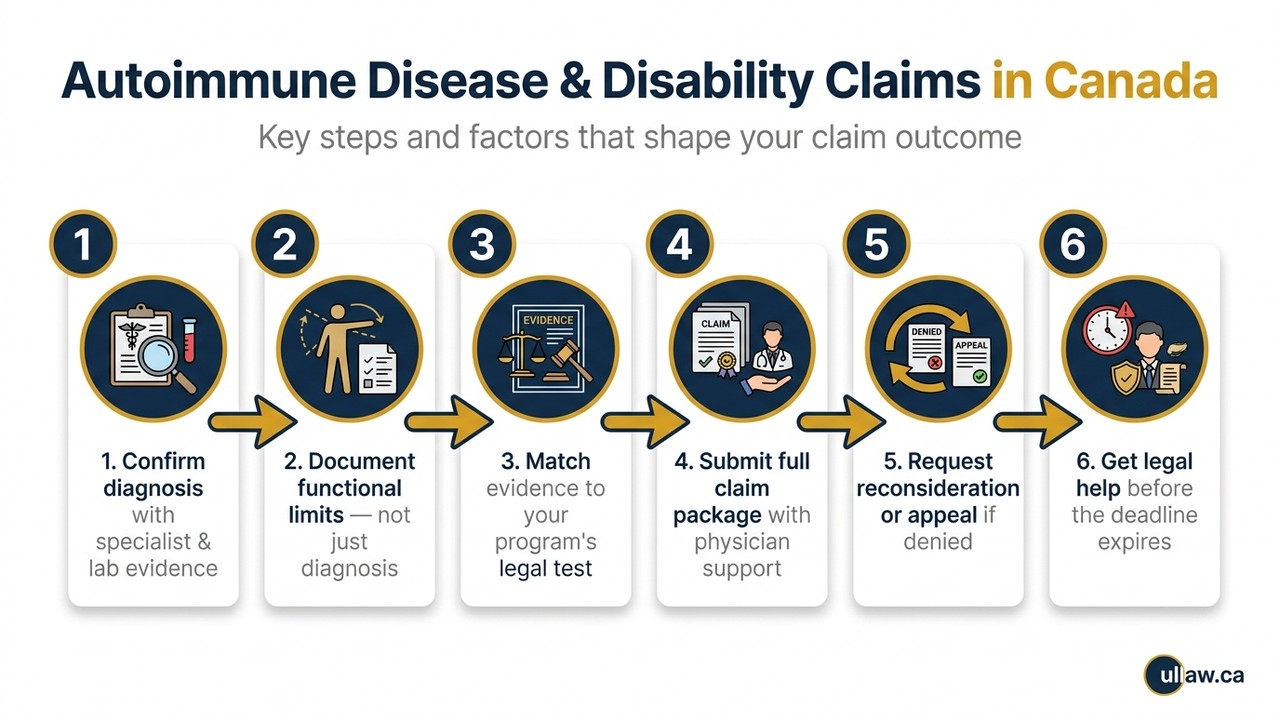
Quick answer: Diagnosis is not enough. Prove function for the program you are in — CPP-D, LTD, or DTC. Denied, delayed, or heading into the 24-month any-occupation switch? Call 905-744-8888 or email info@ullaw.ca. You can also book a free consultation or estimate CPP-D.

Table of Contents
- Are Autoimmune Diseases Considered a Disability in Canada?
- Which Autoimmune Diseases Can Qualify for Disability Benefits?
- How Can Autoimmune Disease Affect Your Ability to Work?
- Can You Get Disability Benefits for Autoimmune Disease in Canada?
- How Do You Prove an Autoimmune Disease Disability Claim?
- Why Do Insurers Deny Autoimmune Disease Disability Claims?
- Is Autoimmune Disease a Permanent Disability?
- Can an Episodic Autoimmune Disease Be a Disability?
- Can Autoimmune Disease Cause Disability Tax Credit Eligibility in Canada?
- Is It Hard to Get Disability for Autoimmune Disease?
Are Autoimmune Diseases Considered a Disability in Canada?
Autoimmune diseases are not automatically classified as disabilities under Canadian law — but they absolutely can be, and frequently are, once the right standard is met.
Canada uses a functional, severity-based definition of disability rather than a diagnosis-based list. What matters is not simply what you have been diagnosed with, but how severely it limits what you can do.
The Three Main Programs — Three Different Tests
1. CPP Disability (CPPD) Administered by the federal government under the Canada Pension Plan, CPP Disability requires that your condition be “severe and prolonged.” Severe means you cannot regularly pursue “any substantially gainful occupation” — not just your usual job, but virtually any work suited to your age, education, and experience. Prolonged means the disability is long-term or likely to result in death.
2. Long-Term Disability (LTD) Insurance Most group or individual LTD policies follow a two-stage definition. For the first 24 months, you typically need to show you cannot perform the essential duties of your own occupation. After that, the definition usually shifts to any occupation — a much harder bar. Autoimmune disease claims often collapse at this transition point.
3. Disability Tax Credit (DTC) The Canada Revenue Agency administers the DTC, which requires a medical practitioner to certify that you have a severe and prolonged impairment in a basic activity of daily living — such as walking, feeding yourself, or mental functions necessary for everyday life.
What This Means for You
An autoimmune disease qualifies as a disability when its functional impact — fatigue, pain, cognitive fog, organ damage, or physical limitation — rises to the threshold of whichever program you are applying to. The diagnosis opens the door; your documented functional limitations push it open.
Which Autoimmune Diseases Can Qualify for Disability Benefits?
There is no official government list of autoimmune diseases that automatically qualify. That said, many conditions are well-recognised in medical literature and by adjudicators. The following are among those most commonly seen in disability claims:
- Rheumatoid Arthritis (RA) — joint destruction, morning stiffness, systemic inflammation
- Systemic Lupus Erythematosus (SLE / Lupus) — multi-organ involvement, photosensitivity, severe fatigue
- Multiple Sclerosis (MS) — progressive neurological damage, mobility and cognitive impairment
- Inflammatory Bowel Disease (Crohn’s disease, ulcerative colitis) — unpredictable flares, malnutrition, pain
- Ankylosing Spondylitis — spinal fusion, chronic pain, limited mobility
- Psoriatic Arthritis — joint and skin involvement, fatigue
- Type 1 Diabetes — hypoglycaemic episodes, neuropathy, cardiovascular complications
- Sjögren’s Syndrome — profound fatigue, nerve pain, organ involvement
- Myositis (Polymyositis, Dermatomyositis) — muscle weakness, swallowing difficulties
- Vasculitis — systemic organ damage, stroke risk
- Autoimmune hepatitis and primary biliary cholangitis — liver damage, fatigue
- Scleroderma (Systemic Sclerosis) — skin hardening, pulmonary and cardiovascular involvement
Rare Autoimmune Conditions Also Count
Rare conditions — such as Neuromyelitis Optica (NMO), Stiff Person Syndrome, or Autoimmune Encephalitis — can also qualify. Rarity does not disqualify a claim; it just means you may need to work harder to educate adjudicators with specialist medical evidence. The law recognises any condition that meets the functional threshold, however unusual the diagnosis.
Do Some Autoimmune Diseases Qualify More Easily?
In practice, conditions with objective, measurable markers — such as positive ANA titres, anti-dsDNA antibodies, MRI lesions, or spirometry results — tend to be easier to prove than those where symptoms are largely subjective. MS, for example, produces visible MRI changes. RA shows up on X-rays and bloodwork. Lupus has established diagnostic criteria involving lab results. Conditions that rely heavily on self-reported pain and fatigue (such as some presentations of Sjögren’s or seronegative arthritis) face more scepticism and require stronger documentation from treating physicians.
How Can Autoimmune Disease Affect Your Ability to Work?
Disability adjudicators look past the diagnosis to the functional consequences. Understanding how autoimmune diseases impair work capacity helps you frame your claim correctly.
Fatigue and Reduced Stamina
Fatigue is one of the most disabling — and most misunderstood — features of autoimmune disease. This is not ordinary tiredness. It is a pathological exhaustion that does not respond to sleep, can be triggered by minimal exertion, and often worsens cognitive function. In conditions like lupus, MS, and RA, fatigue alone can make full-time work impossible even when a person looks well. Documenting fatigue requires consistent entries in clinical notes, fatigue-specific questionnaires (such as the Fatigue Severity Scale), and functional capacity evaluations.
Physical Limitations
- Inability to grip, type, or use a keyboard due to joint inflammation
- Limited standing, sitting, or walking tolerance
- Chronic pain that prevents sustained concentration
- Bladder and bowel urgency (common in MS and IBD) requiring unscheduled breaks
- Swallowing difficulties and nutritional compromise
Cognitive Impairment (“Brain Fog”)
Many autoimmune diseases cause cognitive dysfunction — difficulty with memory, concentration, and word retrieval. This is particularly pronounced in lupus (sometimes called “lupus fog”), MS, and some autoimmune thyroid conditions. Cognitive impairment can disqualify a person from sedentary, desk-based work just as effectively as physical limitations.
Medication Side Effects
Immunosuppressants, corticosteroids, and biologics carry significant side effects — increased infection risk, bone loss, mood disturbances, and fatigue — that themselves restrict what a person can safely do in a workplace. These effects should be documented as part of your claim.
Unpredictability and Flares
Autoimmune diseases often follow a relapsing-remitting pattern. A person may appear functional during a remission but be entirely incapacitated during a flare. This unpredictability is itself a disability — an employer cannot rely on you to attend consistently or maintain a production standard.
Can You Get Disability Benefits for Autoimmune Disease in Canada?
Yes — through several overlapping programs. Here is a practical overview of each.
CPP Disability Benefits
If you have made sufficient contributions to the Canada Pension Plan, you may apply for CPP Disability (CPPD). This federal program pays a monthly taxable benefit calculated on your contribution history. To qualify, your autoimmune disease must be “severe and prolonged” as defined above. You can get a quick sense of your potential benefit using our CPP disability calculator.
Applications are submitted to Service Canada and reviewed by medical adjudicators. The initial denial rate is high — roughly 60% of first applications are refused — but reconsideration and Tribunal appeal options exist.
Long-Term Disability Insurance
If you have group benefits through an employer or an individual policy, you may have LTD coverage. Claims require:
- A completed claim package from you, your employer, and your treating physician
- Consistent medical documentation spanning the entire elimination period (often 90–120 days)
- Evidence of ongoing treatment and compliance
For autoimmune claims, the insurer’s conduct at the 24-month own-occupation to any-occupation transition is a common flashpoint for denials.
Ontario Works / ODSP
For those without CPP contributions or LTD coverage, Ontario Disability Support Program (ODSP) through the Ontario government provides income and health benefits. The disability standard differs from CPPD and is assessed through a separate process.
Disability Tax Credit (DTC)
The DTC is not income — it is a non-refundable tax credit that reduces the taxes you owe, and it can also unlock the Registered Disability Savings Plan (RDSP). A physician, nurse practitioner, or relevant specialist must certify your impairment on Form T2201. Autoimmune disease can qualify if it markedly restricts a basic activity of daily living or requires life-sustaining therapy.
These programs are not mutually exclusive — you may receive CPPD, LTD, and the DTC simultaneously, subject to coordination-of-benefits offsets.
How Do You Prove an Autoimmune Disease Disability Claim?
This is where most claims succeed or fail. Medical diagnosis is only the starting point — functional evidence is everything.
Build a Paper Trail Early
The single biggest mistake claimants make is assuming their doctor’s diagnosis speaks for itself. Adjudicators need to see:
- Consistent, detailed clinical notes that record your symptoms, their frequency, and their impact on daily function at every appointment
- Specialist reports from rheumatologists, neurologists, gastroenterologists, or whichever specialist manages your condition
- Lab work and imaging — bloodwork showing inflammatory markers, ANA panels, MRI findings, spirometry results, or biopsy reports
- Functional Capacity Evaluations (FCEs) conducted by occupational therapists that quantify physical limitations
- Medication records showing the nature, dosage, and duration of treatment (evidence of serious treatment supports a serious condition)
- Symptom and activity journals kept by you, describing good days vs. bad days, the impact of flares, and what you are no longer able to do
Your Attending Physician’s Role
Your family doctor or specialist must be a partner in your claim, not just a signature. Ask them to complete forms thoroughly, use functional language (“patient cannot sit for more than 20 minutes,” not “patient has lupus”), and write narrative letters if needed. A form that says only “diagnosis confirmed” without functional detail is frequently the reason a claim is denied.
Neuropsychological Testing for Cognitive Claims
If brain fog or cognitive impairment is part of your disability, a formal neuropsychological assessment provides objective, hard-to-dispute evidence. This is especially important for MS and lupus claims.
Watch the Timeline
For CPPD, your minimum qualifying period (MQP) — the last date you met the contribution requirements — is critical. Evidence of disability must connect to a period when you were still insured. Getting legal advice early helps you avoid missing this window. Visit our CPP Disability practice page to understand how we help clients document and present their claims.
Why Do Insurers Deny Autoimmune Disease Disability Claims?
Understanding an insurer’s denial tactics puts you in a stronger position to fight back.
“Insufficient Medical Evidence”
This is the most common reason. The insurer argues the file does not establish that you cannot work, only that you have a diagnosis. This is usually a documentation problem, not a medical reality — and it can often be addressed by supplementing the file.
Surveillance and Social Media
Insurers routinely conduct surveillance — video or social media monitoring — looking for images or footage of you performing activities inconsistent with your claimed limitations. A photo of you at a birthday dinner, or a walk in the park on a good day, may be used to argue you are not disabled. Be cautious about what you post online.
Independent Medical Examinations (IMEs)
Insurers may send you to a physician of their choosing for an Independent Medical Examination (IME). These examiners are paid by the insurer and their reports frequently minimise the severity of autoimmune symptoms — particularly fatigue and pain, which cannot be measured on an instrument. You are generally required to attend, but you are entitled to:
- Know the purpose of the examination
- Request a copy of the IME report
- Have your own physician respond to the report in writing
The Episodic Nature of Your Disease
Insurers sometimes point to periods of remission as evidence that you are not truly disabled. An episodic condition can absolutely support a disability claim — the unpredictability of flares, the need to avoid triggers, and the inability to commit to a reliable work schedule are all legitimate functional limitations. Your claim should anticipate this argument and address it head-on.
Pre-Existing Condition Clauses
Some LTD policies contain exclusion clauses for conditions that existed before the policy commenced. If your autoimmune disease was diagnosed before you joined the plan, the insurer may try to rely on this clause. Whether it applies depends on the precise wording of your policy and whether your condition was “active” within the exclusion window.
If you have received a denial, our page on long-term disability denials walks through your next steps in detail.

Is Autoimmune Disease a Permanent Disability?
Some autoimmune diseases cause progressive, irreversible organ or tissue damage — making the disability permanent over time. Others follow a relapsing-remitting course where function can fluctuate significantly.
For CPP Disability, the requirement is that the condition be “prolonged” — meaning of indefinite duration or likely to be long-term. A condition does not need to be permanent in the sense of unchangeable; it needs to be unlikely to improve to the point where work becomes possible within a foreseeable period.
For LTD, policies typically require periodic reassessment. Even where your underlying disease is permanent, the insurer may still conduct file reviews, request updated medical documentation, and periodically send you to IMEs.
Practically speaking, conditions like MS (progressive forms), severe RA with joint destruction, or SLE with major organ involvement often do result in permanent disability findings. Milder or well-controlled autoimmune conditions may not — treatment success is relevant, and adjudicators consider whether medications have stabilised function to a point where some work is possible.
If your condition has worsened since a previous denial, a new application or appeal can succeed on updated medical evidence even if an earlier claim was refused.
Can an Episodic Autoimmune Disease Be a Disability?
Yes — and this is an area where many claimants are wrongly denied.
Episodic disability refers to conditions that fluctuate between periods of relative wellness and periods of significant impairment. Crohn’s disease, lupus, and MS are textbook examples. During a flare, a person may be completely unable to work. During remission, they may appear — and feel — almost normal.
Why Episodic Claims Get Denied (Wrongly)
Adjudicators sometimes assess a claimant only at a “good” moment and conclude the disability threshold is not met. This is incorrect in law. The proper analysis looks at the overall pattern of the condition — including frequency, severity, and duration of flares, and the unpredictability that prevents reliable attendance and performance.
How to Document an Episodic Condition
- Flare diaries: Record the date, duration, symptoms, and functional impact of every significant flare
- Emergency room and hospital records: These are powerful objective evidence of severe episodic episodes
- Physician letters that specifically address the episodic pattern and its impact on work reliability
- Evidence of missed work: Pay stubs, employer letters, or attendance records from before you stopped working
The Ontario e-Laws database and human rights frameworks in Ontario explicitly recognise episodic disability as a protected ground — a point that can be relevant if your employer or insurer refuses to accommodate your condition.
Can Autoimmune Disease Cause Disability Tax Credit Eligibility in Canada?
Yes. The Disability Tax Credit (DTC) is available to Canadians with a severe and prolonged impairment in one or more basic activities of daily living (ADLs), or who require life-sustaining therapy.
Relevant ADLs for Autoimmune Disease
- Walking — severely restricted by RA, AS, or MS-related weakness
- Dressing — limited by joint stiffness or contractures
- Feeding — affected by severe fatigue or swallowing difficulties (dysphagia)
- Mental functions for everyday life — cognitive impairment from MS, lupus, or autoimmune encephalitis
- Eliminating (bowel and bladder) — IBD and MS frequently cause this impairment
Life-Sustaining Therapy
Some autoimmune patients — for example, those receiving regular intravenous immunoglobulin (IVIG) therapy or dialysis due to autoimmune kidney disease — may qualify under the life-sustaining therapy criterion if the treatment requires at least 14 hours per week.
What the DTC Unlocks
Approving the DTC opens access to:
- The Registered Disability Savings Plan (RDSP), which provides substantial federal matching grants and bonds
- The Child Disability Benefit (if the claimant is a child)
- Other caregiver and supplement credits
The application is made on Form T2201, available through the Canada Revenue Agency. Approval is not guaranteed, and applications are sometimes denied on the basis that the impairment is not severe enough. Those denials can be objected to and appealed.
Is It Hard to Get the DTC for Autoimmune Disease?
The CRA’s review process can be exacting. Vague or incomplete T2201 forms are a primary cause of rejection. A physician who describes your condition in diagnostic rather than functional terms — “patient has lupus” versus “patient is unable to walk one city block without stopping due to joint pain and fatigue” — is less likely to secure approval. If your DTC application has been denied, it is worth revisiting the form with your physician.
Is It Hard to Get Disability for Autoimmune Disease?
Honestly — it can be. But “hard” does not mean impossible, and understanding why it is difficult helps you overcome those obstacles.
The Challenges
- Invisible symptoms: Fatigue, pain, and brain fog are real but not visible on an X-ray. Adjudicators and insurers are more comfortable with objective, measurable impairment.
- Fluctuating severity: Good days can be used against you, even though they do not define your overall capacity.
- Complexity of the disease: Autoimmune conditions are managed by multiple specialists, creating fragmented medical records that tell an incomplete story unless someone pulls them together.
- High initial denial rates: CPPD denies roughly 60% of first applications. LTD insurers have financial incentives to deny.
What Makes Claims Succeed
- Early, thorough documentation of functional limitations — not just diagnosis
- A treating physician who understands how to complete disability forms in functional, concrete terms
- Specialist support from rheumatologists, neurologists, or other relevant experts
- A consistent treatment history showing you are doing everything possible to manage your condition
- Legal representation, particularly at the appeal stage
For CPPD specifically, working with an experienced CPP Disability lawyer can significantly improve your odds at the Social Security Tribunal’s General Division and Appeal Division.
Talk to a UL Lawyers Team Member
If you are living with an autoimmune disease and struggling to access CPP Disability, long-term disability, or the Disability Tax Credit, call 905-744-8888 or email info@ullaw.ca. UL Lawyers offers a free consultation to review the denial, the medical file, and the next deadline. You can also book online or start with the CPP disability calculator.
Burlington and Halton claimants can also review the local Burlington long-term disability lawyer and Burlington CPP disability lawyer pages before choosing the right benefits path.