A car accident can upend your life in seconds — and then the insurance company makes you wait months, sometimes years, before offering you a settlement. When that offer finally arrives, most people have no idea whether it reflects what their pain and suffering is actually worth. That uncertainty is by design.
In Ontario, pain and suffering — formally called general damages or non-pecuniary damages — compensates you for the physical pain, emotional distress, loss of enjoyment of life, and disruption to your relationships caused by someone else’s negligence. It is separate from your lost income, medical bills, and other out-of-pocket costs. Understanding how these damages are valued, and what moves the number up or down, is the single most important thing you can do before accepting any offer.
This guide walks you through realistic settlement ranges, Ontario’s legal framework, the factors that insurers and courts weigh most heavily, and the warning signs of a lowball offer. If you want a starting point specific to your situation, try our personal injury settlement calculator — and read on to understand the reasoning behind the numbers.
Table of Contents
- How Much Is the Average Settlement for Pain and Suffering in Ontario?
- How Much Can You Sue for Pain and Suffering in Ontario?
- How Much Compensation Can You Get for a Car Accident Overall?
- What Factors Increase the Value of a Car Accident Claim?
- What Is a Reasonable Amount to Ask for in Pain and Suffering?
- What Are Signs of a Good (or Bad) Settlement Offer?
- Key Takeaways: What to Do After a Motor Vehicle Accident in Ontario
How Much Is the Average Settlement for Pain and Suffering in Ontario?
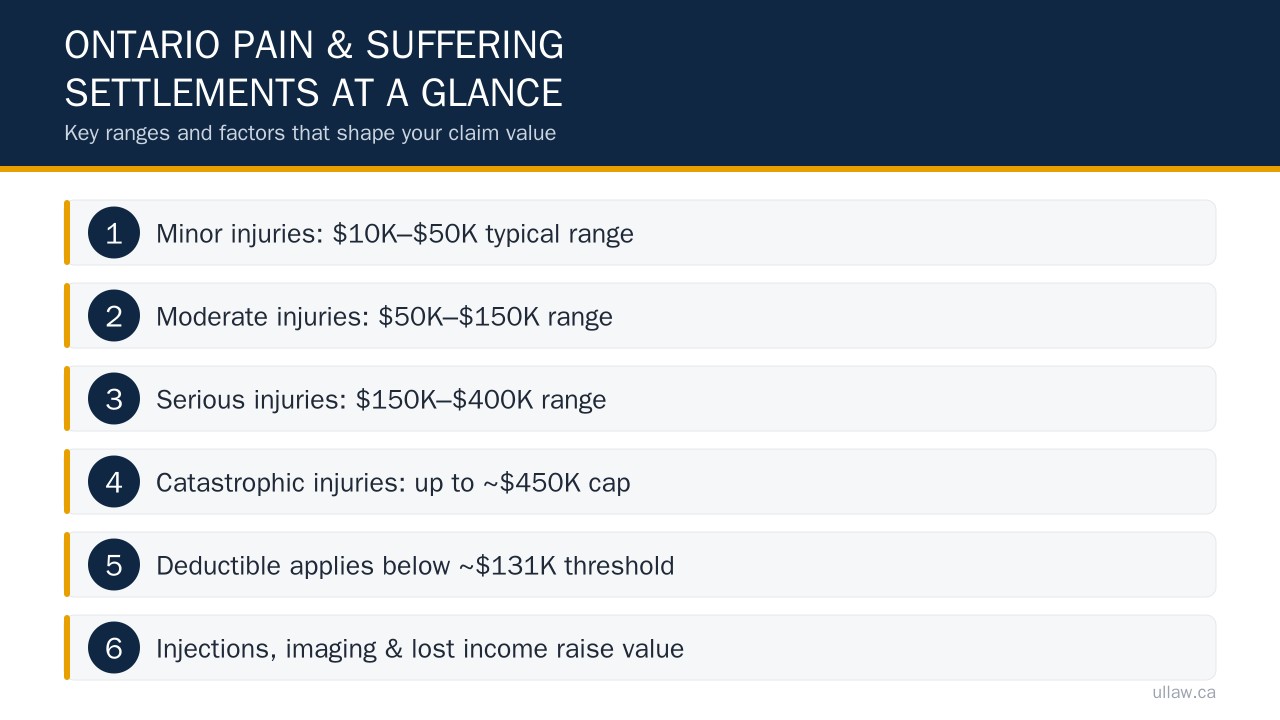
There is no single “average” — Ontario settlements vary enormously based on injury severity, recovery time, and individual impact. That said, experienced personal injury lawyers generally observe the following rough ranges:
| Injury Category | Typical General Damages Range |
|---|---|
| Minor soft-tissue (sprains, whiplash resolving within months) | $10,000 – $50,000 |
| Moderate injuries (disc herniations, fractures, longer recovery) | $50,000 – $150,000 |
| Serious injuries (chronic pain, psychological disorders, surgery required) | $150,000 – $400,000 |
| Catastrophic injuries (brain injury, spinal cord injury, amputation) | $400,000 – $450,000+ |
Why the Wide Range?
Ontario courts look at a long line of comparable jury awards and settlements when valuing pain and suffering. They also apply a statutory deductible to claims that fall below a threshold — more on that in the next section. Even two people with the same diagnosis can receive very different amounts depending on how their injuries affect their specific work, hobbies, and family life.
Settlements reached before trial also tend to reflect a discount for the risk and delay of litigation — meaning a negotiated settlement may sit below what a court could award, but arrives sooner and with certainty.
What About Minor Injury Claims?
Under Ontario’s automobile insurance system (governed by the Insurance Act), injuries classified as Minor Injury Guideline (MIG) injuries — such as sprains, strains, and whiplash-associated disorder Grade I or II without complications — are subject to treatment caps under Statutory Accident Benefits (SABS). This classification can significantly limit early benefit payments, but it does not cap what you can claim in a tort lawsuit against the at-fault driver for general damages.
How Much Can You Sue for Pain and Suffering in Ontario?
Ontario has two important legal limits on pain and suffering claims in car accident lawsuits that every claimant must understand.
The Statutory Deductible
Under the Insurance Act and its regulations, a deductible is subtracted from general damages awards in motor vehicle accident lawsuits where the total award falls below a set threshold. The deductible and threshold amounts are indexed annually. As of recent years, if a court awards you less than approximately $131,854 in general damages (the threshold, subject to annual adjustment), a deductible of approximately $41,503 is applied — effectively reducing your take-home amount. If your award exceeds the threshold, no deductible applies.
This is one of the most misunderstood aspects of Ontario personal injury law. An insurer may offer you $60,000, knowing the deductible will apply — that sounds generous until you realize a court award at the same level would net you significantly less after the deductible. A lawyer can help you assess whether an offer truly accounts for this.
The Constitutional Cap on Non-Pecuniary Damages
Canada’s Supreme Court established a cap on general damages for pain and suffering in personal injury cases. That cap is indexed to inflation and currently sits at approximately $450,000 for the most catastrophic cases — severe brain injuries, complete paralysis, and similar life-altering conditions. The vast majority of claims fall well below this ceiling.
Threshold to Sue for Pain and Suffering
In Ontario, to succeed in a pain and suffering claim against an at-fault driver, your injuries must meet a legal threshold: they must be permanent and serious, causing a substantial interference with your ability to perform the essential tasks of your regular employment or daily life, or a permanent serious disfigurement. This threshold is often disputed by insurers and is one of the key battlegrounds in motor vehicle accident litigation. Learn more about how our team navigates these disputes on our motor vehicle accident practice page.
How Much Compensation Can You Get for a Car Accident Overall?
Pain and suffering is only one piece of your total compensation. A complete motor vehicle accident claim in Ontario can include:
- General damages — pain and suffering (as described above)
- Special damages — out-of-pocket expenses: medical and rehabilitation costs not covered by SABS, prescription costs, home care, adaptive equipment
- Income replacement — lost wages past and future, including reduced earning capacity if your career is permanently affected
- Family law act claims — compensation for family members who have lost the care, guidance, and companionship you provided
- Statutory Accident Benefits (SABS) — a parallel no-fault system providing income replacement, medical/rehab benefits, and attendant care regardless of fault, governed by Ontario’s SABS regulation
- Punitive or aggravated damages — rare, but available in cases of truly egregious conduct
Serious accident cases regularly involve total compensation packages well into the millions when future care costs and lifetime income loss are calculated. Pain and suffering, while significant, is often not even the largest component of such a claim.
What Factors Increase the Value of a Car Accident Claim?
Insurers — and courts — weigh specific factors when valuing a pain and suffering claim. Understanding these helps you protect your claim from the very first day after the accident.
Severity and Nature of Injuries
Fractures, herniated discs, traumatic brain injuries, chronic pain conditions, and psychological disorders such as PTSD consistently attract higher valuations than soft-tissue injuries that resolve quickly. Objective medical evidence — imaging, specialist reports, neuropsychological testing — is crucial.
Medical Treatment and Recovery Timeline
A claim supported by consistent, documented treatment (physiotherapy, specialist visits, surgeries, psychological counselling) is harder to dismiss than one where treatment was sporadic. Gaps in treatment are routinely used by defence counsel to argue your injuries were not as serious as claimed.
Do Injections Increase Your Settlement?
Yes — injections such as nerve blocks, epidural steroid injections, and facet joint injections can meaningfully increase a settlement. They serve as objective evidence that your pain is real, serious, and resistant to conservative treatment. They also signal to a jury or adjuster that ongoing care is necessary. Document every procedure carefully with your treatment team.
Lost Income and Earning Capacity
If your injuries keep you off work — temporarily or permanently — lost income multiplies total compensation significantly. A younger claimant with decades of earning years ahead, or a high-income professional, will generally see larger income loss components.
Long-Term and Permanent Impairment
Permanent restrictions on mobility, cognition, or daily function dramatically increase general damages. Catastrophic impairment designation under SABS unlocks significantly higher benefit limits and also supports a higher threshold tort claim.
Liability and Insurance Coverage
Your ability to collect depends partly on the at-fault driver’s insurance policy limits and any underinsured/uninsured motorist coverage available under your own policy. Ontario’s Insurance Act requires minimum third-party liability coverage, but limits vary. If multiple parties share fault, damages may be apportioned accordingly.

What Is a Reasonable Amount to Ask for in Pain and Suffering?
There is no universal formula, but a reasonable starting demand is typically grounded in:
- Comparable jury awards — Ontario lawyers research precedent cases with similar injuries, age, and lifestyle impact.
- The deductible threshold — Demands are often structured to push the general damages claim above the threshold so no deductible applies.
- The full picture of your losses — Your lawyer will add special damages, income loss, and future care costs to arrive at a total claim value before negotiating the general damages component.
- Your specific life impact — Courts and adjusters are moved by concrete, personal evidence: the marathon you can no longer run, the grandchildren you can no longer lift, the career you were forced to abandon.
A demand that is too low signals weakness and anchors negotiations against you. A demand supported by evidence and legal precedent gives you real leverage. Use our personal injury settlement calculator as a starting reference — then speak with a lawyer before putting any number in writing.
What Are Signs of a Good (or Bad) Settlement Offer?
Recognizing a fair offer — and spotting a lowball — is harder than it sounds when you’re in pain and facing financial pressure.
Signs an Offer May Be Too Low
- The insurer contacts you within days or weeks of the accident, before your injuries have fully declared themselves
- The offer arrives before you have finished treatment or received a prognosis
- The amount does not account for the statutory deductible (i.e., it is not high enough to clear the threshold)
- Future treatment costs and lost earning capacity are absent from the calculation
- You are pressured to accept quickly or told the offer will be withdrawn
Signs an Offer Is Worth Seriously Considering
- You have completed (or nearly completed) treatment and your prognosis is clear
- The offer reflects the deductible threshold dynamics and comparable case values
- Your lawyer has independently assessed it against precedent and confirms it falls within a reasonable range
- Future care needs and income loss are addressed
- You have had independent legal advice, not just the insurer’s reassurance
Never accept a settlement without independent legal advice. Once you sign a release, you typically cannot re-open your claim — even if your condition worsens.
Key Takeaways: What to Do After a Motor Vehicle Accident in Ontario
Protecting the value of your claim starts the day of the accident. Here is a practical checklist:
- Report the accident to police (if injuries or significant damage) and your insurer promptly — deadlines under the Insurance Act are strict
- Seek medical attention immediately and follow through with all recommended treatment
- Document everything: photographs, a pain journal, all medical records and receipts, lost wage documentation
- Do not give a recorded statement to the at-fault driver’s insurer without legal advice
- Apply for Statutory Accident Benefits (SABS) within 30 days of the accident — these no-fault benefits run parallel to your tort claim
- Consult a personal injury lawyer early — limitation periods in Ontario are generally two years from the date of the accident, but notice requirements can arise sooner
- Avoid social media — posts and photos are routinely used to dispute the severity of injuries
For a detailed look at how our team handles these cases from first call to resolution, visit our motor vehicle accident practice page.
Talk to a UL Lawyers Team Member
Every car accident claim is different, and the numbers in this guide are ranges — not promises. The best way to understand what your specific situation may be worth is to speak with an experienced Ontario personal injury lawyer. UL Lawyers offers free, no-obligation consultations — contingency fee options may be available. Contact our team today to get a clear, honest assessment of your claim.