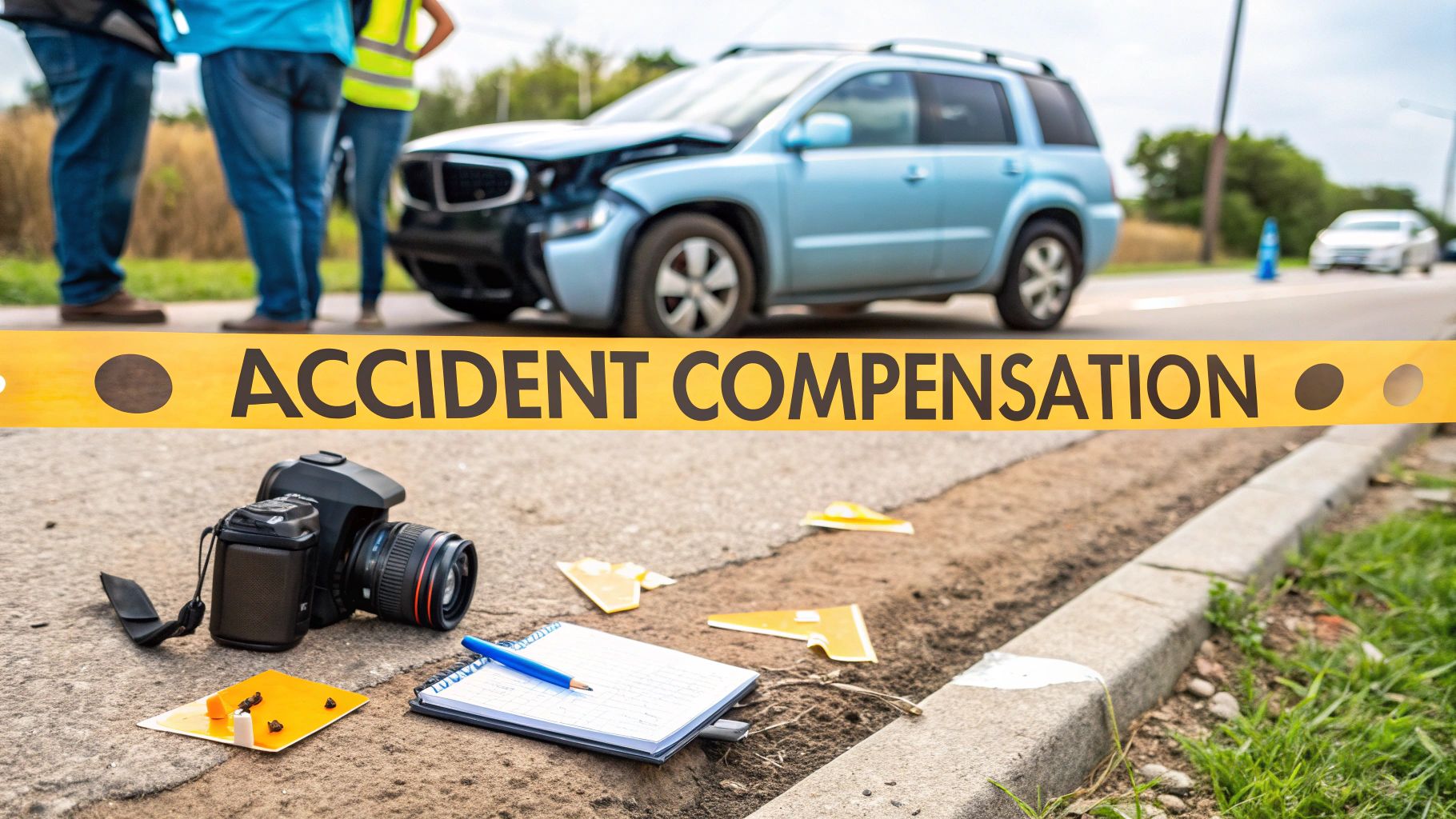
In the chaotic moments right after a car accident, what you do next can make a huge difference—not just for your health, but for your ability to get fair compensation. It’s a disorienting experience, but the steps you take at the scene lay the foundation for a strong claim. This is about more than just swapping insurance slips; it’s about methodically gathering the facts that protect your rights down the road.
What to Do Immediately After a Collision
The minutes following a crash can leave anyone shaken and confused. But whether you’re on a quiet street in Burlington or a busy highway in Scarborough, your actions at the scene are the first, most critical step in protecting yourself physically and legally.

Safety Is Always Priority Number One
Before anything else, check on yourself and your passengers. Are you okay? Is anyone hurt? If there are any injuries, no matter how minor they seem, call 911 right away. It’s best not to move anyone who is injured unless they’re in immediate danger, like from a fire or oncoming traffic.
If your vehicles are still drivable and it’s safe, pull over to the shoulder. This is especially important on major routes like the QEW or the 401, where a stopped car can quickly cause another accident. Flip on your hazard lights to make sure other drivers can see you clearly.
Reporting the Accident to the Police
In Ontario, the law says you must report a collision to the police if:
- Anyone is injured.
- The combined damage to all vehicles looks like it’s over $2,000.
- You think another driver might be impaired by drugs or alcohol.
Honestly, even if the damage seems small, calling the police is almost always a good move. An official police report is an unbiased, third-party account of what happened. When it’s your word against someone else’s, that report can be the deciding factor for your claim.
To help you remember these critical steps in a high-stress situation, here’s a quick checklist of what to do at the scene.
On-Scene Accident Checklist for Ontario Drivers
| Action Item | Why It’s Important for Your Compensation Claim |
|---|---|
| Check for Injuries & Call 911 | Establishes an official record of any injuries from the outset, which is vital for medical claims. |
| Move Vehicles to Safety (If Possible) | Prevents further liability and shows you took responsible steps to secure the scene. |
| Report to Police (When Required) | The police report is a key piece of evidence that insurers and lawyers use to determine fault. |
| Exchange Information | You can’t start a claim without the other driver’s insurance details, name, and contact info. |
| Document with Photos & Videos | Visual evidence of damage, road conditions, and vehicle positions is hard to dispute. |
| Identify & Talk to Witnesses | Independent witness statements can powerfully support your version of events. |
| Do Not Admit Fault | Admitting fault at the scene can be used against you, even if you later find out you weren’t to blame. |
Following this checklist ensures you don’t miss any details that could strengthen your case later on.
Gather Your Own Evidence
This is where you need to shift gears and become your own investigator. The information you collect right here, right now, will be the backbone of your claim. Your smartphone is your best tool.
Start by getting all the essential details from the other driver(s). Don’t just get a name and number. You need to be thorough. Make sure you have their:
- Full name, address, and phone number
- Driver’s licence number
- Insurance company and policy number
- Licence plate and vehicle info (make, model, colour)
Next, look around for anyone who saw what happened. Witnesses can be incredibly helpful. Politely ask for their names and phone numbers. Their objective account can break a stalemate if the other driver changes their story later. For a complete rundown, you can learn more about what to do after a motor vehicle accident in Ontario in our comprehensive article.
Your Camera Is Your Best Friend
They say a picture is worth a thousand words, and in an accident claim, it can be worth thousands of dollars. Use your phone to document everything.
- The Big Picture: Get wide shots of the entire scene from different angles. Show where the cars ended up.
- The Damage: Take close-ups of the damage on all cars involved, not just yours.
- The Scene: Photograph skid marks, debris, traffic signs, and even the weather conditions. Was it raining? Was the sun in your eyes? These details matter.
This visual proof helps reconstruct the accident and shuts down attempts to dispute who was at fault. It gives your claim a solid, factual footing from day one.
Understanding Ontario’s “No-Fault” Accident Benefits
The term “no-fault” insurance in Ontario throws a lot of people for a loop. It’s a common misconception, and frankly, a bit of a misnomer. It doesn’t mean that no one is at fault for the accident. What it really means is that your own insurance company is your first stop for immediate help, no matter who caused the crash.
This system is designed to get you support right away.

This initial support flows through something called the Statutory Accident Benefits Schedule (SABS). I always tell my clients to think of SABS as the first layer of protection—benefits you’ve already paid for with your premiums, specifically there to provide fast medical and financial assistance when you need it most.
What You’re Entitled to Under SABS
After a collision, SABS acts as a critical safety net. These benefits are available to anyone hurt in a motor vehicle accident, whether you were a driver, passenger, cyclist, or even a pedestrian. The whole point is to help you cope with the immediate fallout without having to wait for a long, drawn-out process to determine who was to blame.
Here’s a breakdown of the key benefits you can access:
- Medical and Rehabilitation Benefits: This is a big one. It covers necessary medical costs that OHIP doesn’t, like physiotherapy, chiropractic treatments, massage therapy, prescriptions, and crucial psychological counselling.
- Income Replacement Benefits (IRBs): If you can’t work because of your injuries, you could be eligible for up to 70% of your gross income. The standard policy caps this at $400 per week, but it’s worth noting you can purchase optional coverage to raise this limit.
- Attendant Care Benefits: When injuries are severe, you might need help with daily personal care—things like dressing, bathing, or just getting around. This benefit helps cover the cost of an aide or personal support worker.
- Caregiver Benefits: Were you the main caregiver for a child or an elderly parent? If you can’t perform those duties anymore due to your injuries, this benefit helps pay for someone to step in and take over.
- Other Expenses: SABS can also cover a surprising range of other costs. Think housekeeping assistance if you can’t manage chores, taxi fares to and from medical appointments, or even lost tuition fees if you were a student.
Getting these benefits is your right, but you have to act fast. You must inform your insurance company about the accident and your plan to claim benefits within the strict deadlines outlined in your policy. For a deeper dive into the legal specifics, our guide to Ontario’s car accident law is a great resource.
How SABS Works in the Real World
Let’s put this into a practical scenario. Imagine a commuter from Burlington is driving on the QEW during the morning rush. They get rear-ended, leaving them with a bad neck injury and a concussion.
Through the SABS framework, their own insurance company would immediately start covering the costs of physiotherapy and prescription drugs. Since the concussion makes their office job impossible for now, they would begin receiving weekly Income Replacement Benefits. And because the neck injury makes it tough to get dressed or cook, they could also qualify for Attendant Care Benefits to bring in a support worker for a few hours each day.
This support system ensures our injured commuter can focus on getting better without facing an immediate financial crisis. That’s the entire purpose of Ontario’s no-fault system in a nutshell.
While Ontario’s “no-fault” system offers a crucial first layer of support through Statutory Accident Benefits (SABS), there are times when these benefits just don’t cut it. SABS has hard limits that often fall short of covering the true cost of a life-altering injury.
When the accident’s impact on your life—your health, your career, your family—goes far beyond what SABS can provide, you might need to file a tort claim. This is essentially a lawsuit against the person who caused the accident. It’s the only way to get compensation for things your own insurer won’t cover, like your pain and suffering or significant long-term income loss.
This is about holding the at-fault driver accountable for the full extent of the harm they’ve caused.

Figuring out the total financial and personal toll of an accident is a complicated but essential step toward securing the fair compensation available under the law.
Navigating the claims process means understanding the two main avenues for compensation available to you. Let’s break down the key differences between no-fault accident benefits and a tort claim.
Accident Benefits (SABS) vs. Tort Claim Compensation in Ontario
| Compensation Type | Source of Funds | What It Covers | Eligibility Requirement |
|---|---|---|---|
| Accident Benefits (SABS) | Your own auto insurance company. | Immediate medical care, rehabilitation, attendant care, and a portion of lost income (up to a set maximum). | You are eligible regardless of who was at fault for the accident. |
| Tort Claim | The at-fault driver’s insurance company. | Pain and suffering, full past and future income loss, future care costs, and other out-of-pocket expenses not covered by SABS. | You must prove another party was at fault and your injuries meet a specific legal threshold. |
In short, SABS provides immediate, no-fault support for basic needs, while a tort claim is necessary to pursue full compensation for long-term and non-economic losses from the person responsible.
Meeting the Legal Threshold in Ontario
You can’t sue for every little fender-bender in Ontario. The law sets a clear standard to keep minor claims out of the courts. To move forward with a tort claim for pain and suffering, your injuries have to meet a legal “threshold” as defined in the Insurance Act.
This means your injuries must result in a:
- Serious and permanent disfigurement (like significant, visible scarring).
- Serious and permanent impairment of an important physical, mental, or psychological function.
Proving you meet this threshold is no simple task. It requires a mountain of evidence—detailed medical records, reports from specialists, and a clear story showing how the injury has fundamentally derailed your life. An injury is considered “permanent” when medical experts agree it’s not going to get substantially better. An impairment is “serious” when it dramatically interferes with your ability to work, take care of your family, or simply enjoy your daily life.
Damages You Can Claim in a Lawsuit
A tort claim opens the door to compensation for losses that SABS either doesn’t touch or doesn’t fully cover. The goal is to restore you, as much as money can, to the life you had before the crash.
The main types of damages you can pursue include:
- Pain and Suffering: This is for the physical pain, emotional trauma, and loss of enjoyment of life you’ve been forced to endure.
- Future Care Costs: This covers all the projected medical and rehabilitation needs that SABS won’t pay for, like long-term physiotherapy, specialized equipment, or modifications to your home.
- Loss of Income: You can claim for both past and future lost income that goes above the standard SABS limit of $400/week. This is critical if you were a high-earner or if the accident has ended your career.
- Family Member Claims: Under Ontario’s Family Law Act, your spouse, children, or parents can also file their own claims for the loss of care, guidance, and companionship they’ve suffered because of your injuries.
It’s critical to know that Ontario has a significant deductible for pain and suffering awards. For 2024, that deductible is over $40,000. This amount gets subtracted from your award unless the damages are exceptionally high.
While every case is unique, Ontario courts have established precedents for valuing these claims. For example, settlements for moderate soft tissue injuries may fall into one range, while claims involving catastrophic impairments like brain injuries or paralysis can result in multi-million dollar awards, reflecting the profound difference in the impact on a person’s life.
Strict Deadlines You Cannot Miss
In Ontario, the clock starts ticking the moment the accident happens. The law gives you a very limited time to act, and these rules are governed by the Limitations Act.
First, you must give written notice of your intent to sue the at-fault party within 120 days of the accident. Even more importantly, you have to formally file your lawsuit with the court within two years of the collision date.
If you miss that two-year deadline, your right to sue is almost certainly gone forever. These deadlines are incredibly strict. That’s why it’s so vital to get clear advice on your rights and obligations right away. To learn more about the first things you should do, read our guide on what to do after a car accident to make sure you’re on solid ground from the start.
Building a Rock-Solid Evidence File
When you’re dealing with a motor vehicle accident claim, arguments and explanations only get you so far. The real strength of your case comes down to the proof you can provide. It’s built on a foundation of solid, undeniable evidence.
Think of it less as just grabbing a few photos at the scene and more as methodically telling the complete story of how this accident has impacted every corner of your life. Every single document, receipt, and note you keep adds another layer to that story, creating a powerful narrative that an insurance adjuster—or a court—can’t simply brush aside.
Your Medical Journey: The Paper Trail is Everything
Your medical records are the absolute cornerstone of your injury claim. It’s not enough to tell an adjuster you were hurt; you have to show them, in black and white, the full extent of your injuries, the treatment you’ve needed, and what this means for your future. Being meticulous here isn’t optional.
Get a folder—a physical one or a digital one, whatever works for you—and start collecting everything.
- Medical Reports: Get copies of every report from your family doctor, any specialists, and the hospital.
- Treatment Records: This includes the detailed notes from every single physiotherapy, chiropractic, or massage therapy appointment.
- Prescription Receipts: Don’t throw out a single pharmacy receipt for medications prescribed for your accident injuries.
- Imaging: Keep track of all X-rays, MRIs, or CT scans you’ve had.
This collection does more than just list your injuries. It creates a clear timeline of your recovery, proving you’ve been diligent in following medical advice. That’s a huge factor in demonstrating just how serious your condition is.
Tracking the Financial Bleed: Every Dollar Counts
The financial fallout from an accident goes way beyond just fixing your car. To get properly compensated, you need to track every single expense, no matter how small it might seem. These out-of-pocket costs can add up surprisingly fast.
Your financial file should have proof of:
- Lost Wages: This means your pay stubs from before the accident to show your income, plus records of every day you missed from work. If you’re self-employed, invoices and bank statements will do the trick.
- Travel Costs: Keep a simple log of your mileage for every trip to a doctor, pharmacy, or therapy session. Hold onto receipts for parking and public transit, too.
- Medical Aids: Did you need to buy crutches, a brace, or even a special pillow for sleeping? Keep the receipts.
- Hired Help: If your injuries meant you had to hire someone for lawn care, snow removal, or house cleaning, get invoices for those services.
My rule of thumb is this: if you had to spend a dollar because of the accident, that dollar needs to be documented. This detailed record is what gets you that money back.
The Power of a Personal Injury Journal
Some of the biggest losses in a claim—your pain, your suffering, your frustration—are the hardest things to prove. They don’t come with a neat little receipt. This is where keeping a personal injury journal becomes one of the most powerful things you can do for your case.
A journal turns your personal experience of pain and struggle into tangible evidence. It provides a day-to-day account that gives real weight to a claim for non-economic damages, like pain and suffering, that are otherwise difficult to quantify.
You don’t need to write a novel. Just take a few minutes each day with a simple notebook or a document on your computer. Make a note of:
- Pain Levels: Rate your pain on a scale of 1-10. Where did it hurt? What did it feel like?
- Daily Challenges: What was hard to do today? Did you struggle with getting dressed, cooking a meal, or carrying groceries?
- Your Emotional State: Write down if you’re feeling anxious, frustrated, or depressed. Are you having trouble sleeping?
- What You Missed Out On: Note any social events, hobbies, or family activities you had to skip because you weren’t up to it.
For instance, an entry might look like this: “October 26: Back was a solid 8/10 today. I couldn’t sit at my desk for more than 20 minutes at a time. Had to miss my daughter’s soccer game and felt awful about it.”
When you read these entries back over weeks and months, they paint a vivid, compelling picture of your reality. It’s a picture that’s far more impactful than just saying “my back hurts.”
Knowing When to Hire a Personal Injury Lawyer
After a car accident, you’re overwhelmed. It’s tempting to think you can handle the insurance claim yourself to keep things simple. But going it alone against a large insurance company is a path filled with potential pitfalls, especially when you’re dealing with serious injuries.
Knowing the right moment to bring in a legal professional isn’t just a strategic move—it’s often the most critical step you can take to protect your rights and your future.
Trying to manage a complex claim while you’re recovering puts you at a massive disadvantage. Insurance adjusters are professionals trained to settle claims for the lowest possible amount. They do this every single day. For you, this is likely a first-time experience, and you’re navigating it while in pain and under stress.
Red Flags That Signal You Need Legal Help
There are certain situations that should be immediate red flags, telling you it’s time to pick up the phone and call a lawyer. These aren’t minor issues; they are clear signs that the insurance company might not have your best interests at heart.
Recognizing these signals early on can save you from making a costly, irreversible mistake.
- Your Injuries Are Serious or Permanent: If you’ve suffered broken bones, a brain injury, spinal cord damage, or any injury that will have a lasting impact on your life, the stakes are simply too high. A lawyer is needed to accurately calculate your future care costs and lifetime income loss, which is an incredibly complex task.
- The Insurance Company Disputes Liability: Is the other driver’s insurer blaming you for the crash? Or even suggesting you were partially at fault? This is a direct challenge that requires a strong response. A lawyer is essential to gather the right evidence and build a solid case establishing who was truly responsible.
- Your Benefits Are Denied or Cut Off: When an insurer suddenly denies your claim for income replacement or terminates your medical and rehabilitation benefits, it’s a major problem. They are essentially questioning the severity of your injuries, and you need a professional advocate to fight back.
The Lowball Settlement Offer
One of the most common tactics we see is the quick, lowball settlement offer. An adjuster might call you just days after the accident, sounding sympathetic and offering a few thousand dollars to “settle things quickly and get you some cash.” While tempting, this is almost always a trap.
A fast settlement offer is rarely a fair one. It’s a calculated move to close your file before you even know the full extent of your injuries, the long-term treatment you’ll need, or how much income you’re truly going to lose. Once you accept, your claim is closed forever.
A seasoned personal injury lawyer understands the real value of a claim. They won’t be pressured into accepting an inadequate amount. Instead, they will work to ensure any offer fully accounts for your pain and suffering, out-of-pocket expenses, and all of your future financial needs.
How a Lawyer Levels the Playing Field
Hiring a lawyer is about so much more than paperwork. It’s about putting an expert in your corner to level the playing field against a powerful insurance company. Your lawyer takes over the stressful phone calls, manages the legal deadlines, and builds a compelling case on your behalf.
Here’s what an experienced lawyer brings to the table:
- Expert Negotiation: They are skilled negotiators who have seen every tactic in the book and know precisely how to counter them to secure fair compensation.
- Resource Network: Good lawyers have a trusted network of medical specialists, accident reconstructionists, and economists who can provide powerful evidence to prove the full scope of your damages.
- Deadline Management: The legal system has strict deadlines for filing notices and lawsuits. Missing one of these can mean your entire case is thrown out. Your lawyer ensures everything is filed correctly and on time.
I know many people hesitate to call a lawyer because they’re worried about the cost. It’s a completely understandable concern. For more details on getting local help, review our Burlington car accident lawyer services.
Demystifying the Contingency Fee Agreement
The good news is that most reputable personal injury lawyers in Ontario work on a contingency fee basis. This arrangement was specifically designed to give everyone access to justice, no matter their financial situation.
Put simply, it means you pay no legal fees upfront.
Your lawyer covers all the costs of building and fighting your case—from expert reports to court filing fees. Their payment is a pre-agreed percentage of the final settlement or court award they secure for you. If your matter does not result in a recovery, you owe them nothing for their work. This system ensures your lawyer is just as invested as you are in achieving the strong outcome.
Answering Your Questions About Ontario Accident Claims
After a crash, your mind is probably racing with questions. It’s a confusing and stressful time, and a lot of the legal and insurance jargon can feel overwhelming. People in Burlington, the GTA, and all over Ontario often come to us with the same core concerns about how the system works.
Let’s cut through the noise and give you some straightforward answers to the questions we hear most often. My aim here is to clear up some of the mystery around the claims process so you can feel more in control. We’ll touch on how fault is decided, what to expect for timelines, and the scary “what if” scenario of an uninsured driver.
How Is Fault Actually Decided After a Collision?
It’s a common misconception that fault is just one person’s story against another’s. In Ontario, it’s far more structured than that. Insurance companies must follow the provincial Fault Determination Rules, which are part of the Insurance Act.
These rules are surprisingly detailed, laying out more than 40 common accident scenarios—everything from a simple rear-ender to complex situations at four-way stops. An insurance adjuster will take the police report, what you and the other driver said, any witness statements, and the physical damage to the vehicles, then match the facts to one of these pre-defined scenarios. In a textbook rear-end collision, for instance, the driver who struck the car in front is nearly always found 100% at fault.
It’s really important to know that you can still get compensation even if you’re found partially to blame. Ontario’s system allows for this. Your settlement is just reduced by your percentage of fault. So, if you were found 25% responsible for the accident, you can still claim 75% of your total damages.
How Long Will My Claim Take?
This is the million-dollar question, and the honest answer from any experienced professional is: it depends. A straightforward claim with minor injuries and zero arguments over who was at fault might wrap up in a few months. On the other hand, a serious case involving life-changing injuries and a fight over liability can easily take several years to resolve properly.
Several things really drive the timeline:
- The Severity of Your Injuries: This is the big one. We never want to settle a claim until you’ve reached what’s called Maximum Medical Recovery (MMR). That’s the point where your doctors have a clear picture of how your injuries will affect you for the long haul. Settling too soon is a huge mistake.
- Disputes with the Insurance Company: If the insurer is pushing back—questioning how badly you were hurt, denying benefits, or arguing about fault—things will slow down. Every dispute requires more evidence, more reports, and more negotiation.
- Needing to File a Lawsuit: While the vast majority of claims settle without seeing a courtroom, sometimes filing a lawsuit is the only way to get the insurance company to take your claim seriously and make a fair offer. The legal process itself has built-in timelines that naturally extend how long things take.
What Happens if the At-Fault Driver Has No Insurance?
That moment of discovery—realizing the driver who hit you is uninsured—can send a wave of panic through anyone. But take a breath. The system in Ontario has a safety net for exactly this scenario. It’s called Uninsured Automobile Coverage, and it’s a mandatory part of every single auto insurance policy in the province.
This coverage means you can make a claim against your own insurance company for your damages. Your insurer effectively steps into the shoes of the at-fault driver’s insurance company (that doesn’t exist) and covers your losses. This includes things like pain and suffering, future medical care, and lost income, typically up to a policy limit of $200,000. If you’re looking for answers to other key questions, our comprehensive personal injury FAQ page is a great place to start.
At UL Lawyers, we know just how overwhelming this all is. If you have more questions rattling around or just need someone to help you figure out the next step, we’re here to provide clear, compassionate advice. We are proud to serve clients in Burlington, across the GTA, and throughout Ontario. Reach out for a free, no-pressure consultation to talk about your situation and understand your options. Visit us at https://ullaw.ca to see how we can help.
Related motor vehicle accident resources
If your question is moving from general research to a real claim, these UL Lawyers pages may help:
- Motor vehicle accident services — service overview for injury claims after a crash.
- Accident benefits support — focused service page for SABS/benefit disputes.
- Hit-and-run accident support — focused service page for unidentified or uninsured driver issues.
- Personal injury settlement calculator — helpful calculator for understanding claim factors.
Sources of Compensation After an Ontario Car Accident
In Ontario, compensation for motor vehicle accident injuries can come from two main sources: accident benefits and a tort claim. Each is governed by specific laws and regulations.
Accident Benefits (No-Fault Benefits) Regardless of who caused the accident, you may be entitled to accident benefits under the Statutory Accident Benefits Schedule (SABS) – O. Reg. 34/10. These benefits are paid by your own insurer and can include income replacement, medical and rehabilitation expenses, attendant care, and other benefits. Disputes about entitlement or the amount of benefits are heard by the Licence Appeal Tribunal – Automobile Accident Benefits Service (LAT-AABS).
Tort Claims (Pain and Suffering and Other Damages) If another driver was at fault, you may also sue for damages such as pain and suffering, loss of income beyond accident benefit limits, and out-of-pocket expenses. However, these claims are restricted by O. Reg. 461/96 (Court Proceedings for Automobile Accidents), which imposes a threshold and a deductible. The Financial Services Regulatory Authority of Ontario (FSRA) publishes annual indexation amounts that affect the deductible.
The interplay between these systems is complex. For instance, accident benefits may be deducted from a tort award. It is important to seek legal advice to understand the full scope of compensation available in your case.
Additional Considerations From Related Guides
The following points consolidate useful material from closely related UL Lawyers resources that covered overlapping search intent. They are included here so readers can find the strongest version of the guidance in one place.
From: A Plain-Language Guide to Motor Vehicle Accidents Law in Ontario
Your First Steps After an Accident in Ontario
When a collision happens, your first priorities are simple: make sure everyone is safe, meet your legal obligations, and start gathering evidence. The stress of the situation makes it tough, but a clear plan helps you protect yourself, both physically and legally.
Your duties are laid out in Ontario’s Highway Traffic Act. It’s not optional—the law requires you to stop, help anyone who’s injured, and swap key information with the other drivers. Leaving the scene is a serious offence, so staying put and following the rules is the first, most critical step.
Gathering Critical Evidence at the Scene
Once you’ve made sure the scene is safe and everyone’s immediate medical needs are handled, your job shifts to documentation. Memories get fuzzy, but photos don’t lie. Your smartphone is your best tool right now, so use it to take as many pictures and videos as you can from every possible angle.
- Vehicle Damage: Get close-ups of the damage to every vehicle involved. Then, take wider shots to show where the vehicles ended up after the crash.
- The Surrounding Area: Snap photos of traffic lights, stop signs, road conditions like ice or potholes, skid marks, and any debris on the road.
- Injuries: If you have any visible injuries—cuts, bruises, anything—take pictures of them right away. This can become crucial evidence later.
Beyond taking photos, you need to collect contact and insurance information from every other driver. And if there are any witnesses? Get their names and phone numbers. An independent account of what they saw can be incredibly powerful for your case.
The information you gather in that first hour is often the strongest evidence you’ll ever have. It’s raw, it’s immediate, and it’s absolutely essential for proving who was at fault.
This flowchart breaks down those first critical actions into a simple, three-step process.
Following a clear sequence like this brings a bit of order to the chaos and makes sure you don’t miss anything important.
Understanding Ontario’s Two-Part System
It’s also helpful to know how compensation actually works in Ontario right from the start. Our system runs on two separate tracks at the same time.
First, you have access to what are called ‘no-fault’ Statutory Accident Benefits (SABS) directly from your own insurance company. These benefits are there to give you immediate help with things like medical treatments and lost wages, no matter who caused the accident.
How Fault Is Determined in an Ontario Car Accident
While no-fault benefits provide an immediate financial safety net, they don’t answer the most important question after a collision: who was legally responsible? This is where we get into the concepts of fault and liability. Figuring out who’s at fault is the key that unlocks your right to sue the other driver for damages that your own insurance won’t cover—things like pain and suffering or long-term financial struggles.
Determining fault in Ontario isn’t a guessing game. The whole process is guided by a clear set of rules designed to make the process predictable and consistent for everyone involved, from insurance companies to the courts.
The Role of Ontario’s Fault Determination Rules
To bring some order to the chaos, the province created the Fault Determination Rules. The best way to think of these rules is as a detailed playbook for insurance adjusters. This playbook lays out more than 40 common accident scenarios and assigns a specific percentage of fault to each driver.
The rules cover just about everything you can imagine, from a fender-bender in a crowded parking lot to a serious collision at an intersection. For example, if you’re rear-ended while stopped at a red light anywhere in the GTA, whether on the Gardiner Expressway or a quiet side street, the rules almost always place 100% of the fault on the driver who hit you from behind.
Here are a few classic examples and how fault is typically assigned:
- Rear-End Collision: The driver who strikes the vehicle from behind is almost always found 100% at fault.
- Left-Turn Accident: If a driver turning left collides with a vehicle coming straight through the intersection, the turning driver is usually considered 100% at fault.
- Stop Sign Violation: A driver who fails to stop at a stop sign and causes an accident is 100% at fault.
These rules give us a solid starting point for any claim. You can dig into more of these scenarios in our detailed guide on Canadian vehicle accident laws.
When You Are Partially at Fault
But what happens when things aren’t so black and white? Accidents are often messy, and sometimes both drivers share some of the blame. This is where the legal principle of contributory negligence comes into the picture.
Contributory negligence simply means that while the other driver was mostly at fault, your own actions played a part in causing the crash or making your injuries worse. Let’s say you were driving a little over the speed limit through a busy Mississauga intersection when another driver ran a red light and T-boned you.