
Losing your job without warning is a gut-punch. One day you’re planning your week; the next, you’re sitting in HR with a manila envelope and a security escort to the door. If that’s happened to you — or you’re worried it could — you probably have one urgent question: was that even legal?
The short answer is: yes, Ontario employers can let you go without advance notice — but only if they pay you properly for it. What “properly” means, however, is where many employees get short-changed. The law sets minimum floors, courts have built a much higher ceiling, and the gap between the two can mean tens of thousands of dollars.
This guide walks you through how Ontario’s termination rules actually work, what you’re entitled to collect, and the critical mistakes to avoid — including why you should never sign a severance package without getting advice first. If you’d like to understand your specific situation, our Ontario employment law team offers a free consultation.

Table of Contents
- Can I Be Fired Without Warning in Ontario?
- What Does Termination Without Cause Mean in Ontario?
- What Am I Entitled to If I Get Fired?
- How Much Notice or Severance Are You Actually Owed?
- When Does a Termination Without Cause Become a Wrongful Dismissal?
- Can You Be Fired Without Cause While on Leave?
- What Happens If You Accept a Severance Package?
- Fired Without Cause? Don’t Sign Anything Before Reading This
Can I Be Fired Without Warning in Ontario?
Yes — but with an important condition.
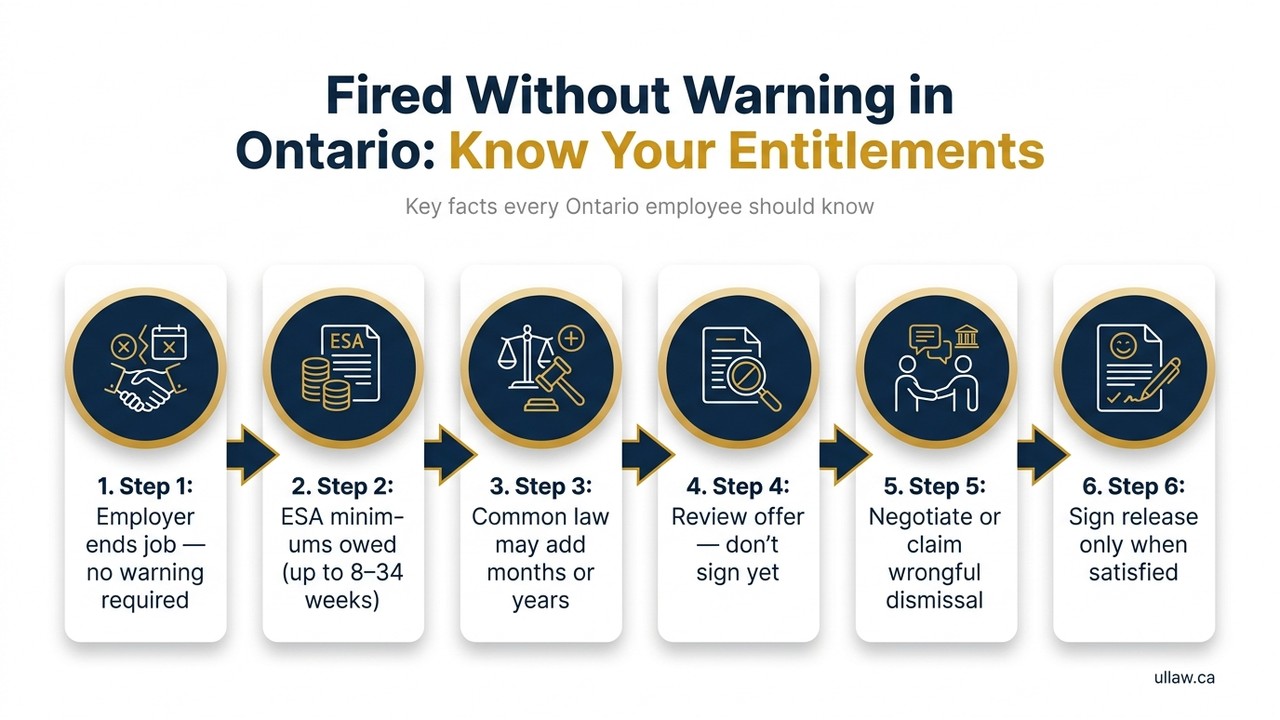
Ontario law does not require your employer to give you advance notice of termination, provided they pay you termination pay (also called pay in lieu of notice) instead. This is explicitly permitted under the Employment Standards Act, 2000, Ontario’s baseline employment statute. An employer can hand you a termination letter on a Tuesday morning without a single prior warning — as long as they meet their financial obligations.
However, “no warning” does not mean no consequences for the employer. Skipping notice triggers the obligation to compensate you. The amount owed depends on:
- How long you’ve worked there (your length of service)
- The terms of your employment contract (if any)
- Common law reasonable notice — an amount set by courts that is often much higher than the statutory minimum
- Whether the termination was handled properly under the ESA and human rights legislation
Do You Need a Warning Before Being Fired?
There is no legal requirement in Ontario for an employer to issue verbal warnings, performance improvement plans, or prior disciplinary steps before terminating you — unless your employment contract or a workplace policy specifically requires it. Even then, a breach of that internal process rarely voids the termination itself; it may, however, give rise to additional damages.
The exception is termination for cause. If an employer wants to dismiss you for cause — meaning serious misconduct — and pay you nothing, they must be able to prove the conduct. Courts interpret “just cause” very narrowly. Failing to meet targets, personality clashes, or minor errors almost never qualify. Without airtight cause, an employer must pay.
Bottom line: Your employer can fire you without warning, but they almost certainly owe you money when they do.
What Does Termination Without Cause Mean in Ontario?
Termination without cause simply means your employer is ending your employment for business reasons — restructuring, cost-cutting, role elimination, or even just because they want to — rather than because of something you did wrong.
It is, by far, the most common type of dismissal in Ontario. And despite the word “cause” appearing in the phrase, there is nothing inherently scandalous about it. It is a completely lawful action an employer can take at virtually any time.
Is Termination Without Cause Legal in Ontario?
Absolutely. Ontario’s Employment Standards Act, 2000 expressly contemplates termination without cause and sets out minimum notice or pay-in-lieu entitlements for it. The statute does not require employers to justify a business decision to let someone go.
What the law does require is that the employee be treated fairly financially. The absence of cause does not mean the absence of entitlement — if anything, it confirms the entitlement.
Termination Without Cause vs. Termination for Cause
| Without Cause | For Cause | |
|---|---|---|
| Reason required? | No | Yes — serious misconduct |
| Notice or pay owed? | Yes | Generally no |
| Common in practice? | Very common | Rare (and hard to prove) |
| Employee’s record affected? | Neutral | Potentially significant |
Employers sometimes claim cause to avoid paying — a practice courts take seriously. If your employer cited cause but the conduct doesn’t meet the legal threshold, you may have a claim for wrongful dismissal.
What Am I Entitled to If I Get Fired?
When you are terminated without cause in Ontario, you may be entitled to several types of compensation. These are not always explained clearly in the letter your employer hands you.
1. Statutory Minimums Under the ESA
The Employment Standards Act, 2000 sets minimum entitlements based on your length of service:
- Termination pay: 1 week per year of service, up to a maximum of 8 weeks
- Severance pay (for employees with 5+ years of service at a company with a payroll of $2.5 million or more): up to 26 weeks
These are floors, not ceilings. Many employees settle for ESA minimums without realizing they are entitled to considerably more.
2. Common Law Reasonable Notice
Unless you signed a valid employment contract that caps your entitlement at ESA minimums, you are also entitled to common law reasonable notice — an amount determined by courts based on:
- Age (older workers typically receive more)
- Length of service
- Character of employment (seniority, specialization)
- Availability of similar employment in your field
For mid-to-senior employees, reasonable notice can range from several months to two years’ worth of pay. This is the amount most often disputed — and most often undervalued in employer-drafted severance offers.
3. Benefits Continuation
Your employer may owe you continuation of benefits — extended health, dental, life insurance — through the notice period, not just a lump-sum salary replacement.
4. Bonus, Vacation Pay, and Commissions
Any earned but unpaid vacation pay, pro-rated bonuses, and commissions that would have vested during a proper notice period may also be owed.
Use our severance pay calculator to get a quick estimate of what your package might be worth — then speak with a lawyer before signing anything.
How Much Notice or Severance Are You Actually Owed?
This is the question that matters most in practical terms, and the answer varies significantly from person to person.
The Three-Layer Framework
Think of your entitlement in three potential layers:
- ESA minimums — the absolute floor; every Ontario employee without a valid contracting-out clause gets at least this
- Contractual notice — if your employment contract specifies a notice period, that governs (as long as it meets or exceeds the ESA)
- Common law reasonable notice — applies when there is no valid contract clause; this is almost always the largest number
Practical Ranges
While every situation is different, courts generally award roughly one month of notice per year of service as a rough starting point — but this is adjusted (often upward) based on age, specialization, and the job market. A 52-year-old VP with 12 years of service in a niche industry might receive 18–22 months’ notice; a 28-year-old coordinator with 2 years might receive 2–4 months.
Why Employer Offers Are Often Low
Employers draft their initial severance offers to minimize cost. They frequently:
- Offer only the ESA statutory minimum
- Include a signed release that waives your common law rights
- Set a tight deadline to pressure a quick decision
Don’t sign under pressure. Use our severance pay calculator as a first check, then book a consultation with our employment law team to understand the full picture.
When Does a Termination Without Cause Become a Wrongful Dismissal?
Wrongful dismissal in Ontario does not mean you were fired for an illegal reason (though that is a separate issue). It means your employer ended your employment without providing adequate notice or compensation.
In other words: almost every termination without cause is a wrongful dismissal if the employer only pays ESA minimums and you were entitled to more under common law. The term sounds dramatic, but it describes a very common situation.
Specific Scenarios That Can Constitute Wrongful Dismissal
- Inadequate severance: Being offered 4 weeks when reasonable notice is 12 months
- Constructive dismissal: Your employer doesn’t fire you outright, but makes your working conditions so intolerable — cutting your pay, demoting you, changing your role fundamentally — that you’re forced to resign. Courts treat this as a firing.
- Bad faith conduct: How an employer handles the termination matters. Humiliating dismissals, false allegations of cause, or callous behaviour during the process can attract Wallace damages (now folded into the general damages analysis)
- Breach of human rights: A termination connected to a protected ground — disability, pregnancy, age, race, religion, and others protected under the Ontario Human Rights Code — may expose the employer to human rights damages on top of wrongful dismissal damages
What Counts as Wrongful Termination in Ontario?
Any of the above. The core test is: did you receive the notice (or pay in lieu) you were legally entitled to? If not, the dismissal may be actionable — either through the courts, the Ministry of Labour under the ESA, or the Human Rights Tribunal of Ontario where a human rights violation is alleged.

Can You Be Fired Without Cause While on Leave?
This is one of the most anxiety-inducing questions we hear — and rightly so, because employees on leave are among the most vulnerable.
The Short Answer
Technically, yes — an employer can eliminate a position while an employee is on a protected leave (parental leave, medical leave, etc.). However, there are serious legal risks for employers who do so.
Protections Under Ontario Law
The Employment Standards Act, 2000 prohibits employers from punishing employees for taking a protected leave. Terminating someone because they are on leave — or timing a dismissal to coincide with a leave in a way that suggests that motive — can be characterized as a reprisal, which is prohibited.
The Ontario Human Rights Code adds another layer: pregnancy, disability, and family status are all protected grounds. A dismissal that is even partly motivated by any of these factors may constitute discrimination, entitling you to additional remedies beyond ordinary wrongful dismissal compensation.
Practical reality: If your employer eliminates your role while you are on parental leave, EI leave, or a disability-related leave, you should get legal advice immediately. The timing alone raises a red flag that courts and tribunals take seriously. Even if the employer claims a legitimate business reason, the circumstances may support a much stronger claim than a standard without-cause termination.
What Happens If You Accept a Severance Package?
Accepting a severance package without legal review is one of the most common — and costly — mistakes Ontario employees make.
What Signing Usually Means
Almost every employer-drafted severance package includes a full and final release. By signing, you:
- Accept the offered amount as complete satisfaction of all claims
- Waive your right to sue for wrongful dismissal, human rights violations, or any other employment-related claim
- Often agree to non-disparagement and sometimes non-solicitation clauses
Once signed and the revocation period (if any) has passed, it is extremely difficult to undo.
The Deadline Pressure Tactic
Many employers attach a short signing deadline — sometimes as little as a few days — to their offer. This pressure is intentional. You are not legally required to sign by that deadline. Reasonable employers will almost always extend it when a lawyer is involved. If they won’t, that itself is a warning sign.
What a Lawyer Can Do for You
An employment lawyer can:
- Assess whether the offer meets your common law entitlement
- Identify whether human rights or other claims exist that the release would extinguish
- Negotiate a better package — often significantly higher — before you sign
- Review non-compete and non-solicitation clauses that could affect your next job
Get legal advice before you sign anything. Our employment law team reviews severance packages and can advise you on whether it is fair — or whether there is room to negotiate more.
Fired Without Cause? Don’t Sign Anything Before Reading This
If you have just been terminated, here is a practical checklist to protect yourself:
Immediate Steps After Being Fired
- Stay calm and say little. You are not obligated to provide reasons or explanations. Anything you say in the moment can potentially be used to support a “cause” argument later.
- Ask for everything in writing. Request your termination letter, Record of Employment (ROE), and any severance offer in writing.
- Keep copies of your employment contract, offer letter, performance reviews, and any relevant communications.
- Do not sign anything on the spot. A release signed under pressure may still be enforceable.
- Note the circumstances. Were you on leave? Recently pregnant or injured? Just filed a complaint? These details matter.
- Get a severance estimate. Our severance pay calculator gives you a rough benchmark within minutes.
- Speak to an employment lawyer promptly. Limitation periods apply. In Ontario, most civil claims must be commenced within two years of the date the claim arose. Don’t let the clock run out.
Your Duty to Mitigate
One critical and often-misunderstood obligation: once dismissed, you have a duty to mitigate your losses. This means making reasonable efforts to find comparable new employment. Failure to do so can reduce what a court will award you — even if your dismissal was clearly wrongful. Keep a record of your job search efforts.
The Law Society of Ontario has a referral service if you need help finding a qualified employment lawyer, and many Ontario employment lawyers — including our team — offer free initial consultations.
Talk to a UL Lawyers Team Member
Ready to find out what your dismissal is really worth? The difference between what your employer offers and what you may actually be entitled to can be substantial — sometimes tens of thousands of dollars. Our Ontario employment law team offers a free, no-obligation consultation to review your situation, explain your options, and tell you honestly whether your severance offer is fair. Reach out today — and don’t sign anything until you do.