
Losing your job is stressful enough. Losing it with a “for cause” label attached can feel devastating — and the shock is often made worse when your employer tells you that you are not entitled to a single dollar of severance. Many employees simply accept that and walk away. That is often a costly mistake.
“Fired for cause” is one of the most misused phrases in Ontario employment law. Employers sometimes reach for this label as a way to avoid paying out notice or severance — even when the facts on the ground do not legally support it. In reality, the bar for proving true just cause is very high, and courts have repeatedly found that many terminations labelled “for cause” do not meet that standard. If your employer got it wrong, you may be owed substantial compensation.
This guide explains what just cause actually means under Ontario law, what kinds of conduct can and cannot support it, the warning signs that a for-cause label may not hold up, and what you should do right now to protect your rights. If you want a quick estimate of what you might be owed, try our severance pay calculator — and for a full picture of your situation, our employment law team is ready to help.
Table of Contents
- Can You Get Severance If You Are Fired for Cause in Ontario?
- Just Cause vs. With Cause: What Is the Difference?
- What Counts as Just Cause in Ontario?
- Signs the For-Cause Label May Not Hold Up
- What Are You Entitled to If the Just Cause Label Is Wrong?
- What Makes You Ineligible for Severance Pay in Ontario?
- What to Do If You Were Terminated for Cause in Ontario
- How Courts Assess Just Cause: The Contextual Approach
Can You Get Severance If You Are Fired for Cause in Ontario?
The short answer is: yes, you may still be entitled to severance, even if your employer says you were fired for cause. Whether you actually receive it depends on whether the employer’s just cause claim would survive legal scrutiny.
Under the Employment Standards Act, 2000 (ESA), employees who are dismissed for cause are generally not entitled to statutory notice or termination pay. However, this exemption does not apply automatically just because your employer uses that phrase. The conduct must genuinely rise to the legal threshold for just cause — and that threshold is far higher than most employers (and employees) realize.
At common law, courts have described just cause as the “capital punishment” of employment law — reserved for only the most serious misconduct. The Supreme Court of Canada has confirmed that just cause requires conduct so serious that it fundamentally breaks the employment relationship. Minor infractions, poor performance, personality conflicts, or honest mistakes almost never qualify.
The Two Legal Frameworks
- Statutory entitlements (ESA): If your employer cannot prove just cause under the ESA, you are entitled to statutory notice or termination pay (up to eight weeks) and, if applicable, severance pay (up to 26 weeks for longer-service employees at larger companies).
- Common law entitlements: Even if the ESA cause exemption technically applied, courts assess just cause separately at common law. Common law notice periods can be far more generous — often one month per year of service as a rough starting point, depending on your age, role, and length of service.
In other words, your employer must meet the just cause standard under both regimes to escape liability. If they cannot, you may be owed significant compensation. Use our severance pay calculator to get a preliminary sense of the range, then speak with a lawyer about the specifics of your situation.
Just Cause vs. With Cause: What Is the Difference?
You may hear both terms — “just cause” and “with cause” — used interchangeably by employers, but they carry different legal weight.
“With cause” is an informal term that simply means the employer has a stated reason for the dismissal. An employer can fire someone with cause for poor performance, a policy violation, or a single bad incident — but that does not automatically mean the termination was for just cause in the legal sense.
“Just cause” is a specific legal standard. It means the employee’s conduct was so serious that it justified ending the employment relationship immediately and without any notice or compensation. Courts have been clear: just cause is not a low bar. It is not met by:
- A first-time or isolated incident (in most cases)
- Poor performance without prior warnings or a performance-improvement plan
- Workplace tension or a personality clash with management
- A mistake made without dishonest intent
Why This Distinction Matters
An employer who fires you with cause (i.e., citing a reason) but cannot prove just cause in law has effectively carried out a wrongful dismissal. You remain entitled to reasonable notice — or pay in lieu of notice — and potentially severance pay under the ESA. The label on your termination letter does not determine your legal rights. The underlying facts do.
This is why it is so important to have a lawyer review the circumstances of your dismissal before accepting any employer’s characterization of it as “for cause.”
What Counts as Just Cause in Ontario?
Ontario courts and the Ontario Human Rights Code framework recognize a range of conduct that can amount to just cause — but even within these categories, the analysis is highly fact-specific. No single act automatically equals just cause.
Theft or Fraud
Theft, fraud, and financial dishonesty are among the most commonly upheld grounds for just cause. Stealing from an employer, falsifying expense reports, or manipulating financial records strikes at the heart of the trust that underlies every employment relationship. However, even here, courts look at:
- The value and nature of what was taken or falsified
- The employee’s length of service and prior record
- Whether the employer investigated properly before dismissing
- Whether the conduct was a one-time lapse or a pattern
Serious Dishonesty
Lying to an employer — especially on material matters like qualifications, credentials, or workplace incidents — can constitute just cause. Courts have upheld dismissals where employees misrepresented their credentials on hiring or deliberately misled their employer during an investigation.
Insubordination and Willful Misconduct
Refusing a lawful and reasonable workplace directive — especially after warnings — can support a just cause finding. The key word is willful: deliberate refusal is treated differently from a good-faith disagreement.
Workplace Violence or Harassment
Physical violence in the workplace, or severe and sustained harassment of colleagues, can justify immediate dismissal without notice. A single serious act of violence is generally treated more harshly than other types of misconduct.
Conflicts of Interest
Undisclosed conflicts of interest — such as working for a competitor while employed, or secretly directing business opportunities away from the employer — may constitute just cause depending on the employee’s seniority and the scope of the conflict.
Important Caveat
Even if your conduct falls into one of these categories, just cause is not automatic. Courts use a contextual and proportionate analysis. The question is always: did this conduct, in this context, for this employee, justify the most severe sanction in employment law — immediate dismissal without compensation? Often, the answer is no.
Signs the For-Cause Label May Not Hold Up
Employers sometimes terminate employees for cause when the facts do not legally support it. Knowing the warning signs can help you recognize whether your dismissal deserves a second look.
No Prior Warnings
For most types of misconduct — particularly performance issues and policy violations — courts expect employers to have given progressive discipline: a verbal warning, then a written warning, then a final warning, before dismissal. Jumping straight to termination for cause without prior warnings is a red flag, especially for a first or minor offence.
The Incident Was Minor or Isolated
A single lapse in judgment, a one-time rule violation, or an honest mistake rarely meets the just cause standard. If your employer is relying on a small incident to justify no severance at all, the proportionality of that response will likely be challenged.
No Proper Investigation
Employers have a duty to conduct a fair and thorough investigation before concluding that an employee committed serious misconduct. If you were never given a chance to respond to allegations, if the investigation was rushed or one-sided, or if the conclusions were pre-determined, a court may find the dismissal was not truly for just cause — or may treat the manner of dismissal as an aggravating factor.
Long, Clean Employment History
A long-serving employee with a strong track record is held to a different standard than a newer or frequently disciplined one. Courts consistently take into account years of service and prior conduct when assessing whether a single incident justifies dismissal for cause. The longer and cleaner your record, the harder it is for an employer to justify forfeiting all your entitlements.
The Timing Is Suspicious
If you were fired “for cause” shortly after raising a workplace concern, filing a complaint, requesting accommodation, or blowing the whistle on a policy violation, the for-cause label may be pretextual. These situations can give rise to additional claims beyond wrongful dismissal.
The Letter Is Vague or Inconsistent
A termination letter that is vague about the reasons for dismissal, or that cites reasons your employer never raised with you before, is a signal that the cause allegation was not well-founded. Employers must generally be able to articulate the specific conduct that justified the termination.
What Are You Entitled to If the Just Cause Label Is Wrong?
If your employer cannot prove just cause at the legal standard, your dismissal is treated as a wrongful dismissal — and your entitlements can be significant.
Statutory Entitlements Under the ESA
Under the Employment Standards Act, 2000, most employees who are wrongfully dismissed are entitled to:
- Termination pay: Up to eight weeks of pay in lieu of statutory notice, based on years of service.
- Severance pay: Up to 26 weeks of severance pay if you worked for the employer for five or more years and the employer has a payroll of $2.5 million or more (or if your position was eliminated as part of a mass layoff). These entitlements accumulate separately and can stack.
Common Law Reasonable Notice
Beyond the ESA minimums, Ontario courts recognize a broader right to reasonable notice at common law — unless a valid termination clause in your employment contract limits that right. Courts assess reasonable notice based on the Bardal factors:
- Age — older employees generally receive more notice
- Length of service — the longer you worked, the more notice you are owed
- Character of employment — senior or specialized roles attract longer notice periods
- Availability of similar employment — how hard will it be to find comparable work?
As a rough guide, common law notice can range from a few weeks to 24 months or more in exceptional cases. Our severance pay calculator can give you an estimate based on your profile.
Aggravated and Punitive Damages
In cases where the employer conducted the dismissal in bad faith — for example, making false allegations of just cause to pressure you into waiving your rights — courts may award aggravated damages for the manner of dismissal. In rare and egregious cases, punitive damages may also be available.
Human Rights Damages
If the for-cause termination was connected to a protected ground — such as disability, age, family status, or race — you may have a claim under the Ontario Human Rights Code in addition to a wrongful dismissal claim. Our employment law team can help you understand how these claims interact.

What Makes You Ineligible for Severance Pay in Ontario?
Not every dismissed employee is entitled to severance — but the exceptions are narrower than many employers suggest.
Genuine Just Cause
The clearest disqualifier is proven just cause. If your employer can demonstrate to a court or adjudicator that your conduct genuinely met the legal standard — wilful misconduct, theft, fraud, serious insubordination — you lose your entitlement to statutory notice and severance pay under the ESA. Common law notice may also be forfeited if just cause is established there too.
Short Tenure
Under the ESA, you must have worked for an employer for at least three months to qualify for termination pay, and at least five years to qualify for severance pay (subject to the payroll threshold). Employees with very short tenures may have limited or no statutory entitlements, though common law notice can still apply.
Valid Termination Clauses
Some employment contracts include termination clauses that limit your entitlements to the ESA minimums. If the clause is properly drafted and meets all legal requirements, it may cap your severance at statutory minimums even where no just cause exists. However, many termination clauses are unenforceable because they fail to comply with the ESA — a lawyer can assess whether yours is valid.
Resignation or Constructive Dismissal
If you resigned voluntarily, you are generally not entitled to severance. However, if you were constructively dismissed — meaning your employer made your working conditions so intolerable that you had no real choice but to leave — the law may treat your departure as a termination, and entitlements can follow.
Independent Contractors
Employees are protected by the ESA; independent contractors generally are not. However, whether you are truly a contractor or a misclassified employee is a legal question that depends on the real nature of your working relationship — not just the label on your contract.
What to Do If You Were Terminated for Cause in Ontario
If you have just been fired for cause, take a breath — and then take action. The steps you take in the first days and weeks can significantly affect your ability to recover what you are owed.
1. Do Not Sign Anything Right Away
Employers often present a release and settlement agreement at termination. Signing it waives most or all of your legal rights in exchange for whatever they are offering. Do not sign anything until a lawyer has reviewed it. There is no immediate legal deadline that forces you to sign at the meeting itself.
2. Gather Your Documents
Collect whatever employment records you can access, including:
- Your employment contract and any amendments
- Any written performance reviews or warnings
- Emails or messages related to the termination or the alleged misconduct
- Your T4s and recent pay stubs
- Your termination letter
3. Write Down What Happened
While memory is fresh, make detailed notes about the circumstances of your dismissal: what was said, who was present, what reasons were given, and the timeline of events leading up to it. These notes may be valuable later.
4. Understand Your Limitation Periods
Ontario has limitation periods — deadlines — for making legal claims. Under the Limitations Act, 2002, most civil claims (including wrongful dismissal) must generally be commenced within two years of the date the claim arose. Some ESA complaints have shorter timelines. Do not wait.
5. Get a Legal Opinion Before Accepting Anything
A consultation with an employment lawyer can help you understand whether the just cause label is likely to hold up, what you may realistically be entitled to, and whether the employer’s offer (if any) is fair. Many employment lawyers, including our team, offer free initial consultations. Use our severance pay calculator as a starting point — but a calculator cannot replace legal advice tailored to your situation.
6. File an ESA Complaint If Appropriate
If your employer is withholding statutory entitlements without a legitimate just cause defence, you may be able to file a complaint with the Ontario government’s Ministry of Labour, Immigration, Training and Skills Development. This is a free process, though it is subject to recovery caps and may not capture common law damages.
How Courts Assess Just Cause: The Contextual Approach
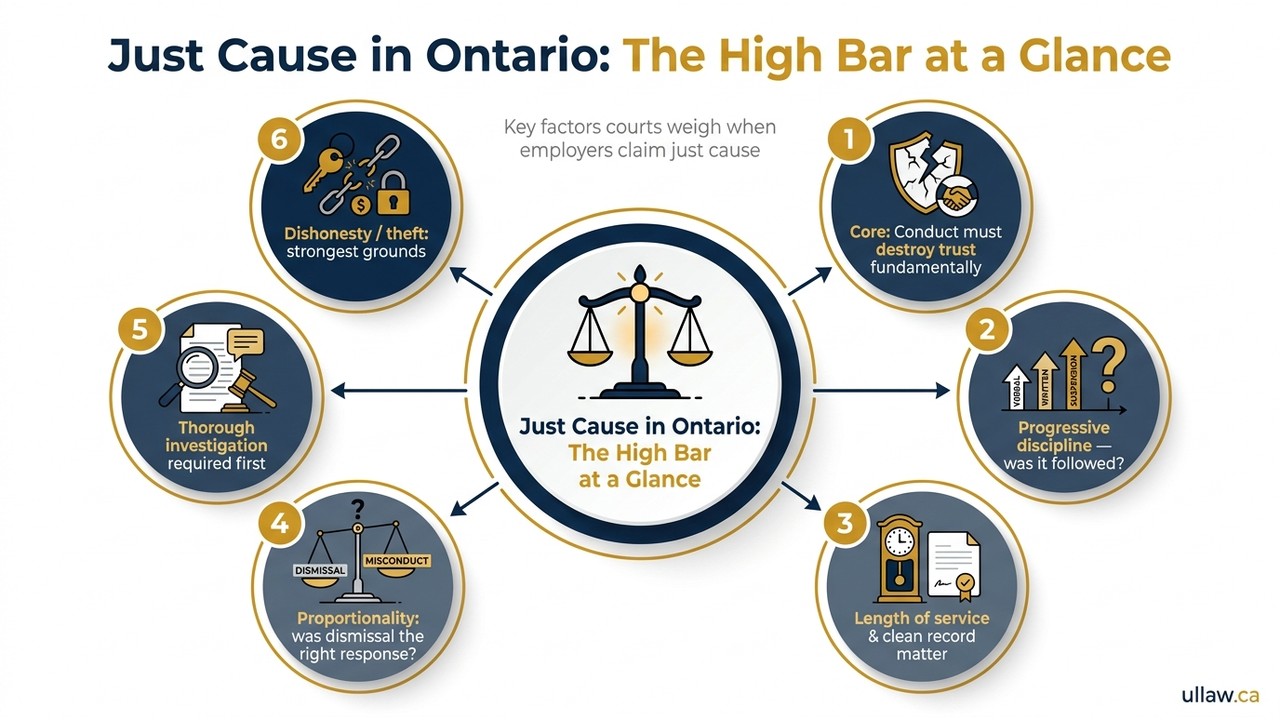
Ontario courts do not decide just cause in a vacuum. They apply a contextual and proportionate approach, weighing the nature of the misconduct against everything else known about the employment relationship.
The McKinley Principle
Canada’s Supreme Court has confirmed that just cause analysis must be contextual — not categorical. The fact that conduct falls into a category (say, dishonesty) does not automatically mean just cause is made out. Courts ask: was the response — immediate, permanent dismissal with no compensation — proportionate to the gravity of the conduct in this particular context?
Factors Courts Consider
- The nature and severity of the misconduct: Was it deliberate or accidental? Single incident or a pattern?
- The employee’s length of service and employment record: A 20-year employee with no prior discipline is treated very differently from a 6-month employee.
- Whether the employer warned the employee: Prior progressive discipline supports just cause; its absence often undermines it.
- The employee’s response: Did the employee acknowledge the conduct, show remorse, or attempt to correct it?
- The employer’s workplace culture and policies: If similar conduct was tolerated or overlooked for others, it is harder to justify singling out one employee for dismissal.
- Harm to the employer: Did the conduct cause real damage to the business, its reputation, or its customers?
Proportionality Is Everything
Even serious misconduct does not always justify the most serious employment sanction. Courts have found that where an employee has a long and otherwise unblemished career, even a real but isolated lapse may not warrant forfeiting all notice and severance. The question is always whether dismissal without compensation was the proportionate response — not just whether the employer had some reason to be upset.
This is why getting legal advice is so important. The strength of a just cause defence is never black and white — it is a spectrum, and where your situation falls on that spectrum determines your entitlements.
Talk to a UL Lawyers Team Member
If you were fired for cause and told you are owed nothing, do not accept that conclusion without a legal review. The just cause standard is high, and many employers get it wrong. Call 905-744-8888 or email info@ullaw.ca. Contact our employment law team today for a free, no-obligation consultation — we will assess the strength of the just cause claim against you, explain your realistic entitlements, and help you decide your best next step. Kitchener-Waterloo employees can start on employment lawyer Kitchener. You may have far more to recover than you think.