Can I sue my employer for stress and anxiety in Canada? Yes — if the employer’s conduct crossed a legal line. Ordinary workplace pressure is not enough. Ontario law looks for harassment, a poisoned workplace, constructive dismissal, bad-faith firing, or discrimination, plus documented psychological harm.
Quick answer: Keep emails, medical notes, and dates. Two-year civil limit; one year for most HRTO filings. Call 905-744-8888 or email info@ullaw.ca before a deadline runs. You can also book a free consultation.
Workplace stress is one of the most common — and most dismissed — forms of suffering employees face. The longer answer depends on how the stress arose, how severe it is, and whether your employer’s conduct crossed a legal line. Ontario courts have grown more willing to take workplace psychological harm seriously.

Table of Contents
- Can I Sue My Employer for Stress and Anxiety in Canada?
- What Stress and Anxiety Qualifies for a Lawsuit?
- What Can I Sue My Employer for in Canada?
- Can I Sue My Employer in Ontario?
- What Can You Sue Your Employer for in Canada? (A Full Picture)
- The Legal Framework Behind Workplace Mental Health Claims in Ontario
- How Much Compensation Can You Get for Stress at Work?
- Should I Sue My Employer for Stress and Anxiety?
Can I Sue My Employer for Stress and Anxiety in Canada?
Yes — but not every bad day at work gives rise to a lawsuit. Canadian courts and employment tribunals distinguish between ordinary workplace friction and conduct that is serious enough to attract legal liability.
To succeed in a claim related to stress and anxiety, your situation will generally need to fit into one or more recognized legal categories:
- Constructive dismissal: If your employer made your working conditions so intolerable — through harassment, demotion, unreasonable workloads, or hostility — that you felt forced to resign, you may have been constructively dismissed. This is treated like a firing in law and can entitle you to wrongful dismissal damages.
- Wrongful or bad-faith dismissal: When an employer terminates you in a harsh, vindictive, or high-handed manner, Ontario courts may award damages for mental distress caused by how the dismissal was handled — separate from regular severance.
- Intentional infliction of mental suffering: This tort requires showing that your employer’s conduct was flagrant and outrageous, that it was calculated to harm you, and that it did in fact cause a visible and provable illness (not just hurt feelings).
- Human Rights violations: If the stress stems from discrimination, harassment, or failure to accommodate a disability (including anxiety or depression), you may have a claim under the Ontario Human Rights Code.
- Occupational Health & Safety violations: The Occupational Health and Safety Act imposes a duty on employers to keep workplaces free from harassment. A breach may support a civil claim or a Ministry of Labour complaint.
The threshold matters. Courts look for conduct that goes beyond the ordinary difficulties of employment. If your employer was negligent, abusive, discriminatory, or acted in bad faith, you may have grounds to pursue a claim.
What Stress and Anxiety Qualifies for a Lawsuit?
Not every form of workplace stress will support a legal claim — but the bar is lower than many people assume. Here is what lawyers and courts typically look for:
The Employer’s Conduct Must Be Serious
Courts distinguish between legitimate management decisions (criticism, restructuring, performance management) and conduct that is oppressive, abusive, or in bad faith. A supervisor who raises their voice occasionally is different from one who systematically humiliates, isolates, or threatens an employee.
Your Psychological Harm Should Be Documented
The strongest claims involve medically recognized conditions — anxiety disorder, major depressive disorder, post-traumatic stress — diagnosed by a physician or psychologist. While courts have occasionally recognized severe distress without a formal diagnosis, medical documentation significantly strengthens your position.
What a ‘Nervous Breakdown at Work’ Can Mean Legally
The term nervous breakdown has no precise legal definition, but it is often used to describe an acute mental health crisis triggered by workplace conditions. If your employer’s conduct caused you to suffer a breakdown that required medical leave, therapy, or hospitalization, that is precisely the kind of visible and provable illness that can support a claim for intentional infliction of mental suffering or bad-faith dismissal damages.
Qualifying Scenarios May Include
- Sustained workplace bullying or psychological harassment
- Being placed on an unwarranted performance improvement plan as a pretext to force you out
- A poisoned work environment driven by discrimination
- Abrupt termination paired with public humiliation or false accusations
- Refusal to accommodate a mental health disability
Keep a contemporaneous record: dates, witnesses, emails, and a journal of how the situation affected your health. This evidence is invaluable.
What Can I Sue My Employer for in Canada?
The types of damages available to you will depend on which legal avenue applies to your situation. Here is an overview of what Canadian employees can potentially claim:
Wrongful Dismissal Damages (Notice Pay)
If you were fired without adequate notice or pay in lieu, you are entitled to reasonable notice damages — calculated based on your age, length of service, position, and availability of comparable employment. Use our severance pay calculator to get a preliminary estimate of what you may be owed.
Bad-Faith / Wallace Damages
Where an employer acts in a callous, misleading, or high-handed manner in the course of dismissal — for example, making false allegations or humiliating you in front of colleagues — a court may add additional compensation for the mental distress that manner of dismissal caused.
Moral Damages
Distinct from Wallace damages, moral damages compensate for an employer’s breach of the good-faith obligations implied in every employment contract. They are available where the employer’s conduct during termination was unfair and caused foreseeable mental suffering.
Human Rights Damages
Under the Ontario Human Rights Code, the Human Rights Tribunal of Ontario may award general damages for injury to dignity, feelings, and self-respect — with no legislated cap. These claims are separate from wrongful dismissal proceedings.
Aggravated and Punitive Damages
Aggravated damages compensate for losses beyond the normal range, including psychological harm. Punitive damages are reserved for truly egregious conduct and are intended to punish and deter the employer.
Tort Damages (Intentional Infliction of Mental Suffering)
In rare but serious cases, employees sue in tort for intentional infliction of nervous shock. This requires proving flagrant conduct, intent or recklessness, and a resulting recognized psychiatric injury.
Visit our employment law practice page to learn more about how we approach these claims.
Can I Sue My Employer in Ontario?
Yes — Ontario employees have multiple forums and legal mechanisms available to them, making it one of the stronger jurisdictions in Canada for pursuing workplace mental health claims.
Ontario Superior Court of Justice
Most wrongful dismissal, constructive dismissal, and tort claims are litigated here. Judges in Ontario have recognized damages for mental distress arising from bad-faith terminations for decades, and the law continues to evolve in employees’ favour.
Human Rights Tribunal of Ontario (HRTO)
If your stress and anxiety stems from discrimination or harassment based on a protected ground — such as disability, race, sex, or age — you can file an application with the HRTO. This is a specialized administrative tribunal, often faster and less expensive than full court litigation.
Ontario Labour Relations Board
If you are a unionized employee, your remedies typically flow through the grievance arbitration process under your collective agreement rather than through the courts.
Ministry of Labour (Employment Standards Act Complaints)
For straightforward violations of the Employment Standards Act, 2000 — unpaid wages, vacation pay, termination pay — you can file a complaint at no cost. However, ESA remedies do not cover general damages for mental suffering, so this route is often insufficient on its own for stress-related claims.
Key Limitation: The Two-Year Clock
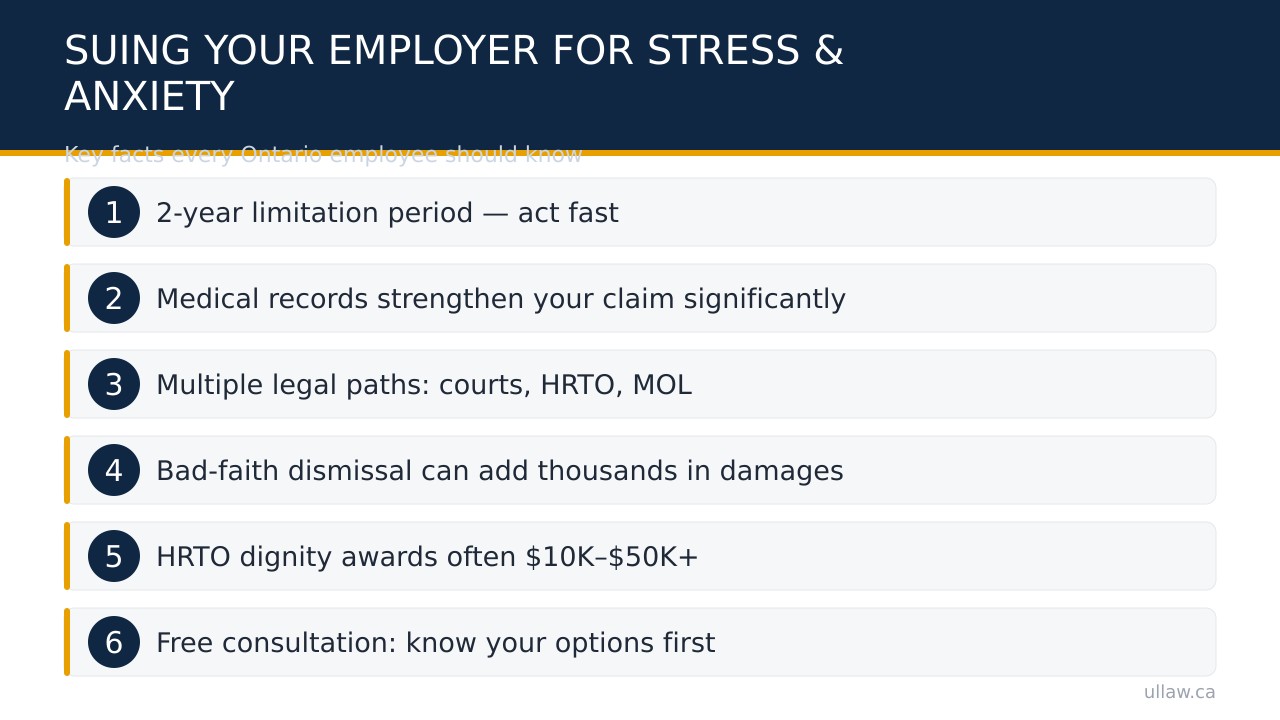
In Ontario, most civil claims are subject to a two-year limitation period under the Limitations Act, 2002, running from the date you knew or ought to have known you had a claim. Human Rights applications also carry strict timelines. Do not delay seeking legal advice.
What Can You Sue Your Employer for in Canada? (A Full Picture)
Beyond stress and anxiety, Ontario employees may have claims for a broader range of employer misconduct. Understanding the full landscape helps you identify every avenue available to you.
Common Claims Against Employers in Canada
- Wrongful dismissal — termination without reasonable notice or cause
- Constructive dismissal — forced resignation due to intolerable conditions
- Harassment and workplace bullying — under occupational health legislation and human rights law
- Discrimination — based on race, disability, sex, age, religion, or other protected grounds under the Ontario Human Rights Code
- Breach of employment contract — failure to pay promised bonuses, commissions, or benefits
- Unpaid wages and overtime — under the Employment Standards Act, 2000
- Reprisal for raising health and safety concerns — protected under the Occupational Health and Safety Act
- Privacy violations — unlawful monitoring or misuse of personal information
- Defamation — false and damaging statements made about you during or after employment
Many of these claims can be combined in a single lawsuit. An employment lawyer can help you identify which apply to your circumstances and structure your claim for maximum effect.

The Legal Framework Behind Workplace Mental Health Claims in Ontario
Understanding the legislation that governs your rights can help you feel more grounded when speaking with a lawyer.
- Employment Standards Act, 2000 (ESA): Sets minimum entitlements for termination and severance pay. Employers must meet at least these minimums — but most employees are entitled to significantly more at common law.
- Ontario Human Rights Code: Prohibits discrimination and harassment in employment based on protected characteristics. Mental health conditions such as anxiety and depression are recognized disabilities under the Code, triggering the employer’s duty to accommodate up to the point of undue hardship.
- Occupational Health and Safety Act (OHSA): Since 2010, Ontario’s OHSA has included explicit protections against workplace harassment, defined as engaging in a course of vexatious comment or conduct that is known or ought reasonably to be known to be unwelcome. Employers must have a written policy and investigate complaints.
- Common Law: Beyond statute, judges continue to develop the common law of employment, expanding recognition of bad-faith damages, constructive dismissal, and intentional infliction of mental suffering.
This layered framework means an employee suffering workplace-induced stress and anxiety often has more than one claim — and a skilled employment lawyer can help you navigate all of them.
How Much Compensation Can You Get for Stress at Work?
Compensation for workplace stress and anxiety is not fixed by a tariff — it depends heavily on the specific facts of your case. That said, here is a realistic overview of the ranges courts and tribunals consider:
Wrongful / Constructive Dismissal Notice Awards
These vary based on your age, years of service, seniority, and job market. A long-service manager in their 50s may be entitled to 18–24 months of notice pay; a short-service junior employee may receive 3–6 months. Use our severance pay calculator to get a rough sense of where you fall.
Bad-Faith / Moral Damages
Ontario courts have awarded amounts ranging from a few thousand dollars to tens of thousands where employers acted callously in dismissal. The amount reflects the severity and duration of the employer’s misconduct.
Human Rights General Damages (Injury to Dignity)
The HRTO has historically awarded $10,000 to $50,000+ for injury to dignity, feelings, and self-respect in serious cases, though every case is assessed on its own merits.
Tort Damages (Intentional Infliction of Mental Suffering)
These are the most difficult to prove but can be the most significant — particularly where a documented psychiatric injury has affected your long-term earning capacity.
What Emotional Suffering Means in Law
Emotional suffering (sometimes called mental distress) refers to the psychological pain, anxiety, humiliation, and loss of self-worth caused by another’s wrongful conduct. In employment law, it is compensable when it flows directly from the employer’s breach or misconduct, especially where that suffering manifests as a diagnosable condition rather than ordinary disappointment.
Should I Sue My Employer for Stress and Anxiety?
Deciding whether to pursue a legal claim is deeply personal — and practical. Here are the key factors to weigh:
Reasons to Consider Pursuing a Claim
- Your employer’s conduct was serious, sustained, or deliberate — not a one-off misunderstanding
- You have medical evidence of the impact on your health
- You were dismissed and received little or no severance
- You resigned because the environment was genuinely intolerable
- The situation involved discrimination or harassment based on a protected ground
Reasons to Proceed Carefully
- The stress arose from ordinary management decisions you simply disagreed with
- You have limited documentation of events
- You are still employed and want to preserve the relationship — though a lawyer can often advise on internal remedies first
Practical Steps Before You File
- Consult an employment lawyer — many offer a free first consultation
- Gather documentation: emails, texts, performance reviews, medical records, a personal log of incidents
- Note the dates: limitation periods are strict and can extinguish your rights
- Understand your options: litigation, mediation, and negotiated settlements are all possibilities
A lawsuit is not always the answer — sometimes a well-crafted demand letter or a Human Rights application achieves a better, faster result. Our employment law team can help you assess what makes sense for your specific situation.
Talk to a UL Lawyers Team Member
If workplace stress and anxiety have taken a real toll on your health and livelihood — especially after harassment, a poisoned workplace, or a bad-faith firing — you deserve a clear answer, not guesswork. At UL Lawyers, we offer a free initial consultation. Call 905-744-8888 or email info@ullaw.ca before the limitation period runs. You can also book a free consultation or start on our employment law page.