How to file a complaint against an employer in Ontario depends on what went wrong. Unpaid wages go to the Ministry of Labour / ESA (generally two years). Discrimination goes to the HRTO (generally one year). Wrongful dismissal can be a lawsuit for common-law notice.
Quick answer: Pick the forum first — MOL/ESA, HRTO, OHSA, or court. Reprisal for filing is illegal. Hire an employment lawyer before a deadline runs. Call 905-744-8888 or email info@ullaw.ca. You can also book a free consultation.
Workplace problems can feel isolating and overwhelming. Whether your employer withheld your last paycheque, fired you without proper notice, or made your work environment unbearable, you have real legal rights in Ontario — and real places to go for help. Our employment law team can help you pick the right path.

Table of Contents
- How Do I File a Complaint Against an Employer in Ontario?
- How Do I Actually Start a Complaint Against My Employer in Ontario?
- Who Do I File a Complaint With Against My Employer in Ontario?
- What Are the Three Basic Rights Every Employee Has in Ontario?
- What Is an Example of Being Treated Unfairly at Work?
- Is It Worth It to Sue an Employer in Ontario?
How Do I File a Complaint Against an Employer in Ontario?
The answer depends on what your employer did wrong. Ontario law provides several distinct routes, each handled by a different body.
1. Employment Standards Complaint (Ministry of Labour)
If your employer violated the Employment Standards Act, 2000 — for example, by not paying wages, denying vacation pay, or failing to give proper notice of termination — you can file a claim with the Ontario Ministry of Labour, Immigration, Training and Skills Development. This is free, and you do not need a lawyer to start it. You file through the ministry’s online portal at ontario.ca.
Key limitation: There is a two-year limitation period for most employment standards claims, and there are caps on the amounts the ministry can recover for you. For larger wrongful dismissal claims, a civil lawsuit often yields more.
2. Human Rights Complaint (Human Rights Tribunal of Ontario)
If your employer discriminated against you — based on race, gender, disability, age, religion, or another protected ground under the Ontario Human Rights Code — you can file an Application to the Human Rights Tribunal of Ontario (HRTO). Applications must generally be filed within one year of the last discriminatory act.
3. Occupational Health & Safety Complaint
If your workplace is unsafe or you were punished for raising a safety concern, you can report this to the Ministry of Labour’s Health and Safety Contact Centre. The Occupational Health and Safety Act (OHSA) protects workers who speak up about hazards.
4. Civil Lawsuit (Superior Court of Ontario)
For wrongful dismissal, constructive dismissal, or serious breaches of your employment contract, you (or your lawyer) can file a civil claim in the Ontario Superior Court of Justice. This route can recover full common law reasonable notice — often far more than the minimums under the Employment Standards Act, 2000.
Not sure which path is right for you? Use our severance pay calculator to get a quick estimate of what you may be owed, then speak with a lawyer.
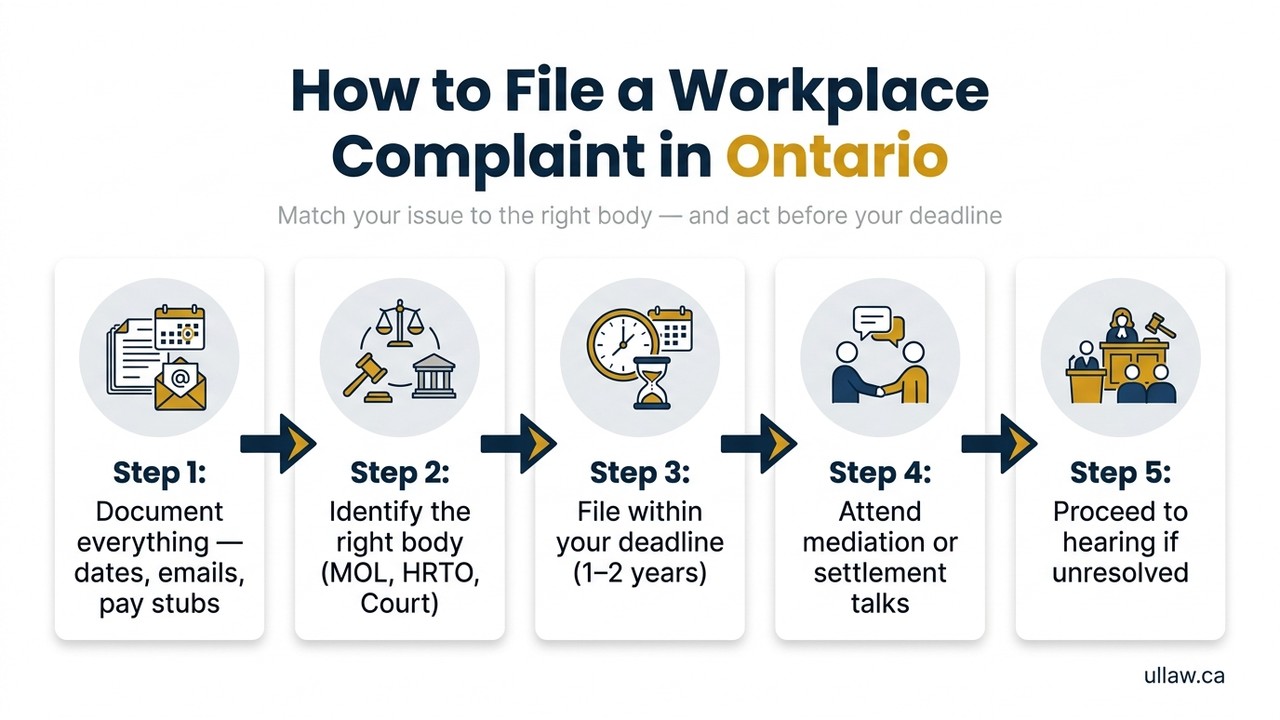
How Do I Actually Start a Complaint Against My Employer in Ontario?
Once you know which body handles your complaint, here is how to take action:
Step 1 — Document Everything
Before you file anything, gather your evidence:
- Employment contract (or offer letter)
- Pay stubs and T4s
- Performance reviews and emails
- Records of incidents (dates, times, witnesses)
- Termination letter (if applicable)
The stronger your paper trail, the stronger your complaint.
Step 2 — Know Your Deadlines
Deadlines are strict in Ontario employment law:
| Route | Deadline |
|---|---|
| Employment Standards claim | 2 years from the violation |
| Human Rights Application | 1 year from the last act |
| Civil lawsuit (wrongful dismissal) | 2 years from termination |
Missing a deadline can mean losing your right to claim entirely. Act promptly.
Step 3 — File Your Complaint
- Employment Standards: File online through the ontario.ca portal under the Ministry of Labour section.
- Human Rights: Apply directly through the Human Rights Tribunal of Ontario’s online system.
- Civil claim: Retain a lawyer to draft and serve a Statement of Claim in the Ontario Superior Court of Justice.
Step 4 — Respond to Investigation or Mediation
Most complaints go through a mediation or settlement stage before any formal hearing. Many are resolved at this point. A lawyer can help you negotiate a settlement that fully reflects what you are owed.
Step 5 — Prepare for a Hearing (if needed)
If mediation fails, your complaint proceeds to a hearing or trial. Having experienced legal representation at this stage can make a significant difference to the outcome.
Who Do I File a Complaint With Against My Employer in Ontario?
This is one of the most common points of confusion. Here is a quick reference:
| Issue | Body to Contact |
|---|---|
| Unpaid wages, vacation pay, overtime | Ministry of Labour (Employment Standards) |
| Discrimination or harassment | Human Rights Tribunal of Ontario (HRTO) |
| Unsafe workplace / reprisal for safety concern | Ministry of Labour (Health & Safety) |
| Wrongful or constructive dismissal | Ontario Superior Court (via a civil lawyer) |
| Federally regulated employer (e.g. banks, airlines) | Federal Labour Program under the Canada Labour Code at canada.ca |
| Pay equity issues | Pay Equity Office of Ontario |
Are you a federally regulated employee? If you work for a bank, a telecommunications company, an airline, or an interprovincial railway, your employment is governed by the Canada Labour Code rather than Ontario’s Employment Standards Act, 2000. Your complaint goes to the Federal Labour Program through canada.ca.
When in doubt, consulting an employment lawyer first can save you from filing with the wrong body and losing valuable time.
What Are the Three Basic Rights Every Employee Has in Ontario?
Under the Occupational Health and Safety Act (OHSA), every Ontario worker has three foundational rights that cannot be taken away:
1. The Right to Know
You have the right to know about hazards in your workplace. Your employer must provide information, training, and supervision to keep you safe.
2. The Right to Participate
You have the right to be involved in health and safety decisions at your workplace, including through a Joint Health and Safety Committee or a health and safety representative.
3. The Right to Refuse Unsafe Work
You have the right to refuse work you believe is dangerous to yourself or others — without fear of punishment or dismissal. If your employer retaliates against you for exercising this right, that is an offence under the OHSA.
Beyond these three OHSA rights, employees also hold broad protections under the Employment Standards Act, 2000 (minimum wage, hours of work, termination and severance pay) and the Ontario Human Rights Code (protection from discrimination and harassment in the workplace). You can explore the full scope of your rights through ontario.ca/laws.

What Is an Example of Being Treated Unfairly at Work?
“Unfair treatment” can mean many things. Some situations are not only unfair — they are illegal under Ontario law. Here are common examples:
- Discrimination: Being passed over for a promotion because of your race, sex, disability, or another protected ground under the Ontario Human Rights Code.
- Harassment: Repeated offensive comments, intimidation, or humiliation by a manager or co-worker.
- Constructive dismissal: Your employer makes your working conditions so intolerable — demoting you without cause, slashing your pay, or changing your role fundamentally — that you are essentially forced to resign. Ontario courts treat this as a dismissal, and you may be entitled to full wrongful dismissal damages.
- Reprisal: Being fired, demoted, or penalized for taking a pregnancy leave, filing a workers’ compensation claim, or reporting a safety hazard.
- Unpaid wages: Working overtime without proper pay, having vacation pay withheld, or receiving your final paycheque late.
- Illegal termination: Being dismissed without adequate notice or severance pay as required by law.
If any of these sound familiar, it is worth speaking with an employment lawyer. Use our severance pay calculator as a first step if your employment was recently ended.
Is It Worth It to Sue an Employer in Ontario?
This is a very fair question — and the honest answer is: it depends on your circumstances.
When Suing May Be Worth It
- You were wrongfully dismissed and your employer is offering far less than the reasonable notice you are entitled to under common law.
- You experienced serious discrimination or harassment and suffered real losses (lost wages, psychological harm).
- Your employer owes you significant unpaid wages or benefits that exceed what the Ministry of Labour can recover.
- You signed an employment contract with unenforceable clauses (many termination clauses in Ontario are struck down by courts).
When Other Options May Be Better
- The amounts at stake are relatively small — an Employment Standards claim may be faster and cheaper.
- You still want to work in the same industry and prefer a quiet, confidential resolution.
- The employer is insolvent or unable to pay a judgment.
The Cost Factor
Most employment lawyers, including our team, work on a contingency fee or consultation basis, meaning you may not need money upfront to get proper advice. Many disputes settle before reaching trial, which reduces cost and stress significantly.
The best way to assess whether it is worth pursuing your claim is to get an honest legal opinion early. Our employment law practice can help you weigh your options without pressure.
Filing a Human Rights Complaint Against an Employer in Ontario: A Closer Look
If you believe your employer has discriminated against you based on a ground protected under Ontario’s Human Rights Code — such as race, disability, sex, age, religion, or family status — you may have the right to file an application with the Human Rights Tribunal of Ontario (HRTO). While the canonical section above introduces this pathway, the steps, forms, deadlines, and evidence requirements deserve a deeper look.
The HRTO Application Process Step by Step
- Determine your protected ground. The Human Rights Code lists 17 protected grounds in the context of employment. Your complaint must connect the employer’s conduct to at least one of those grounds — a general sense of unfair treatment is not sufficient on its own.
- Complete Form 1 — Application. The HRTO’s Form 1 is available through the tribunal’s online portal at hrto.ca. It asks you to:
- Identify yourself and the respondent (your employer or the individual at the workplace);
- Describe the events in chronological order;
- Explain how the conduct relates to a protected ground; and
- State the remedy you are seeking (e.g., compensation, policy changes, reinstatement).
- File through the HRTO’s online portal. Applications are submitted electronically. You will receive an acknowledgement and a file number. Keep copies of everything you submit.
- Serve the respondent. The HRTO notifies the respondent, who then has an opportunity to file a Response (Form 2).
- Proceed to mediation or hearing. Most applications are referred to a mediator first. If mediation does not resolve the matter, the case proceeds to a formal hearing before a HRTO adjudicator.
Important: Filing with the HRTO generally means you cannot also pursue the same human rights claim through a civil lawsuit — you must typically choose one forum. Speak with a lawyer before deciding.
Deadline for Filing a Human Rights Complaint in Ontario
Under section 34 of the Human Rights Code, you ordinarily must file your HRTO application within one year of the last incident of discrimination or harassment. If the conduct was a continuing series of events, the one-year period runs from the most recent event in that series.
The HRTO has discretion to extend the deadline if it is satisfied that the delay was incurred in good faith and no substantial prejudice will result to the respondent. However, extensions are not guaranteed, and waiting too long significantly weakens your position. Mark your calendar and act promptly.
| Situation | General Rule |
|---|---|
| Single incident of discrimination | 1 year from the date of that incident |
| Series of related incidents | 1 year from the date of the last incident |
| Late filing | Discretionary extension — not automatic |
What Forms Do You Need?
| Form | Purpose | Who Completes It |
|---|---|---|
| Form 1 — Application | Initiates the complaint | The applicant (employee) |
| Form 2 — Response | Employer’s reply to the application | The respondent (employer) |
| Form 3 — Reply | Applicant’s response to the employer’s Form 2 | The applicant (optional but recommended) |
| Form 10 — Request for Extension of Time | Asks the HRTO to accept a late filing | The applicant |
All forms are available at hrto.ca. Instructions accompany each form, but the quality of your answers in Form 1 can materially affect the strength of your case — legal assistance at this stage is advisable.
What Evidence Should You Include in a Human Rights Complaint?
Strong applications are built on concrete, specific evidence. Below is a non-exhaustive checklist of the types of documentation that may support your complaint:
- Written communications: Emails, text messages, memos, or letters that contain discriminatory language or demonstrate differential treatment.
- Records of incidents: A contemporaneous log (dates, times, locations, witnesses, and what was said or done) is among the most persuasive forms of evidence.
- Comparator evidence: Documentation showing that a colleague without your protected characteristic was treated more favourably in similar circumstances.
- Performance records: Reviews, disciplinary notices, or attendance records that may contradict the employer’s stated reason for adverse treatment.
- Medical or expert documentation: If the ground is disability, medical records establishing the nature of the disability and any accommodation requests or refusals are critical.
- Witness information: Names and contact information of anyone who observed the conduct, even if they were not direct targets.
- HR or internal complaints: Copies of any complaints you made internally and any responses you received.
- Accommodation correspondence: Any written requests for accommodation and the employer’s replies.
Tip: Organize your evidence in chronological order before completing Form 1. The HRTO expects a clear narrative that links each piece of evidence to a specific protected ground.
Remedies the HRTO Can Order
If your application succeeds, the HRTO may order remedies including, but not limited to:
- Monetary compensation for loss of income and for injury to dignity, feelings, and self-respect;
- Reimbursement of costs incurred because of the discrimination;
- Reinstatement or a change in employment conditions; and
- Implementation of workplace policies or training programs.
The HRTO does not award punitive damages. If you are also pursuing wrongful dismissal, those claims are typically addressed in a separate forum (e.g., the Ministry of Labour or Superior Court).
Talk to a UL Lawyers Team Member
Every workplace situation is different, and Ontario law gives you more options than most employees realise. Whether you are dealing with unpaid wages, discrimination, or a dismissal that doesn’t feel right, call 905-744-8888 or email info@ullaw.ca for an employment consult. You can also book a free consultation. Hire on employment lawyers. We serve clients in Burlington, across the GTA, and throughout Ontario.
Related UL Lawyers resources
- Employment lawyers — ESA claims, wrongful dismissal, and reprisal.
- Human rights complaint Ontario — HRTO file within one year.
- Unpaid wages Ontario — Ministry of Labour pay claim, two-year clock.