
Losing your job — or facing a workplace dispute — is stressful enough without worrying about whether you can afford a lawyer. One of the first questions people ask is: what is this going to cost me? It’s a fair question, and you deserve a straight answer.
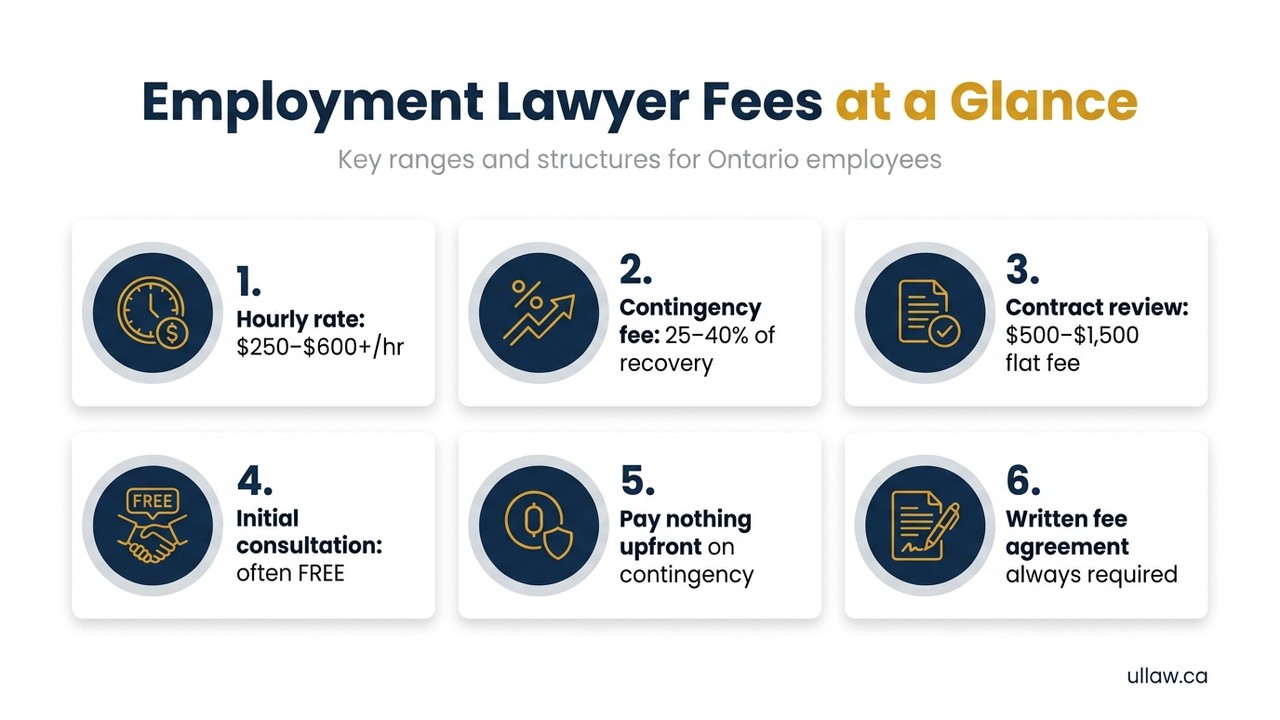
Typical Ontario ranges (not a quote for every file): hourly billing often $250 to $600+, plaintiff-side contingency commonly 25% to 40% of a monetary recovery, and contract reviews often a flat fee. UL Lawyers starts with a free consultation, then a written retainer before work begins. Do not sign a severance release first.
Call 905-744-8888 or email info@ullaw.ca. You can also book a free consultation or start on our employment law page.

Table of Contents
- What Is the Average Fee for an Employment Lawyer?
- How Much Does It Cost Just to Talk to an Employment Lawyer?
- How Much Do Employment Lawyers Charge in Canada?
- Types of Fee Structures: Which One Applies to Your Case?
- Contingency Fees and Access to Justice: Why This Matters
- How Much Does an Employment Lawyer Cost to Review a Contract?
- Transparency Is Important: What to Expect from a Reputable Firm
- Our Intake Process: What Happens When You Reach Out
What Is the Average Fee for an Employment Lawyer?
There is no single “average” fee for an employment lawyer in Ontario because the cost depends heavily on how the lawyer charges — not just how much. That said, here are the real-world ranges you can expect:
Hourly Rates
Most Ontario employment lawyers who bill by the hour charge somewhere between $250 and $600+ per hour, depending on their experience, the size of their firm, and the complexity of your file. Senior partners at large Bay Street firms often sit at the higher end; experienced plaintiff-side boutique firms and mid-size regional firms are typically more moderate.
Flat Fees
Some straightforward tasks — reviewing an employment contract, providing a written legal opinion, or drafting a demand letter — may be quoted as a flat fee. These can range from roughly $500 to $2,500+, depending on the scope of work.
Contingency Fees
For wrongful dismissal, constructive dismissal, and human rights claims, many Ontario employment lawyers work on a contingency basis: they take a percentage of what you recover, and you owe nothing if your matter does not result in a recovery. The typical contingency rate in Ontario runs from 25% to 40% of the amount recovered, though this varies by firm and file complexity.
What Affects the Fee?
- Complexity of the legal issues involved
- Strength of your case and likelihood of recovery
- Seniority and track record of the lawyer
- Stage of the matter (negotiation vs. litigation vs. trial)
- Whether HST and disbursements (court filing fees, expert reports, etc.) are included
Under the Law Society of Ontario rules, all fee arrangements must be fair, reasonable, and clearly communicated to clients in writing. Always ask for a written fee agreement before retaining anyone.
How Much Does It Cost Just to Talk to an Employment Lawyer?
The cost of an initial consultation with an employment lawyer in Ontario ranges from free to roughly $300–$500 for a paid one-hour session — but many plaintiff-side employment firms, including ours, offer a free initial phone or video consultation.
Why Do Many Employment Lawyers Offer Free Consultations?
Plaintiff-side employment lawyers are highly motivated to understand your case quickly. If your matter has merit and they can take it on contingency, a free intake conversation benefits both of you. It lets you assess the lawyer, and it lets the lawyer assess your file — without upfront legal fees where a contingency arrangement applies to you.
What Happens During a Free Consultation?
A good initial consultation typically covers:
- A brief summary of your situation (dismissal, contract issue, harassment, etc.)
- An honest assessment of whether you have a viable claim
- An explanation of your legal options and realistic outcomes
- A clear outline of how the firm charges and what the next steps would be
You are under no obligation to retain the lawyer after a free consultation. Think of it as a two-way interview.
Paid Consultations — When Do They Apply?
Some firms charge for consultations, particularly for nuanced matters like contract reviews, employment agreements before signing, or advice on human rights issues that may not lead to a contingency-eligible claim. If a consultation fee applies, it should be disclosed upfront and clearly. A paid consultation still represents tremendous value — a one-hour session can save you from costly mistakes.
How Much Do Employment Lawyers Charge in Canada?
Fees vary by province, but Ontario rates are broadly representative of what you’ll find across Canada’s major urban centres.
- British Columbia and Alberta: Similar hourly ranges to Ontario — roughly $250–$550/hr at experienced plaintiff-side firms.
- Quebec: Civil law system; rates are often somewhat lower but the legal framework differs significantly.
- Smaller provinces and territories: Rates can be lower, but access to specialized employment counsel may be more limited.
For employees in Ontario specifically, the Employment Standards Act, 2000 sets minimum entitlements — and understanding whether your situation involves only those statutory minimums or also common law reasonable notice (which can be far more valuable) is exactly the kind of analysis an employment lawyer provides. The gap between ESA minimums and full common law entitlements is often where the real value of legal help lies.
Types of Fee Structures: Which One Applies to Your Case?
Understanding the different ways employment lawyers can charge helps you choose the right fit for your situation — and ask the right questions.
1. Contingency Fee
You pay nothing upfront. The lawyer takes a percentage (typically 25–40%) of the settlement or award. This is the most common structure for wrongful dismissal and constructive dismissal claims. It aligns the lawyer’s interests directly with yours.
2. Hourly Billing
You are billed for the actual time spent on your file. Best suited for ongoing employment relationships (e.g., advising an employer), complex litigation, or matters where the outcome doesn’t involve a monetary recovery.
3. Flat Fee
A fixed price for a defined scope of work. Common for:
- Employment contract reviews
- Severance package assessments
- Preparing a human rights complaint
- Drafting a non-compete or non-solicitation opinion
4. Hybrid / Blended Arrangements
Some firms use a reduced hourly rate combined with a lower contingency percentage. This shares risk between lawyer and client and can work well for mid-complexity matters.
5. Legal Aid and Pro Bono
For human rights matters, Legal Aid Ontario may provide assistance if you meet the income threshold. Community legal clinics also offer free employment law advice to low-income Ontarians. Ask your lawyer whether these options apply to your situation.
Contingency Fees and Access to Justice: Why This Matters
One of the most important access-to-justice tools available to Ontario employees is the contingency fee arrangement. Without it, a wrongful dismissal lawsuit could cost a terminated worker tens of thousands of dollars in legal fees — before they see a single dollar of recovery.
Contingency billing levels the playing field. It means a long-tenured employee who was let go without proper notice can go up against a well-resourced employer without needing savings or a line of credit to fund litigation.
At the same time, the Law Society of Ontario regulates contingency fees to ensure they remain reasonable and proportionate to the result. Under Ontario’s rules, a written contingency fee agreement is required, and the fee must be fair given the risk the lawyer assumed, the complexity of the work, and the result achieved.
Before you accept any severance package, it’s worth using our free severance pay calculator to understand what your entitlements may look like — and whether legal help could meaningfully improve your outcome.

How Much Does an Employment Lawyer Cost to Review a Contract?
Contract reviews are one of the most common flat-fee services employment lawyers offer — and one of the most valuable investments you can make before you sign anything.
Typical Cost Range
In Ontario, a thorough employment contract review typically costs between $500 and $1,500, depending on the complexity of the agreement and the seniority of the role involved. Executive-level agreements with equity, bonuses, and restrictive covenants can run higher.
What Does a Contract Review Cover?
A skilled employment lawyer will examine:
- Termination clauses — are they valid under the Employment Standards Act, 2000, or do they illegally contract out of your rights?
- Non-competition and non-solicitation clauses — are these enforceable? Do they go too far?
- Bonus and commission clawback provisions — what are you actually entitled to on termination?
- Probation periods — are they properly structured?
- Confidentiality obligations — are they reasonable in scope?
A poorly drafted termination clause can be worth tens of thousands of dollars to you if it turns out to be unenforceable. Spending $500–$1,500 on a review before signing is almost always money well spent.
Transparency Is Important: What to Expect from a Reputable Firm
Fee transparency isn’t just good practice — it’s a professional obligation under the Law Society of Ontario’s rules of conduct. A reputable employment lawyer will:
- Explain all fee options clearly before you retain them
- Provide a written retainer agreement that sets out exactly how you’ll be charged
- Disclose any disbursements (out-of-pocket costs like filing fees or expert reports) separately
- Give you a realistic sense of potential outcomes without making guarantees
- Tell you honestly when your matter is not a good fit for legal intervention
If a lawyer is vague about fees, reluctant to put anything in writing, or pressures you to retain them immediately — those are red flags. You should feel comfortable asking any question about cost, and a good lawyer will welcome it.
Our employment law team believes that informed clients make better decisions. We walk through fees, process, and realistic expectations in plain language — because you deserve clarity, not confusion.
Our Intake Process: What Happens When You Reach Out
We know that picking up the phone or sending an email to a law firm can feel daunting. Here is exactly what to expect when you contact us:
Step 1 — Free Phone or Video Consultation
We start with a no-charge, no-obligation call or video meeting. You share your situation; we ask questions and listen. This usually takes 20–30 minutes.
Step 2 — Honest Assessment
We give you our candid view of your legal position, your options, and a realistic sense of what pursuing the matter might achieve — and cost. No spin, no pressure.
Step 3 — Fee Agreement
If we’re a good fit and you’d like to proceed, we provide a clear, written retainer agreement before any work begins. No surprises.
Step 4 — Your File, Your Way
We keep you informed at every stage, explain what’s happening and why, and always get your instructions before taking significant steps. You remain in control.
Not sure what your severance entitlements look like? Start with our free severance pay calculator — it takes two minutes and gives you a meaningful baseline before your consultation.
Talk to a UL Lawyers Team Member
Worried about the cost of getting legal advice? You should not have to face a workplace dispute alone. UL Lawyers starts with a free consultation and a written quote before work begins. Call 905-744-8888 or email info@ullaw.ca — and do not sign a release first.
You can also book a free consultation or visit our employment law page.