
Family sponsorship processing time in Canada is not one queue. IRCC splits files by category (spouse, parent, child) and by inland vs outland. Posted averages change; about half of applications take longer than the number on IRCC’s tool.
Quick answer: Check IRCC’s current processing-times tool for your category. A complete package is the main thing you control. You cannot pay to skip the queue. Delayed well past the posted average, returned, or refused? Call 905-744-8888 or email info@ullaw.ca. You can also book a consultation.
Understanding Canadian Family Sponsorship Timelines
Bringing your loved ones to Canada is an emotional marathon, and the waiting period is often the most gruelling part. It’s more than just a number on a government website—it represents months, or even years, of being apart from a spouse, parent, or child.
The key thing to understand is that Immigration, Refugees and Citizenship Canada (IRCC) doesn’t have one single queue. Different applications are funnelled into separate streams, each with its own service standards and backlog. For families across Ontario, from Burlington to the GTA, knowing which stream you’re in is vital for planning ahead.
Spousal Sponsorship: A Tale of Two Timelines
When it comes to sponsoring a spouse, the biggest fork in the road is whether the application is filed from inside Canada (inland) or outside Canada (outland). The gap in processing times between these two paths has become quite significant.
Let’s look at the numbers. As of July 23, 2025, sponsoring a spouse from outside Canada (for provinces other than Quebec) takes an average of 11 months. That’s pretty quick. But if your spouse is already in Canada and you apply through the inland stream, you’re looking at an average wait of 34 months. For those heading to Quebec, which has its own selection process, that inland timeline stretches to 38 months.
The chart below really highlights the stark difference in average spousal sponsorship wait times.
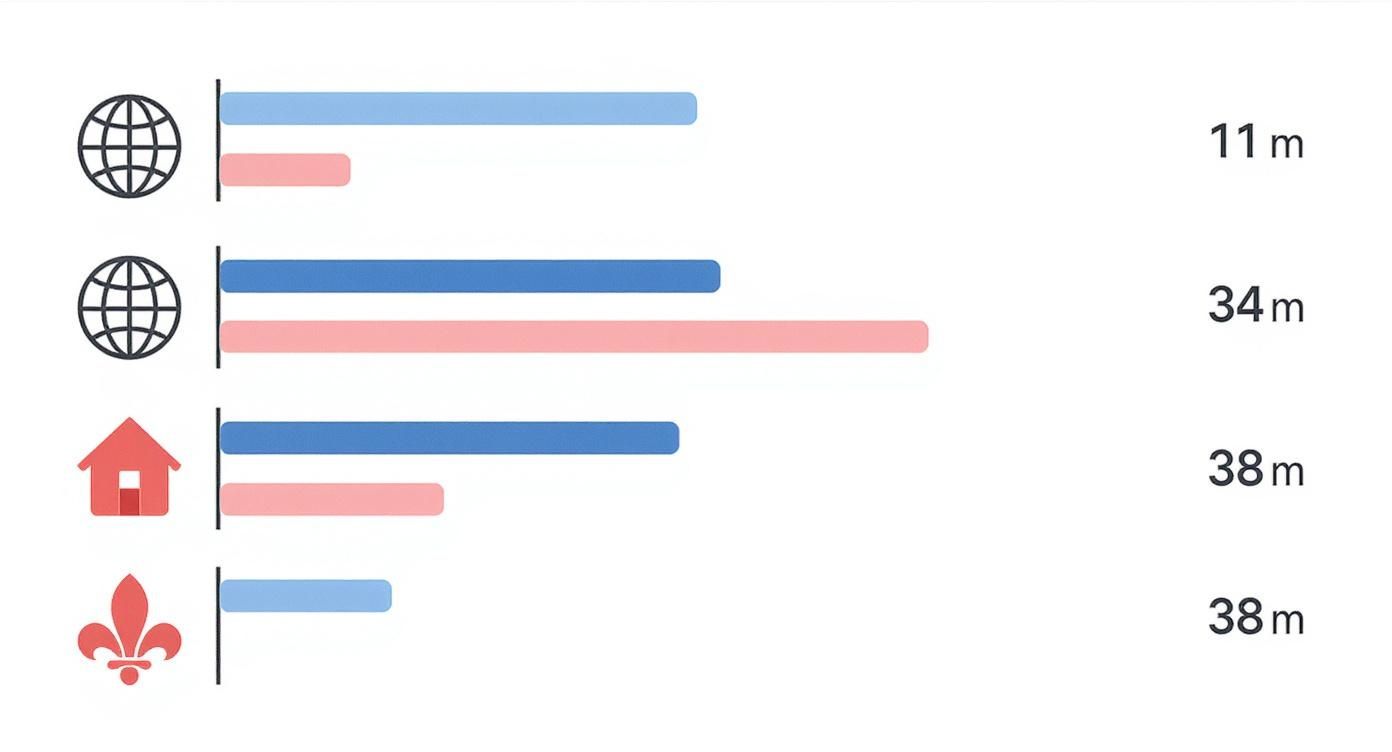
As you can see, the outland route is clearly the faster path on paper. However, many families choose the longer inland process for a very practical reason.
The “correct” path isn’t always the fastest one. For many couples, the ability for the sponsored spouse to get a work permit and stay in Canada during processing makes the longer inland route the only practical choice, despite the extended timeline.
These official figures give us a good baseline, but it’s important to remember they’re just averages. Your specific situation can be affected by a host of other factors. For a more detailed look at what goes into these calculations, you can explore our comprehensive guide on Canadian immigration processing times. Next, we’ll break down why these timelines can vary so much and what you can do to help keep your application on track.
Choosing Between Inland and Outland Sponsorship
When you’re sponsoring a spouse or common-law partner, one of the first big decisions you’ll face is whether to file an ‘inland’ or ‘outland’ application. This isn’t just a box to tick on a form; it fundamentally shapes the entire experience. It affects everything from how long you’ll wait to whether your partner can work in Canada during the process.
There’s no single right answer here. The best path forward really depends on your family’s specific situation and what you prioritise most.
Think of it like choosing between two different ways to travel. The outland route is like a direct flight—often faster, but you have to wait at your starting point until you get the green light to go. The inland route is more like a scenic train journey. It might take longer, but your partner gets to be with you in Canada and can even work while you wait to arrive at your final destination: permanent residence.
Understanding Inland Sponsorship
Inland sponsorship is specifically for couples who are already living together in Canada. To qualify, the person being sponsored must have a valid temporary status (like a visitor, student, or worker) and be living at the same address as their Canadian sponsor.
The biggest plus? The ability for your spouse to apply for an Open Work Permit. This is a game-changer for many families in Ontario. It means they can work for almost any employer in Canada while the permanent residence application is in the queue, offering huge financial and emotional relief.
But there’s a trade-off. This stability often comes with longer processing times and, crucially, travel restrictions. We strongly advise anyone with a pending inland application not to leave Canada. Re-entry isn’t guaranteed, and being denied at the border could put the entire sponsorship application at risk.
Exploring the Outland Sponsorship Path
The outland process is the standard route for couples where the sponsored partner lives outside of Canada. However, it can also be a strategic choice for partners who are already inside Canada but prefer the speed and flexibility this stream offers.
The main draw here is a potentially shorter wait. An analysis of real spousal sponsorship data from January to June 2025 showed outland applications were often processed significantly faster, with averages falling between 96 and 185 days. For comparison, inland applications in that same period averaged about 314 days. But “faster” doesn’t always mean “predictable”—some outland applicants were left waiting as long as 580 days.
The major downside is that your partner generally can’t work in Canada until they officially become a permanent resident. They can usually visit, but their stay is temporary. It’s vital to have a clear picture of the rules, so take some time in understanding visitor visa requirements for Canada.
The decision between inland and outland sponsorship is a strategic one. It requires balancing the need for speed against the need for your partner to remain and work in Canada. There is no one-size-fits-all answer.
Making the Right Choice for Your Family
So, how do you actually decide which path is for you? Start by asking yourselves these key questions:
- How important is speed? If getting the application approved as quickly as possible is your top priority and your partner can comfortably wait abroad, outland is often the better bet.
- Does your partner need to work in Canada? If having a second income is crucial for your family’s finances, the inland route with its Open Work Permit is almost always the more practical choice. We have a helpful guide on Bridging Open Work Permit eligibility if you want to learn more.
- Do you need travel flexibility? If your partner has family or professional commitments that require them to travel internationally without jeopardising their application, the outland process is far more accommodating.
Ultimately, this choice will impact your life for the next one to three years. Carefully weighing the pros and cons against your personal, financial, and professional needs is the only way to pick the sponsorship strategy that truly fits your goals.
Key Factors That Influence Your Sponsorship Timeline
Ever wonder why one family’s sponsorship application sails through while a nearly identical one seems stuck in limbo for months? It can feel random, but the processing time for family sponsorship in Canada is rarely a matter of luck. Several specific factors have a direct impact on how long you and your loved ones will wait for a decision from Immigration, Refugees and Citizenship Canada (IRCC).
Getting a handle on these variables is key. It helps you zero in on what you can actually control—like the quality of your submission—and set realistic expectations for the parts you can’t, such as government backlogs or the workload at a specific visa office. Let’s pull back the curtain on the main elements that can make or break your timeline.
The Completeness and Quality of Your Application
If there’s one thing you can do to influence your timeline, this is it. An incomplete or sloppy application is the number one cause of preventable delays. Think of it this way: your application package is the blueprint an IRCC officer uses to approve your family’s case. If pieces are missing or the instructions are a mess, they simply can’t build it.
It’s often the small, simple mistakes that send an application to the bottom of the pile:
- Missing Signatures: A forgotten signature on a single form can get your entire package sent back, forcing you to restart the clock.
- Outdated Forms: IRCC updates its forms from time to time. Using an old version is an instant rejection.
- Not Enough Proof: This is a big one, especially for spousal sponsorships. If you don’t provide strong evidence of a genuine relationship—things like joint bank accounts, photos together over time, or message logs—it raises red flags. This triggers a request for more information, easily adding months to your wait.
A meticulously prepared application is your best offence. Taking that extra hour to double-check every single detail can save you months of frustration. For anyone navigating the detailed requirements of Canadian immigration, getting professional guidance can be a game-changer. You can find out more about how a dedicated immigration law practice can help make sure your application is flawless from day one.
The Specific Visa Office Processing Your File
Not all IRCC offices operate at the same speed. Where your file is processed—whether it’s inside or outside of Canada—plays a massive role in your wait time. For example, an outland spousal application from the U.K. handled by the London visa office might have a completely different timeline than one from India processed through New Delhi.
This difference comes down to a few realities on the ground:
- Local Application Volume: Some offices are simply swamped with a higher number of applications, creating longer queues.
- Regional Conditions: Things like local security situations, country-specific verification procedures, and even the reliability of the local mail service can slow things down.
- Staffing and Resources: The number of officers and the budget allocated to a visa office can change, directly affecting how quickly they can get through their caseload.
You don’t get to pick which office handles your file, but knowing this variable helps explain why the average processing times you see online don’t always reflect what’s happening with your specific application.
The Complexity of Your Case
Every family’s situation is unique, and some stories naturally require a closer look from immigration officers. A straightforward application—say, a first marriage with no children and a well-documented relationship—will almost always be processed faster than a more complicated one.
The bigger the backlog at IRCC, the more pressure there is on officers to process simple files quickly. This means that any complication, no matter how small, can bump your application into a separate, longer queue for a more detailed review.
Here are a few things that can add layers of complexity and extend your processing time:
- Previous Marriages: Both you and the person you’re sponsoring have to provide clear proof that any past marriages are legally over.
- Admissibility Concerns: Any hint of a criminal record (even for something minor), a medical issue, or a security flag will automatically trigger a much deeper investigation.
- Dependants: Including dependent children, especially if they are from a previous relationship, means more paperwork and more steps for verification.
- Relationship Red Flags: Things like a large age gap, significant cultural differences, or a very short dating period can make an officer pause. They may ask for more proof or even schedule an in-person interview to confirm the relationship is genuine.
Sponsoring Parents, Grandparents, and Children: What to Expect
While sponsoring a spouse gets a lot of attention, the paths to bring parents, grandparents, or children to Canada come with their own unique timelines and hurdles. These streams are crucial for reuniting families, but they run on a completely different set of rules that can really change the family sponsorship processing time in Canada. It’s important to know what you’re getting into to set realistic expectations.
The journey to sponsor your parents or grandparents, for instance, is a marathon, not a sprint. It’s not just about filling out forms; it starts with a mad dash just to get a chance to apply.
The Parents and Grandparents Program (PGP) Lottery
Bringing a parent or grandparent to Canada through the Parents and Grandparents Program (PGP) is a bit of a nail-biter. The process kicks off long before Immigration, Refugees and Citizenship Canada (IRCC) ever sees your application, and the very first step is the toughest: the lottery-style intake system.
Every year, IRCC opens a short window for sponsors to submit an online “Interest to Sponsor” form. This creates a massive pool of applicants, and from that pool, a limited number of invitations are randomly drawn. Only those lucky enough to get an Invitation to Apply (ITA) can actually submit a full sponsorship application.
This system creates a lot of uncertainty.
- The Long Wait: You could be waiting for years just for an invitation. Many people submit their interest year after year without ever being chosen.
- The Short Window: The sign-up period is often incredibly brief, so you have to be ready to act the moment it opens.
- No Guarantees: Putting your name in the hat doesn’t mean you’ll ever get an invitation.
Once you finally get that invitation and submit your complete application, the official processing clock starts. Right now, the processing time for PGP applications is about 20 months for those outside of Quebec. But remember, the total time—from when you first expressed interest to your parents actually arriving—can be significantly longer because of that unpredictable lottery.
Timelines for Dependent and Adopted Children
Sponsoring a child might sound simple, but the timeline can shift based on the circumstances. The process looks different depending on whether you’re sponsoring your biological child or adopting a child from another country.
For a dependent child living outside Canada, the average processing time is currently around 10 months. This timeline generally holds for straightforward cases where you can easily prove your relationship with a birth certificate and other clear documents.
The smoothness of a child sponsorship application really comes down to the paperwork. Cases with clear, undisputed proof of parentage move much faster than those with missing records or complicated custody situations.
International adoption is a whole different ball game. It’s a much more complex journey that involves satisfying both Canadian immigration law and the legal system in the child’s home country. Because you’re dealing with two sets of laws, the wait times can be very unpredictable, often stretching out for several years. Key factors include:
- The adoption laws in the child’s country of origin.
- How long it takes to legally finalise the adoption there.
- The time needed for the Canadian immigration processing that follows.
Each of these sponsorship streams demands a unique strategy. With so much on the line, it’s always a good idea to get advice from professionals who know the ins and outs of each program. If you need help figuring out the best path forward, connecting with lawyers for immigration near me can offer the expert guidance needed to bring your family together in the Greater Toronto Area and across Canada.
How to Track Your Application and Understand Updates
Let’s be honest—the waiting period after you’ve sent in your family sponsorship application can be the most nerve-wracking part of the whole journey. Constantly wondering what’s happening can feel like a full-time job, but knowing where to look for updates gives you back a sense of control.
Thankfully, Immigration, Refugees and Citizenship Canada (IRCC) has tools that let you follow your application’s progress. Think of it as tracking a package, but one that’s infinitely more important. Knowing how to use these tools and what the updates really mean can turn a long, uncertain wait into a manageable process where you can see the small wins along the way.
Using the Official IRCC Application Tracker
Your first and most important stop for updates is the official IRCC online status checker. This portal gives you a bird’s-eye view of where your application is in the queue.
To log in, you’ll need a few key pieces of information from your application, like your Unique Client Identifier (UCI) or application number, along with some personal details. Once you’re in, you’ll get the latest official status on your file.

This is your direct window into IRCC’s system, designed to keep your information secure while providing crucial updates on your application’s progress.
Decoding Vague Status Updates
One of the biggest frustrations for families in Ontario is trying to figure out what the vague status updates actually mean. Seeing “In Progress” for months on end can be maddening. So, what’s really going on behind the scenes?
Here’s a quick breakdown of what those common statuses usually signal:
- Submitted: Your application package has arrived safely at IRCC, but an officer hasn’t opened it yet to check if it’s complete.
- In Progress: This is the big one—and often the longest stage. It means your file passed the initial completeness check and is now in line for a detailed review. This status can cover everything from background checks and medical reviews to an officer assessing your eligibility.
- Decision Made: An officer has made a final call on your application. Crucially, this status won’t tell you whether it was approved or denied. You’ll have to wait for an official letter or email for the final verdict.
Seeing an “In Progress” status is actually good news. It means your application wasn’t incomplete and sent back to you. The time spent in this stage varies wildly depending on your case’s complexity and the specific office’s workload, so hang in there.
When to Order GCMS Notes for a Deeper Look
What if your application seems stuck in limbo, well past the average family sponsorship processing time Canada for your category? If the online tracker isn’t giving you enough information, it might be time to look deeper. This is where GCMS notes come in.
GCMS (Global Case Management System) notes are essentially the complete file an immigration officer sees. When you request them, you get a detailed log of every single action taken on your application, including the officer’s personal notes, any concerns they’ve flagged, and the status of background checks.
It’s usually a good idea to order GCMS notes if:
- Your application has been “In Progress” for significantly longer than the posted processing times.
- You have a gut feeling something might be wrong but haven’t heard anything from IRCC.
- Your application was refused, and you need to understand the exact reasons why before you decide to appeal or reapply.
These notes can reveal if your file is held up on a specific security check or if an officer has a question they haven’t sent you yet. This kind of detailed insight is invaluable for figuring out what’s causing a delay and planning your next move.
Strategies to Avoid Common Application Delays
You can’t control the backlogs at Immigration, Refugees and Citizenship Canada (IRCC) or how busy a particular visa office is. What you can control is the application you send them. The single most powerful tool you have to influence your family sponsorship processing time in Canada is a well-prepared, thorough, and honest application. By building a “bulletproof” file from the start, you sidestep the unforced errors that lead to frustrating and totally preventable delays.
Think of your application package as the complete story of your relationship. Your job is to make that story so clear, organised, and compelling that the immigration officer is left with no unanswered questions.
Front-Load Your Application with Strong Evidence
Don’t wait for IRCC to come back asking for more information. Your application should paint a vivid and undeniable picture of a genuine relationship right from the beginning. This is absolutely critical for spousal sponsorships.
Gather compelling proof that shows the history and authenticity of your connection. Some of the best evidence includes:
- Financial Interdependence: Show joint bank account statements, shared utility bills, or proof of mutual financial support. This demonstrates a shared life.
- Social Recognition: Include photos with family and friends from different events over time, letters from loved ones who know you as a couple, and even social media posts that show your relationship is public.
- Consistent Communication: If you’ve ever lived apart, provide logs of your calls, video chats, and messages. This proves your connection remained strong despite the distance.
The stronger your evidence is upfront, the lower the chance an officer will need to hit pause on your file to issue a Request for Additional Information—a step that can easily add months to your wait time. For a detailed breakdown of what you’ll need, our comprehensive spousal sponsorship checklist is an excellent place to start.
Anticipate and Address Potential Red Flags
Every relationship is unique, and certain situations will naturally draw a bit more scrutiny from an officer. Rather than crossing your fingers and hoping they won’t notice a potential issue, it’s always better to address it head-on with a clear explanation and supporting documents.
Common red flags can include things like:
- Significant age differences between you and your partner.
- Previous marriages or divorces for either of you.
- Major cultural or religious differences that might seem unusual to an officer.
- A short relationship history before getting married or applying for sponsorship.
Proactively explaining a potential red flag in a cover letter shows you’re being honest and transparent. It lets you frame the story in your own words and provide important context, instead of forcing an officer to make assumptions.
For instance, if there’s a large age gap, you could include a detailed letter explaining how you met, what you have in common, and why your connection is genuine. If there was a complicated divorce in the past, make sure you include the final divorce certificate and a brief, clear explanation of the circumstances.
When to Seek Professional Legal Help
Many people successfully navigate the sponsorship process on their own. However, there are times when getting professional legal help is a smart, strategic move. An experienced immigration lawyer can be a game-changer, especially if your case has any complex elements.
A good lawyer can spot potential issues you might overlook, ensure every form is filled out perfectly, and help you put together a submission that is clear, convincing, and complete.
Ultimately, getting it right the first time is the absolute best way to avoid delays. A flawless application can save you months of stress and uncertainty, helping you reunite with your family as quickly and smoothly as possible.
Your Top Questions About Sponsorship Processing, Answered
Going through the family sponsorship process can feel like a marathon, and it’s natural to have a lot of questions pop up along the way. Let’s tackle some of the most common ones we hear from families in Ontario and across the country.
Is There Any Way to Speed Up My Application?
The short answer is no, you can’t pay a fee to jump the queue with Immigration, Refugees and Citizenship Canada (IRCC). The single best thing you can do to keep your application moving is to submit a perfectly prepared, complete package right from the start. Think of it as giving the officer everything they need, exactly how they need it, so they never have to hit pause on your file.
This proactive approach is your best defence against the most common delays, like requests for more information or, in the worst-case scenario, having your entire application sent back. In very rare, dire circumstances involving humanitarian and compassionate grounds, you can request an urgent review, but these are seldom approved and require extraordinary proof.
What if My Application is Taking Longer Than the Posted Times?
It’s easy to get anxious when you see the “average” processing time come and go. Remember, those timelines are just that—an average. By definition, about half of all applications will take longer than the posted time.
So, what could be causing the holdup? It could be anything from your file landing at a visa office with a big backlog, to specific complexities in your case that require a more detailed look. Even standard background checks can vary wildly in how long they take. If you’re really worried about a long delay, ordering your GCMS (Global Case Management System) notes can often provide a behind-the-scenes look at your file’s progress and pinpoint the cause.
Does Living in Ontario Change My Processing Time?
For federal sponsorship programs—like sponsoring a spouse or a child—it doesn’t matter whether you live in the GTA or a small town in Northern Ontario. IRCC processes these applications based on a national standard. The processing timeline hinges on whether you file from inside or outside Canada (inland vs. outland) and the specifics of your case, not which province you call home (with the notable exception of Quebec, which has its own process).
While waiting for the application to be finalised, many sponsors and applicants also have practical questions on their minds, such as whether Canadian healthcare covers visitors before permanent residency is granted.
If your family sponsorship processing time is well past IRCC’s posted average, or the file was returned or refused, call UL Lawyers at 905-744-8888 or email info@ullaw.ca. You can also book a free consultation.
Related UL Lawyers resources
- Spousal sponsorship checklist — relationship proof, forms, medicals, and police certificates before you file.
- Immigration law services — sponsorship, work permits, and IRCC refusals.