Losing your job is stressful. Losing your job while your immigration status depends on that employer can feel urgent and confusing.
If you are in Canada on an employer-specific work permit—often called a closed work permit—you have two problems to solve at the same time: your employment rights after termination and your immigration/work authorization options. The wrong first step can create status risk, weaken a severance claim, or make it harder to move to a new employer.
Quick answer: If you were fired or laid off on a closed work permit in Canada, do not start a new job until you understand the permit conditions. Review status, a new-employer filing, and severance together. Call 905-744-8888 or email info@ullaw.ca before you sign. You can also book a free consultation. Hire on immigration lawyers and employment lawyers. Peel files can start on immigration lawyer Brampton.
This guide explains the practical sequence UL Lawyers reviews when employment law and immigration status overlap.

Table of Contents
- Closed work permit job loss: the two-track problem
- What to do in the first 48 hours
- Can a temporary foreign worker be fired or laid off?
- Immigration status: what changes after termination?
- Changing employers on a closed work permit
- Employment rights: termination pay, severance, wages and discrimination
- If abuse, threats or unsafe work are involved
- Documents to gather before legal advice
- How UL Lawyers can help
- Official sources

Closed work permit job loss: the two-track problem
A closed work permit usually names a specific employer, job, location, or conditions. That means the immigration question is not only “Was the firing legal?” It is also “Can I keep working, and for whom?”
The employment-law track asks questions such as:
- Did the employer give proper notice or pay instead of notice?
- Does the contract limit severance, and is that clause enforceable?
- Are wages, vacation pay, commissions, bonuses, or expenses unpaid?
- Was the dismissal connected to illness, injury, pregnancy, disability, safety complaints, or discrimination?
The immigration track asks different questions:
- When does the current work permit expire?
- Are you still in status in Canada?
- Can you apply to change employers?
- Does a new employer need a Labour Market Impact Assessment (LMIA) or an LMIA-exempt offer?
- Is a vulnerable-worker open work permit, maintained status strategy, visitor record, study/work pathway, or permanent-residence step relevant?
You need both tracks reviewed together because a severance negotiation can affect timing, documents, and immigration planning.
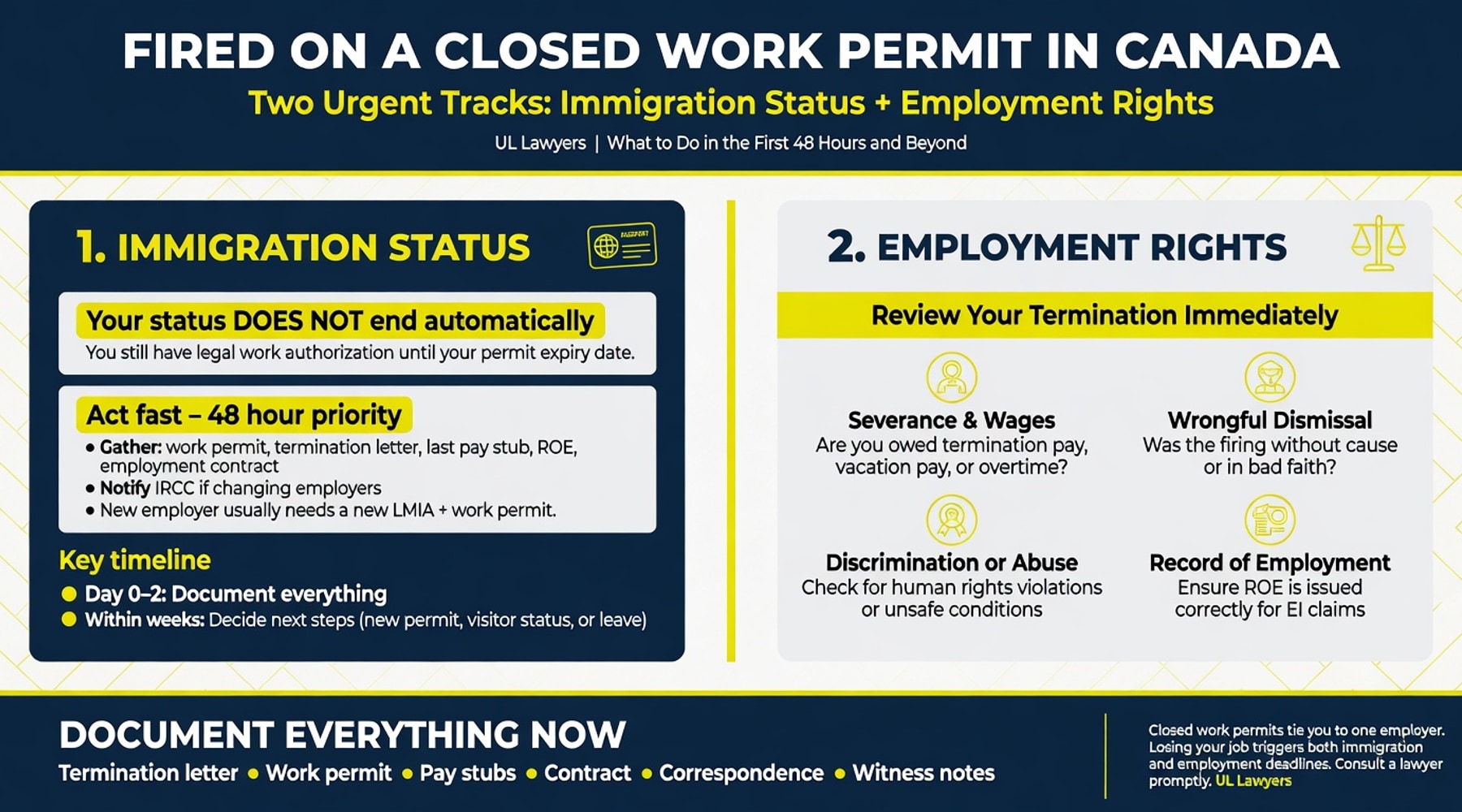
What to do in the first 48 hours
Your first moves should preserve options, not close them.
- Do not sign the release immediately. Many termination packages require you to give up claims in exchange for payment. Ask for time to review.
- Save the termination letter and work permit. Keep copies of the permit, employment contract, LMIA/offer documents, pay stubs, ROE information, and all termination communications.
- Check the expiry date and conditions on your permit. The job loss does not erase the words printed on the permit, but the employer-specific condition matters.
- Do not start with a new employer without authorization. IRCC guidance says changing employers generally requires applying to change work permit conditions.
- Write a timeline. Record when you were hired, when issues started, when termination happened, and what was said about your status or future in Canada.
- Preserve proof of mistreatment. If there were threats, unpaid wages, unsafe work, passport/document control, recruitment fees, or retaliation, save messages and names.
If the employer gave you a deadline to sign, that deadline is not the same thing as the legal deadline to bring a claim. It is often negotiable.
Can a temporary foreign worker be fired or laid off?
Yes, a temporary foreign worker can be laid off or dismissed, but the employer must still follow applicable laws. IRCC’s Help Centre says an employer can lay off or fire a foreign worker if it follows federal and provincial or territorial labour laws.
That does not mean the employer can ignore termination pay, unpaid wages, human rights duties, health and safety rules, or contractual obligations. In Ontario, foreign nationals can have rights under the Employment Standards Act, 2000, and broader common-law rights may also apply depending on the contract and circumstances.
The key distinction is this: employment law may require compensation, while immigration law controls whether you can keep working and for whom.
Immigration status: what changes after termination?
If you lose the job named on your closed work permit, you should treat the situation as urgent even if the permit expiry date is months away.
In many cases:
- you may remain in Canada until your temporary status expires, unless another issue affects status;
- you generally cannot continue working for the former employer after termination;
- you generally cannot start working for a different employer without proper authorization;
- a new employer-specific work permit, LMIA-supported application, LMIA-exempt application, or other status strategy may be needed;
- timing matters if your permit expiry date is close.
This is why “I was fired—do I need to leave Canada today?” is the wrong first question. The better question is: What is my current status, what work am I authorized to do now, and what application should be filed before anything expires?
Changing employers on a closed work permit
IRCC’s Help Centre states that to change employers, you must apply to change the conditions of your work permit. Before applying, you need information and documents from the new employer.
Practically, that may involve:
- a new job offer;
- a new LMIA, if the role requires one;
- an LMIA-exempt employer compliance submission, if the role is exempt;
- proof you still have valid temporary status;
- an application to change the employer, occupation, or conditions on your permit;
- waiting for approval or specific authorization before beginning the new job.
Do not rely on informal assurances such as “you can just start while it processes.” Unauthorized work can create serious future immigration problems.
Employment rights: termination pay, severance, wages and discrimination
A closed work permit does not erase employment rights.
Depending on the facts, you may need to review:
- ESA termination pay: minimum notice or pay instead of notice based on completed years of employment.
- ESA severance pay: possible where eligibility rules are met, including length of service and employer payroll/closure conditions.
- Common-law reasonable notice: potentially more than ESA minimums if the contract does not validly restrict entitlements.
- Unpaid wages and vacation pay: including final pay, overtime, public holiday pay, vacation, commissions, or promised bonuses.
- Human rights issues: if termination was connected to disability, pregnancy, family status, race, citizenship-related assumptions, country of origin, or other protected grounds.
- Reprisal issues: if you were fired after asking about legal rights, refusing unsafe work, reporting abuse, or requesting owed pay.
Use UL Lawyers’ Ontario severance pay calculator as a rough starting point, then review the result with your contract and immigration timeline. If you need other planning tools, the UL Lawyers legal calculator hub groups severance, overtime, vacation pay, disability, and injury calculators in one place.
If abuse, threats or unsafe work are involved
Some terminations are not just ordinary job loss. They may involve abuse, threats, unsafe work, document control, unpaid wages, or retaliation after the worker asks for help.
Canada’s temporary foreign worker rights guidance says temporary foreign workers have protected rights. IRCC also has an open work permit pathway for vulnerable workers who are experiencing abuse or are at risk of abuse in the context of employer-specific work.
Warning signs include:
- threats that you will be deported if you complain;
- being forced to perform duties outside the job you were hired for;
- unpaid wages, illegal deductions, or recruitment-fee issues;
- unsafe housing or unsafe work conditions;
- employer control over passport or immigration documents;
- termination after reporting abuse, injury, illness, harassment, or discrimination.
If any of these are present, gather evidence before systems access disappears: emails, texts, schedules, pay records, photos, names of witnesses, housing records, and copies of any document the employer asked you to sign.
Documents to gather before legal advice
Bring or upload:
- current and past work permits;
- passport identity page and status documents;
- employment contract, job offer, LMIA, or employer compliance documents;
- termination letter, release, and severance offer;
- pay stubs, T4s, commission/bonus records, vacation records, and ROE details;
- messages about termination, immigration status, job duties, threats, or new conditions;
- medical notes if illness, injury, disability, or accommodation was involved;
- job-search and new-employer records if you are trying to change employers;
- PR, Express Entry, PNP, or sponsorship documents if job loss affects a pending immigration plan.
The goal is to avoid solving only half the problem. A strong employment demand may still need an immigration-safe timeline.
How UL Lawyers can help
UL Lawyers can review the employment and immigration issues together so your next step does not create a new risk.
We can help assess:
- whether the severance offer is low or the release is too broad;
- whether a termination clause may limit or fail to limit your rights;
- whether unpaid wages, vacation pay, overtime, commissions, or bonuses are missing;
- whether discrimination, disability, injury, pregnancy, safety, or abuse issues change the strategy;
- whether your work permit status, expiry date, and new-employer plan need urgent immigration action;
- whether a vulnerable-worker open work permit or other status pathway should be considered.
If you were fired or laid off on a closed work permit in Canada, call 905-744-8888 or email info@ullaw.ca before signing a release, starting a new job, or assuming you have no rights. You can also book a free consultation. Start on immigration lawyers or employment lawyers. Peel clients can use immigration lawyer Brampton.
Official sources
-
IRCC Help Centre — Can I lay off or fire a foreign worker?
https://ircc.canada.ca/english/helpcentre/answer.asp?qnum=212&top=17 -
IRCC Help Centre — How do I change employers?
https://ircc.canada.ca/english/helpcentre/answer.asp?qnum=1201&top=17 -
Employment and Social Development Canada — Temporary foreign workers: Your rights are protected
https://www.canada.ca/en/employment-social-development/services/foreign-workers/protected-rights.html -
IRCC — Open work permit for vulnerable workers: Who can apply
https://www.canada.ca/en/immigration-refugees-citizenship/services/work-canada/special-instructions/vulnerable-workers/eligibility.html -
IRCC — Open work permit for vulnerable workers: How to apply
https://www.canada.ca/en/immigration-refugees-citizenship/services/work-canada/special-instructions/vulnerable-workers/apply.html -
Ontario Ministry of Labour — Your Rights as a Foreign National Under the Employment Standards Act
https://files.ontario.ca/mltsd-june-2021/mltsd-your-rights-as-a-foreign-national-en-2021-06-07.pdf
Related UL Lawyers resources
- Immigration lawyers — status, new-employer filings, and work-permit conditions.
- Immigration lawyer Brampton — Peel hire page for work permits and IRCC refusals.
- Employment lawyers — termination pay, severance, and ESA claims.
- Restoration of status — 90 days if a permit already expired.
This article is general information, not legal advice. Employment and immigration options depend on your contract, permit conditions, timing, status history, employer documents, and province. Get legal advice about your own situation before signing a release, changing employers, or making an immigration filing.