
Being fired while on medical leave in Ontario can feel like losing the floor beneath you. One day you are trying to recover, follow your doctor’s restrictions, and manage bills. The next day you are looking at a termination letter, a severance deadline, and questions about benefits or disability insurance.
The most important point is this: termination during medical leave is not automatically legal or illegal. The answer depends on why the employer acted, what medical information was available, whether accommodation was required, what leave rights applied, and whether the severance package reflects your full entitlements.
Quick answer: what should you check first?
If you were fired while on medical leave, check four things right away:
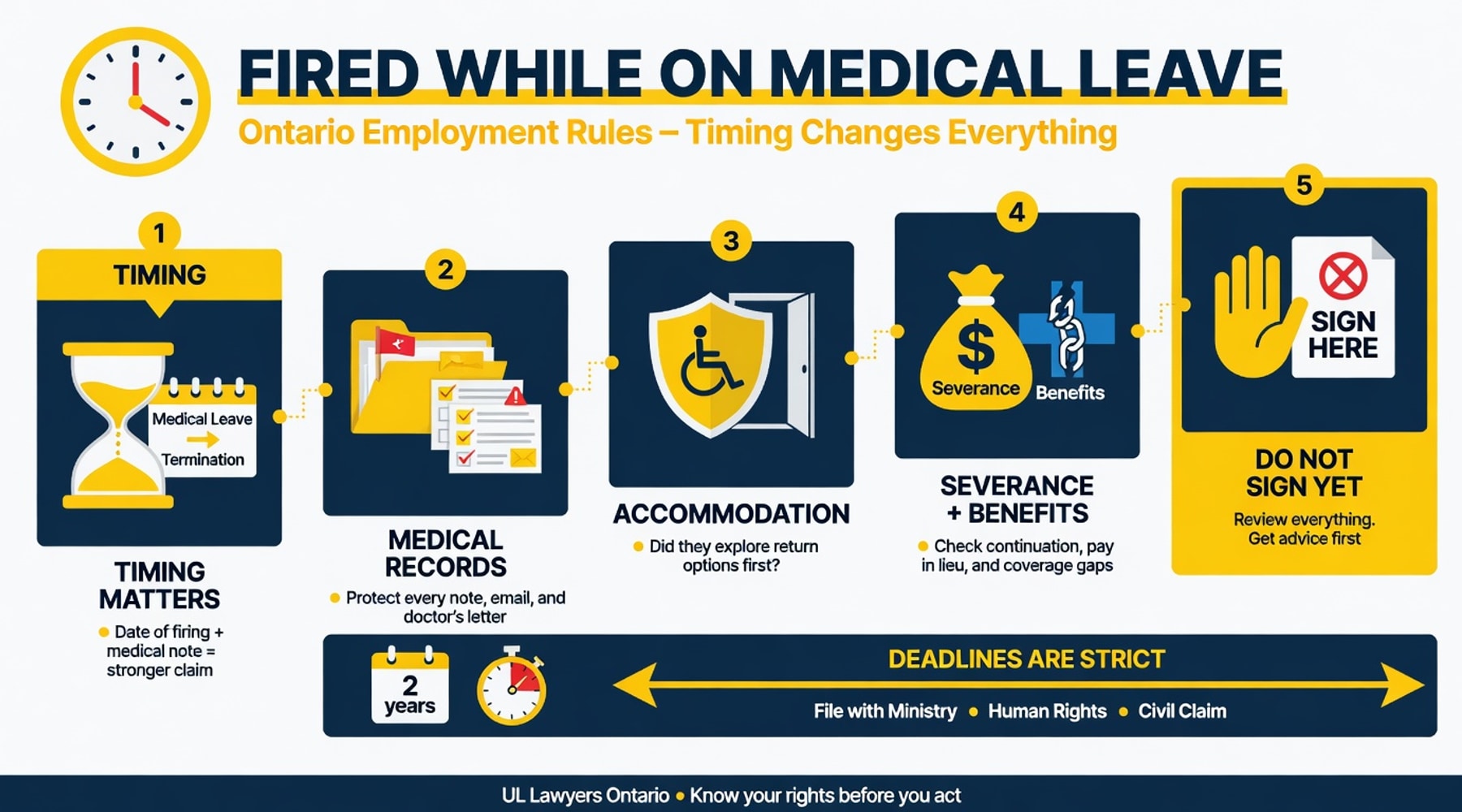
- The reason and timing. Did termination happen soon after you requested leave, provided restrictions, asked for accommodation, or disclosed a disability?
- Your leave rights. Were you on ESA sick leave, long-term illness leave, family medical leave, or another protected leave?
- Accommodation history. Did the employer explore modified duties, gradual return, schedule changes, remote work, or other reasonable options before ending the job?
- Your package and benefits. Does the offer continue wages, benefits, bonus, commissions, pension, STD, LTD, and other compensation long enough?
Do not treat a short signing deadline as the real legal deadline. Employers often ask for a quick signature, but your actual rights may be much broader than the first offer suggests.

Medical leave can involve more than one law
Several legal frameworks can apply at once.
Ontario’s Employment Standards Act provides certain job-protected leaves. For example, Ontario’s guide to sick leave explains that most eligible employees can take unpaid, job-protected leave for personal illness, injury, or medical emergency. Ontario also introduced long-term illness leave, which can provide unpaid, job-protected leave for eligible employees dealing with a serious medical condition.
Human rights law is separate. The Ontario Human Rights Commission explains the duty to accommodate disability-related needs to the point of undue hardship. That duty can apply even when an ESA leave is not the whole answer.
Employment contract and common-law rights also matter. Even if the employer says the termination is “without cause,” you may still be owed reasonable notice or pay in lieu of notice. For a broader overview, see UL Lawyers’ guide to wrongful dismissal in Ontario and our employment law services.
When firing during medical leave may be legally risky
A termination can raise red flags when:
- the employer fired you shortly after receiving a doctor’s note;
- HR asked intrusive medical questions and then ended your employment;
- you requested modified duties or a gradual return and the employer ignored the request;
- the employer said your restrictions were inconvenient or disruptive;
- your benefits were cut off while a disability claim was pending;
- your role was eliminated but similar work continued; or
- the severance offer treats you as if you were fully healthy and immediately employable.
These facts do not automatically prove discrimination or wrongful dismissal, but they are important. The closer the termination is to the medical leave or accommodation request, the more carefully the timeline should be reviewed.
Accommodation does not mean an employer must do the impossible
The duty to accommodate is powerful, but it is not unlimited. An employee usually needs to provide enough medical information to confirm restrictions, expected duration where known, and functional limits. The employer does not usually need a full diagnosis, but it does need enough information to understand what accommodation is being requested.
Reasonable accommodation might include:
- temporary modified duties;
- reduced hours or a gradual return-to-work plan;
- schedule changes for treatment appointments;
- remote or hybrid work where the job allows it;
- assistive devices or ergonomic changes;
- a different reporting process during recovery; or
- short extensions of leave supported by medical evidence.
The employer can ask for clarification and can refuse an accommodation that creates undue hardship. But inconvenience, impatience, or a preference to replace the worker is not the same as undue hardship.
What about frustration of contract?
Employers sometimes argue that a long medical absence has “frustrated” the employment contract. That means the employee is medically unable to return to work for the foreseeable future, making the employment relationship impossible to continue.
This is a fact-specific argument. It should not be used casually. A temporary leave, an uncertain prognosis, or a need for more medical information is not always enough. If the employer relies on frustration, the medical evidence, benefit-plan history, accommodation steps, and timing all need careful review.
This issue often overlaps with short-term disability or long-term disability benefits. If your employer ends employment while an STD or LTD claim is active, ask how benefits will continue and whether the insurer is taking a different position about your ability to work. UL Lawyers’ long-term disability services and short-term disability services may be relevant if the job loss and benefit denial are connected.
Do not sign before checking these documents
Before signing a release, gather:
| Document | Why it matters |
|---|---|
| Termination letter and severance offer | Shows the employer’s stated reason, deadline, and proposed compensation. |
| Employment contract and policy documents | May contain termination, benefit, bonus, and leave language. |
| Medical notes and restrictions | Helps assess accommodation and timing. |
| Emails or texts with HR/managers | Shows what the employer knew and when. |
| STD/LTD, benefits, and insurance correspondence | Reveals whether income-replacement or coverage issues are at risk. |
| Pay stubs, T4s, bonus/commission records | Helps calculate compensation beyond base salary. |
A severance package may need to account for salary, benefits, bonus, commissions, pension, car allowance, disability coverage, and the difficulty of finding comparable work while medically restricted. If the offer only covers the ESA minimums, it may be far below the full value of the claim.
Practical next steps
If this just happened:
- Ask for the termination letter, severance offer, ROE, and benefit-continuation details in writing.
- Do not sign a release until you understand its effect on employment, human-rights, and benefit claims.
- Keep your medical appointments and follow treatment recommendations.
- Save all messages about leave, restrictions, accommodation, benefits, and termination.
- Write a short timeline while events are fresh.
- Get legal advice before the employer’s offer deadline if possible.
UL Lawyers can review the termination package, accommodation history, medical-leave timeline, and any STD/LTD issues together. That combined review is important because a case like this is rarely just “employment” or just “disability”; it is often both.
If you were fired while on medical leave in Ontario, contact UL Lawyers for a free consultation before signing away rights or assuming the employer’s first offer is final.
Additional Practical Guidance After a Medical Leave Termination
The following guidance consolidates useful material from a closely related resource that covered the same medical-leave termination search intent. It is included here so readers can use one stronger, canonical guide rather than comparing overlapping articles.
Your World Turned Upside Down
When someone is fired during medical leave, the legal issue often gets buried under the emotional one. People worry about mortgage payments, medication coverage, how to explain the termination, and whether challenging it will make things worse. Those reactions are normal.
The more useful question is not, “Can they really do this?” The better question is, “What exactly are they relying on, and what rights do I still have?” In Ontario, those answers usually sit in three different places: minimum statutory protections, human rights protections, and dismissal damages.
Practical rule: Don’t assume one legal problem means one legal claim. In medical leave terminations, the strongest cases often involve more than one route.
A lot turns on details that feel small when you’re under stress. Who told you the job was ending. Whether you were asked for medical information. Whether there was any discussion of accommodation. Whether performance concerns only appeared after your leave started. Whether the employer suddenly used words like “restructuring,” “fit,” or “business needs.”
What makes these cases different
A routine dismissal file is usually about notice or severance. A medical leave dismissal can become much more complicated because the employer’s timing may raise questions about reprisal, discrimination, and accommodation.
That’s why calm documentation matters more than outrage. Anger is understandable, but evidence wins these files.
Here’s the basic lens to use right now:
- If the leave itself was protected, the ESA may matter.
- If disability or illness played any role, the Human Rights Code may matter.
- If the employer ended the relationship without proper notice or compensation, wrongful dismissal may matter.
What tends to work
Employees protect themselves best when they move quickly but don’t act impulsively. The right first steps are usually quiet ones: save documents, stop casual conversations, and get legal advice before signing anything.
What usually doesn’t work is arguing your whole case by email on day one. Long emotional messages rarely improve your position. Short, factual communication is safer.
Is It Legal to Be Fired on Medical Leave in Ontario?
The short answer is sometimes, but not because you’re sick or on leave. That distinction matters. Ontario law does not create a blanket rule that every termination during medical leave is illegal. It does create serious limits on why and how an employer can end the relationship.
Two layers of protection
Think of Ontario employees as having two shields here.
The first shield is the Employment Standards Act, 2000. Ontario’s legal framework includes job-protected leave rights. As noted in this discussion of ESA termination rights in Ontario, and in Ontario commentary discussing the statute, employees with 13 or more consecutive weeks of service who cannot work because of a serious medical condition may, as of June 19, 2025, take up to 27 weeks of unpaid, job-protected leave in a 52-week period. The leave weeks do not have to be consecutive, and a certificate from a qualified health practitioner is required to confirm the condition and expected period of absence, as explained in this Ontario analysis of medical leave protections and ESA changes.
The second shield is the Ontario Human Rights Code. If your medical condition qualifies as a disability, your employer cannot make disability a factor in the termination decision. They also have a duty to accommodate disability-related needs to the point of undue hardship.
Being fired during leave is not the same thing as being fired because of leave. The legal fight is often about proving the second point.
The real fight is about the reason
Employers rarely say, in writing, “We are terminating you because you took medical leave.” They usually give a cleaner explanation. Restructuring. Performance. Elimination of role. Business change. Cause. Frustration of contract.
Some of those reasons can be legitimate. Some are post-event labels.
Ontario employment guidance commonly treats these files as a sequence of questions:
- Was the leave protected under the ESA?
- Was the termination unrelated to illness or disability?
- Did the employer assess accommodation before ending employment?
That sequence matters because timing can create a powerful inference. If the dismissal happened during leave, right after a medical note, or close to an accommodation request, the employer may face a much harder time proving the decision had nothing to do with your condition.
A practical way to think about it is this. The closer the termination sits to your leave or disclosure, the more carefully the employer’s explanation will be tested. A restructuring label alone often won’t carry the day if the surrounding documents tell a different story.
Your First 48 Hours Five Critical Actions to Take
The first two days matter more than many realize. This is when evidence disappears, access gets cut off, and employees accidentally damage their own cases by speaking too freely or signing too soon.
What to do before anything disappears
-
Don’t sign the severance package yet If you received a termination letter, release, or offer with a deadline, pause. Employers often present these documents as routine. They are not routine if your dismissal happened during medical leave. Once you sign, you may give up claims you didn’t know you had.
-
Write a fresh timeline from memory Do this now, not next week. Start with the day your health issue affected work. Add the dates of doctor visits, medical notes, leave requests, benefit forms, conversations with HR, accommodation requests, and the termination itself. Memory hardens quickly around emotion and gets weaker on detail.
-
Preserve every communication Save emails, texts, meeting invites, Teams or Slack messages, letters, screenshots, benefit correspondence, and voicemail summaries. Forward what you lawfully can to a personal device or print copies. Don’t alter documents. Keep them in original form.
Your file is not built later in court. It starts the moment your employer gives a reason for the dismissal.
What not to do
-
Ask for your ROE and final pay records You want the Record of Employment, final paystub, benefits information, and anything showing how the employer coded the end of employment. Those documents can become important later, especially if the employer’s stated reason shifts.
-
Stay off social media and out of group chats Don’t post that you were “fired for being sick,” even if that’s exactly how it feels. Don’t vent in LinkedIn comments. Don’t joke in text threads about being unable to work forever. Context gets stripped out later, and employers do use public and semi-public posts defensively.
A few more practical cautions belong in this window:
- Keep medical follow-up consistent: Continue treatment and attend appointments. Gaps can create avoidable disputes about your condition or work capacity.
- Store documents outside work systems: If everything sits in your company inbox, you may lose it without warning.
- Use neutral language with HR: You don’t need to prove your whole case immediately. A short acknowledgement is enough.
- Avoid phone-only discussions: If a manager calls, take notes and send a brief follow-up email confirming the main points.
One immediate decision that matters
If the employer says the deadline is urgent, treat that as a reason to get advice faster, not as a reason to sign faster. Tight deadlines are common. They do not necessarily mean the offer is fair or that the legal analysis is simple.
Navigating Your Three Legal Pathways in Ontario
Medical leave terminations often involve three separate pathways, and they serve different purposes. People lose their advantage when they assume all forums do the same thing. They don’t.
Path one under the ESA
An ESA route is often the most direct place to look when the problem is reprisal for taking protected leave or failure to provide statutory minimum entitlements. It focuses on employment standards, not the full range of common law damages.
This path may suit a case where the core issue is straightforward. The employee took a protected leave. The employer ended the job because of that leave, or failed to meet minimum obligations. It’s less about broad damages and more about enforcing baseline rights.
Path two at the Human Rights Tribunal
The Human Rights Tribunal of Ontario is the main forum when disability discrimination is the central issue. This route becomes especially important if the employer failed to explore accommodation, ignored restrictions, or treated your medical condition as a negative factor.
Many employees misunderstand the proof problem. You usually don’t need to show disability was the only reason for termination. The practical issue is whether it was a factor. Timing, requests for accommodation, changed treatment after disclosure, and unexplained hostility can all matter.
If your employer says the dismissal was for a non-medical reason, the question becomes whether the documents support that explanation or undermine it.
Path three in a wrongful dismissal lawsuit
A civil lawsuit is often the route for common law notice, larger severance disputes, and claims that go beyond ESA minimums. In these cases, the financial stakes can become more significant.
Ontario commentary on case law shows why employers treat these cases seriously. In one Superior Court decision discussed in this analysis of termination during medical leave and damages, an employee terminated while on leave was awarded nine months’ salary in damages, measured from January 31, 2016 to October 31, 2016, with adjustments for amounts already paid under the ESA. The point is not that every case gets the same result. The point is that termination during leave can expose an employer to meaningful notice damages if it cannot prove a valid, non-disability-related basis for dismissal.
Which route fits which goal
Here is the practical comparison:
| Pathway | Best when the main issue is | Typical focus |
|---|---|---|
| ESA claim | Protected leave rights or minimum standards | Reprisal analysis, statutory rights, minimum pay |
| HRTO application | Disability was a factor, accommodation failed | Discrimination, accommodation, Code remedies |
| Wrongful dismissal lawsuit | Notice or severance is inadequate | Common law notice, compensation, broader damages |