
Signs of constructive dismissal in Ontario include a unilateral pay cut, demotion, stripped duties, or a poisoned workplace that forces you out. The law can treat that resignation as a firing — but resigning too soon, or staying too long without objecting, can wreck the claim.
Quick answer: Do not quit on the spot. Object in writing, keep working if you can, and get advice before you resign. Call 905-744-8888 or email info@ullaw.ca. You can also book a consultation or run a first estimate on the severance pay calculator.
What happens when your employer changes the game so much that you feel you have no choice but to quit? You haven’t been fired, but staying feels impossible. This is the heart of constructive dismissal—a situation where your employer’s actions essentially force you to resign.
This guide will break down the common signs of constructive dismissal in Ontario, so you can recognize them and understand your rights.
What is Constructive Dismissal in Ontario?

Often called a “disguised dismissal,” constructive dismissal happens when your employer makes a significant, negative change to a core part of your job without your agreement. Even though you’re the one who officially resigns, Canadian law sees it differently. It views your employer’s actions as so severe that they’ve effectively terminated your employment.
Think of it like this: your employment contract is the blueprint for your job. If your employer suddenly decides to remove a critical support beam—like drastically cutting your pay or demoting you without cause—the whole structure is compromised. In legal terms, this action shows your employer no longer intends to honour the original deal, essentially breaking the contract.
The Employee’s Dilemma
From your perspective, you’re backed into a corner. You can either accept the new, often terrible, conditions or walk away. When these changes are significant enough, the law acknowledges that your resignation wasn’t a free choice. It was a forced decision, a direct result of your employer’s actions.
This is a crucial protection under Ontario employment law. It provides a legal remedy for employees who feel they’ve been pushed out the door, recognizing that a dismissal doesn’t always come in a formal termination letter. Figuring out if your circumstances fit this legal test is the first step in protecting your rights.
Key Things a Court Will Look For
Not every change at work qualifies. To build a case for constructive dismissal in Ontario, the situation has to meet a specific legal standard. Courts will examine whether the employer’s action was a fundamental breach of the employment contract.
Here are the core elements that must be present:
- A Fundamental Change: The alteration must strike at the very root of your job. This could involve your salary, core duties, title, reporting structure, or even your work location.
- A Unilateral Move: The change must be imposed by the employer without your consent or proper legal notice.
- A Forced Resignation: The new reality must be so unacceptable that any reasonable person in your shoes would feel they had no other option but to leave.
Minor tweaks to your daily routine or small inconveniences won’t cut it. The change has to be substantial and damaging to your role. Understanding these nuances is key to navigating this complex area of law and protecting your career.
How Do You Prove Constructive Dismissal in Ontario? The Legal Test
Feeling like you’re being forced out of your job is a deeply unsettling experience. But in the eyes of Canadian law, that feeling has to meet a specific standard set by the Supreme Court of Canada. We’re not talking about a bad week or a minor disagreement; we’re talking about your employer fundamentally shattering the terms of your employment.
To prove constructive dismissal, Canadian courts apply a crucial two-part test. For a claim to be successful, your situation has to satisfy both parts. Think of it as a legal filter that separates typical workplace friction from actions that truly break the employment contract.
Part One: A Serious Breach of the Contract
First, a court has to pinpoint a specific action—or a string of actions—that constitutes a serious breach of your employment contract.
This breach could be of an express term, which is something written down, like your salary, job title, or work location. Or, it could be a breach of an implied term—an unwritten but legally understood obligation, such as the duty to maintain a safe and respectful work environment.
Sometimes, a single, major change is enough. For instance, an employer who unilaterally slashes an employee’s pay by 20% has clearly violated a core term of the contract. Other times, it’s not one big event but a series of smaller, negative changes that pile up over time, creating what lawyers call a “cumulative breach.”
The key question is an objective one: Did the employer’s actions, viewed reasonably, fundamentally change an essential part of your job without your agreement? It’s not about what the employer intended; it’s about the real-world impact of their decisions.
Part Two: A Reasonable Person’s Perspective
Once a serious breach is established, the second part of the test kicks in. The court then asks: would a reasonable person in the same position believe the employer no longer intended to honour the original employment contract?
This is a critical step. It shifts the focus from your personal feelings to an objective standard. The law needs to know if someone else in your shoes—with your role, experience, and circumstances—would also conclude that the relationship was effectively over. This standard protects both sides: it prevents claims based on oversensitivity while still protecting employees from genuinely intolerable work situations.
Let’s look at a few examples:
- A demotion in title but not pay: This is definitely upsetting. But if your core responsibilities and salary haven’t changed, a court might find that a reasonable person wouldn’t see it as a fundamental breach.
- A transfer to a new team with a tough manager: While unpleasant, this likely won’t meet the test unless it’s accompanied by a significant loss of status, pay, or key duties.
- A huge increase in workload without any support: If the new demands make your job impossible to perform and you’re being disciplined for it, a reasonable person would probably agree that the employer has broken the original deal.
If your employer’s actions are severe enough to pass this two-part test, the law treats your resignation as a termination. This is why constructive dismissal is often considered a form of wrongful dismissal. To learn more about your rights in these situations, check out our guide on what is wrongful dismissal in Ontario explained.
Common Signs of Constructive Dismissal You Cannot Ignore
Constructive dismissal rarely happens with a clear, formal announcement. It’s usually a slow burn—a series of actions by your employer that chips away at your role until staying becomes impossible. Recognizing these red flags is the first, crucial step to protecting your rights as an employee in Ontario.
While every case is different, Canadian courts have seen certain patterns emerge time and again. These aren’t just minor workplace frustrations; they are significant, unilateral changes that go right to the heart of the job you agreed to do.
A Significant Reduction in Pay or Compensation
Your paycheque is arguably the most fundamental part of your employment contract. When an employer suddenly slashes your pay without your agreement, it’s one of the most glaring signs of constructive dismissal. It’s like they’ve decided to tear up your financial agreement and write a new one all by themselves.
Of course, the change has to be significant. While there isn’t a strict magic number, Ontario courts have often found that pay cuts of 15% to 20% or more are substantial enough to be considered a breach of your contract. A small tweak to a commission structure might not be enough, but a major drop in your earnings can make your job financially unsustainable overnight.
A Demotion or Major Change in Status
Another huge red flag is a demotion. This is about more than just a new job title; it’s a real loss of responsibility, authority, or prestige. Your employer can’t just decide to move you from a management position to an entry-level role and expect you to simply accept it.
Here’s what that could look like in the real world:
- A department manager is suddenly reassigned to a role with no one reporting to them.
- A top-performing sales executive has their most lucrative accounts or territory given to someone else.
- A project leader is pulled off all their key initiatives and left with minor administrative busywork.
Even if your salary stays the same, a serious hit to your status can fundamentally change the job you were hired for, potentially giving you grounds for a claim.
The legal test essentially follows a clear path: an employer’s action leads to a serious breach of the employment contract, which in turn forces the employee to resign.
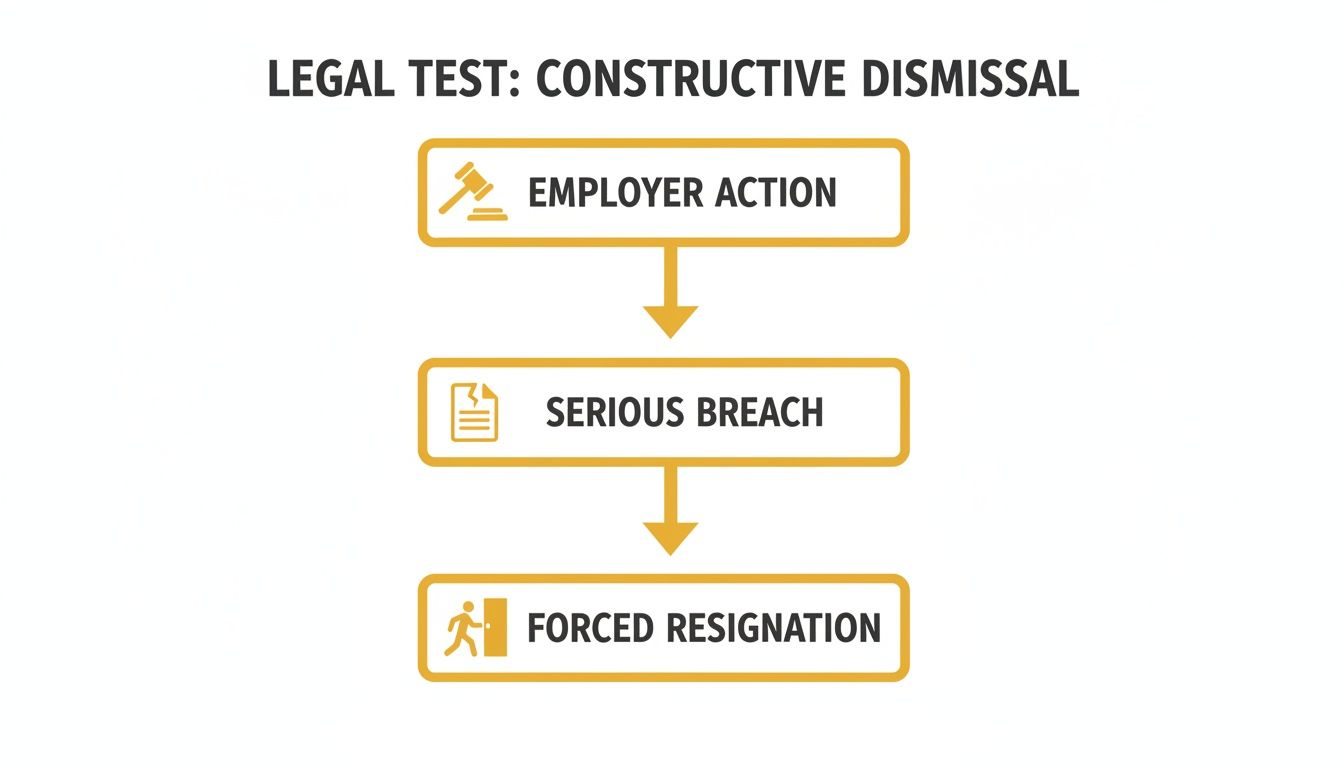
This flowchart shows the chain of events the courts look for—it all starts with a unilateral decision from the employer that is so severe it effectively breaks the agreement.
In fact, one-sided changes to core job terms are a leading cause of constructive dismissal claims in Canada. Pay cuts and demotions are particularly powerful arguments. A recent Ontario Superior Court case, McFarlane v. King Ursa Inc., awarded an employee over $290,000 after his employer demoted him, slashed his pay, and drastically altered his duties. This ruling shows just how seriously courts take the damage caused when an employer’s actions force an employee out the door. You can read more about this constructive dismissal ruling to see the legal reasoning behind it.
A Forced Relocation or Transfer
Your workplace location is a pretty big deal. If your employer suddenly tells you that you have to move to a new office in a different city, it could be a case of constructive dismissal.
It all comes down to what’s reasonable. A move to a new building a few kilometres down the road probably won’t cut it. But a mandatory transfer from Burlington to Ottawa, forcing you to uproot your entire life? That’s a fundamental change to your working conditions, especially if relocation was never on the table for your role.
A Hostile or Poisoned Work Environment
Sometimes, constructive dismissal has nothing to do with your pay or title. It’s about the workplace itself becoming so toxic that you can’t continue working there. This is what’s known as a “poisoned work environment,” and it can be caused by relentless harassment, bullying, or discrimination.
This isn’t about dealing with a grumpy boss or having a few bad days. It’s a persistent and severe pattern of conduct that makes the workplace humiliating, unsafe, or hostile. Every employer has a legal duty to provide a safe work environment. Failing to stop serious harassment is a breach of that duty.
Is It Constructive Dismissal? Common Scenarios in Ontario
It can be tough to know where the line is. This table offers a quick comparison to help you figure out if what you’re experiencing might meet the legal threshold in Ontario.
| Employer’s Action | Likely Constructive Dismissal (If Unilateral) | Unlikely to Be Constructive Dismissal |
|---|---|---|
| Compensation Change | A 25% salary reduction imposed immediately. | A temporary freeze on annual bonuses due to company performance. |
| Role and Duties | A senior manager is stripped of all reports and assigned entry-level tasks. | A minor change in daily duties that aligns with your overall role. |
| Work Location | A mandatory transfer from Mississauga to Thunder Bay with no relocation support. | A move to a new office building in the same city. |
| Work Environment | Ignoring documented complaints of serious harassment from a supervisor. | A personality conflict with a single colleague. |
If your employer has made any of these fundamental changes to your job without your consent, you may have effectively been dismissed. It’s critical to understand your legal options before you make any moves.
When Workplace Changes Are Not Constructive Dismissal
Not every unwelcome change at work crosses the legal line into constructive dismissal. Ontario law gives employers reasonable leeway to run their business, including making routine adjustments to day-to-day operations. For a change to qualify as a breach of your employment agreement, it has to be substantial — something that fundamentally rewrites the core of your job, not just an inconvenience.
Legitimate Business Decisions
Where is the line between a legitimate business decision and a fundamental breach of contract? It comes down to scale and impact. Changes that typically do not qualify as constructive dismissal include:
- Minor adjustments to your duties: Being asked to take on a new task that fits within the general scope of your role.
- Small changes in reporting structure: A reorganization that moves you under a new manager while your title, pay, and status stay the same.
- Fair performance management: Being placed on a reasonable performance improvement plan (PIP) with clear, achievable goals.
- Lateral transfers: Being moved to a similar position in another department with comparable pay, status, and responsibilities.
The key difference is the impact. A minor tweak is part of business. A complete overhaul of your employment terms is a potential breach.
The Role of Your Employment Contract
Your employment contract is the single most important document here. A well-drafted contract can explicitly give your employer the right to make certain changes — changes that might otherwise look like constructive dismissal. A valid temporary-layoff clause is a common example: if the clause is enforceable and the employer follows its terms, it is much harder to argue the layoff was a constructive dismissal.
Recent Ontario court decisions have repeatedly confirmed that a clear, specific contract defines the rules of the employment relationship. Your rights are a product of both employment law and the specific agreement you signed. Our guide to notice and severance rights in Ontario offers more on your entitlements.
When a Toxic Work Environment Becomes Constructive Dismissal
Sometimes, the clearest signs of constructive dismissal aren’t found on your pay stub or in a revised job description. You feel them in the atmosphere, the day-to-day reality of your workplace. When an environment turns so hostile, harassing, or psychologically damaging that staying becomes unbearable, the law may see it as a “poisoned work environment.”
This isn’t about the occasional bad day or not getting along with a particular manager. We’re talking about a severe, ongoing pattern of behaviour that chips away at your dignity and well-being. Every employer in Ontario has a core responsibility—an implied duty—to ensure the workplace is free from bullying and harassment. If they drop the ball on this, they’ve breached your employment contract just as significantly as if they had arbitrarily cut your salary in half.
From Bad Culture to a Legal Breach
So, when does a toxic atmosphere cross the line and become a legal basis for constructive dismissal? The conduct has to be so serious that any reasonable person in your shoes would feel they had no choice but to leave. It’s a high standard, but it’s met more often than many people realize.
Here are a few real-world scenarios that could build a case for a poisoned work environment in Ontario:
- Relentless Bullying or Harassment: Think constant yelling, demeaning comments in front of colleagues, professional sabotage, or being deliberately isolated from the rest of your team.
- Unchecked Discrimination: If you’re subjected to ongoing discrimination based on your race, gender, disability, or another protected ground under the Ontario Human Rights Code, and your employer looks the other way.
- Ignoring Safety Issues: An employer who repeatedly dismisses legitimate complaints about workplace safety, putting you in either physical or psychological harm’s way.
The key is the cumulative effect. A single inappropriate comment probably isn’t enough. But a relentless campaign of harassment that your employer is aware of—and does nothing to stop—can legally transform your resignation into a forced one.
Documenting the Intolerable
Proving a poisoned work environment can be trickier than pointing to a 25% pay cut, simply because it’s built on experiences that can feel subjective. This is why meticulous documentation is your most powerful tool. Your mission is to build an objective record that shows a persistent, undeniable pattern of mistreatment.
A toxic environment is often rooted in widespread unethical behavior in the workplace, which can be a cornerstone of a constructive dismissal claim. Keeping a detailed journal is the best way to protect yourself.
Start logging specific incidents. For each one, be sure to note:
- Date and Time: When did it happen?
- What Happened: Write down exactly what was said or done.
- Who Was Involved: Name the person responsible and anyone who saw or heard it.
- Your Response: How did you react? Did you report it? To whom?
- Employer’s Action (or Inaction): Crucially, document what management did—or failed to do—in response.
This detailed log turns a general feeling of being mistreated into a concrete timeline of events, giving you the hard evidence needed to build a strong legal case.
Your Action Plan If You Suspect Constructive Dismissal

Realizing you might be facing constructive dismissal is one thing, but what you do next is absolutely critical. It’s easy to act on emotion or impulse, but a rash decision can unfortunately undermine your entire case. To protect your rights, you need to be strategic and deliberate.
Think of this as a critical moment where every move matters. The objective isn’t to react emotionally but to make informed choices that keep all your legal options on the table. Here’s a clear roadmap for what to do if you believe your employer is trying to force you out.
Document Everything Meticulously
Your memory isn’t good enough for a legal claim; you need a paper trail. Start keeping a detailed, private log of every incident, change, or conversation that contributes to the hostile work environment. This documentation will be the most powerful tool you have.
For every entry, be sure to include:
- The Date and Time: Pinpoint when the event took place.
- Who Was Involved: Note everyone present and their job titles.
- What Happened: Give an objective description of the event or conversation. Use direct quotes if you can remember them.
- The Impact on You: Briefly explain how the change affected your job, your duties, or even your well-being.
Make sure you keep copies of any relevant documents—emails, memos, updated job descriptions, or negative performance reviews. Store them somewhere safe and personal, like a home computer or a personal cloud account, never on a company-owned device.
Object to the Changes in Writing
If you stay silent, your employer can later argue that you accepted the new reality. Whenever a significant change is forced upon you, you must formally object to it in writing. This is a vital step that shows you never agreed to the new terms of your employment.
Your written objection should be professional and direct. Clearly state that you do not accept the unilateral change—be it a pay cut, a demotion, or a transfer—and that you view it as a breach of your employment agreement. It’s often wise to add that you are prepared to continue working under your original terms while you assess the situation.
This simple act puts your employer on formal notice and creates a clear record of your protest. If you don’t object in a timely manner, the company could argue that by continuing to work without complaint, you “condoned” or accepted the change.
Do Not Resign Immediately
This is the biggest mistake employees make. They get fed up and quit on the spot. While the whole point of constructive dismissal is feeling like you have no choice but to leave, resigning prematurely can destroy your case before it even starts.
Quitting your job is a serious decision with massive financial and legal implications. Your resignation should be the very last step, taken only after you’ve received legal advice and are ready to formally claim you were constructively dismissed. By staying put (while objecting in writing), you keep your income stream and give yourself the time to build a solid case with professional guidance.
Seek Legal Advice Before You Act
Before you send that written objection, and definitely before you think about resigning, you need to speak with an experienced Ontario employment lawyer. They can look at the details of your situation, compare it to the legal test for constructive dismissal, and give you an honest assessment of your chances.
A lawyer will help you:
- Evaluate Your Evidence: They’ll tell you if your documentation is strong enough to build a winning case.
- Craft Your Objection: They can help you word your protest perfectly to protect your legal standing.
- Navigate Severance: They can explain what you’re entitled to and show you how to negotiate a severance package, which is the ultimate goal of a constructive dismissal claim.
Getting this kind of expert guidance is indispensable. Going it alone is a huge risk, especially as workplace disputes are becoming more common. In fact, the Canadian Human Rights Commission has seen a jaw-dropping 2,000% increase in demand for certain federal dispute resolution services, many tied to termination issues. You can read more about these workplace dispute trends in Canada in their latest report.
Understanding Your Remedies and Legal Options
So, what happens if you can prove you were constructively dismissed? The moment you do, Ontario law treats your resignation as if your employer had fired you without cause. This is a crucial distinction because it means you’re entitled to compensation, just as you would be in a wrongful dismissal case.
This compensation is often called a severance package, and it’s built around the idea of “reasonable notice.” It’s important to understand that this isn’t just about the bare minimums set out in employment legislation. We’re talking about a much more substantial entitlement rooted in Canadian common law.
Common Law Reasonable Notice
Think of reasonable notice as a financial bridge. Its entire purpose is to support you financially while you look for a new job that’s comparable to the one you were forced to leave. When determining the length of this bridge—how many months of pay you’re owed—an Ontario court will look at a few key things.
They consider factors like:
- Your Age: Courts recognize that it can be tougher for older employees to find new work, so they often award longer notice periods.
- Your Role: Were you in a highly specialized or senior position? If so, finding a similar role will likely take longer, and your entitlement will reflect that.
- Your Length of Service: Loyalty matters. The more years you dedicated to the company, the longer your notice period will generally be.
- The Availability of Similar Jobs: The court also looks at the current job market. If opportunities in your field are scarce, that can increase your notice period.
This common law entitlement almost always provides for more than the minimums laid out in the Employment Standards Act, 2000. While you can learn about those basic requirements in our guide to termination pay under the Employment Standards Act, remember that your true entitlement in a constructive dismissal claim is usually far greater.
A successful constructive dismissal claim does more than just validate what you went through—it opens the door to significant financial remedies. The law acknowledges the very real hardship that comes from being forced out of your job, and the compensation is designed to offset that damage.
Other Potential Damages
On top of pay in lieu of notice, you might be able to claim other damages. For instance, if your employer’s conduct was particularly cruel, dishonest, or unfair throughout this process, you could be awarded “bad faith” or “moral” damages. This is compensation specifically for the psychological distress caused by their egregious behaviour.
Canadian employment law is very clear on this: when an employer makes a fundamental change to your job without providing proper notice, they are exposing themselves to serious legal risk. If they can’t prove they had a legitimate reason for their actions, they open the door to a constructive dismissal claim, which can result in substantial common law damages—often equating to many months of pay, and sometimes even six-figure awards for those in senior roles.
The Two-Year Clock and the Risk of Condonation
Ontario’s Limitations Act gives you two years from the date of the major change to file a lawsuit for constructive dismissal. The clock starts the moment your employer makes the breaching change, not the moment you finally resign.
But the two-year deadline is not your real timeline. If you keep working under the new conditions for too long without making it clear that you object in writing, your employer can argue that you condoned — legally accepted — the change just by continuing to show up. Condonation can destroy an otherwise strong claim, no matter how serious the breach was. The practical takeaway: object in writing early, and get legal advice well before you make any final decision about resigning.
How an Employment Lawyer Can Strengthen Your Claim
Trying to navigate a constructive dismissal claim on your own is a huge gamble. Once you’ve spotted the warning signs, you’re stepping into a world of complex legal arguments and high-stakes negotiations. One wrong move could derail your entire case. This is where an experienced Ontario employment lawyer becomes your greatest asset—part strategist, part advocate, and your shield through the entire process.
Their first, and most critical, job is to give you an honest assessment of your claim. They’ll take a hard, objective look at your evidence and measure it against the legal test for constructive dismissal in Canada. This tells you whether the changes to your job are serious enough to have a real shot. This kind of professional gut-check stops you from chasing a losing battle or, just as importantly, from undervaluing a strong case.
From Strategy to Settlement
Once you decide to move forward, your lawyer takes over all communication with your employer. This is a game-changer. They will draft a powerful, legally sound demand letter, manage all the back-and-forth, and protect you from the stress of dealing directly with the company. Let’s be frank: employers and their legal counsel take a letter from a law firm far more seriously than they take an employee’s complaints.
An employment lawyer also knows exactly what you’re entitled to—and it’s almost always more than you think. When exploring your legal options, it’s vital to understand the foundational principles of labor law that govern employee rights in Ontario. A lawyer ensures you don’t get lowballed with a severance offer that just meets the bare minimums. They will fight for your full common law reasonable notice period and pursue damages if the employer acted in bad faith.
The real goal is to secure a fair settlement package that truly reflects your age, position, and years of service, ideally without ever setting foot in a courtroom. A skilled negotiator can often get you a better outcome, faster and with less expense than litigation.
Bringing in legal counsel helps you avoid critical errors, like resigning too soon or accidentally accepting the new terms of your job through your actions. For more specialized guidance, you can learn about the role of dedicated labour lawyers in Ontario who focus on these complex workplace disputes. Ultimately, a lawyer levels the playing field, giving you the expertise and confidence to stand up to your employer and get the resolution you deserve.
If you are seeing signs of constructive dismissal, do not resign first. Call UL Lawyers at 905-744-8888 or email info@ullaw.ca for a confidential consultation. You can also book a consultation.
Related dismissal and employment-law resources
If your dismissal issue needs a next step, these UL Lawyers pages may help:
- Employment law services — service overview for termination, severance, and workplace disputes.
- Termination for cause support — focused service page for cause allegations.
- Ontario severance pay calculator — estimate ESA minimums and a practical common-law range.
- Severance package lawyer guide — when you need a legal review before signing.