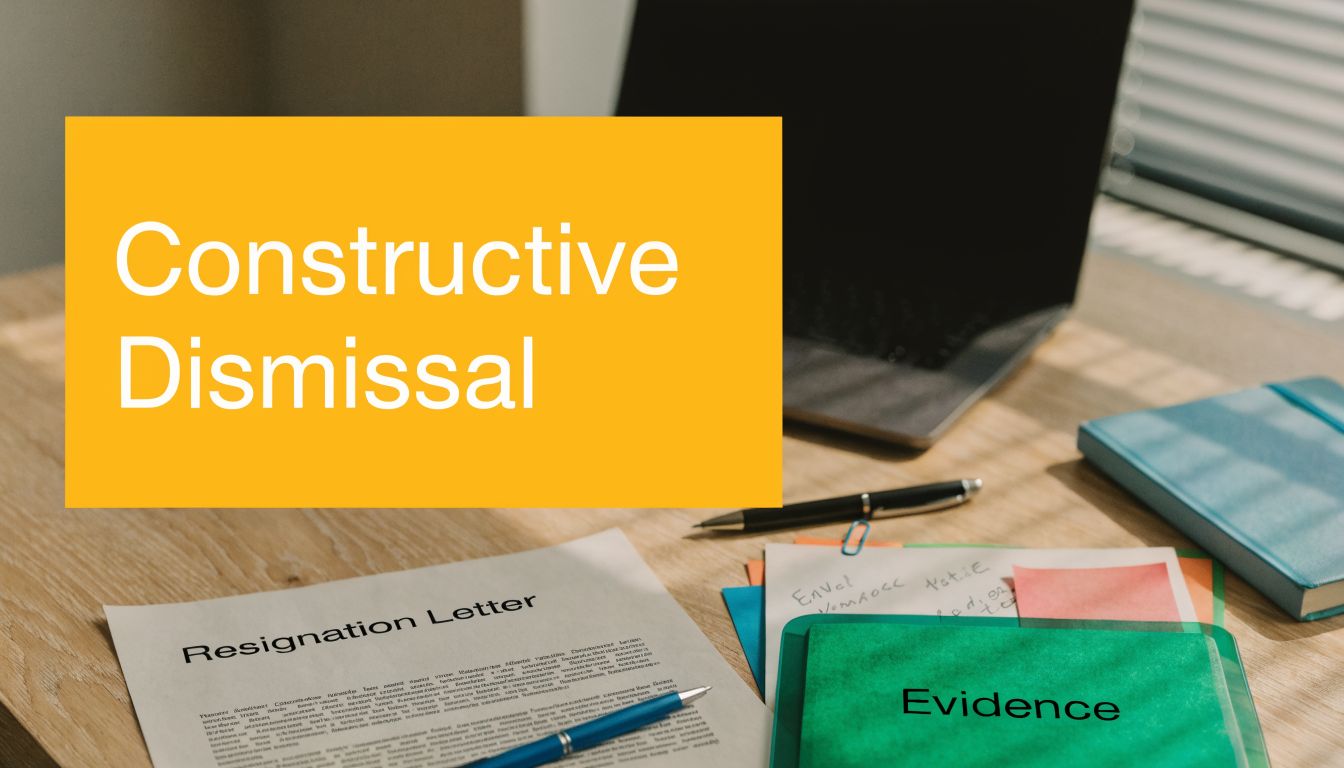
A lot of people search how to prove constructive dismissal after a week that felt like a trap.
Your pay has been cut. Your title has changed without warning. A manager has turned the workplace into something you dread walking into each morning. Nobody has said, “You’re fired,” but the message feels clear enough. The danger is that many employees make their biggest mistake at this exact point. They resign too quickly, or they resign the wrong way.
In Ontario, timing and documentation often decide whether a strong claim survives or collapses.
Feeling Forced to Quit Your Job in Ontario?
One common pattern looks like this. An employee with solid performance reviews is suddenly told their duties are being stripped away. Another is pushed under a new manager who bullies them in meetings, excludes them from key decisions, and starts creating a poisoned work environment. Someone else is told their compensation or schedule is changing immediately, whether they agree or not.

If that sounds familiar, you may be dealing with constructive dismissal. In plain terms, that means an employer hasn’t formally terminated you, but has changed the job or the workplace so seriously that the law may treat it as a termination.
That distinction matters. If the facts support constructive dismissal, your resignation may not be treated as a simple voluntary quit. It may be treated as a dismissal with legal consequences for the employer.
Why employees lose good claims
Many people assume the worst part is proving the workplace became intolerable. Often, the harder issue is what the employee did next.
Employees hurt their position when they:
- Stay silent: they keep working under the new terms without objecting
- Use vague language: they resign for “personal reasons” or “another opportunity”
- Wait too long: they give the employer an argument that they accepted the change
- Fail to preserve records: they rely on memory instead of documents
A practical starting point is learning the signs of constructive dismissal in Ontario workplaces. Once you recognise the issue, the next question isn’t just whether the employer crossed the line. It’s what you need to do now to protect the claim.
You don’t prove constructive dismissal with feelings alone. You prove it with a clear breach, a clear objection, and a clear response.
The Legal Test for Constructive Dismissal
Ontario courts don’t ask whether the situation felt unfair in a general sense. They ask whether the employer significantly changed the employment relationship and whether you resigned because of that change.
The modern framework comes from the Supreme Court of Canada. In Ontario, proving constructive dismissal requires showing a fundamental breach of the employment contract by the employer, followed by resignation in response, as set out in Potter v. New Brunswick Legal Aid Services Commission, 2015 SCC 10, discussed in this RBS analysis of the Potter decision.

The first branch of the test
A fundamental breach is a serious unilateral change to an essential term of employment. “Unilateral” matters. The employer doesn’t get to rewrite core terms of your job without your agreement and then call it business as usual.
Examples often include:
- Compensation cuts: a modest adjustment may not be enough, but a substantial reduction can be
- Demotion: loss of status, authority, reporting level, or core responsibilities
- Poisoned workplace conditions: harassment, bullying, or conduct that destroys trust
- Major location or schedule changes: especially where they alter the substance of the job
Not every unpleasant workplace issue qualifies. Courts use an objective lens. The question is whether a reasonable person in your position would view the employer’s conduct as a serious breach of the employment relationship.
The second branch of the test
Even if the employer committed a fundamental breach, you still need to show that you resigned because of that breach.
That’s where many claims get weaker than they should. If an employee continues on under the changed terms without a prompt objection, the employer will often argue acceptance. If the resignation letter points to burnout, family reasons, or a new job, the employer will argue the resignation was unrelated.
Practical rule: Constructive dismissal is not just about what the employer did. It’s also about what your response communicates.
Why the contract matters more than most people think
When I assess these cases, I look at the actual contract, not just the latest dispute. Written terms matter. So do implied terms, workplace policies, compensation structures, reporting relationships, and how the job functioned in practice.
If you want a plain-English primer on understanding employment contracts in Canada, that can help you identify which terms are essential and which changes are more likely to support a claim.
The burden is still on the employee to prove the facts. If you want a useful backgrounder on that standard, see the burden of proof in civil cases. In real terms, that means your documents need to tell a cleaner story than your employer’s explanation does.
How to Build Your Case Before You Resign
Constructive dismissal cases are usually won or lost based on this.
By the time an employee contacts counsel, the employer’s breach may already be serious. But if the employee resigned casually, failed to object, or kept no records, the legal argument becomes much harder than it needed to be. The strongest move is often not resigning immediately. It’s preparing properly first.

Your first job is preserving evidence
Start with the documents that show the job before the change and the job after it.
Build a file that includes:
- Your employment contract and offer letter: these show the original terms
- Pay records: if compensation changed, preserve the before-and-after numbers
- Job descriptions and organisation charts: these help prove a demotion or reduced authority
- Emails, texts, and meeting notes: especially messages that announce or confirm the unilateral change
- Performance reviews: these can rebut a later claim that the employer changed your role because of poor performance
- HR correspondence: complaints, responses, investigation notes, and policy references
Don’t edit documents. Don’t annotate originals. Keep them in the form they were created and organise them by date.
Build a timeline, not a pile
A constructive dismissal file should read like a timeline, not a drawer full of frustration.
Use a simple chronology:
- What the job was before the problem
- What changed
- When you objected
- How the employer responded or failed to respond
- Why the breach forced the resignation
That timeline becomes useful in settlement discussions, demand letters, affidavits, and testimony. It also helps separate legal facts from understandable emotion.
The employee who can show dates, emails, and exact wording usually has far more leverage than the employee who says, “Everyone knew what was happening.”
Object in writing, quickly
This is the step employees miss most often. In Ontario, you often need to object to the breach in writing within a very short period. Sometimes that window is as little as 2 to 5 days, and a 2023 Ontario Bar Association survey noted that 68% of employment lawyers saw untimely objections as the top barrier to proving constructive dismissal, as described in Minnis & Smallets’ discussion of proving constructive dismissal.
The point of the objection is straightforward. You are telling the employer, in writing, that:
- you do not accept the change
- you consider it a serious breach
- you are giving the employer a chance to correct it, where appropriate
A useful objection usually identifies the change with precision. For example, don’t write, “I’m unhappy with recent events.” Write what changed. Salary, title, reporting structure, hours, location, duties, or conduct.
What that written objection should say
It doesn’t need legal theatre. It needs clarity.
A practical version often includes:
- The date of the change
- The term that changed
- A statement that you do not accept it
- A request that the employer reverse or address it promptly
- A statement that you reserve your rights
If the issue involves harassment, bullying, or discrimination, the complaint should also identify the conduct, the dates, the witnesses if any, and the effect on your work environment. If that’s part of your situation, examples of workplace discrimination issues in Ontario can help you frame the problem accurately.
What usually doesn’t work
Some reactions feel natural but create legal problems:
- Resigning in anger on the spot: emotionally understandable, strategically risky
- Agreeing “temporarily” without legal advice: employers may later call that acceptance
- Complaining only verbally: hard to prove, easy to deny
- Using your work email to vent: facts help, insults don’t
- Assuming HR is neutral: HR may help resolve things, but HR works for the employer
Where possible, get legal advice before sending the objection. One option is UL Lawyers, which advises Ontario employees on wrongful dismissal and constructive dismissal issues. But whichever lawyer you speak with, the important part is speed. Early advice can prevent the kind of waiver problem that is difficult to fix later.
Drafting Your Resignation Letter
You objected to the change. The employer did not fix it. Now you are thinking about resigning.
This is the point where many constructive dismissal claims are weakened. The resignation letter has one job. It must make clear that you are leaving because of the employer’s breach, not because you chose to move on.
A vague letter can undo careful steps you took earlier. If it says nothing about the pay cut, demotion, poisoned work environment, or other fundamental change, the employer may later argue that you resigned for personal reasons, burnout, or another job. That argument is harder to answer if your final written communication is polite but empty.
What the letter needs to say
Keep it short, factual, and tied to the timeline.
State the change. State that you did not accept it. State that you raised it before resigning, if you did. Then state that because the employer has not corrected the problem, you consider yourself constructively dismissed and are resigning as a result.
That wording matters because delay and mixed messages often become the employer’s defence. If you continue working for too long without a clear objection, or resign with a generic thank-you note, the employer may argue you accepted the new terms.
Good wording versus bad wording
Bad example
I have decided to resign effective immediately. Thank you for the opportunity. I am pursuing other opportunities.
That wording may sound professional, but legally it creates room for the employer to say this was an ordinary resignation.
Better example
I am resigning because the company unilaterally changed a fundamental term of my employment. On [date], my compensation was reduced without my agreement. I objected in writing on [date] and the issue has not been corrected. I therefore consider myself constructively dismissed, effective [date].
If the issue is harassment, discrimination, or a toxic work environment, say that directly and identify the conduct in plain terms. Accuracy matters more than polish.
Before you send it, check these points
- Match the letter to the actual breach. If the issue was a demotion, say demotion. If it was a schedule change that made the job materially different, describe that change.
- Keep your reason consistent. Do not mention “personal reasons,” “career growth,” or “another opportunity” if you intend to claim constructive dismissal.
- Refer back to your earlier written objection. That helps show you did not accept the change.
- Choose an effective date carefully. In some cases, a brief transition period is reasonable. In others, staying longer creates risk. This is a judgment call, not a template exercise.
- Save proof of delivery. Keep the sent email, attachments, read receipt if available, and a PDF copy of the final letter.
- Do not argue the whole case in the letter. Set out the reason clearly, then stop.
Tone matters, but not in the way many employees assume. You do not need to sound angry to be taken seriously, and you do not need to sound grateful if gratitude muddies the reason you are leaving. Controlled and specific is usually best.
If you want help with formatting, a general guide on how to write a professional resignation letter can help with structure. If you are also trying to estimate what the resignation may be worth, an Ontario severance pay calculator can give you a starting point before you decide what to do next.
If your resignation letter does not clearly connect your departure to the employer’s breach, the employer may try to frame it as a voluntary resignation.
Calculating Your Potential Damages and Entitlements
Before you decide whether resigning makes financial sense, get a realistic range for the claim. Employees often focus on whether the employer’s conduct was bad enough. The other half of the analysis is whether the likely recovery justifies the risk, the delay, and the obligation to look for new work right away.
In Ontario, a constructive dismissal claim usually starts with pay in lieu of reasonable notice at common law, plus any minimum statutory entitlements that apply under the Employment Standards Act, 2000. In the right case, the claim may also include bonus compensation, benefits, statutory severance pay, or damages tied to bad-faith employer conduct.
Common law notice and the Bardal factors
Common law notice is assessed case by case. Courts look at the Bardal factors, including your age, length of service, character of employment, and availability of similar work.
That is why two employees with the same salary can have very different claims.
A senior employee with long service and a narrower re-employment market will often have a stronger notice claim than a short-service employee in a role with many comparable openings. Ontario decisions also show a practical pattern on compensation cuts. Smaller reductions are harder to frame as a fundamental breach, while large reductions are more likely to support a constructive dismissal argument, as noted earlier.
Example common law notice periods
| Employee Profile | Estimated Notice Period |
|---|---|
| Short-service junior employee | Lower range, fact-specific |
| Mid-career employee with several years of service | Moderate range, fact-specific |
| Long-service manager or executive | Can approach the upper common law range |
| Older employee in a specialised role | Often assessed more generously due to re-employment difficulty |
This table is only a starting point. It does not account for disputed bonus language, mitigation issues, a fixed-term contract, or the harder question that often decides these cases first. Whether the employee preserved the claim by objecting promptly and resigning at the right time.
What may be included in the claim
The value of the case is not limited to salary.
Potential components can include:
- Base pay and benefits during the notice period
- Bonus, commission, or incentive compensation if the plan wording does not validly remove it
- Statutory termination pay and severance pay where the ESA applies
- Aggravated or other damages in a narrower set of cases involving bad-faith conduct and provable harm
The problem arises when employees sometimes underestimate the downside of waiting too long before resigning. If the employer argues you accepted the change, the damages analysis may never get off the ground because liability itself becomes much harder to prove.
Online calculators help, but only up to a point
A calculator can help you get an initial range before you make a decision. This Ontario severance pay calculator is useful for that first pass.
Treat the result as a rough screening tool, not an answer. It will not tell you whether a pay cut was fundamental in your specific context, whether your bonus survives through the notice period, whether you gave up the claim by staying too long, or whether a court would find you failed to mitigate.
Once resignation is on the table, the numbers and the timing have to be assessed together.
Your Legal Pathways After Resignation
You resign after a pay cut or a demotion, then the employer says you chose to leave. At that point, the case shifts from workplace problem to legal proof. The path you choose after resignation affects what compensation you can pursue, how the evidence gets tested, and how much room you have to respond if the employer denies constructive dismissal.
Ontario employees usually have two possible routes. One is a Ministry of Labour claim for statutory amounts under the Employment Standards Act. The other is a civil claim for wrongful dismissal damages at common law.
Ministry claim or civil action
A Ministry claim can make sense if the dispute is limited to unpaid statutory termination pay, severance pay, or other ESA minimums. It is narrower, and that can be an advantage in a straightforward case.
It can also limit your options.
Employees often miss that election issues matter here. If you start down one route, you may give up the ability to pursue broader common law damages elsewhere. That is a serious trade-off where the lost income may be far more than ESA minimums.
A civil action is often the better fit where the employer disputes that a constructive dismissal happened, where the compensation package includes bonus or commission issues, or where the facts are contested and need documents, witness evidence, and credibility findings. If the employer is going to argue that you accepted the change, delayed too long, or resigned for unrelated reasons, court is usually the forum that can deal with that record properly.
Why timing still matters after you’ve left
Resignation does not fix earlier timing problems. It only locks them in.
Ontario courts regularly scrutinize delay, objection, and conduct after the alleged breach. Employees who can clearly prove a fundamental change, and show they objected and acted consistently with that objection, are in a stronger position than employees who stayed on without a clear protest or resigned on vague terms. Cases involving bullying, demotions, pay cuts, or major duty changes can succeed, but only where the evidence shows the employee treated the employer’s conduct as a repudiation of the employment contract.
That is why the steps taken before resignation still shape the case after resignation. If the employer can point to silence, mixed messages, or a long period of continued work, it may argue you accepted the new terms. That defence can reduce the case dramatically or defeat it altogether.
The practical next step
Get legal advice quickly if you have already resigned. The first job is to protect the record while the facts are still fresh.
Bring:
- Your employment contract and any later amendments
- The written change, if there was one
- Any emails or messages where you objected
- Your resignation letter
- A timeline of what changed and when
- Recent pay records, bonus documents, and benefits information
If you are deciding whether to pursue the matter formally, it helps to understand what working with an Ontario severance lawyer usually involves.
A constructive dismissal claim after resignation often turns on a small set of practical questions. What changed. When did you object. How long did you stay. What reason did you give for leaving. Those details usually matter more than how unfair the situation felt.
If your employer has changed your job, cut your pay, demoted you, or made the workplace intolerable, UL Lawyers can assess whether the facts support a constructive dismissal claim under Ontario law. Early advice often makes the difference between preserving your rights and giving the employer a defence that could have been avoided.
Related dismissal and employment-law resources
If your dismissal issue needs a next step, these UL Lawyers pages may help:
- Employment law services — service overview for termination, severance, and workplace disputes.
- Termination for cause support — focused service page for cause allegations.
- Ontario severance pay calculator — estimate ESA minimums and a practical common-law range.
- All UL Lawyers legal calculators — compare severance, vacation pay, overtime, disability, and injury calculators in one hub.
- Severance package lawyer guide — when you need a legal review before signing.