
Getting your immigration status right in Canada is one of the most important things you will ever do — for yourself and for your family. Whether you are applying for permanent residence, sponsoring a loved one, or fighting a refusal, the stakes could not be higher. A mistake on a form, a missed deadline, or a wrong answer at the border can set your plans back by years.
That is why so many people ask: is it worth using an immigration lawyer? The honest answer is that it depends on your situation — but for most applicants facing anything beyond the simplest application, the answer leans firmly toward yes. A qualified immigration lawyer does not just fill out paperwork; they assess your eligibility, anticipate problems before they arise, and advocate for you if things go sideways.
This guide walks you through the key questions prospective clients ask most — from whether a lawyer is truly necessary, to what you can expect to pay, to what you should never say to an immigration officer. If you are ready to talk through your specific circumstances, our team is always available for a free consultation through our immigration law practice.

Table of Contents
- Is It Worth Using an Immigration Lawyer?
- Is It Worth Getting an Immigration Lawyer in Canada Specifically?
- What Is the Average Price for an Immigration Lawyer in Canada?
- Is It Worth It to Hire an Immigration Lawyer? (Weighing the Value)
- What Not to Say to an Immigration Officer
Is It Worth Using an Immigration Lawyer?
For many people, the answer is yes — and here is why.
Canadian immigration law is governed by the Immigration and Refugee Protection Act (IRPA) and a web of accompanying regulations, policies, and program-specific guidelines that change frequently. Programs like Express Entry, the Provincial Nominee Program (PNP), family sponsorship, and refugee protection each have their own eligibility rules, documentation requirements, and procedural timelines.
An immigration lawyer brings three things that online guides and immigration consultants often cannot:
- Legal training and accountability. Lawyers are licensed by a provincial law society and can represent you before federal courts if needed.
- Strategic advice. A lawyer reviews your full picture — your immigration history, criminal record if any, ties to Canada — and picks the path most likely to succeed.
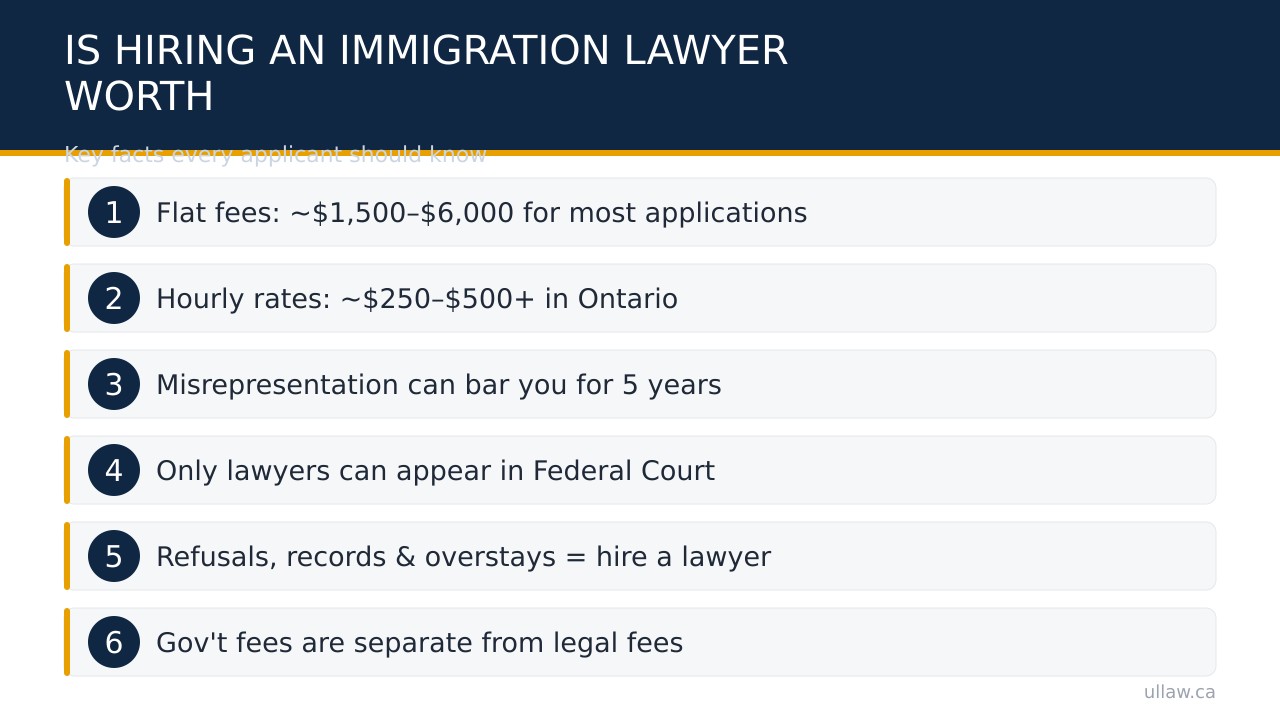
- Error prevention. Immigration applications are unforgiving. Misrepresentation, even accidental, can trigger a five-year bar on future applications or a finding of inadmissibility.
If your situation is straightforward — say, a first-time work permit renewal with a clean record — you may manage on your own. But if there is any complexity (a previous refusal, a gap in status, a criminal record, a medical issue, or a refugee claim), a lawyer’s involvement can be the difference between approval and years of delay.
The peace of mind alone is something many clients say was worth every dollar.
Is It Worth Getting an Immigration Lawyer in Canada Specifically?
Canada’s immigration system is widely admired — but it is also one of the most complex in the world. Immigration, Refugees and Citizenship Canada (IRCC) processes millions of applications annually, and the rules governing each program are dense and frequently updated.
Here are some Canada-specific reasons why a lawyer often pays off:
The Consequences of Refusal Are Severe
A refused application does not just mean starting over. Depending on the program, a refusal can affect your Comprehensive Ranking System (CRS) score in Express Entry, trigger a reassessment of your status in Canada, or result in an enforcement action.
Misrepresentation Has Long-Term Consequences
Under IRPA, a finding of misrepresentation — even an innocent error on a form — can make you inadmissible for five years. A lawyer helps you present your information accurately and completely from the start.
Appeals and Judicial Review Are Available
If your application is refused, you may have the right to appeal to the Immigration Appeal Division (IAD) or seek judicial review at the Federal Court of Canada. Only a lawyer (not a consultant) can represent you in Federal Court.
Authorized Representatives Are Regulated
In Canada, only lawyers, Quebec notaries, and Regulated Canadian Immigration Consultants (RCICs) licensed by the College of Immigration and Citizenship Consultants (CICC) can charge fees to give immigration advice. If someone else is offering to help for a fee, walk away.
For anyone dealing with a refusal, inadmissibility, or a complex sponsorship, working with a Canadian immigration lawyer is not a luxury — it is a safeguard. Learn more about how we can help on our immigration law practice page.
What Is the Average Price for an Immigration Lawyer in Canada?
Legal fees vary significantly depending on the complexity of your matter, the lawyer’s experience, and your location in Canada. Here is a general picture of what clients typically encounter:
Flat-Fee Services
Many straightforward applications are handled on a flat-fee basis, meaning you pay one agreed amount for the whole service. Common examples include:
- Work permit applications: roughly $1,500 – $3,500
- Permanent residence (Express Entry): roughly $3,000 – $6,000
- Spousal/family sponsorship: roughly $2,500 – $5,000
- Study permit: roughly $1,000 – $2,500
These ranges are approximate and vary widely — do not treat them as quotes.
Hourly Rates
For complex matters — appeals, refugee hearings, judicial reviews, or criminal inadmissibility — lawyers typically charge hourly rates ranging from roughly $250 to $500+ per hour in Ontario, depending on seniority and firm.
Government Fees Are Separate
Remember that IRCC application fees are paid directly to the government and are separate from legal fees. These can range from a few hundred dollars for a work permit to over $1,500 for permanent residence, plus biometrics.
How Expensive Is a Really Good Lawyer?
A highly experienced immigration lawyer — one with a track record in complex cases, Federal Court appearances, or humanitarian and compassionate applications — may charge at the higher end of those hourly ranges or command premium flat fees. That expertise often pays for itself by avoiding costly mistakes or securing an approval where a less experienced representative might not.
Always ask for a clear, written fee agreement before engaging any legal professional.

Is It Worth It to Hire an Immigration Lawyer? (Weighing the Value)
Let’s put the cost question in context. Ask yourself: what is the value of the outcome you are trying to achieve?
For most people, Canadian immigration represents the ability to work, reunite with family, access healthcare, build a life, or find safety. Measured against those stakes, professional legal fees — even at the higher end — are often a small fraction of what is at risk.
When Hiring a Lawyer Is Especially Worth It
- You have a previous refusal on any application
- You have a criminal record anywhere in the world (even minor offences can affect admissibility)
- You have overstayed a visa or had a gap in lawful status
- You are facing deportation or removal proceedings
- You are making a refugee or humanitarian claim
- Your sponsorship application involves a complex relationship history
- You need to appear before the Immigration Appeal Division or Refugee Protection Division
When You Might Manage Without One
- You are renewing a straightforward work or study permit with no complications
- Your employer has a dedicated immigration department handling the application
- You have successfully navigated the same process before with no issues
Even in simpler cases, a one-time legal consultation — where a lawyer reviews your situation and advises you — can catch potential problems before they become expensive ones.
Ultimately, hiring a lawyer is about managing risk. The cost of a refused application, a removal order, or years of delay almost always exceeds the cost of getting it right the first time.
What Not to Say to an Immigration Officer
Whether you are crossing the border, attending a visa interview, or appearing before the Immigration Division, what you say — and how you say it — matters enormously. Here are the most important principles:
Never Lie or Guess
If you do not know the answer to a question, say so. Providing a wrong answer — even accidentally — can be treated as misrepresentation under IRPA, with serious consequences including a finding of inadmissibility.
Do Not Volunteer Information You Were Not Asked For
Answer the question asked. Full, honest answers are essential, but offering unsolicited information can open doors to additional scrutiny you did not anticipate.
Avoid Saying Anything That Suggests Immigrant Intent When on a Temporary Visa
If you are entering Canada on a visitor or temporary basis, statements suggesting you intend to stay permanently — even casual comments like “I am hoping to find work here” — can lead to refusal of entry.
Common Mistakes to Avoid
- Inconsistencies between what you say and what is in your application or previous documents
- Downplaying ties to your home country (family, property, employment) — these demonstrate you intend to return
- Discussing legal proceedings or immigration history without fully understanding how it may be interpreted
If you have a complex background or previous issues with immigration authorities, speak with a lawyer before any interview or border crossing. Preparation can make all the difference.
Talk to a UL Lawyers Team Member
Every immigration situation is unique, and the right strategy depends on your history, your goals, and the program you are applying under. Our team at UL Lawyers Professional Corporation offers a free initial consultation so you can understand your options before committing to anything. Reach out through our immigration law practice page — we serve clients in Burlington, across the GTA, and throughout Ontario.