Navigating Canada’s immigration system can feel overwhelming — especially when you’re unsure where to even begin asking for help. The good news is that several trusted, free resources exist across Canada and right here in Ontario to answer your immigration questions, whether you’re applying for permanent residence, worried about a deportation order, or trying to understand your refugee rights.
This guide walks you through every major free resource available to you, from federal government services to provincial legal aid clinics and community organizations. It also explains what to do when free general information isn’t enough — and when speaking directly with an immigration lawyer may be the right move for your situation.
You don’t have to figure this out alone. Whether you’re searching for a quick answer or facing a complex immigration matter, understanding your options is the first step toward protecting your status in Canada.

Table of Contents
- Where Can I Ask Immigration Questions for Free in Canada?
- How Do I Ask Questions About Immigration for Free?
- Who Can I Call in Canada to Ask About Immigration?
- Refugee and Immigration Legal Help
- Get Help in Your Language
- My Refugee Claim Was Denied — Can I Still Appeal?
- I Am Inside Canada and Want to Claim Refugee Protection — How Do I Make My Claim?
- Filing Forms or Meeting Deadlines at the Immigration and Refugee Board
- When Free Resources Aren’t Enough: Working With an Immigration Lawyer
Where Can I Ask Immigration Questions for Free in Canada?
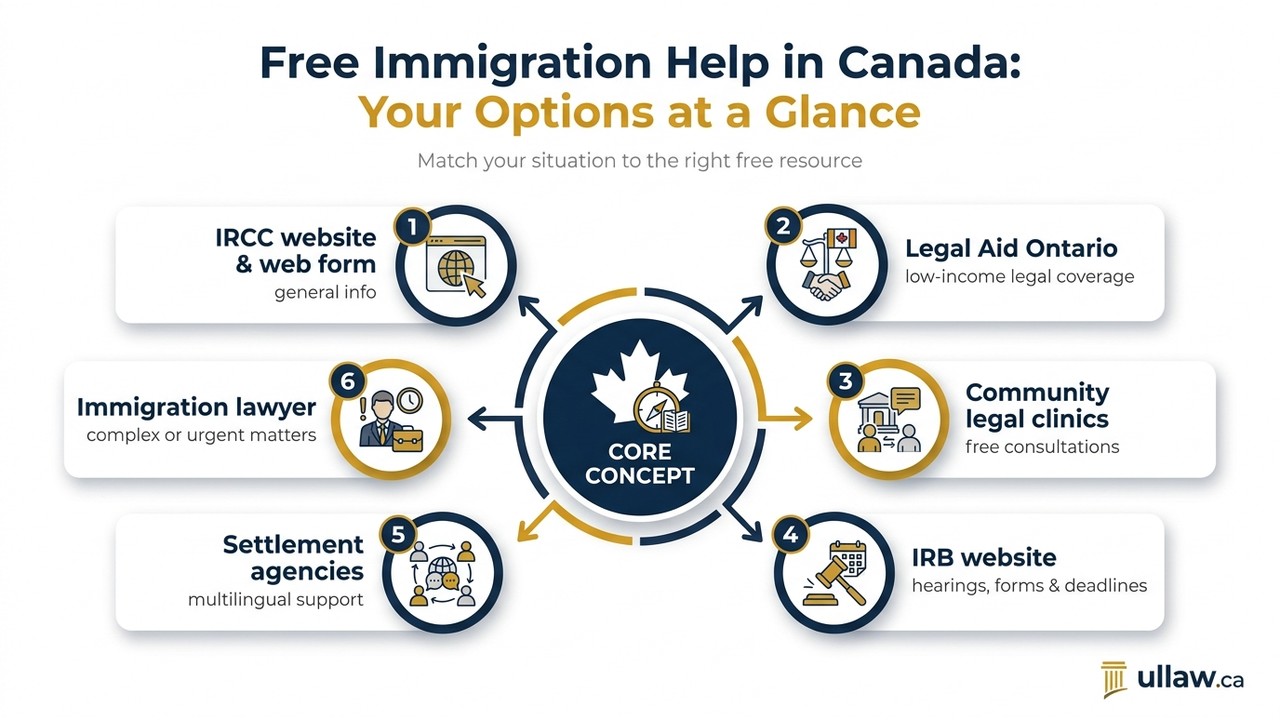
Canada offers several legitimate, no-cost channels where you can get answers to immigration questions. Here are the most reliable options:
1. IRCC’s Official Website and Web Form
Immigration, Refugees and Citizenship Canada (IRCC) maintains one of the most comprehensive immigration information portals in the world. You can check application processing times, find eligibility requirements, and submit questions through the IRCC web form — all for free.
2. Legal Aid Ontario (LAO)
If you live in Ontario and have a low income, Legal Aid Ontario may cover free legal representation or advice for certain immigration and refugee matters, including refugee hearings, detention reviews, and deportation proceedings. You can call LAO’s client services line to find out if you qualify.
3. Community Legal Clinics
Ontario has dozens of community legal clinics funded partly through Legal Aid Ontario. Many specialize in immigration and refugee law and offer free consultations to low-income individuals in their catchment areas. Clinics can advise on refugee claims, spousal sponsorship, work permits, and more.
4. Newcomer Settlement Agencies
Federally and provincially funded settlement agencies (such as ACCES Employment, Centre for Immigrant and Community Services, and others) offer free information sessions, workshops, and one-on-one help with common immigration forms and questions. These are not lawyers, but they can be a strong starting point.
5. The Immigration and Refugee Board (IRB)
If your question relates to a hearing or proceeding before the IRB, the Immigration and Refugee Board of Canada publishes detailed guides, rules, and procedural information on its website — all free.
6. CanLII
For those who want to research case law or read the actual text of immigration legislation like the Immigration and Refugee Protection Act, CanLII provides free access to Canadian statutes and tribunal decisions.
Important: Free information services can help you understand general rules, but they cannot give you legal advice tailored to your specific file. For personalized guidance, consider speaking with a licensed immigration lawyer.
How Do I Ask Questions About Immigration for Free?
Knowing where to ask is only half the battle — knowing how to ask saves you time and gets you better answers.
Use the Right Channel for the Right Question
- Processing time or application status? → Log in to your IRCC online account or use the IRCC web form.
- General eligibility rules? → Start at Canada.ca — the official federal government portal covers most common pathways.
- Legal rights in a hearing or detention? → Contact Legal Aid Ontario or a community legal clinic immediately. Deadlines in these situations can be very short.
- Forms and IRB procedures? → Visit the IRB’s website directly for guides and fillable forms.
Prepare Before You Call or Visit
When reaching out to any free resource, have the following ready:
- Your full name and date of birth
- Your client ID number or UCI (Unique Client Identifier) if you have one
- Any application or file numbers
- A brief, written summary of your situation (dates, decisions received, deadlines)
The more organized you are, the faster a clinic or legal aid worker can help you.
Know the Limits of Free General Advice
Free information services — including government websites and settlement agencies — explain the law as it applies generally. They cannot review your specific documents, advocate for you at a hearing, or tell you exactly what to do in your unique case. For that level of help, you need a licensed immigration lawyer or an authorized representative regulated by the College of Immigration and Citizenship Consultants (CICC).
Our immigration law practice offers consultations where a lawyer reviews your actual situation and explains your real options under Canadian law.
Who Can I Call in Canada to Ask About Immigration?
Several phone lines are available depending on your situation:
- IRCC Client Support Centre: The federal government operates a dedicated call centre for immigration inquiries. Wait times can be long, but agents can check file status and answer general questions.
- Legal Aid Ontario: Call LAO’s central intake line to determine whether you qualify for a certificate or a summary legal advice appointment with a lawyer.
- Community Legal Clinics: Most clinics have a phone intake process. Find your nearest clinic through the Legal Aid Ontario clinic locator on the Ontario government website.
- Newcomer Hotlines: Some municipalities and provinces operate newcomer information lines staffed by trained settlement workers who speak multiple languages.
- The IRB Registry: If you have an active matter before the Immigration and Refugee Board, the Registry can answer procedural questions about your file — though they cannot give legal advice.
Tip: If you are facing an urgent situation such as detention, an imminent removal, or a looming deadline, call a lawyer or legal clinic first — not a government call centre.
Refugee and Immigration Legal Help
Refugees and asylum seekers have access to some of the most important free legal resources in Canada, because the stakes — including potential return to danger — are extremely high.
Legal Aid for Refugee Claimants
In Ontario, Legal Aid Ontario provides refugee legal aid to claimants who meet financial eligibility criteria. This can cover representation at the Refugee Protection Division (RPD) and Refugee Appeal Division (RAD) of the IRB, as well as Pre-Removal Risk Assessments (PRRAs).
Refugee Law Office (RLO)
The Refugee Law Office in Toronto is a specialty Legal Aid Ontario clinic that provides free legal representation to refugee claimants in the Greater Toronto Area who have a Legal Aid certificate.
Non-Profit Organizations
Organizations such as the Canadian Council for Refugees and local newcomer centres across Ontario can connect you with free legal clinics, translation services, and settlement support.
Private Immigration Lawyers
For complex refugee matters — particularly failed claims, Federal Court applications, or humanitarian and compassionate grounds — a private immigration lawyer may be your strongest option. Many offer an initial consultation so you can understand your situation before committing.
Get Help in Your Language
Canada’s immigration system is used by people from every corner of the world, and language barriers should never prevent you from getting accurate information.
- IRCC’s website is available in English and French, and many official forms are translated into multiple languages.
- Settlement agencies across Ontario routinely offer services in Mandarin, Cantonese, Punjabi, Tamil, Arabic, Spanish, Tagalog, Somali, and many other languages — often at no cost.
- Certified interpreters can be arranged for Legal Aid Ontario appointments and for IRB hearings. You have the right to an interpreter at your refugee hearing.
- Community organizations tied to specific ethno-cultural communities (e.g., Chinese Canadian, South Asian, African-Canadian) often maintain lists of lawyers and consultants who speak your language.
When you contact a legal clinic or settlement agency, always ask upfront whether services are available in your preferred language. Many clinics can arrange an interpreter even if staff don’t speak your language directly.

My Refugee Claim Was Denied — Can I Still Appeal?
Yes — in many cases, a denied refugee claim is not the end of the road. Canada’s immigration system includes several layers of review:
1. Refugee Appeal Division (RAD)
If the Refugee Protection Division denied your claim, you may be able to appeal to the Refugee Appeal Division of the IRB. There are strict deadlines — usually 15 days to file a Notice of Appeal — so act immediately upon receiving a negative decision.
2. Pre-Removal Risk Assessment (PRRA)
If you have exhausted your appeal rights, you may be eligible to apply for a PRRA, which assesses whether you face risk if returned to your country.
3. Judicial Review at Federal Court
In some circumstances, a negative RAD decision can be challenged at the Federal Court of Canada on a judicial review application. This is a specialized process with its own short deadlines and procedural rules. Legal representation is strongly recommended.
4. Humanitarian and Compassionate (H&C) Grounds
You may also be able to apply for permanent residence on humanitarian and compassionate grounds based on your establishment in Canada, the best interests of any children involved, and other factors.
If your claim has been denied, contact a legal aid clinic or immigration lawyer as soon as possible. Every day counts when deadlines are involved.
I Am Inside Canada and Want to Claim Refugee Protection — How Do I Make My Claim?
If you are already in Canada and fear returning to your home country, you may be eligible to make a refugee protection claim (also called an asylum claim). Here is a general overview of how the process works:
- Make your claim at a port of entry (border or airport) or at an inland IRCC office.
- Eligibility determination: An officer decides whether your claim can be referred to the Refugee Protection Division of the IRB. Not all claims are eligible.
- Basis of Claim (BOC) form: You must complete this detailed written account of your personal circumstances and submit it within a set deadline.
- Refugee hearing: The RPD schedules a hearing where a decision-maker reviews your evidence and testimony.
- Decision: If accepted, you receive protected person status and can apply for permanent residence. If denied, appeal options may be available (see above).
The Immigration and Refugee Board of Canada publishes guides for claimants on its website. However, given the complexity of refugee hearings and the consequences of a negative decision, getting legal advice early — ideally before you file your BOC — can make a significant difference in your case.
Filing Forms or Meeting Deadlines at the Immigration and Refugee Board
If you have an active matter before the IRB, missing a deadline or filing a form incorrectly can have serious consequences — including the abandonment of your claim or appeal.
Key Points About IRB Deadlines
- Deadlines at the IRB are set out in the IRB Rules for each division (RPD, RAD, IAD, ID) and are generally strictly enforced.
- You can request an extension of time, but you must demonstrate a valid reason and act quickly.
- Forms must be filed with the correct IRB division registry — confirm the address or online filing method before submitting.
Filing Methods
The IRB accepts documents by mail, in-person drop-off at registry offices, and in some cases through its online portal. Always keep proof of filing (a stamped copy, a courier receipt, or an electronic confirmation).
What If a Hearing Is Scheduled?
If you have received a Notice to Appear, attend your hearing — even if you don’t yet have a lawyer. Failing to appear can result in your claim being declared abandoned. If you need more time to find legal help, contact the IRB registry immediately and explain your situation.
Visit the Immigration and Refugee Board’s website for current rules, forms, and registry contact information for each division.
When Free Resources Aren’t Enough: Working With an Immigration Lawyer
Free resources — government websites, settlement agencies, legal aid clinics — are genuinely valuable, and we encourage you to use them. But there are situations where professional legal representation can be the difference between staying in Canada and being removed:
- You have received a removal order or a deportation notice
- Your refugee claim has been denied and deadlines are approaching
- You are in immigration detention
- Your sponsorship application was refused
- You are dealing with misrepresentation allegations
- You have a criminal record that may affect your admissibility
- Your matter is headed to Federal Court
In these situations, a licensed immigration lawyer can review your actual file, identify legal arguments you may not know exist, and advocate directly on your behalf before the IRB, IRCC, or the courts.
Make sure any representative you hire is either a lawyer regulated by the Law Society of Ontario or a registered immigration consultant regulated by the College of Immigration and Citizenship Consultants. Using an unauthorized representative (a “ghost consultant”) can seriously harm your case.
Learn more about how our team can help on our immigration law practice page.
Talk to a UL Lawyers Team Member
Every immigration situation is different, and the stakes are often very high. If you have questions that free resources haven’t been able to answer — or if you’re facing a deadline, a refused application, or a removal order — we invite you to reach out to UL Lawyers for a free consultation. Our immigration law team serves clients in Burlington, across the GTA, and throughout Ontario, and we’re here to help you understand your options in plain language, with no pressure and no obligation.