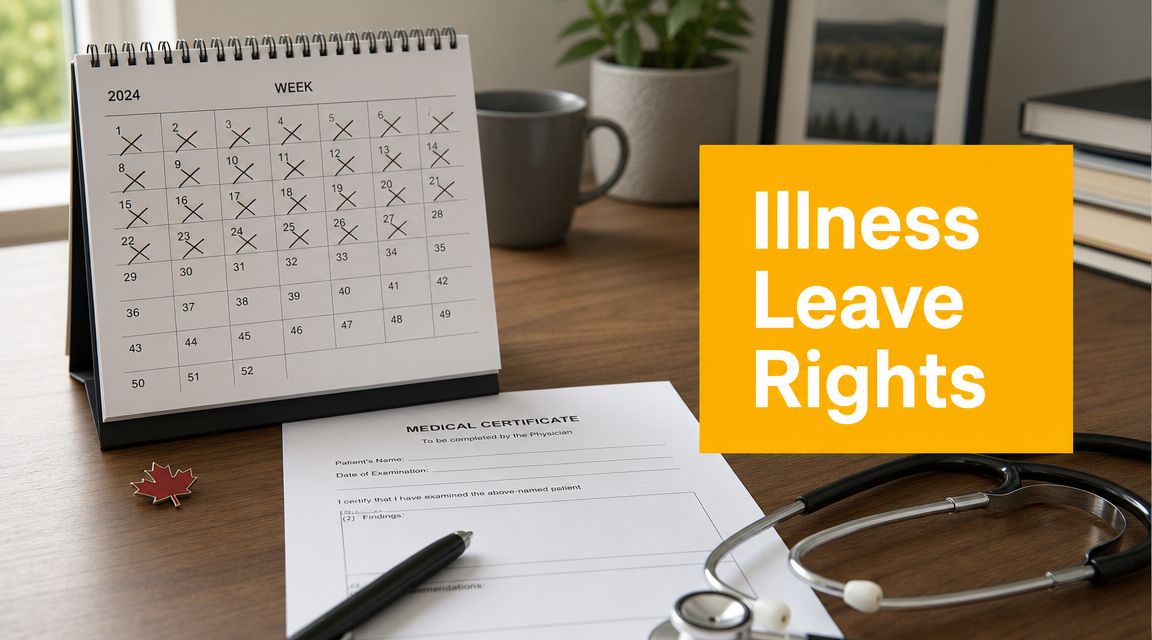
You’ve just been told you need surgery, cancer treatment, or time away from work for a serious chronic condition. Your first thoughts usually aren’t legal. They’re practical. How will I pay my bills? Do I tell my manager right away? What happens to my benefits? Can they replace me if I’m off too long?
That fear is real, and it often gets worse when an insurer denies short-term or long-term disability benefits. Many employees assume a denied disability claim means they’ve also lost their right to be away from work. In Ontario, that isn’t necessarily true. Your right to take a statutory medical leave and your right to receive income replacement are separate questions.
Ontario’s new long-term illness leave matters because it gives eligible employees a province-wide baseline of job protection during a serious medical absence. It does not guarantee a paycheque. It protects your position while you deal with your health. If your employer has already threatened your job, guidance on being fired while on medical leave in Ontario can also help you understand the warning signs quickly.
Table of Contents
- An Unexpected Diagnosis and Your Job Security
- What Is Ontario’s Long-Term Illness Leave
- Your Obligations and Your Employer’s Responsibilities
- How This Leave Works with LTD, CPP, and EI
- Returning to Work and Requesting Accommodation
- Common Pitfalls and Costly Mistakes to Avoid
- When You Need an Employment Lawyer on Your Side
An Unexpected Diagnosis and Your Job Security
You leave a medical appointment with a treatment plan, follow-up tests, and one pressing question. What happens to your job if you cannot work for the next several months?
That is the problem Ontario’s long-term illness leave is meant to address. It gives eligible employees a statutory right to time away from work without losing their position, even while the financial side of the crisis remains unsettled.
The first point to get clear is the one employees and employers often mix up. Job-protected leave and income replacement are separate systems. The ESA deals with your right to be off work without being terminated or penalized for taking the leave. LTD, CPP disability, and sometimes EI deal with money. One system protects your job. The others may replace part of your income.
Practical rule: A denied disability claim does not automatically cancel your right to ESA long-term illness leave.
That distinction changes the advice I give at the start of almost every serious illness case. If an insurer refuses LTD, many employees assume they have no protection left and rush back before they are medically ready, or they resign out of fear. In many cases, that is the wrong move. Your leave rights can still exist even while the benefits dispute is ongoing, and employees who are worried about being fired while on medical leave in Ontario need to assess the employment issue separately from the insurance issue.
There is also a practical trade-off here. The leave protects your job, but it does not create pay. That means you may need to pursue more than one path at the same time. You may be confirming your ESA leave with your employer, appealing an LTD denial, and reviewing whether CPP disability or other support is available. Emotional support often matters too during this period, and Interactive Counselling’s guide may be helpful for some people dealing with the strain of a sudden diagnosis.
Employees usually feel more in control once they stop treating this as one all-or-nothing decision. It is often two legal questions running side by side. Can your employer hold your job as required by law? Can you secure income while you are off work? Keeping those issues separate is often the first step toward protecting both your employment and your financial stability.
What Is Ontario’s Long-Term Illness Leave

A serious illness often creates two separate problems at once. You need time away from work, and you need money coming in. Ontario’s long-term illness leave deals with the first problem. It gives eligible employees a legal right to unpaid, job-protected leave under the Employment Standards Act, 2000.
That distinction matters in practice. An LTD insurer can deny your claim and your ESA leave rights may still exist. Your employer also cannot treat this leave as a resignation or shortcut around basic Employment Standards Act termination rules.
The legal basics
This leave came into force on June 19, 2025. It provides up to 27 weeks of unpaid leave within a 52-week period for eligible employees who cannot work because of a serious medical condition.
Before this amendment, many employees were left piecing together protection from workplace policy, disability insurance wording, and human rights principles. The new leave gives a clearer minimum standard across Ontario. For employees, that means a more direct statutory right. For employers, especially those reviewing their workplace safety and HR laws, it means absences tied to serious illness need to be handled with more care and better record-keeping.
Who qualifies
The test is specific. You must have at least 13 consecutive weeks of employment, and you must provide a certificate from a qualified health practitioner confirming that you have a serious medical condition and stating the period you will be unable to perform your work.
Three practical points come up often in my file reviews.
- Length of service matters: Employees who have not yet reached 13 consecutive weeks may not have access to this particular ESA leave.
- The medical note needs substance: A vague note saying you are “sick” usually creates problems. The certificate should address incapacity and expected duration.
- The workplace issue is functional: The legal question is whether the condition prevents you from doing your job, not whether the diagnosis sounds severe to HR.
A strong medical note is usually specific about restrictions, prognosis, and time away from work. It does not need dramatic language.
How the leave can be used
The 27 weeks do not have to be taken in one continuous block. The leave can be used in separate periods within the same 52-week window if the medical support fits the absence.
That flexibility helps employees with conditions that improve, relapse, or require treatment in stages. It also creates tracking issues. Employees should keep their own timeline of days and weeks used, because payroll records, insurer records, and HR records do not always match.
There is also a cap. The leave provides a total of 27 weeks in the 52-week period. It is not a new bank each time a different medical issue arises.
The point I want employees to hold onto is simple. This leave protects your position while you are medically unable to work. It does not decide whether an insurer owes LTD benefits, whether CPP disability will be approved, or whether EI sickness benefits are available. Those are separate decisions under different rules.
Your Obligations and Your Employer’s Responsibilities

Leave disputes often start with poor communication, not bad intentions. An employee assumes HR knows what’s happening. A manager assumes the absence is informal. The insurer asks for one thing, the employer asks for another, and nobody is looking at the legal minimum under the ESA.
For small and mid-sized workplaces that are still building their internal processes, practical reading on workplace safety and HR laws can help explain why documentation and policy discipline matter so much. If the absence later turns into a termination dispute, it’s also useful to understand the basics of the Employment Standards Act termination rules.
What you need to do
Your side of the process is straightforward, but it needs care.
- Give notice early: Tell your employer you need a medical leave as soon as you reasonably can. If the illness is sudden, give notice as soon as the situation allows.
- Provide proper medical support: The medical certificate should confirm that you have a serious medical condition and identify the period you can’t perform your duties.
- Stay consistent: If you tell your insurer one thing, your doctor another, and your employer something else, you create avoidable credibility issues.
- Keep records: Save emails, letters, medical notes, forms, and details of phone calls.
Employees sometimes overshare because they think more detail is always better. Usually, what matters most is functional information. Can you work? If not, for how long? Are restrictions expected when you return?
What your employer must do
An employer doesn’t get to opt out of the ESA because the leave is inconvenient. If you qualify, the leave must be granted.
Your employer also has obligations during the absence and at the end of it. In practical terms, that means they should treat the leave as a protected absence, not as job abandonment or a performance problem because you’re unavailable.
Employers should focus on entitlement, timing, and operational planning. They should not turn a valid leave request into a demand for unnecessary personal medical detail.
A responsible employer will usually do the following:
- Acknowledge the leave request and explain what documentation is required.
- Track the leave properly instead of relying on guesswork or informal manager notes.
- Avoid reprisal for taking a statutory leave.
- Prepare for reinstatement when the leave ends, including discussion of any restrictions or accommodation needs.
The legal framework is simple in principle. The friction usually comes from process failures, mixed messaging, or an employer treating an unpaid leave as if it were optional.
How This Leave Works with LTD, CPP, and EI
A serious illness often triggers three separate processes at once. Your employer is dealing with job protection. An insurer is deciding whether to pay benefits. A government program may be assessing whether you qualify for public income support.
Those systems overlap in real life, but they do not answer the same question.
Separate your job protection from your income claim
Ontario’s long-term illness leave is about your job. If you qualify for the ESA leave, your employer must treat the absence as a protected leave.
LTD, CPP disability, and EI sickness benefits are about money. Each has its own test, paperwork, timelines, and decision-maker. An insurer can deny LTD because it says the medical proof is insufficient under the policy. Service Canada can approve or deny EI sickness benefits based on its own eligibility rules. CPP disability applies a different legal standard again.
The practical point is the one employees miss under stress. A denied disability claim does not automatically cancel your right to ESA leave. If your medical condition meets the leave requirements, your job-protected leave may still exist even while you fight over benefits.
If you are dealing with an insurer at the same time, this guide on long-term disability insurance claims and denials explains why benefit decisions often turn on different evidence than a workplace leave request.
What each system does
| Issue | ESA Long-Term Illness Leave | LTD Insurance | CPP Disability | EI Sickness Benefits |
|---|---|---|---|---|
| Main function | Protects your job while you are off work for a serious medical condition | Replaces part of your income if you meet the policy definition of disability | Provides public disability benefits if you meet the CPP test | Provides short-term income support if you cannot work due to illness |
| Who decides | Employer, subject to ESA rules | Private insurer | Federal government | Federal government |
| Is it paid | No | Sometimes, if approved | Sometimes, if approved | Sometimes, if approved |
| What evidence matters | Medical certificate supporting the leave | Medical records, claim forms, and policy-specific proof | Medical and work capacity evidence under the CPP standard | Medical and eligibility information required by Service Canada |
| What a denial means | You may still have other income options | It does not erase ESA leave rights | It does not erase ESA leave rights | It does not erase ESA leave rights |
Where employees get into trouble
The common mistake is treating one denial as if it answers everything.
For example, your doctor may say you should not work for now. Your employer may accept medical documentation for leave. Then the insurer denies LTD or short-term disability because it wants more specialist evidence, updated records, or proof that you meet the policy wording. Employees often assume that means they have no protected absence. That is not necessarily true.
The reverse can also happen. A person may receive EI sickness benefits or even have an LTD claim under review, but still fail to give the employer the medical certificate needed to support the ESA leave. Payment and job protection need attention on separate tracks.
A practical way to handle all three
Keep your files consistent, but do not collapse them into one issue.
Use one track for your employer. Confirm the leave request, provide the medical certificate required for the ESA leave, and keep a written record of what was delivered and when.
Use another track for benefits. Meet the insurer’s deadlines, read the denial letter closely, and ask what medical evidence is missing. If you are applying for CPP disability or EI sickness benefits, treat those applications as separate claims with separate tests.
This distinction matters for financial stability. ESA leave can protect your job while you are off work, but it does not replace your pay. LTD, CPP, or EI may replace some income, but approval is never automatic and a denial may need to be appealed or challenged.
Protect the leave first. Then deal with the income claim on its own terms.
Employees who understand that separation make better decisions. They are less likely to resign too early, less likely to panic after an insurer denial, and more likely to preserve both their employment rights and their chance of recovering benefits.
Returning to Work and Requesting Accommodation

A return to work rarely feels clean and simple after a serious illness. Some employees are fully ready to resume their old role. Others can come back, but only with restrictions, reduced hours, or modified duties. That difference matters.
Your return is not all or nothing
The end of ESA leave is not always the end of your legal protection. It may be the point where the focus shifts from leave to accommodation.
Ontario’s long-term illness leave created a province-wide baseline for serious medical absences. But it didn’t erase the human rights framework that already existed. If you’re medically able to return in some capacity, the next conversation is often about what work you can do safely, not whether you must instantly resume everything exactly as before.
That’s especially important for employees dealing with fatigue, chronic pain, cancer recovery, or mental health conditions. If your situation includes psychological disability or stress-related illness, information on mental health leave in Ontario may help you frame the discussion with your employer.
Accommodation is a separate right
Accommodation usually works best when both sides focus on restrictions rather than labels. A medical note that says you can return with limits on hours, lifting, concentration demands, or scheduling is often more useful than a note limited to stating you are “not better yet.”
In practical terms, accommodation may involve:
- Modified duties: Some tasks are removed or reassigned.
- Reduced hours: You return gradually instead of all at once.
- Scheduling changes: Start times, break timing, or work patterns are adjusted.
- Temporary changes in role structure: The employer reorganises duties while you recover.
The strongest return-to-work plans are specific, written, and reviewed regularly. Vague promises usually break down fast.
Employees sometimes make the mistake of believing they must be one hundred per cent recovered before they can ask to come back. Employers sometimes make the opposite mistake and assume that if the ESA leave is ending, the employee must either return fully fit or leave the workplace entirely. Neither assumption is reliable.
The better question is simpler. What can you do now, what support do you need, and what medical information backs that up?
Common Pitfalls and Costly Mistakes to Avoid
A lot of job problems begin while the employee is still focused on getting through treatment, appointments, and day-to-day symptoms. A short email gets sent. A medical note is too thin. HR asks a question, and nobody answers it clearly. What looked minor at the start can later be used to argue about whether the leave was properly requested, how much time was used, or whether the employment relationship broke down.
The first mistake is mixing up two very different rights. Ontario’s long-term illness leave is about job protection. It does not guarantee income. LTD, CPP disability, and EI sickness benefits are separate systems with separate tests. If an insurer denies your disability claim, that does not automatically erase your ESA leave rights.
That distinction matters more than many employees realize.
I often see people panic after an LTD denial and rush back to work before they are medically ready, or assume they have no leave left because no benefits are being paid. Both choices can create avoidable damage. A denied benefits claim may need to be challenged on one track, while your job status is protected on another. If that is your situation, this guidance on what to do after a long-term disability denial can help you avoid weakening one claim while trying to fix the other.
Medical paperwork is another common problem. A note that says “off work until further notice” may not answer the practical question the employer is entitled to ask, especially if the issue is whether the absence fits the statutory leave, how long it is expected to last, or whether updated information is required. You do not need to hand over your diagnosis in every case, but you do need medical support that is clear enough to back the leave.
Silence also creates risk. You are not required to provide constant health updates, but you should respond to reasonable requests, keep copies of what you send, and confirm important discussions in writing. A short email after a phone call is often enough.
The intermittent leave trap
Intermittent absences can use up protected time faster than employees expect. Under Ontario’s approach to counting this leave, a week runs from Sunday to Saturday, and a partial week may still count as a full week for the 27-week total.
That can be hard on employees with episodic illnesses, flare-ups, or treatment schedules that do not fit into neat blocks of time.
If you miss two days one week for testing, work part of the next week, then miss another day for complications, you may think you have only used a handful of days. Your employer may record those absences more conservatively for ESA purposes. That gap in understanding often becomes a fight later, especially if HR and payroll are not explaining the count clearly.
A few habits reduce that risk:
- Keep your own leave calendar: Track every absence by date and week.
- Ask HR how the employer is counting each week: Do not assume payroll records tell the full story.
- Update medical support when the pattern changes: Especially if absences become intermittent or extend longer than expected.
- Read benefits correspondence carefully: An insurer’s denial is about income replacement, not necessarily about whether your leave is protected.
- Do not resign just because money has stopped: Financial pressure is real, but resignation can cut off rights you may still have.
Employees usually get the best results when they treat the leave file, the disability benefits file, and the return-to-work file as connected but separate problems. That one change in approach prevents a lot of expensive mistakes.
When You Need an Employment Lawyer on Your Side
Some situations are manageable with good documentation and calm communication. Others aren’t.
You should seriously consider legal advice if your employer refuses a valid leave request, pressures you to resign, treats your absence as misconduct, terminates your employment while you are off work, or refuses to discuss reinstatement or accommodation when you are medically able to return. The same is true if you’re caught in the gap between no income and no clear path back to work because an LTD or CPP disability claim has been denied.
These cases are difficult because they usually involve overlapping legal systems. Employment standards, disability benefits, human rights accommodation, and medical evidence all affect the result. A mistake in one file can damage the others.
Good legal help can do more than start a lawsuit. It can clarify your status, organise your medical and workplace evidence, push back against a premature termination, and address a denied disability claim without sacrificing your job rights in the process.
If you’re dealing with a serious illness, a denied disability claim, or pressure from your employer while you’re off work, UL Lawyers can help you understand your options. The firm offers free consultations, no upfront fee arrangements in many matters, and a 24/7 disability hotline for urgent support. If you need practical, compassionate guidance on protecting your job, pursuing disability benefits, or both at the same time, reaching out early can make the situation easier to control.