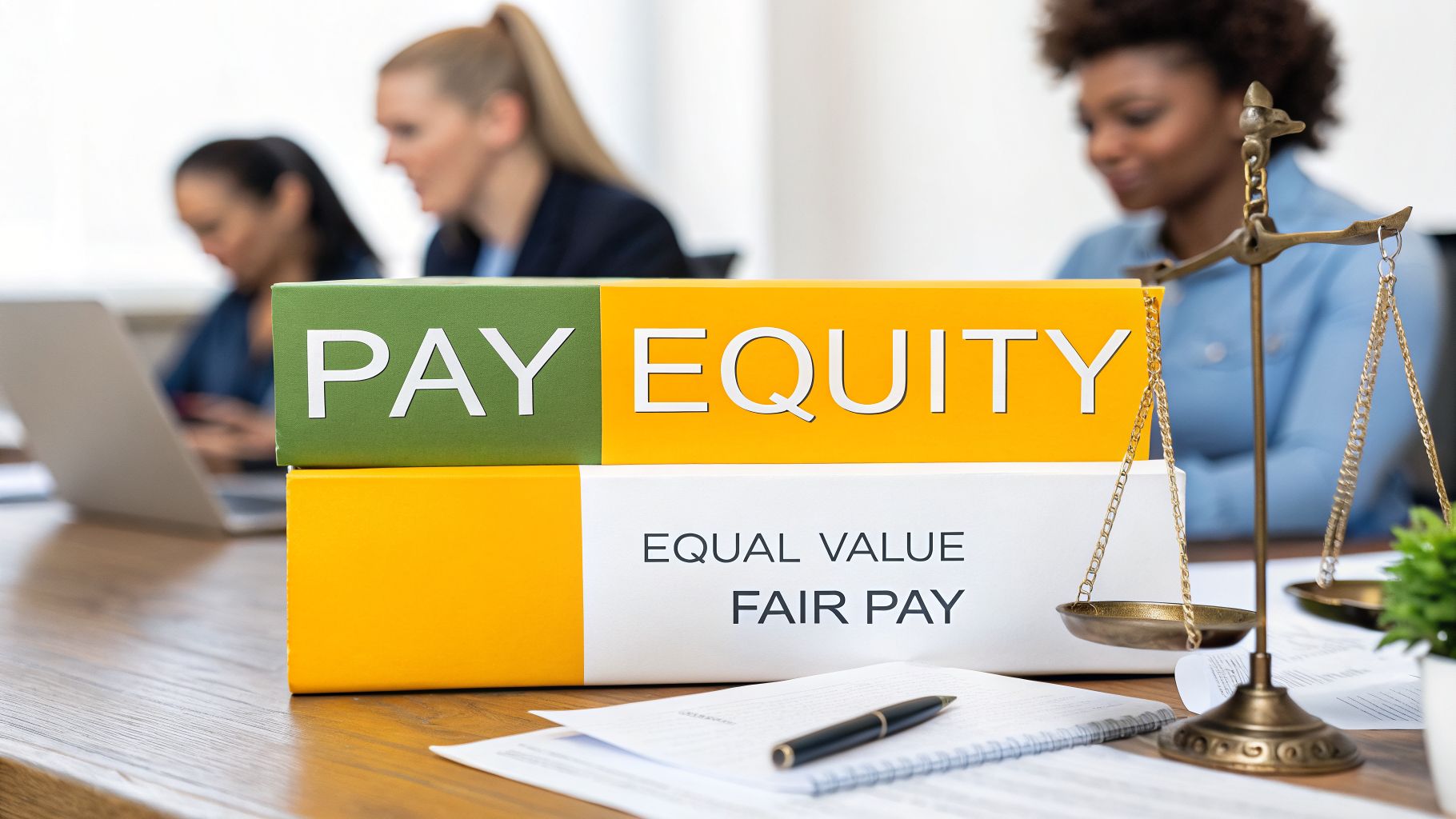
Pay equity isn’t just about paying two people in the same role the same amount of money. While that’s important, Ontario’s legislation goes much, much deeper. It’s designed to tackle a more hidden and systemic problem: the long-standing habit of undervaluing work simply because it’s traditionally done by women.
The law requires that jobs historically held by women are paid the same as jobs of comparable value that have historically been held by men—even when the day-to-day work looks completely different. It’s a proactive approach that puts the responsibility on employers to find and fix these gender-based wage gaps.
What Pay Equity Means and Why It Matters in Ontario

Most people hear “pay equity” and immediately think of “equal pay for equal work.” But the core idea behind Ontario’s Pay Equity Act is actually “equal pay for work of equal value,” a far more powerful concept that gets to the root of historical pay discrimination.
Think about it this way. An early childhood educator (a field dominated by women) has a very different job from a warehouse technician (a field dominated by men). But when you look past the specific tasks and objectively evaluate what each role requires—the skill, the effort, the level of responsibility, and the working conditions—you might find their value to the organization is remarkably similar. If the work has equal value, the Act says the pay should be equal.
The Purpose Behind the Legislation
At its heart, Ontario’s pay equity law exists to close the stubborn wage gap between men and women. It’s not about comparing individuals in the same job. It’s about re-evaluating and re-valuing entire categories of jobs that have been underpaid for generations, largely because they were seen as “women’s work.”
The law is proactive, not reactive. This means employers have a legal duty to establish and maintain pay equity within their organization without waiting for an employee to file a complaint. Fair compensation is a fundamental right for all employees in Ontario.
This legislation didn’t appear overnight. It’s the result of a long, hard-fought battle by unions and women’s groups that began in Canada in the late 19th century. Ontario’s first attempt at an equal pay law came in 1951, but it barely made a dent. For decades after, women in the province continued to earn significantly less than men. That early law, however, paved the way for the much stronger 1987 Pay Equity Act we have today, which finally shifted the focus to the crucial concept of “work of equal value.”
How It Protects Ontario Workers
Whether you work in a high-rise in the Greater Toronto Area (GTA) or for a small business in a rural town, the Pay Equity Act provides essential protections. Knowing how it works is the first step in spotting if you’re being paid unfairly.
Here’s a breakdown of how the law works for you:
- It creates a fair standard: The Act forces employers to use a single, gender-neutral system to compare the value of different jobs across their organization.
- It demands action: If a pay gap is discovered between a female-dominated job class and a male-dominated one of equal value, the employer must increase the pay for the underpaid female job class.
- It shields you from negative consequences: An employer can’t cut a man’s pay to fix a gap, nor can they punish or dismiss an employee for asking questions about pay equity.
By setting out a clear process for evaluating jobs and adjusting wages, the Act aims to dismantle pay discrimination based on outdated gender stereotypes. Of course, applying these principles can get complicated, and understanding your rights under broader employment law is key to ensuring you get the fair treatment you deserve at work.
Understanding Who the Pay Equity Act Covers
The first thing to figure out is whether Ontario’s pay equity law even applies to your workplace. The rules are designed to be far-reaching, covering most of the province’s workers, but there are a few key details you need to know.
At its heart, the Pay Equity Act applies to nearly every employer in Ontario. However, the law splits them into two groups: the public sector and the private sector. The specific duties can vary a bit between them, particularly when it comes to the size of the business.
For the public sector, it’s simple: the Act covers all employers, no matter how many people work there. This includes a massive range of organisations that serve the public.
In the private sector, the magic number is 10. If a private company in Ontario has 10 or more workers on its payroll, it is legally required to follow the Pay Equity Act. This means everyone from a small, family-owned shop in Burlington to a massive corporation anywhere in the GTA or across Ontario has to ensure they are providing equal pay for work of equal value.
Who Is Considered an Employee?
One of the most common points of confusion is who actually gets counted towards that “10 employee” number. The Act’s definition of an “employee” is deliberately broad to make sure as many people as possible are protected.
It isn’t just about your typical full-time, 9-to-5 staff. The count includes:
- Full-time employees: The standard, core members of the team.
- Part-time employees: Anyone working fewer hours than the full-time standard.
- Casual or on-call workers: People brought in only when needed, without a set schedule.
- Seasonal workers: Staff hired for specific times of the year, like the summer or holidays.
- Contract employees: In many situations, dependent contractors are counted as well.
This all-encompassing definition is critical. It stops employers from using hiring tactics—like loading up on part-time or seasonal staff—to sidestep their pay equity obligations. The moment a business hires its tenth person, regardless of their status, the clock starts on its legal duty to create and maintain a pay equity plan.
Key Takeaway: The Pay Equity Act is proactive legislation. This means an employer can’t just sit back and wait for someone to complain. They have a positive obligation to analyse their own pay structures and fix any gender-based wage gaps they discover.
This proactive duty is what gives the law its teeth. It puts the responsibility squarely on the employer to prove they are compliant, rather than forcing an employee to prove they’ve been discriminated against. This is a fundamental principle that applies whether your employer just hit the 10-employee mark or has been around for decades.
Grasping these basic rules is your first step. If you work for any public sector organisation in Ontario, or for a private company with 10 or more employees, you have these protections. This knowledge empowers you to ask the right questions and feel confident that you’re being paid fairly for the value you bring. For more insights on handling workplace issues, our employment law team can advise on complex job-related challenges.
What Your Employer Must Do to Ensure Pay Equity
In Ontario, ensuring pay equity isn’t just a good idea—it’s the law. Your employer has a legal duty to be proactive about it. They can’t just sit back and wait for someone to complain about unfair pay. The Pay Equity Act requires them to actively dig into their own pay systems, find any wage gaps based on gender, and take real, measurable steps to close them.
This isn’t a vague process left up to interpretation. The Act lays out a very specific roadmap that every covered employer must follow to first achieve, and then maintain, pay equity. For you as an employee, understanding these duties is key. It gives you a clear framework for judging whether your employer is playing by the rules and if your own pay has been set fairly.
Building the Pay Equity Plan
The whole process starts with a document called a pay equity plan. This isn’t some fluffy mission statement; it’s a detailed, working blueprint that maps out the organization’s path to fair pay.
First, your employer has to take stock of all the jobs in the workplace and sort them into what the law calls “job classes.” Think of a job class as a bucket for positions that share similar duties, need similar skills and qualifications, are hired in the same way, and have the same salary range.
Next, they have to figure out the gender makeup of each of these job classes. A class is flagged as female-dominated if 60% or more of the people in it are women. On the flip side, it’s considered male-dominated if 70% or more are men. This step is critical because it sets the stage for the comparisons that come next.
The Four Factors of Job Evaluation
Once the job classes are sorted, the employer has to figure out what each one is “worth” to the organization. This isn’t about gut feelings or old-fashioned hierarchies. The Pay Equity Act demands a gender-neutral evaluation system that values jobs based on four core factors:
- Skill: The know-how, training, and experience needed to do the job properly.
- Effort: The level of mental or physical energy required.
- Responsibility: The amount of accountability the job holds for things like budgets, equipment, or supervising others.
- Working Conditions: The environment where the work gets done, including any physical risks, stress, or uncomfortable elements.
By using a consistent, point-based system to score every job class against these four factors, an employer can arrive at an objective “value” for each role. This allows for an apples-to-apples comparison between very different types of work.
For example, a female-dominated administrative role might get high points for responsibility and mental effort. A male-dominated maintenance role might score high on physical effort and challenging working conditions. The system allows the employer to see that, even though the work is completely different, their total point value might be the same.
Making Comparisons and Adjusting Pay
With the evaluations done, the next step is the comparison. Your employer must compare the pay of female-dominated job classes to the pay of male-dominated ones that have an equal or comparable value score. If they find that a female job class is being paid less than its male counterpart, a pay equity gap exists.
When a gap is discovered, the law is crystal clear: the employer must raise the wages of the underpaid female job class to match the pay of the comparable male job class. It is illegal to lower a man’s wages to fix a pay equity problem. These pay increases are mandatory and must be made to correct the discrimination.
But what happens when there are no male-dominated jobs to compare to? This is common in public sector fields like healthcare or social services. For these organizations, the Act has a “proxy comparison” method. It allows them to look outside their own walls to a similar public sector employer to find a suitable male job class for comparison, ensuring their female employees aren’t left behind. Part of this process also includes ensuring compensation is reflected properly from the outset, which is why creating compliant employment contracts is a foundational step for employers.
Ultimately, these duties aren’t a one-and-done project. Pay equity must be maintained. This means employers have an ongoing responsibility to review their pay practices. They need to make sure that new jobs, or changes to existing ones, don’t accidentally create new gender-based wage gaps. In fact, if your own employment status changes, like in the case of a dismissal, knowing all your rights is vital. You can get a clear picture of the rules around job loss in our guide on the Employment Standards Act and termination.
To help clarify these obligations, here’s a quick summary of what the law requires from your employer.
Key Employer Responsibilities Under the Pay Equity Act
| Responsibility | Description | Who It Applies To |
|---|---|---|
| Develop a Pay Equity Plan | Create a formal, written plan detailing the process for identifying and correcting gender-based pay discrimination. | All public sector employers and private sector employers with 10 or more employees. |
| Identify & Value Job Classes | Group jobs into classes and evaluate them based on skill, effort, responsibility, and working conditions using a gender-neutral system. | All employers covered by the plan requirement. |
| Compare Compensation | Compare the pay of female-dominated job classes to male-dominated job classes of equal or comparable value. | All employers covered by the plan requirement. |
| Make Pay Adjustments | Increase the wages of any underpaid female job classes to match their male comparators. Wage reductions are prohibited. | Any employer who identifies a pay equity gap. |
| Maintain Pay Equity | Regularly review compensation practices to ensure new or changing jobs do not reintroduce wage gaps. | All employers covered by the Act. |
This table outlines the fundamental journey every covered Ontario employer must take. It’s a continuous process designed to ensure that the historical undervaluation of work done by women is not only corrected but prevented from happening again.
How Jobs Are Compared and Pay Is Adjusted
So, how does the idea of “equal pay for work of equal value” actually play out in the real world? It’s not about making educated guesses or relying on old job hierarchies. Ontario’s pay equity law requires a formal, unbiased process for comparing jobs that, on the surface, look nothing alike.
This is where we move from a legal principle to a practical, step-by-step method your employer must use. The goal is to assign a numerical value to every job, allowing for a true apples-to-apples comparison. Understanding this system is key—it shows you exactly how your job’s worth is calculated and empowers you to challenge the process if it hasn’t been done fairly.
At its core, the process is quite logical. Employers have to identify job classes, evaluate their value using a consistent system, and then adjust pay where a gap is found.

This isn’t a one-time fix. It’s a structured journey that requires employers to be diligent in finding and fixing discriminatory wage gaps.
The Four Factors of Value
The heart of any pay equity plan is a gender-neutral job evaluation system. This system must measure every job’s value based on four key factors, assigning points to each.
-
Skill: This looks at the total package of what a person needs to know to do the job. It’s a mix of formal education, on-the-job experience, specific training, and any specialized talents required.
-
Effort: This measures the mental and physical demands of the work. For instance, a job might require hours of intense focus and complex problem-solving (mental effort) or involve heavy lifting and precise manual work (physical effort).
-
Responsibility: This assesses the level of accountability the job carries. A role that manages a significant budget, supervises other people, or makes high-stakes decisions that affect the organization will score highly here.
-
Working Conditions: This evaluates the physical and psychological environment. It considers everything from exposure to noise, chemicals, or other hazards to the level of stress, pressure from deadlines, or dealing with difficult situations.
By scoring each job against these four pillars, an employer calculates a total value. This is what allows them to directly compare a female-dominated job with a male-dominated one, even when the day-to-day duties are completely different.
A Real-World Comparison
Let’s put this into practice with a classic example from a municipal government. We’ll compare a female-dominated job class, Librarian, with a male-dominated one, IT Support Analyst.
Imagine the employer uses a point-factor system, scoring jobs out of a possible 1,000 points.
| Factor | Librarian (Female-Dominated) | IT Support Analyst (Male-Dominated) |
|---|---|---|
| Skill | 300 points (Requires Master’s degree, research skills, community programming knowledge) | 270 points (Requires college diploma, multiple certifications, troubleshooting expertise) |
| Effort | 150 points (High mental effort for research and reader advisory, moderate physical effort for shelving) | 180 points (High mental effort for diagnostics, moderate physical effort for equipment installation) |
| Responsibility | 200 points (Accountable for collection development budget, public programming, information accuracy) | 200 points (Accountable for network uptime, data security, expensive hardware) |
| Working Conditions | 50 points (Public-facing role with potential for conflict, standard office environment) | 50 points (On-call duties, moderate stress from system failures, standard office/server room) |
| Total Value | 700 Points | 700 Points |
In this scenario, after a thorough evaluation, both the Librarian and the IT Support Analyst job classes are assigned the same total value: 700 points. While their scores differ across the individual factors—the Librarian job ranks higher on skill, while the IT Analyst job ranks higher on effort—their overall value to the organization is identical.
Now, let’s look at the pay. If the municipality finds the average salary for the Librarian job class is $65,000 per year, but the average for the IT Support Analyst is $72,000, a pay equity gap exists. The law is then unambiguous.
The employer is legally required to increase the pay for the entire Librarian job class to match the IT Support Analyst class. What’s crucial to remember is that an employer can never lower a male job class’s pay to achieve equity. The only legally acceptable solution is to raise the compensation of the underpaid female job class until the gap is closed. This mechanism ensures fairness is achieved by lifting employees up, not by pulling others down.
Filing a Complaint and Your Path to Justice

If you have a growing suspicion that your employer isn’t following pay equity legislation in Ontario, you don’t have to just accept it. The law isn’t just a set of suggestions; it has teeth. There’s a clear process in place to hold employers accountable and get the fair pay you’re owed.
Your first stop on this journey is the Pay Equity Office. This government body is the dedicated watchdog for pay equity in the province. Its entire purpose is to investigate complaints, educate workers and companies, and sort out disputes when pay discrimination is suspected.
When you believe a violation has happened—maybe your employer never created a plan, the one they have is deeply flawed, or they simply aren’t paying the required adjustments—your first move is filing a formal complaint with the Pay Equity Office. This is what kicks off an official investigation into the matter.
The Investigation Process
Once your complaint is received, the Pay Equity Office assigns a Review Officer to your file. Think of this person as a neutral fact-finder. They have broad powers to dig in and determine whether your employer has actually complied with the Act.
A Review Officer has the authority to:
- Enter the workplace to conduct on-site inspections.
- Demand access to payroll records, job evaluation documents, and the company’s pay equity plan.
- Interview you, your coworkers, and management to get the full story.
The officer’s main job is to gather all the necessary facts. They’ll scrutinize your employer’s pay equity plan (or lack thereof), the job evaluation system they used, the comparisons they made, and whether the right adjustments were paid out. This is exactly why keeping your own records of your job duties and pay stubs is so critical.
It’s important to know that throughout the investigation, the Review Officer will often try to help you and your employer reach a settlement. A negotiated agreement can often be the quickest route to getting the back pay you’re owed and ensuring your wage is corrected for the future.
If a settlement can’t be reached, the officer will issue a formal Order. This is a legally binding decision that can force your employer to take action, such as creating a proper plan, re-doing job evaluations, or making specific pay adjustments, often including interest.
Escalating to the Tribunal
But what if you—or your employer—disagree with the Review Officer’s decision? The next step is an appeal to the Pay Equity Hearings Tribunal. This body functions much like a specialized court, holding formal hearings to make final, binding rulings on pay equity cases.
At a hearing, both you and your employer will present evidence and make legal arguments, usually with lawyers present. The Tribunal can agree with the Review Officer’s Order, change it, or throw it out entirely. Its decisions are the final word and carry the full force of law.
Navigating this path, from the initial complaint all the way to a potential Tribunal hearing, can be complicated. The legal rules are strict and the arguments get technical fast. This is where having an experienced employment lawyer by your side becomes a real strategic advantage. A lawyer ensures your case is presented effectively, all deadlines are met, and your rights are protected at every turn.
Ultimately, partnering with a legal expert turns a stressful and confusing process into a clear path forward. They handle the bureaucracy and legal wrangling so you can stay focused on your job, confident that a professional is fighting for the compensation you’ve rightfully earned.
Your Next Steps Toward Fair Compensation
It’s easy to feel lost in the details of Ontario’s pay equity legislation. The rules can seem complicated, but figuring out your next move doesn’t have to be. If you have a nagging feeling that you’re being paid unfairly, the best thing you can do is get organized.
You don’t have to go on the offensive right away. The first step is simply to gather the facts and see if your suspicion holds water.
An Actionable Checklist for Employees
Think you might have a pay equity issue? Here’s a practical way to approach it, one step at a time:
-
Check if Your Workplace is Covered: First things first, does the Pay Equity Act even apply? If you work in the public sector, the answer is yes. For private-sector jobs, the law covers any workplace with 10 or more employees—and that includes everyone, from full-time to part-time, seasonal, and casual staff.
-
Ask About the Pay Equity Plan: Your employer is supposed to have a pay equity plan, and you have the right to see it. You can simply ask your manager or someone in HR if a plan exists and where it’s posted for employees to review. It’s a standard, and required, procedure.
-
Document Everything About Your Job: This is absolutely critical. Take the time to write down everything you do. Detail your specific responsibilities, the skills you need, the mental and physical effort involved, and the conditions you work under. This record is the foundation for comparing your job to others and is essential for any future claim.
These initial steps are all about moving from a feeling of uncertainty to a place of confidence. You’re arming yourself with the information you need to make a smart decision.
Getting a handle on the Pay Equity Act is a challenge, and having an expert in your corner can make all the difference. For those just launching their careers, knowing some solid tips on entry-level salary negotiation is also a great way to start off on the right foot and ensure you’re paid fairly from the get-go.
At the end of the day, you don’t have to figure this all out alone. If you want to talk through your situation with someone who understands the law inside and out, we’re here to listen.
To get a clear picture of your rights and what to do next, you can schedule a free consultation with an employment attorney to discuss your case in confidence.
Frequently Asked Questions About Pay Equity in Ontario
It’s completely normal to have questions when you’re trying to understand your rights under Ontario’s pay equity laws. We get it. To help clear things up, here are some straightforward answers to the questions we hear most often from employees.
Can My Employer Fire Me for Asking About Pay Equity?
Absolutely not. The Ontario Pay Equity Act has powerful anti-reprisal rules to protect you. It is illegal for an employer to fire, demote, intimidate, or penalize you in any way just for asking about pay equity in your workplace.
These protections cover everything from making simple inquiries about the company’s pay equity plan to participating in an investigation or filing a formal complaint. If you feel you’re facing any kind of negative consequence for standing up for your rights, that’s likely reprisal, and it’s a serious offence. An employment lawyer can step in to protect you if you’re facing this kind of retaliation.
What Is the Difference Between Pay Equity and Equal Pay for Equal Work?
This is a really common point of confusion, but the difference is critical. ‘Equal pay for equal work’ means exactly what it sounds like: a man and a woman doing the identical job should get the same paycheque.
Pay equity, often called ‘equal pay for work of equal value,’ goes much further. It’s a broader concept that compares the value and pay of different jobs, specifically looking at roles dominated by women versus those dominated by men within the same company.
Think of it this way: a company might have an ‘administrative assistant’ role (often held by women) and a ‘shipper/receiver’ role (often held by men). While the jobs are completely different, pay equity asks: is their value to the company the same? If an objective analysis of skill, effort, responsibility, and working conditions shows they are of equal value, the law says their pay must be equal too.
Does the Law Apply to Newer Companies?
Yes, it does. Pay equity isn’t a one-and-done task from the 1980s; it’s an ongoing legal responsibility for Ontario businesses. Any new company that starts up in Ontario has to comply with the Pay Equity Act as soon as it hires its 10th employee.
The clock starts ticking the moment a business hits that 10-employee mark. This requirement applies to all covered employers, whether they’ve been around for decades or just opened their doors last year.
What Compensation Can I Receive if a Violation Is Found?
If the Pay Equity Office or Tribunal determines that your employer hasn’t followed the law, you could be owed a significant amount. Typically, the remedy includes retroactive pay adjustments to make up for the wage gap you experienced, plus interest on that amount.
On top of the back pay, your employer will be ordered to raise your current wage to the correct level moving forward. This can mean a substantial lump-sum payment for the past, plus a permanent and meaningful raise for the future.
Trying to figure out the legal side of pay equity can feel overwhelming, but you don’t have to go through it by yourself. The team at UL Lawyers has deep experience fighting for employees and making sure their rights are respected. Based in Burlington, we serve clients throughout the GTA and all of Ontario. If you believe you are being paid unfairly, reach out to us for a confidential consultation to understand your options. Find out more about how we can support you at https://ullaw.ca.