Spousal sponsorship checklist (Canada, 2026): IRCC will not approve the file on a marriage certificate alone. You need identity and status documents, proof the relationship is genuine, the sponsor’s financial undertaking, complete forms, medicals, police certificates, and a package that tells one consistent story.
Quick answer: A strong package proves both eligibility and relationship genuineness — identity, status, relationship history, cohabitation or communication proof, financial support, and forms in one record. Incomplete or inconsistent files are a common refusal reason.
IRCC’s official spouse, partner, or child sponsorship application page is the source to check before filing. Want a lawyer to review the checklist before you submit? Call 905-744-8888 or email info@ullaw.ca. You can also book a consultation.
This comprehensive spousal sponsorship checklist is designed to demystify the process for you. We will break down the eight most critical components of a successful application, providing actionable insights specifically for couples navigating the Canadian immigration system. From gathering sufficient proof of your genuine relationship to ensuring every form is flawlessly completed and submitted, this guide provides the clarity you need to move forward with confidence.
Whether you are sponsoring your spouse from within Canada or from abroad, understanding these key areas is the first step toward a successful reunion. For couples in Burlington, across the GTA, or anywhere in Ontario, this detailed checklist will serve as your roadmap. We will guide you through the essential documentation, financial requirements, and procedural steps necessary to prepare a strong and complete application package for IRCC.
1. Proof of Genuine Relationship
The cornerstone of any successful Canadian spousal sponsorship application is demonstrating that your relationship is genuine and not entered into for immigration purposes. Immigration, Refugees and Citizenship Canada (IRCC) scrutinizes this aspect intensely. Your goal is to paint a comprehensive and convincing picture of your shared life, proving the authenticity, continuity, and legitimacy of your partnership.
This part of your application goes beyond simply having a marriage certificate or common-law declaration. You must provide a wide array of supporting documents that collectively tell the story of your relationship from its beginning to the present day. This evidence is the most critical component of your spousal sponsorship checklist.
Why It’s Crucial
IRCC officers are trained to detect “relationships of convenience.” A lack of substantial proof can lead to an interview, additional requests for information, or an outright refusal. You must proactively address any potential doubts by submitting a well-organized and thorough collection of evidence that substantiates your claims.
Types of Evidence to Include
Your evidence should cover various aspects of your life together. Strong applications typically include a mix of the following:
- Financial Cohabitation: Documents like joint bank account statements, shared credit cards, joint property ownership or rental agreements, and shared utility bills are powerful indicators of a shared life.
- Relationship History: Create a detailed narrative of your relationship. Include a timeline with key milestones like when you met, started dating, got engaged, married, or began living together. Supplement this narrative with photos that corroborate these events. Include pictures with family and friends from different occasions to show the relationship is public and accepted.
- Ongoing Communication: If you have spent time apart, evidence of continuous contact is vital. Provide a selection of call logs, text messages (like WhatsApp or iMessage), emails, and video call records. Focus on showing consistent communication over time, not just a few recent conversations.
This infographic provides a quick reference to the essential categories of proof IRCC expects to see.
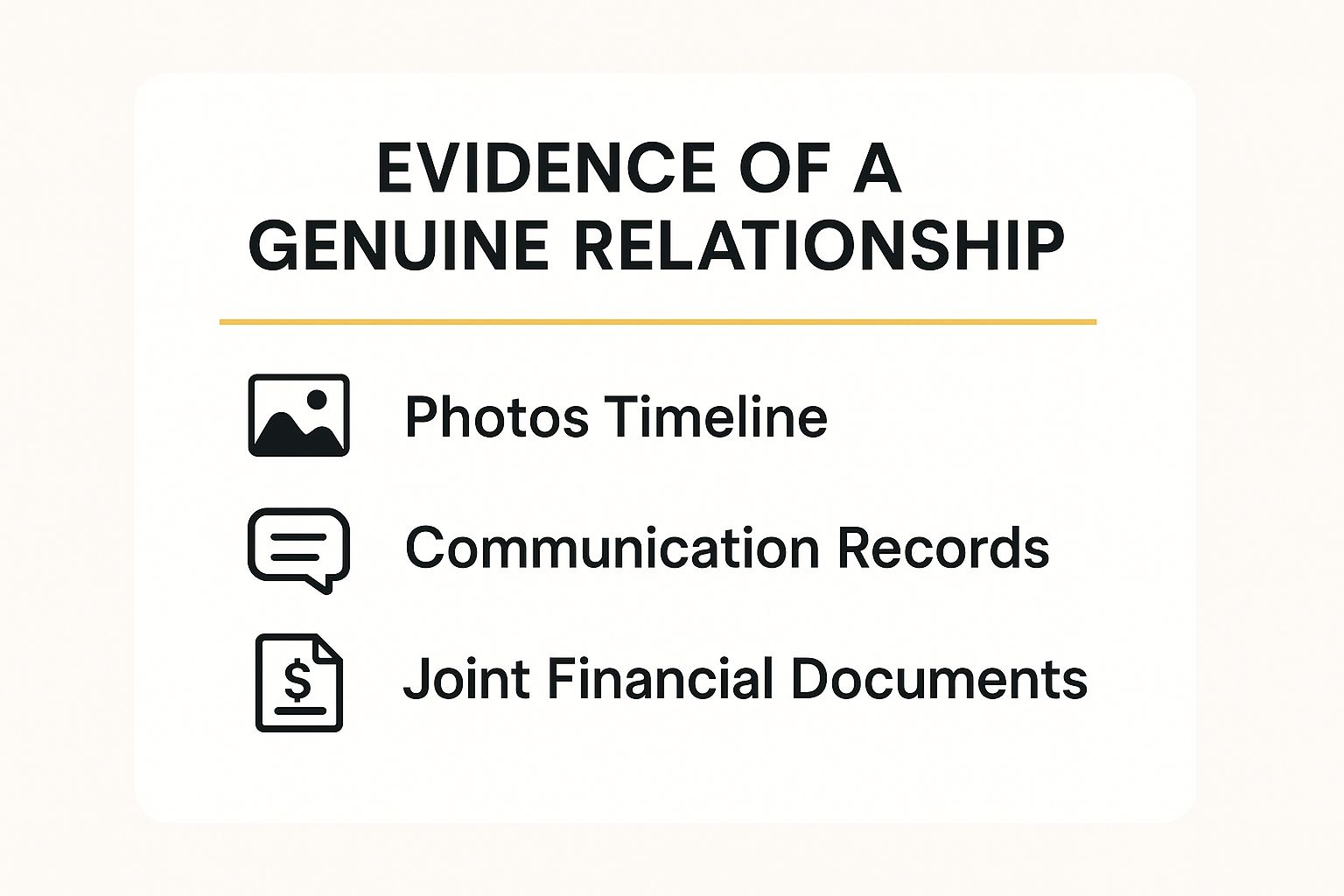
Combining evidence from these three core areas creates a robust and believable portrait of your genuine partnership for immigration officers.
Key Insight: Don’t just submit documents; provide context. A brief, well-written letter explaining your relationship history can tie all your evidence together, helping the officer understand your story. Explain any cultural nuances that might affect how your relationship is presented. For an in-depth look at what’s required, you can learn more about the Proof of Genuine Relationship requirements on www.ullaw.ca.
2. Financial Support and Sponsorship Requirements
A key responsibility in the spousal sponsorship process is the sponsor’s commitment to financially support their partner. While there is no strict Low Income Cut-Off (LICO) for sponsoring a spouse, common-law partner, or conjugal partner (unless they have dependent children who have their own dependent children), you must still prove to Immigration, Refugees and Citizenship Canada (IRCC) that you have the financial capacity to provide for their basic needs without relying on social assistance.
This requirement is formalized through a legally binding “undertaking.” By signing this agreement, you promise to support your sponsored partner for three years from the day they become a permanent resident. This includes providing for their food, clothing, shelter, and other essential needs. Your ability to meet this obligation is a crucial part of your spousal sponsorship checklist.
Why It’s Crucial
IRCC needs assurance that the sponsored individual will not become a upfront cost burden on Canadian society. A failure to demonstrate sufficient and stable financial capacity can raise red flags for an immigration officer, potentially leading to a refusal. Proving your financial stability shows that you have planned for this new chapter and are fully prepared to uphold your sponsorship obligations.
Types of Evidence to Include
Your financial evidence should create a clear and stable picture of your income and financial health. A strong application includes documents that demonstrate consistent earning power and responsible financial management:
- Proof of Employment and Income: Submit an employment letter detailing your position, salary, and date of hire. Include recent pay stubs and your Canada Revenue Agency (CRA) Notice of Assessment (NOA) for the most recent tax year. Providing NOAs for the past few years can effectively show income consistency.
- Self-Employment or Business Income: If you are self-employed, provide business registration documents, financial statements prepared by an accountant, and tax documents like T1 Generals. A letter from an accountant verifying your business’s income can also add significant weight.
- Evidence of Assets: Supplement your income proof with evidence of savings, investments, or property ownership. Bank statements showing a healthy balance and property deeds demonstrate additional financial security that can strengthen your application.
Key Insight: Transparency is essential. If you have gaps in your employment or significant income fluctuations, address them directly in a letter of explanation. For example, explain a period of unemployment due to returning to school or a temporary downturn in business. This proactive approach shows honesty and can prevent misinterpretations by the officer. For complex financial situations, you can get personalized advice by consulting a professional about your financial support and sponsorship requirements.
3. Identity and Civil Status Documentation
Beyond proving your relationship is genuine, you must provide a comprehensive collection of official documents that establish the legal identity and civil status of both the sponsor and the person being sponsored. This paperwork forms the legal bedrock of your application, and every piece of information must be accurate, current, and verifiable by Immigration, Refugees and Citizenship Canada (IRCC). These documents confirm who you are, your nationality, and your legal relationship status.
This step in the spousal sponsorship checklist involves gathering foundational legal documents like birth certificates, passports, and marriage or divorce certificates. Failing to provide complete and properly formatted documentation can cause significant delays or even lead to the refusal of your application. IRCC requires this evidence to verify that both parties are eligible to participate in the sponsorship process.
Why It’s Crucial
IRCC must legally verify the identities of both the sponsor and the applicant to prevent fraud, ensure both parties are free to marry or enter a common-law partnership, and confirm their citizenship or status. Any inconsistencies, such as name discrepancies between documents or expired papers, can raise red flags. Providing clear, certified, and organized documents is essential for a smooth and efficient processing experience.
Types of Evidence to Include
Your document package must be meticulously organized and contain specific items for both the sponsor and the sponsored person. Strong applications always include:
- Identity Documents: Clear, legible copies of passports or travel documents for both individuals are mandatory. You’ll also need birth certificates to establish identity and family connections.
- Proof of Marital Status: Depending on your situation, this could be a marriage certificate (for example, an Ontario Certificate of Marriage), a Statutory Declaration of Common-Law Union (IMM 5409) supported by evidence of 12+ months of cohabitation, or proof of previous divorce (such as a Certificate of Divorce issued by a Canadian court).
- Police Certificates and Clearances: The sponsored person and their family members (18 or older) must provide police certificates from every country where they have lived for six months or more since the age of 18. These certificates are crucial for the mandatory background checks.
Ensuring each document meets IRCC’s specific requirements, including certified translations for any document not in English or French, is a non-negotiable part of a successful application.
Key Insight: Start the document collection process immediately. Some official records, like police certificates or authenticated divorce decrees from foreign countries, can take several months to obtain. Use only IRCC-recognized certified translators and always keep high-quality copies of every single document you submit for your personal records.
4. Medical Examinations and Health Requirements
An essential step in the Canadian spousal sponsorship process involves a mandatory medical examination for the person being sponsored. This examination is designed to ensure the applicant does not pose a risk to Canadian public health or safety and will not place an “excessive demand” on Canada’s health or social services. This is a non-negotiable part of your spousal sponsorship checklist and must be completed correctly to avoid delays or refusal.
The exam must be conducted by a Panel Physician, a doctor specifically approved by Immigration, Refugees and Citizenship Canada (IRCC). The results are sent directly from the physician’s office to IRCC for assessment. Understanding this requirement and preparing for it properly is crucial for a smooth application process.
Why It’s Crucial
Canada’s immigration system prioritizes the health and safety of its population. The medical examination screens for inadmissible health conditions. If an applicant has a condition that could endanger public health (like active tuberculosis) or be prohibitively expensive to manage, it could lead to their application being denied. Being transparent and proactive about health conditions is vital.
What the Examination Involves
The medical exam is a standard physical check-up and is not meant to be invasive. The process generally includes:
- Medical History Review: The physician will ask about past and current medical conditions. It is critical to be honest and disclose everything, including managed conditions like diabetes or high blood pressure.
- Physical Examination: This includes standard checks like height, weight, blood pressure, vision, and hearing tests.
- Lab Tests: Applicants over 15 typically require a chest X-ray and blood tests. For pregnant applicants, the chest X-ray may be deferred until after delivery to ensure safety.
- Proof of Vaccination: While not always mandatory for sponsorship, providing a record of your vaccinations, including for COVID-19, is highly recommended.
The panel physician will submit the results electronically to IRCC through the eMedical system. You will be given an information sheet confirming the exam was completed, which you should keep for your records.
Key Insight: You can complete the medical exam in one of two ways: either before submitting your application (an “upfront” medical exam) or by waiting for IRCC to send you instructions after you apply. Completing an upfront medical exam can often speed up processing times, as IRCC will not have to issue a separate request for it later.
5. Background Checks and Security Clearances
A core component of Canada’s immigration system is ensuring the safety and security of the country. For your spousal sponsorship checklist, this translates into a mandatory and thorough background screening process for the person being sponsored. Immigration, Refugees and Citizenship Canada (IRCC) must be satisfied that the applicant does not pose a security or health risk and is admissible to Canada.
This stage of the application involves a detailed review of the applicant’s personal history. It requires submitting police clearance certificates from every country where the applicant has lived for six months or more since the age of 18. This is a non-negotiable step designed to verify the applicant’s criminal history, or lack thereof, and is crucial for meeting admissibility requirements.
Why It’s Crucial
Admissibility is a fundamental pillar of Canadian immigration law. An applicant can be deemed inadmissible on several grounds, including criminality, security risks, or misrepresentation. Failing to provide accurate and complete background information can lead to severe consequences, such as processing delays, an interview, a finding of inadmissibility, or even a ban on entering Canada for a specified period.
Types of Evidence to Include
Your submission must be comprehensive and meticulously organized to facilitate a smooth review by the IRCC officer. Strong applications address all aspects of the applicant’s background upfront.
- Police Clearance Certificates: This is the primary document for this section. You must obtain an official police certificate from each country (and in some cases, each province or territory) where the sponsored person has lived for six or more consecutive months since turning 18. For instance, an applicant who lived in Alberta and then moved abroad would need a Canadian RCMP check in addition to clearances from any other countries.
- Detailed Personal History: The application forms require a complete history of addresses and activities (like work or school) for the past 10 years. Ensure there are no unexplained gaps. If there are periods of unemployment or travel, they must be clearly accounted for.
- Supporting Documentation (If Applicable): If the applicant has a past minor conviction, it is vital to be transparent. Provide all court documents, proof of sentence completion, and evidence of rehabilitation. For example, a person with a past military career should include their service records to provide full context.
Thoroughness and honesty in this section are paramount to preventing delays and demonstrating your commitment to a transparent application process.
Key Insight: Start the process of obtaining police clearances as early as possible. Processing times can vary dramatically from a few weeks to several months depending on the country. Since these certificates are typically valid for only one year, timing their acquisition is a key strategic part of your application timeline. To understand how admissibility impacts long-term goals, you can explore the process of a Canadian citizenship application on www.ullaw.ca.
6. Complete and Accurate Application Forms
The foundation of a smooth and efficient spousal sponsorship application lies in the meticulous completion of all required government forms. Even a small error, an outdated form version, or an unanswered question can cause significant delays or lead to your entire application package being returned. Immigration, Refugees and Citizenship Canada (IRCC) requires absolute precision and completeness in its documentation.
Think of the application forms as the official framework for your entire case. While supporting documents provide the evidence, the forms structure that evidence and present your personal information directly to the immigration officer. Ensuring every detail is correct, consistent, and current is a non-negotiable step in any spousal sponsorship checklist.
Why It’s Crucial
IRCC processes a massive volume of applications, and their system is designed to handle standardized, correctly completed forms. Inaccuracies or omissions act as immediate red flags, forcing officers to return the application or issue requests for clarification, halting all progress. Using an outdated form version, for instance, often results in an automatic return without review, wasting months of your time.
Types of Forms and Key Details
Your application package will include several key forms for both the sponsor and the person being sponsored. Precision is paramount across all of them:
- Version Control: Always download the latest versions of forms like the IMM 1344 (Application to Sponsor, Sponsorship Agreement and Undertaking) and IMM 0008 (Generic Application Form for Canada) directly from the IRCC website before you start. An old version will be rejected.
- Validate Before You Print: The IMM 1344 is a 2D barcode form. Fill it out electronically, click the “Validate” button, and only then print the barcode pages. The barcode encodes everything you typed — if you hand-correct the printed form without re-validating, the barcode and the visible text will mismatch and the package is likely to be returned.
- Comprehensive Information: Fill out every single field. If a question does not apply to you, write “N/A” or “Not Applicable.” Leaving a field blank can be misinterpreted as an incomplete application.
- Consistency is Key: Ensure details like names, dates of birth, and relationship timelines are identical across all forms. For example, the date you began your common-law relationship on the IMM 5532 (Relationship Information and Sponsorship Evaluation) must match the information provided in other documents. A sponsor must meticulously detail their financial capacity, and the sponsored person must provide a complete 10-year travel history in Schedule A.
Paying close attention to these forms prevents the most common and avoidable processing delays.
Key Insight: After filling out the forms on your computer, print and sign them immediately. Some forms have validation barcodes that are generated upon completion, and it’s critical that the printed and signed version matches the validated electronic file you will upload. Have a trusted friend or family member review the forms for a fresh perspective on any potential errors. Understanding potential delays can help set realistic expectations; you can learn more about Canadian immigration processing times on www.ullaw.ca.
7. Quebec Provincial Sponsorship Assessment
If you reside in Quebec and plan to sponsor your spouse or partner, you must navigate a two-step process that involves both federal and provincial authorities. While IRCC handles the permanent residence application itself, the sponsor’s eligibility is first assessed and approved by Quebec’s Ministry of Immigration, Francization and Integration (MIFI). This dual-layer approval is a critical part of the spousal sponsorship checklist for Quebec residents, because sponsors must meet specific provincial financial and integration requirements that are distinct from the rest of Canada.
The process begins with the federal sponsorship application to IRCC, which is then forwarded to MIFI for assessment. The sponsor submits a separate undertaking application (demande d’engagement) directly to the Quebec government. MIFI evaluates the sponsor’s financial capacity using its own income thresholds and confirms the sponsor’s commitment to support their spouse in Quebec.
Why It’s Crucial
Failure to meet MIFI’s criteria will halt the entire application, regardless of federal eligibility. Quebec applies its own undertaking and income standards on top of IRCC’s, so a sponsor who would qualify elsewhere in Canada can still be refused at the provincial stage.
What to Prepare
- Meet Provincial Financial Thresholds: Quebec maintains its own income grid for sponsors, separate from federal LICO. Review the current MIFI grid carefully and assemble Notices of Assessment, pay stubs, and employer letters that prove you meet the specific figures for your household size.
- Submit the Undertaking Promptly: Once IRCC forwards your file, MIFI will request your demande d’engagement. Have your supporting documents — proof of Canadian status, residency, and financial records — ready before you receive the request so you can respond inside MIFI’s short deadlines.
- Show Integration Intent: While not always a strict requirement, demonstrating a plan for your spouse to integrate into Quebec society can strengthen your file. This may include enrolling in French language courses (francisation) or outlining plans to engage with the local community.
Key Insight: Quebec applies its own undertaking standard on top of IRCC’s federal requirements, and the two are reviewed by different officers at different stages. Aligning your federal and provincial paperwork from the start — same income figures, same household composition, consistent narrative — prevents the kind of small contradictions that turn into long delays at the MIFI stage.
8. Submission Package Organization and Final Verification
The last step before sending your application to IRCC is meticulously organizing every document into a comprehensive submission package. This is more than gathering papers; it is presenting your entire case in a clear, logical, easy-to-review format that mirrors IRCC’s requirements. A well-organized package significantly reduces the risk of delays, requests for more information, and outright rejection on administrative grounds.
Proper package preparation also signals thoroughness and credibility. A processing officer who can verify your information at a glance moves your file forward faster than one who has to chase missing pieces.
Why It’s Crucial
A messy or incomplete package invites scrutiny and can start your sponsorship journey on the wrong foot. IRCC return rates for completeness errors are non-trivial, and a returned package can cost months. Treat the final assembly as a separate phase, not an afterthought to the data collection.
Actionable Tips for Final Assembly
- Follow the Official Checklist: Use the IRCC Document Checklist (IMM 5533 for spouses) as your definitive guide. Arrange every document in the exact order listed on the checklist. Deviating from this sequence can cause confusion and processing delays.
- Create a Table of Contents: For paper applications with extensive supporting evidence, a short table of contents acts as a roadmap for the reviewing officer. It shows professionalism and makes your package easier to navigate.
- Handle Originals and Copies Correctly: Keep your original documents — passports, birth certificates, marriage certificates — unless IRCC specifically requests them. Submit high-quality, legible photocopies. Any document not in English or French must be accompanied by a certified translation and an affidavit from the translator.
- Digital File Naming Convention: If submitting through the online portal, follow IRCC’s file naming conventions and size limits. Use clear names like
Principal-Applicant-Passport.pdforSponsor-Proof-of-Employment.pdfto avoid confusion during upload and any later officer review.
Key Insight: The final assembly of your application package is where most preventable mistakes occur. A short, deliberate review at this stage — checklist in hand, every document re-examined for completeness and consistency — catches the kind of small errors that turn into a returned package or a Procedural Fairness letter months later.
Spousal Sponsorship Requirements Comparison
| Item | Implementation Complexity 🔄 | Resource Requirements ⚡ | Expected Outcomes 📊 | Ideal Use Cases 💡 | Key Advantages ⭐ |
|---|---|---|---|---|---|
| Proof of Genuine Relationship | High – requires gathering diverse and detailed evidence | Moderate – time-intensive documentation collection | Strong demonstration of relationship authenticity | Essential for all spousal sponsorships to prove legitimacy | Overcomes red flags; shows genuine commitment |
| Financial Support and Sponsorship Requirements | Moderate – mainly document preparation and verification | Moderate – financial documents, tax returns | Assurance of sponsor’s financial capability | Sponsors with variable income or self-employment | Prevents burden on public services; financial security |
| Identity and Civil Status Documentation | Moderate – obtaining official documents from multiple sources | Moderate to high – may incur costs, translations needed | Legal verification of identity and civil status | All applicants requiring clear legal status proof | Ensures compliance with legal requirements; background clarity |
| Medical Examinations and Health Requirements | Moderate – must coordinate with approved physicians | High – medical exams can be costly and limited in availability | Confirms health admissibility and public safety | Mandatory for all sponsored persons | Protects public health; identifies treatable conditions |
| Background Checks and Security Clearances | High – multiple security checks and documentation | Moderate – time-consuming police clearances | Ensures applicant poses no security risk | Applicants with complex or multi-country histories | Comprehensive vetting; early inadmissibility detection |
| Complete and Accurate Application Forms | Low to Moderate – requires attention to detail and updates | Low – mostly digital forms and signatures | Avoids processing delays and refusals | All applicants submitting sponsorship applications | Standardized, validated forms reduce errors and delays |
| Quebec Provincial Sponsorship Assessment | High – dual federal-provincial requirements | High – additional financial proofs, French-language evidence, MIFI-specific documents | Adds provincial eligibility layer; can extend timelines | Sponsors living in or moving to Quebec | Province-tailored review of economic and linguistic integration |
| Submission Package Organization | Moderate – strict ordering, indexing, certification, fee proof | Moderate – printing, indexing, tracked delivery, time for final checks | Minimizes RFIs and delays; secures clean intake | Final pre-submission step for all applications | Proper format and completeness significantly cut processing time |
Ensuring a Smooth Journey with Expert Guidance
Navigating the intricacies of a Canadian spousal sponsorship application is a journey defined by diligence and meticulous attention to detail. This comprehensive spousal sponsorship checklist has broken down the critical pillars of a successful application, from gathering irrefutable proof of your genuine relationship to ensuring every single form is completed with absolute precision. We have covered the importance of demonstrating financial capacity, compiling all necessary identity and civil status documents, and successfully clearing the mandatory medical and security requirements. Each component is a crucial piece of the puzzle, and a single missing or incorrectly presented element can unfortunately lead to significant delays or even refusal.
The goal is not simply to submit a package of documents; it is to present a compelling, clear, and undeniable case to Immigration, Refugees and Citizenship Canada (IRCC). Your application tells the story of your relationship, and it must be supported by a foundation of solid, well-organised evidence. Mastering this checklist means moving beyond just ticking boxes. It involves understanding the why behind each requirement and anticipating how an officer will interpret the information you provide.
Key Takeaways for a Strong Application
To crystallize your next steps, let’s revisit the most critical takeaways:
- Authenticity is Non-Negotiable: The burden of proof for a genuine relationship rests on you. Focus on providing a wide variety of evidence that spans the entirety of your relationship, showcasing its development and public recognition.
- Precision Prevails: Inaccuracies or inconsistencies, even minor ones, can raise red flags. Triple-check every date, name, and detail across all forms and supporting documents before you even think about submitting your file.
- Completeness is Mandatory: An incomplete application is one of the most common and avoidable reasons for return or rejection. Use this spousal sponsorship checklist as your guide to ensure every required document, signature, and fee is included.
Embarking on this process is a testament to your commitment to building a future together in Canada. While the path can seem daunting, a methodical and informed approach transforms an overwhelming task into a series of manageable steps. The reward, a life shared with your partner in your chosen home, is undoubtedly worth the effort. By taking the time to prepare a thorough and compelling application, you are laying the strongest possible foundation for your new beginning.
Feeling overwhelmed or want a professional to review your application before submission? Call UL Lawyers at 905-744-8888 or email info@ullaw.ca. We review Canadian spousal sponsorship packages for clients across Ontario.
You can also book a consultation or start on our immigration law page.
Related UL Lawyers resources
If your situation is moving from general research to a real legal problem, these service pages may help you choose the next step:
- Immigration law services — service overview.
- Immigration judicial review — focused service page.
- Work permit refusal help — focused service page.