
If you’ve been hurt because someone else was careless, you’ve probably heard the word negligence thrown around. But what does it actually mean — and how do you prove it in a Canadian courtroom? Negligence is the legal backbone of most personal injury claims in Ontario, from slip-and-fall accidents to car collisions to medical errors. Without establishing negligence, there is no compensation.
The good news is that negligence isn’t a mystery. Courts assess it through a structured, four-part test that has been refined over decades of Canadian common law. Each part is distinct, and each must be proven on a balance of probabilities — meaning it is more likely than not that the element is true. Miss even one element, and your claim may not succeed.
This guide walks you through each of the four proofs of negligence in plain language, explains what evidence matters, discusses how partial fault or non-physical harm can affect your case, and tells you what to do if you believe someone’s carelessness has harmed you.
Table of Contents
- What Are the 4 Proofs of Negligence?
- What Are the Four Proofs of Negligence? (A Closer Look at Each)
- What Are the Four Elements of Negligence in a Personal Injury Case?
- How Do You Prove the Four Elements of Negligence?
- Are There Different Types of Negligence?
- What Is Negligence Per Se?
- How Is Compensation Affected by the Negligence Involved?
- What If You Were Partly Negligent for the Accident That Caused Your Injuries?
- Can You Seek Compensation for Negligence If You Were Not Physically Injured?
What Are the 4 Proofs of Negligence?
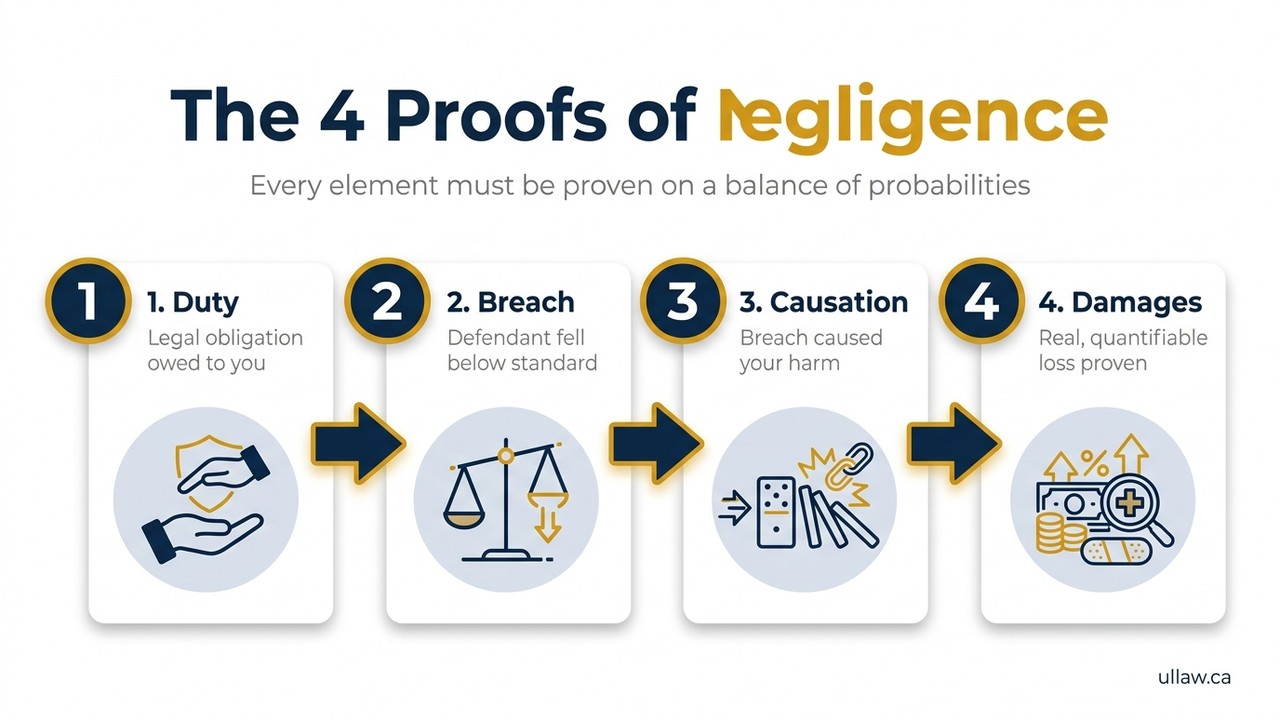
To succeed in a negligence claim in Ontario, you must prove four distinct legal elements. Think of them as four locks — every one must be opened before you can recover compensation.
1. Duty of Care
Duty of care is the legal obligation one person owes to another to act with reasonable caution. Canadian courts ask: was it reasonably foreseeable that the defendant’s actions could harm someone in the plaintiff’s position? Drivers owe a duty of care to other road users. Property owners owe a duty to visitors. Doctors owe a duty to their patients. Duty of care is usually the easiest element to establish, but it is not automatic — you must show the relationship between the parties is one the law recognises.
2. Breach of Duty
Once a duty exists, you must show it was breached. The standard is that of a reasonable person in the same circumstances. Did the defendant fall short of that standard? A driver who runs a red light, a store that ignores a wet floor, a contractor who skips mandatory safety steps — all of these can amount to a breach. Evidence here often includes witness statements, photographs, expert reports, and safety records.
3. Causation
Causation is frequently the most hotly contested element. You must show that the defendant’s breach caused your loss — courts often use the phrase “but for” the defendant’s conduct, the harm would not have occurred. In medical malpractice or complex injury cases, causation may require expert medical testimony to link the negligent act directly to your injuries.
4. Damages
Finally, you must show you suffered actual, compensable harm. In Ontario, recoverable damages can include medical expenses, lost income, pain and suffering, and future care costs. Without provable damages, there is no negligence claim — even if the defendant acted recklessly. Keep all receipts, medical records, and income documentation from the moment an incident occurs.
These four elements — duty, breach, causation, damages — form the complete framework courts use under the common law of negligence.
What Are the Four Proofs of Negligence? (A Closer Look at Each)
Because each element is independently tested, it helps to understand what “proof” actually looks like in practice for each one.
Proving Duty of Care
Duty of care was famously articulated in the foundational Donoghue v Stevenson principle adopted throughout Canadian common law: you must take reasonable care to avoid acts or omissions that you can reasonably foresee would injure your “neighbour” — meaning anyone closely and directly affected by your conduct. Ontario courts have expanded this concept significantly. The Ontario e-Laws database lists numerous statutes — such as the Occupiers’ Liability Act and the Highway Traffic Act — that codify specific duties of care.
Proving Breach
Breaching a duty means failing to meet the reasonable person standard. Courts ask what a hypothetical, prudent person would have done in identical circumstances. Evidence can include:
- Photos or video of the hazard or scene
- Maintenance or inspection logs (or the absence of them)
- Witness accounts of the conduct
- Industry standards or regulations the defendant failed to meet
- Expert testimony on accepted professional practices
Proving Causation
The “but-for” test is the primary tool: but for the defendant’s breach, would you have suffered the harm? If yes, causation fails. If no, causation is established. In cases involving multiple contributing causes — such as a pre-existing condition aggravated by an accident — Ontario courts may apply a material contribution analysis. Medical and engineering experts are frequently essential here.
Proving Damages
Damages must be real and quantifiable. Ontario recognises several heads of damages in tort claims:
- Special damages: out-of-pocket losses (medical bills, medications, income lost to date)
- General damages: non-pecuniary losses like pain, suffering, and loss of enjoyment of life
- Future damages: projected future care costs and lost earning capacity
Keep meticulous records from day one. A gap in documentation can significantly weaken the damages portion of your claim.
What Are the Four Elements of Negligence in a Personal Injury Case?
Personal injury cases — car accidents, slip-and-falls, dog bites, construction site injuries — are the most common arena where the four negligence elements are tested in Ontario.
Although a scenario may seem straightforward to you, a defendant and their insurer will scrutinise every element. Consider a rear-end car collision: the victim must establish each element carefully:
- Duty: The at-fault driver owed a duty of care to other motorists under the Highway Traffic Act and general common law.
- Breach: Running a red light, distracted driving, or following too closely all constitute a breach of the reasonable driver standard.
- Causation: Medical evidence must link the crash directly to the injuries — insurers routinely argue that neck pain pre-existed the accident.
- Damages: Hospital bills, physiotherapy costs, lost wages, and pain and suffering must all be documented and quantified.
Some examples of evidence useful in a personal injury case include:
- Collision reports and police records
- Dashboard camera or traffic camera footage
- Independent medical examinations and specialist reports
- Employment records confirming lost income
- Receipts for all treatment and accommodation costs
Personal injury victims in Ontario also navigate statutory frameworks such as the Insurance Act and the Statutory Accident Benefits Schedule (SABS), which govern accident benefits separately from the tort claim. Understanding both streams is important to maximising your recovery.
How Do You Prove the Four Elements of Negligence?
Proof in a civil negligence case is assessed on the balance of probabilities — a lower threshold than the criminal “beyond a reasonable doubt” standard. This means you must convince the court that it is more likely than not (greater than 50%) that each element is satisfied.
Building Your Evidence Package
A strong negligence claim typically rests on several categories of evidence working together:
- Scene evidence: Photographs taken immediately after the incident, preserving hazardous conditions before they are repaired or altered
- Medical records: Emergency room notes, specialist diagnoses, treatment plans, and prognosis reports
- Expert reports: Accident reconstruction specialists, occupational therapists, engineers, and economists may all be needed
- Documentary evidence: Contracts, inspection logs, safety policies, and correspondence that reveal what the defendant knew and when
- Witness testimony: Eyewitnesses and expert witnesses can provide critical support at trial
- Your own evidence: A detailed personal journal documenting pain levels, functional limitations, and the effect on your daily life
The Role of an Ontario Litigation Lawyer
Gathering and presenting this evidence effectively requires legal skill. Lawyers know what documents to request through discovery, how to retain the right experts, and how to cross-examine defence witnesses. If you believe you have a negligence claim, speaking with an experienced team — like the litigation lawyers at UL Lawyers — can help you understand your position before critical evidence disappears or limitation periods expire.
In Ontario, the general limitation period for most civil claims is two years from the date you knew or ought to have known you had a claim, under the Limitations Act, 2002.
Are There Different Types of Negligence?
Yes. Ontario law recognises several important variations on negligence, each relevant depending on the facts of your situation.
Ordinary Negligence
The most common type — a failure to act with the care a reasonable person would exercise in the circumstances.
Gross Negligence
Gross negligence implies a more serious, reckless disregard for the safety of others. It can arise, for example, in cases of extreme speeding or a care facility ignoring obvious signs of a resident’s deteriorating health. Gross negligence may expose a defendant to greater liability in certain contractual and statutory contexts.
Professional Negligence (Malpractice)
When the defendant is a professional — a doctor, lawyer, engineer, or accountant — the standard of care is measured against what a reasonably competent member of that profession would do. Medical malpractice claims in Ontario are a common example.
Contributory and Comparative Negligence
If you played some role in causing your own injuries, Ontario applies contributory negligence principles under the Negligence Act. Your damages are reduced in proportion to your share of fault. You can still recover even if you were partly at fault — see the section below.
Vicarious Liability
Vicarious liability holds employers and organisations responsible for the negligence of their employees or agents acting within the scope of their duties. This can significantly broaden who you can name as a defendant.
What Is Negligence Per Se?
Negligence per se is a doctrine — more prominent in American law but recognised in principle in Canadian jurisprudence — where a defendant’s violation of a statute or regulation is treated as automatic proof of a breach of the standard of care.
In Ontario, breaching a statutory duty does not automatically create civil liability in the same formulaic way as in some U.S. states, but it is highly persuasive evidence of negligence. For example:
- A transport truck driver exceeding hours-of-service limits under federal regulations, then causing a collision, has clearly breached a statutory safety standard.
- A building owner who fails to maintain a property in compliance with the Occupiers’ Liability Act may find that statutory non-compliance strongly supports a finding of breach.
- A driver who runs a red light in violation of the Highway Traffic Act has violated a standard designed precisely to protect other road users.
Courts will consider the purpose of the statute, whether you belong to the class of persons it was meant to protect, and whether the harm suffered is the type the statute was designed to prevent. The Ontario e-Laws portal is a reliable source for reviewing the specific legislative standards that may apply to your situation. Statutory violations won’t win your case alone, but they are powerful building blocks in establishing breach.
How Is Compensation Affected by the Negligence Involved?
The degree of negligence — on both sides — directly shapes the amount of compensation you may recover.
Full Recovery When Only the Defendant Is at Fault
If the defendant is entirely responsible, you may be entitled to the full value of your special damages, general damages, and future losses without any reduction.
Reduction for Contributory Negligence
If you are found to be partly at fault, Ontario’s Negligence Act directs the court to apportion liability. For example, if a court finds you 25% at fault for an accident, your total award is reduced by 25%. This does not bar your claim entirely — Ontario does not apply the old contributory negligence rule that would have eliminated your claim for any personal fault.
The Impact of the Defendant’s Degree of Fault
In claims involving multiple defendants, Ontario courts may apply several liability — meaning each defendant pays only their proportionate share of fault — or joint and several liability, depending on the circumstances and applicable legislation. This affects practical recovery significantly.
Statutory Caps and Deductibles
In Ontario motor vehicle injury cases, non-pecuniary general damages (pain and suffering) are subject to a statutory deductible under the Insurance Act in cases where the award falls below a threshold. This is a uniquely Ontario consideration that an experienced personal injury and litigation lawyer can explain in the context of your specific claim.
What If You Were Partly Negligent for the Accident That Caused Your Injuries?
Being partly at fault does not automatically disqualify you from seeking compensation in Ontario. Under the Negligence Act, the court assigns a percentage of fault to each party, and your damages are reduced accordingly.
Practical Example
Suppose you were injured in a slip-and-fall at a store but the court finds you were 30% at fault for not watching where you were walking. If your total proven damages are $100,000, you would recover $70,000 — reduced by your 30% share of fault.
Seatbelt and Helmet Reductions
In Ontario motor vehicle cases, failing to wear a seatbelt can result in a reduction of damages — even if the accident was entirely the other driver’s fault. Helmet non-use in cycling or motorcycle cases is treated similarly.
Contributory Negligence Does Not Mean No Claim
Many injured people assume that because they did something wrong, they have no case. This is a common misconception. Even significant contributory fault does not necessarily eliminate a claim. The key is understanding how the apportionment will affect your net recovery — a conversation best had with a lawyer who can assess the facts of your specific situation.
The Canadian legal information platform CanLII contains Ontario court decisions illustrating how judges have apportioned fault in a wide range of accident types, which can provide useful context for similar circumstances.
Can You Seek Compensation for Negligence If You Were Not Physically Injured?
This is a nuanced area of Ontario law. The short answer is: sometimes yes, but it is more difficult.
Pure Economic Loss
Ontario courts have recognised claims for pure economic loss — financial harm without accompanying physical injury — in certain circumstances. Examples include negligent misrepresentation by a professional that causes someone to make a costly financial decision. However, courts apply strict proximity and policy considerations to prevent an unlimited flood of claims.
Psychiatric and Psychological Injury
Serious psychological or psychiatric injuries — such as post-traumatic stress disorder, major depressive disorder, or anxiety disorders — are recognised as compensable injuries even without physical harm, provided they meet the threshold of a recognisable psychiatric illness rather than ordinary grief or upset. Expert psychiatric evidence is essential.
Secondary Victims (Nervous Shock)
Ontario law may allow a family member who witnessed a traumatic injury to a loved one to claim for nervous shock if they suffered a recognised psychiatric illness as a result. Courts apply careful limits to such claims.
Property Damage Without Personal Injury
If your property was damaged due to someone else’s negligence but you suffered no personal injury, you may still have a valid negligence claim for the property loss — provided all four elements are met.
If you are unsure whether your circumstances give rise to a compensable claim, speaking with a lawyer is the most reliable way to assess your options.
Talk to a UL Lawyers Team Member
If you believe you have been harmed by someone else’s negligence — whether in a car accident, a slip-and-fall, a professional setting, or another situation — the sooner you speak with a lawyer, the better. Evidence fades, witnesses’ memories change, and Ontario’s two-year limitation period can close the door on an otherwise valid claim. The litigation team at UL Lawyers offers a free initial consultation to help you understand whether the four elements of negligence can be established in your case and what your next steps might look like. Reach out today — there is no obligation, and no cost, to have that first conversation.