Just days ago, an Ontario Superior Court decision put homelessness, safety, and equality at the centre of a major Charter ruling.
In The Regional Municipality of Waterloo v. Named Respondents and Persons Unknown, 2026 ONSC 2971, the Court dismissed Waterloo Region’s application to remove people from the encampment at 100 Victoria Street North in Kitchener. Justice Gibson found that the Region’s site-specific and amended by-laws violated sections 7 and 15(1) of the Canadian Charter of Rights and Freedoms and could not be justified under section 1.
For survivors of intimate partner violence, the decision matters because leaving abuse is often not just a relationship issue. It is a housing issue, a safety issue, a financial-control issue, and sometimes a child-protection concern all at once.
Ontario legal update: The Waterloo encampment ruling recognizes homelessness as an analogous ground under section 15 of the Charter. It does not automatically decide family law cases, but it may help courts and lawyers understand why post-separation housing instability can be central to survivor safety.
This article explains what happened in the case, why the ruling is legally significant, and how it may affect IPV survivors facing unsafe housing after separation.
Table of Contents
- What Happened in the Waterloo Encampment Case?
- Key Legal Takeaways from 2026 ONSC 2971
- Why This Matters for IPV Survivors
- Practical Implications and Actionable Advice
- How the 2026 Decision Builds on Prior Waterloo Law
- What Survivors Should Do Next
- Speak With UL Lawyers

What Happened in the Waterloo Encampment Case?
Waterloo Region applied to clear an encampment at 100 Victoria Street North in Kitchener, a location connected to the planned Kitchener Central Transit Hub. The Region relied on a site-specific by-law and an amended by-law aimed at removing people from the property.
The respondents challenged the by-laws. They argued that enforcement would violate Charter rights because people living at the encampment did not have adequate, safe, and realistic alternatives.
Justice Gibson dismissed the Region’s application and granted the respondents’ cross-application in part. The Court declared the challenged by-laws of no force and effect under section 52(1) of the Constitution Act, 1982 and issued an injunction restraining enforcement and eviction.
The Court also left a path forward. Waterloo Region may return for further direction if it implements a Safe Tenting Protocol, provides an alternative encampment site reasonably proximate to 100 Victoria Street, or both.
The full decision is available through the Social Rights Advocacy Centre: Decision of Gibson J., May 21, 2026.
Key Legal Takeaways from 2026 ONSC 2971
The Waterloo encampment ruling is important because it connects homelessness, equality, security, and government decision-making under the Charter.
Key takeaways include:
- Homelessness was recognized as an analogous ground under section 15. This means homelessness can be considered within equality-rights analysis, even though it is not listed expressly in section 15.
- The by-laws violated section 7. The Court found that enforcement affected life, liberty, and security of the person in a way that was not consistent with the Charter.
- The by-laws violated section 15(1). The Court found the challenged by-laws had discriminatory effects and were not justified under section 1.
- The decision is site- and fact-specific. It does not mean every encampment can remain permanently or that municipalities can never regulate public land.
- Realistic alternatives matter. The ruling focuses on whether people facing displacement have safe and practical places to go.
Justice Canada explains section 7 of the Charter and section 15 equality rights in its Charterpedia resources.
One of the most powerful passages from the decision is this:
“The homeless are not Other. They are Us. They are rights bearers no less entitled than any other Canadian citizens to the full benefit and protection of the Charter.”
That sentence matters for anyone whose safety depends on access to stable housing.
Why This Matters for IPV Survivors
Many survivors do not leave an abusive relationship into immediate stability. They leave into uncertainty.
A survivor may need to leave the family home quickly because of physical violence, coercive control, stalking, threats, financial control, or escalating abuse after separation. But leaving safely often depends on money, documents, transportation, childcare, shelter availability, and support.
When those supports are missing, survivors may be forced into:
- emergency shelters;
- temporary stays with friends or family;
- unsafe rentals;
- hidden homelessness;
- couch-surfing;
- returning to an abusive partner because there is nowhere else to go;
- in the most extreme cases, public-space survival or encampments.
The Waterloo encampment ruling does not turn every IPV case into a Charter case. But it reinforces a core point: homelessness and housing instability are not simply personal failures. They can reflect systemic barriers, poverty, trauma, discrimination, disability, economic abuse, and lack of safe alternatives.
Safe housing after abuse in Waterloo and Kitchener
For IPV survivors, a housing option is not truly safe just because it technically exists.
A proposed shelter, room, or temporary placement may be unsuitable if it:
- exposes the survivor to stalking or renewed violence;
- is not confidential or secure;
- separates the survivor from children;
- cannot accommodate disability, language, trauma, or accessibility needs;
- does not allow the survivor to keep medication, documents, or essential belongings;
- forces the survivor into a setting that increases risk;
- does not account for gender-specific or family-specific safety needs.
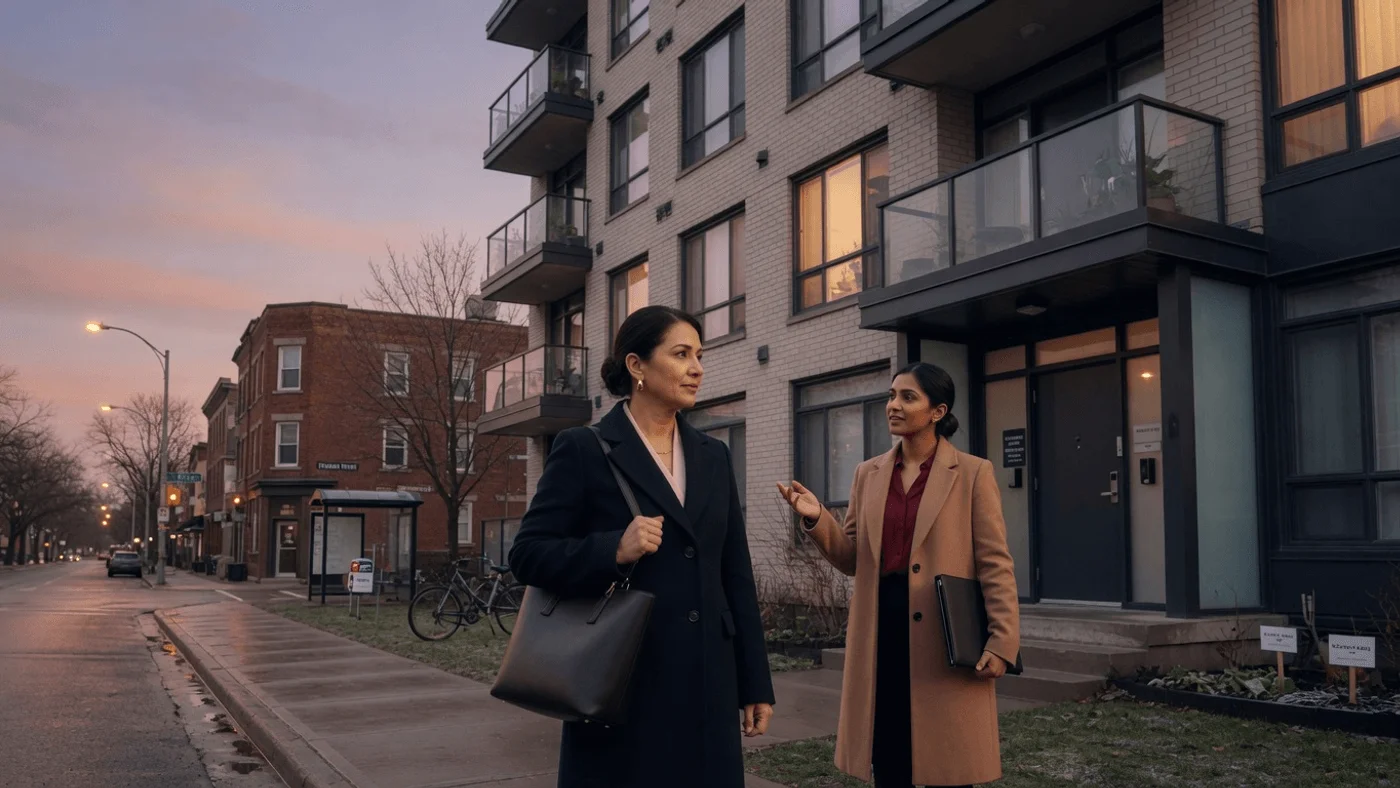
This is why the phrase “safe housing for survivors after abuse Waterloo Kitchener” is not just an SEO keyword. It is the real question many survivors face after separation: where can I go that is actually safe?
Post-separation housing instability and family law in Ontario
Housing instability can affect almost every part of a family law case.
Depending on the facts, housing may be relevant to:
- parenting arrangements and child safety;
- whether a parent can exercise parenting time safely;
- urgent support needs;
- support evidence, including child support or spousal-support needs;
- exclusive possession of the matrimonial home;
- the impact of coercive control or economic abuse;
- whether one party has been forced into unsafe or unstable living arrangements.
For survivors of IPV, post-separation economic abuse can be especially destabilizing. An abusive partner may control bank accounts, damage credit, hide income, refuse support, withhold documents, or use the family home as leverage.
Those facts may matter in separation, parenting, support, or urgent motion evidence. For related Ontario family-violence context, see UL Lawyers’ guide to Ahluwalia v. Ahluwalia and intimate partner violence in Ontario.
Practical Implications and Actionable Advice
The Waterloo encampment decision may help lawyers and survivors explain why housing instability after abuse should be treated as a serious safety issue.
It may be relevant when a survivor needs to show:
- why leaving the family home was necessary;
- why temporary housing is unsafe or unsuitable;
- why urgent financial support is needed;
- why a proposed parenting arrangement creates safety concerns;
- how coercive control affected access to money, documents, or housing;
- why exclusive possession of the home may be necessary;
- how a child’s routine, school, or stability has been affected.
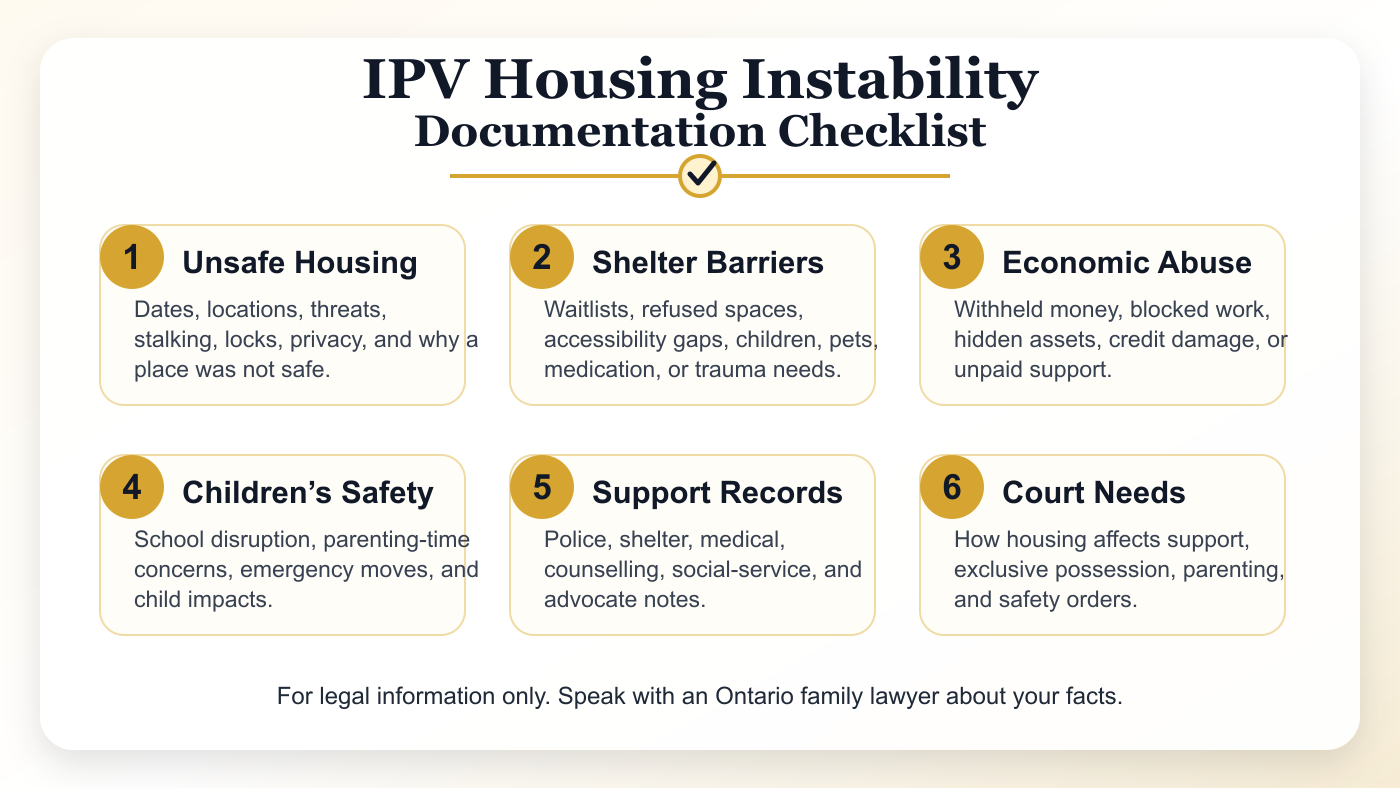
Survivors should document housing challenges as clearly as possible. Helpful records may include:
- dates and locations of unsafe housing;
- shelter waitlists or refusals;
- notes showing why a shelter option was unsafe, inaccessible, or inappropriate;
- messages about threats, stalking, coercive control, or financial abuse;
- police occurrence numbers;
- medical, counselling, or social-service records;
- school or childcare disruption;
- proof of income loss, blocked accounts, unpaid support, or hidden assets;
- communications about the family home, rent, mortgage, or access to belongings.
An Ontario family lawyer can help decide which evidence is legally useful and how to present it safely.
How the 2026 Decision Builds on Prior Waterloo Law
The 2026 ruling builds on an earlier Waterloo encampment decision from 2023.
In The Regional Municipality of Waterloo v. Persons Unknown and to be Ascertained, 2023 ONSC 670, the Ontario Superior Court found that enforcing the Region’s by-law to evict encampment residents would be unconstitutional where shelter spaces were inadequate.
The 2026 decision goes further by recognizing homelessness as an analogous ground under section 15 equality rights.
That matters because section 15 focuses on substantive equality. It looks at whether a law or government action creates or worsens disadvantage for a protected or analogous group.
For IPV survivors, the equality framing is important because housing instability often overlaps with gender, disability, Indigenous identity, poverty, trauma, caregiving responsibilities, and family violence.
The National Housing Strategy Act also recognizes housing as connected to dignity, well-being, and the progressive realization of the right to adequate housing. The Waterloo ruling applies Charter analysis in a specific municipal enforcement context, but it sits within a broader rights-based housing conversation.
What Survivors Should Do Next
If you are experiencing housing instability after leaving an abusive relationship, consider these steps:
- Prioritize immediate safety. If you are in danger, call 911 or contact local crisis supports.
- Document housing barriers. Keep records of shelter waitlists, refusals, safety issues, accessibility problems, and financial barriers.
- Preserve evidence of coercive control. Save messages, emails, banking records, police occurrence numbers, and support-worker notes where possible.
- Get legal advice before making major decisions. Leaving the home, relocating with children, or signing housing documents can affect your legal position.
- Ask about family law remedies. Depending on the facts, you may need urgent parenting terms, support, exclusive possession, or safety-related orders.
For parenting issues involving safety and housing, speak with a lawyer before assuming what the court will or will not consider. If children’s expenses are part of the dispute, UL Lawyers’ guide to section 7 expenses in Ontario may also be useful.
Speak With UL Lawyers
The Waterloo encampment ruling is more than a municipal by-law case. It is a reminder that homelessness, family violence, equality, and safety often intersect.
For IPV survivors, housing instability can be one of the biggest barriers to leaving abuse safely. A person may leave an abusive relationship only to face shelter shortages, economic abuse, unsafe temporary housing, and urgent parenting concerns.
If you are an IPV survivor struggling with housing instability after separation, UL Lawyers can help you understand your options and take practical legal steps to protect your safety, your children, and your future.
Contact UL Lawyers to book a consultation.