
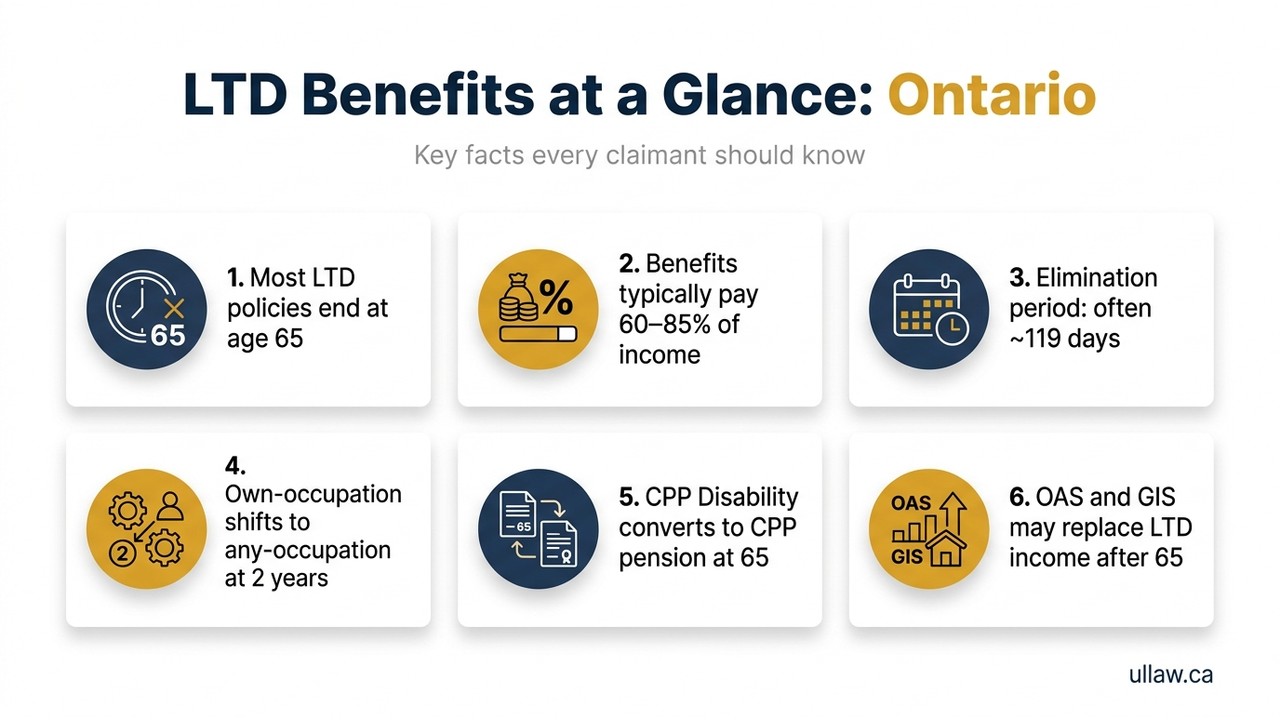
What happens to your LTD benefits when you turn 65? In most Ontario group policies, they stop. Age 65 is the typical end of the benefit period. Some policies extend if you were disabled close to 65 or if the wording guarantees a minimum period.
Quick answer: Most group LTD ends at 65. OAS and CPP retirement then apply; CPP Disability converts to a retirement pension. Cut off early? Call 905-744-8888 or email info@ullaw.ca. You can also book a free consultation. Hire on long-term disability lawyers or the Toronto LTD lawyer page.
Receiving long-term disability (LTD) benefits can be a financial lifeline when illness or injury keeps you out of work. In Ontario, most group LTD policies are tied to your working years, and age 65 is usually when benefits end or shift. That does not mean you are left with nothing — OAS, CPP, and in some cases a short policy extension can still apply.
If you’re already in a dispute with your insurer or worried about an upcoming cutoff, our long-term disability lawyers can review the policy wording. Toronto and GTA files can start on LTD lawyer Toronto.

Table of Contents
- What Happens to My LTD When I Turn 65?
- How Much Do You Get for LTD in Ontario?
- How Long Can You Stay on LTD in Ontario?
- What Medical Conditions Qualify for LTD Benefits?
- When Should You Expect LTD Benefits to Be Paid?
- What Are You Entitled to When You Turn 65 in Canada?
What Happens to My LTD When I Turn 65?
For most Ontarians, long-term disability benefits end at age 65. This isn’t arbitrary — it reflects the age at which most group insurance policies define the end of the “benefit period,” and it aligns with when government retirement programs like the Canada Pension Plan (CPP) and Old Age Security (OAS) become fully available.
However, there are important nuances:
Most Group Policies Terminate at 65
The majority of employer-sponsored LTD plans in Canada explicitly state that benefits cease on your 65th birthday. The reasoning is that 65 is the standard retirement age, and the policy is designed to replace employment income — once you’ve reached retirement age, the insurer’s obligation under that framework typically ends.
Some Policies May Extend Beyond 65
Not all policies are identical. If you were disabled close to age 65 — say, within the last two years before your birthday — some policies offer a shorter extended benefit period rather than cutting you off immediately. Others are written to pay for a minimum duration (for example, two years) even if that carries you past 65. Always read the exact wording of your policy or have a lawyer review it.
What Replaces LTD After 65?
When LTD ends, several programs may provide income support:
- Old Age Security (OAS): A federal monthly pension available to most Canadians at 65, administered through Canada.ca.
- CPP Retirement Pension: If you were receiving CPP Disability benefits, they automatically convert to a CPP Retirement Pension at 65.
- Registered Retirement Savings (RRSPs/RRIFs): Personal savings you’ve accumulated.
- Workplace pension plans, if applicable.
The transition at 65 can be financially complex. If your insurer is trying to cut off your benefits prematurely — before your 65th birthday — or is disputing the benefit period in your policy, contact our long-term disability lawyers or start on LTD lawyer Toronto. Call 905-744-8888.
How Much Do You Get for LTD in Ontario?
LTD benefit amounts in Ontario vary widely depending on your policy, your pre-disability income, and any offsets that apply. Understanding the typical ranges can help you plan your finances.
The Standard Formula
Most group LTD plans pay between 60% and 85% of your pre-disability gross monthly earnings. A common benchmark is 66.7% (two-thirds) of your regular income, though higher-income earners may find their benefits capped at a monthly dollar maximum set out in the policy.
Offsets That Reduce Your Payment
LTD insurers are almost always entitled to reduce your benefit by other income sources you receive — these are called offsets or deductions. Common offsets include:
- CPP Disability benefits (if you are approved)
- Workers’ Compensation (WSIB) payments
- Other group disability income
- Employment income from any part-time or modified work
This means the amount you actually receive in your bank account can be noticeably lower than the stated percentage in your policy.
Taxes
Whether your LTD benefits are taxable depends on who paid the premiums. If your employer paid all the premiums, your benefits are generally taxable income. If you paid the premiums with after-tax dollars, benefits are typically received tax-free. Many plans split premiums, making the tax treatment partly taxable.
Use a Calculator to Estimate Your Benefits
To get a clearer picture of what you might receive, try our free long-term disability benefits calculator. Keep in mind that every policy is different — a lawyer’s review of your actual plan documents gives you the most accurate answer.
For more context on income support programs, Ontario’s government resources and Canada.ca outline complementary programs that may supplement your LTD.
How Long Can You Stay on LTD in Ontario?
The duration of LTD benefits is one of the most important — and most misunderstood — aspects of any disability policy. There is no single universal answer; it depends entirely on your policy’s benefit period and definition of disability.
Short vs. Long Benefit Periods
Some policies offer benefit periods of 2 years, 5 years, or 10 years. Others — typically the most comprehensive group plans — pay to age 65. A very small number of individual policies may extend beyond 65, but these are uncommon.
The Shifting Definition of Disability
A critical feature of most LTD policies is the “own occupation” to “any occupation” change, which typically occurs after 24 months (two years) of receiving benefits:
- Own occupation: You qualify if you cannot perform the duties of your specific job.
- Any occupation: After the changeover, you qualify only if you cannot perform any job for which you are reasonably suited by education, training, or experience.
This transition is one of the most common triggers for a claim denial or termination. If your insurer has recently denied or cut off your benefits using this definition change, a disability lawyer can help you challenge that decision.
The Maximum Benefit Period
For most Ontarians on a group plan, the longest possible benefit period runs to age 65. That means if you become disabled at age 40, you could theoretically receive LTD benefits for 25 years — provided you continue to meet the policy’s definition of disability and fulfill all ongoing reporting obligations.
Use our long-term disability benefits calculator to model how long your own benefits might last based on your age and policy type.
What Medical Conditions Qualify for LTD Benefits?
There is no fixed list of conditions that automatically qualify for LTD. What matters is whether your condition — physical or mental — prevents you from working according to your policy’s definition of disability.
Common Qualifying Conditions
That said, certain diagnoses frequently appear in LTD claims:
Physical conditions:
- Chronic back and spine disorders
- Cancer and cancer treatment side effects
- Heart disease and cardiovascular conditions
- Neurological disorders (e.g., multiple sclerosis, Parkinson’s disease)
- Autoimmune diseases (e.g., lupus, rheumatoid arthritis)
- Chronic pain syndromes and fibromyalgia
Mental health and cognitive conditions:
- Major depressive disorder and anxiety disorders
- Post-traumatic stress disorder (PTSD)
- Bipolar disorder
- Burnout and adjustment disorders (these can qualify, though insurers often scrutinize them closely)
Fibromyalgia, chronic pain, ME/CFS, and mental health are among the hardest disabilities to get LTD approved in Ontario — and they are also the files insurers most often try to cut off before age 65.
What Insurers Look For
Regardless of your diagnosis, your insurer will want objective medical evidence — clinical notes, specialist reports, functional capacity evaluations, and imaging results — that demonstrates your limitations are severe enough to prevent sustained employment. A diagnosis alone is rarely enough; the functional impact must be documented.
Pre-existing Condition Clauses
Many group policies contain a pre-existing condition exclusion that bars benefits for disabilities caused by conditions you were treated for in the months immediately before your coverage began. If this clause is being used to deny your claim, you may have grounds to dispute it.
Ontario’s insurance industry is regulated under the Insurance Act, and insurers must act in good faith when adjudicating claims.

When Should You Expect LTD Benefits to Be Paid?
LTD benefits do not begin the moment you stop working. There is almost always a waiting period — and understanding the timeline helps you plan your finances and avoid gaps in coverage.
The Elimination Period
The elimination period (sometimes called a “qualifying period” or “waiting period”) is the length of time you must be continuously disabled before LTD benefits begin. Most group policies set this at 119 days (approximately 17 weeks) — which is specifically designed to align with the end of Employment Insurance (EI) Sickness Benefits under the federal EI program. Some policies have shorter elimination periods of 60 or 90 days, while others may be longer.
What Covers You During the Elimination Period?
During this gap, you may be eligible for:
- Short-term disability (STD) benefits through your employer
- EI Sickness Benefits (currently up to 26 weeks through Canada.ca)
- Accumulated sick leave or paid time off
Processing Time After You Apply
Once your elimination period is complete and you submit your LTD application, insurers typically take several weeks to a few months to adjudicate the claim. Delays are common, and an initial denial does not mean you are not entitled to benefits — many claims succeed on appeal or through legal action.
What Happens If Benefits Are Paid Late?
If your insurer unreasonably delays or denies a valid claim, you may be entitled to not only the outstanding benefits but also interest and, in some cases, damages for bad faith conduct. Ontario courts have recognized that insurers have a duty to act fairly and promptly.
What Are You Entitled to When You Turn 65 in Canada?
Turning 65 is a significant financial milestone in Canada, regardless of whether you’ve been on LTD. Several government programs become available that can meaningfully support your income.
Old Age Security (OAS)
OAS is a monthly federal pension paid to most Canadians aged 65 and older who meet residency requirements. It is not tied to your employment history. You must apply — it is not automatic for everyone. Learn more through Canada.ca.
Canada Pension Plan (CPP) Retirement Pension
If you contributed to CPP during your working years, you are entitled to a CPP Retirement Pension at 65 (or as early as 60 at a reduced rate). If you were receiving CPP Disability benefits, those automatically convert to the CPP Retirement Pension at age 65 — typically at a higher rate than if you had simply retired.
Guaranteed Income Supplement (GIS)
Low-income seniors receiving OAS may also qualify for the Guaranteed Income Supplement, which provides additional monthly, tax-free income. This can be particularly relevant if your LTD was your primary income source and you have limited retirement savings.
Provincial Supports
Ontario also has programs for lower-income seniors, including the Ontario Disability Support Program (ODSP), though eligibility changes significantly once you reach 65 and transition to federal old-age programs.
Does Your Disability Payment Go Up at 65?
Generally, LTD benefits do not increase when you turn 65 — they end. However, if you were on CPP Disability, the conversion to CPP Retirement is calculated in a way that recognizes your disability history, so the amount may be comparable or slightly different depending on your contribution record.
Talk to a UL Lawyers Team Member
Every LTD policy is different, and the stakes — especially as you approach 65 — are high. Whether your insurer is threatening to cut off your benefits, has already denied your claim, or you simply want to understand what you’re entitled to, call 905-744-8888 or email info@ullaw.ca for a free consultation. You can also book online.
Related UL Lawyers resources
- Long-term disability services — denials, 24-month cutoffs, and appeals.
- LTD lawyer Toronto — GTA hire page if the file is in Toronto.
- Hardest disabilities to get LTD approved in Ontario — fibromyalgia, chronic pain, ME/CFS, mental health.
- Does CPP Disability affect CPP pension? — conversion at 65, not a cut for having been on disability.
- CPP Disability calculator — estimate the CPP-D amount, then call 905-744-8888.