
The hardest disabilities to get LTD approved in Ontario are usually the ones insurers call “subjective”: fibromyalgia, chronic pain / CRPS, mental health (depression, anxiety, PTSD), ME/CFS, and post-concussion. They are real, disabling, and still denied because they do not show cleanly on an X-ray. A diagnosis is not a guarantee of approval — the file usually turns on functional medical evidence.
Denied, delayed, or cut off? Call 905-744-8888 or email info@ullaw.ca for a free consultation. Watch the two-year limitation clock, and do not treat an IME as the last word. You can also book a free consultation or estimate benefits on the LTD benefits calculator.
At a glance — Ontario LTD claims that draw the most pushback
- Fibromyalgia
- Chronic pain / CRPS
- Mental health (depression, anxiety, PTSD, bipolar)
- ME/CFS
- Post-concussion / mild TBI
- Lyme / post-treatment Lyme
- Fluctuating autoimmune conditions (lupus, Crohn’s, MS)
- Occupational stress / burnout
If your doctor says you cannot work but your insurer keeps saying no, you are not alone — and you are not making it up. Long-term disability (LTD) insurers in Ontario routinely deny claims for conditions that are real, debilitating, and thoroughly documented. The common thread? These are conditions that do not show up cleanly on an X-ray, do not resolve on a predictable timeline, and are easy for an insurer’s medical consultant to second-guess from behind a desk.
Understanding why certain disabilities are harder to get approved is the first step toward building a stronger file. This guide walks through the conditions that trigger the most pushback, the tactics insurers use to justify those denials, and the evidence strategies that can make a meaningful difference. It is written for Ontarians who are already in the fight — not for people looking for a basic overview of what LTD is.
Whether you are filing a first application, responding to a termination letter, or preparing for an internal appeal, the information below is designed to help you act strategically. You can also use our long-term disability benefits calculator to get a rough sense of what monthly benefits may be at stake, and explore our long-term disability practice page for how a lawyer reviews denials, 24-month cutoffs, and IMEs. If benefits are approaching age 65, see what happens to LTD benefits when you turn 65.

Table of Contents
- What Is the Hardest Injury or Condition to Prove for LTD?
- 1. Fibromyalgia
- 2. Chronic Pain Disorder / Chronic Regional Pain Syndrome (CRPS)
- 3. Mental Health Conditions: Depression, Anxiety, PTSD, and Bipolar Disorder
- 4. Myalgic Encephalomyelitis / Chronic Fatigue Syndrome (ME/CFS)
- 5. Traumatic Brain Injury (TBI) and Post-Concussion Syndrome
- 6. Lyme Disease and Post-Treatment Lyme Disease Syndrome
- 7. Inflammatory and Autoimmune Conditions (Lupus, Crohn’s, MS)
- 8. Occupational Stress Injuries and Burnout
- Why Do Insurers Deny These Conditions More Aggressively?
- How to Build Strong Medical Evidence for a Hard-to-Prove Claim
- What Happens at the 24-Month Mark — and How to Prepare
- Mental Health LTD Claims: Overcoming the 24-Month Cap and the Stigma
- Navigating an LTD Appeal After Denial
- The Role of a Disability Lawyer in Hard-to-Prove Claims
What Is the Hardest Injury or Condition to Prove for LTD?
There is no single hardest condition — but there is a clear pattern. The disabilities that are most frequently denied, terminated early, or tied up in appeals share one characteristic: the severity of the impairment cannot be confirmed by objective testing alone.
Insurers love objective findings. A fractured femur on an X-ray. A tumour on an MRI. Ejection fraction numbers in a cardiology report. When findings like these are present, the insurer’s ability to dispute your limitations narrows significantly.
The conditions that generate the most disputes are ones where:
- Imaging and bloodwork are normal or inconclusive, even when the person is severely impaired
- Symptoms are self-reported — fatigue, pain, cognitive fog, mood disturbance
- The condition is episodic or fluctuates, making it hard to capture on a single exam day
- There is no universally accepted diagnostic test (only clinical criteria or specialist opinion)
- The treating physician is a general practitioner rather than a relevant specialist
Based on those criteria, the conditions that consistently generate the most LTD denials and litigation in Ontario include:
1. Fibromyalgia
Fibromyalgia is diagnosed clinically — there is no blood test or scan that confirms it. Insurers frequently argue the condition is not “objectively verifiable” and rely on independent medical examinations (IMEs) from rheumatologists who minimise functional limitations.
2. Chronic Pain Disorder / Chronic Regional Pain Syndrome (CRPS)
Chronic pain conditions, including complex regional pain syndrome, are among the most litigated LTD categories in Ontario. Pain is subjective by definition. Insurers use surveillance footage, activity trackers, and IMEs to argue claimants are exaggerating.
3. Mental Health Conditions: Depression, Anxiety, PTSD, and Bipolar Disorder
Mental illness is a major contributor to workplace disability in Canada, yet mental health claims can face enormous scepticism. Some policies contain mental and nervous condition limitations — clauses that may cap benefits at 24 months for certain psychiatric diagnoses. Beyond those caps, insurers may argue that claimants could return to work with proper treatment.
4. Myalgic Encephalomyelitis / Chronic Fatigue Syndrome (ME/CFS)
ME/CFS is characterised by profound, unrefreshing fatigue and post-exertional malaise — a worsening of symptoms after even minimal activity. Because fatigue is invisible and fluctuating, insurers routinely deny these claims. The condition is now better recognised by Health Canada, but insurer acceptance has lagged.
5. Traumatic Brain Injury (TBI) and Post-Concussion Syndrome
Mild TBI and post-concussion syndrome often present with normal CT scans and MRIs. Cognitive symptoms — memory loss, concentration difficulties, light sensitivity — may be severe and disabling without leaving any visible trace on imaging.
6. Lyme Disease and Post-Treatment Lyme Disease Syndrome
Lyme disease, particularly in its chronic or post-treatment form, is highly controversial in the medical community. Diagnosis is contested, treatment protocols are disputed, and insurers exploit that controversy aggressively.
7. Inflammatory and Autoimmune Conditions (Lupus, Crohn’s, MS)
Conditions like lupus, Crohn’s disease, and multiple sclerosis fluctuate in severity. A claimant may appear relatively functional during a remission period but be completely disabled during a flare. Insurers use good-day snapshots — including surveillance — to argue the person is not continuously disabled.
8. Occupational Stress Injuries and Burnout
Severe occupational burnout rising to the level of a diagnosable mental disorder is an emerging category. These claims are difficult because the line between ordinary workplace stress and a disabling psychiatric condition requires careful clinical documentation.
Respiratory files such as COPD disability claims are not always “invisible,” but they face a similar fight when the insurer treats a single spirometry number as the whole story and ignores day-to-day function. The same functional-evidence approach applies.
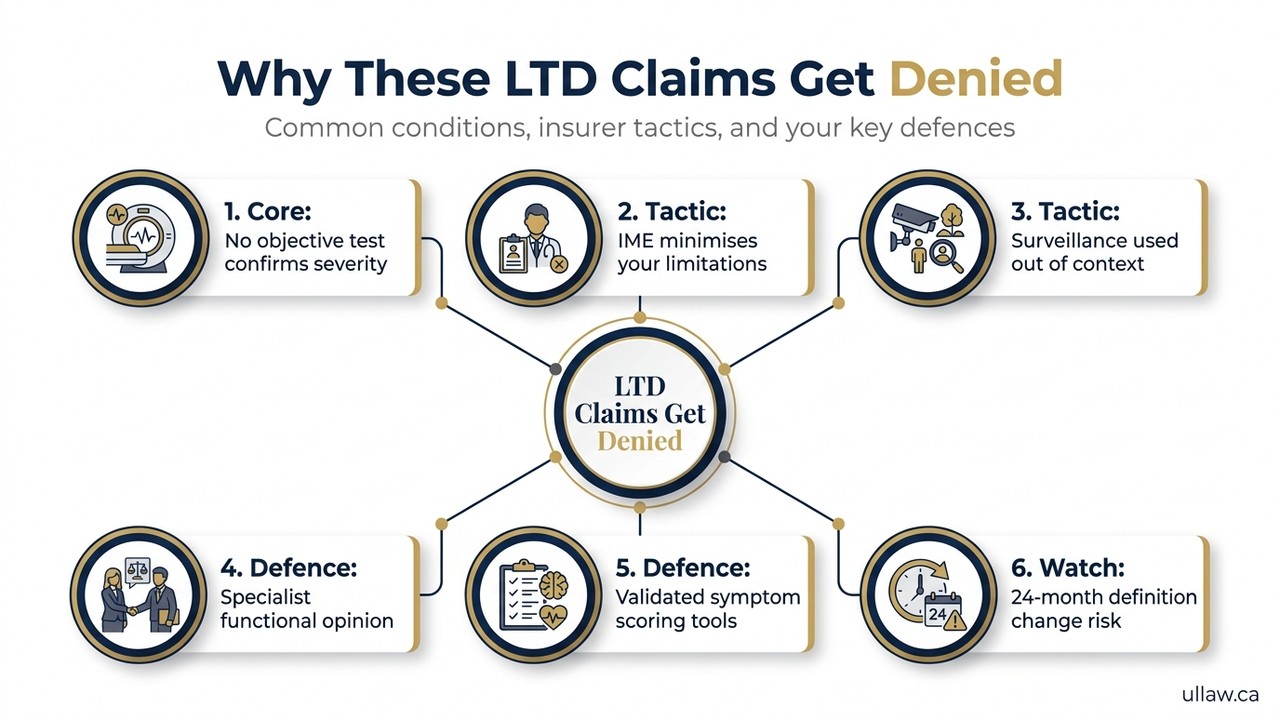
Why Do Insurers Deny These Conditions More Aggressively?
Understanding insurer motivation matters — it helps you anticipate the tactics you will face.
LTD is a profit-driven product. Every claim paid reduces the insurer’s margin. Internally, claims that lack clear objective findings are flagged for closer scrutiny because they are harder to confirm — and harder to challenge in court without substantial medical evidence.
Here are the most common denial strategies used against difficult-to-prove conditions:
The “Objective Evidence” Demand
Many policies require that disability be supported by objective medical evidence. Insurers may interpret this narrowly and focus heavily on the absence of a confirming test result. But clinical diagnoses, treatment history, specialist opinions, and documented functional limitations can all be relevant evidence. The applicable policy wording and the complete medical record matter.
The Independent Medical Examination (IME)
Insurers have the contractual right to require you to attend an IME with a physician of their choosing. These doctors are paid by the insurer and selected repeatedly for claims work. Their opinions are not independent in the way that word implies. An IME report that minimises your limitations can be used to justify a denial or termination.
Strategies to counter an unfavourable IME:
- Bring a support person and take careful notes
- Request a copy of the IME report promptly
- Have your own specialist prepare a rebuttal opinion addressing the IME findings directly
- Document any inconsistencies between the IME doctor’s findings and your treating team
Surveillance
For conditions where physical activity levels matter — chronic pain, fibromyalgia, ME/CFS — insurers may hire investigators to conduct surveillance. Video of you carrying groceries or walking your dog on a good day can be used out of context to suggest you are not as limited as claimed.
Be aware that surveillance is legal in Ontario, subject to privacy law limits. The Ontario e-Laws database includes Ontario’s Insurance Act and relevant privacy legislation that governs how that evidence can be used.
The “Pre-Existing Condition” Exclusion
Many policies exclude disabilities arising from conditions that existed before the policy’s effective date. Insurers sometimes apply this clause broadly to deny conditions that were present but not yet disabling before coverage began.
Shifting the Definition: The 24-Month Change
Many LTD policies have a two-part definition of disability. For an initial period that is often 24 months, the test may focus on whether you can perform the duties of your own occupation. It may then shift to any occupation for which you are reasonably suited by education, training, and experience. Insurers commonly review files around this definition change and may terminate benefits if they conclude the claimant could perform other suitable work.
How to Build Strong Medical Evidence for a Hard-to-Prove Claim
The outcome of a difficult LTD claim often hinges not on what your condition is, but on how well the evidence describes your functional limitations. Here is how to build a record that holds up.
Get the Right Specialist Involved Early
A GP’s opinion, standing alone, is easier for an insurer to dismiss. A diagnosis and functional opinion from a board-certified specialist in the relevant field — a rheumatologist for fibromyalgia, a neuropsychologist for TBI, a psychiatrist for severe depression — carries far more weight. Push your GP for specialist referrals as early as possible.
Document Functional Limitations, Not Just Symptoms
Insurers want to know what you cannot do, not just how you feel. Ask your treating physicians to describe:
- How long you can sit, stand, walk, concentrate, or attend to tasks
- How often symptoms interrupt function during the day
- The impact of post-exertional malaise or pain flares on multi-day capacity
- Whether your condition is expected to improve, plateau, or fluctuate
Use Validated Assessment Tools
For mental health conditions, tools like the PHQ-9 (depression), GAD-7 (anxiety), and PCL-5 (PTSD) produce numerical scores that quantify severity objectively. Neuropsychological testing for cognitive complaints produces standardised scores. Ask your treatment providers whether validated tools are part of their assessment protocol.
Maintain a Detailed Symptom and Activity Journal
A consistent, date-stamped journal documenting your daily functional capacity — including bad days, medication side effects, and how long activities take — creates a contemporaneous record that is difficult to dismiss. It also provides context for surveillance footage.
Collect Collateral Evidence
Evidence from people who observe your day-to-day functioning is underused in LTD claims. Affidavits or letters from a spouse, adult child, close friend, or home care worker describing what they observe can meaningfully supplement medical evidence.
Don’t Miss Deadlines
Ontario LTD claims are governed by the Limitations Act, 2002, available through Ontario’s e-Laws portal. In most cases, the limitation period for a wrongful denial is two years from the date you knew or ought to have known that the insurer would not pay. Missing that window can permanently bar your claim regardless of its merits.
What Happens at the 24-Month Mark — and How to Prepare
The shift from the own occupation to the any occupation definition is the single biggest risk point for claimants with difficult-to-prove conditions. Many people who have been receiving benefits for two years are surprised when the insurer suddenly terminates their claim.
At this stage, the insurer will typically:
- Commission a vocational assessment to identify jobs they claim you could perform
- Order a new IME to assess your functional capacity under the any-occupation standard
- Review your entire medical file for evidence of improvement
- Issue a termination letter arguing that some sedentary or light-duty occupation exists for which you qualify
How to Protect Yourself
- Begin specialist consultations well before the 24-month mark to update your functional documentation
- Ask your treatment team explicitly whether the any-occupation standard applies to your condition
- Consider a neuropsychological assessment if cognitive limitations are part of your disability — these are often overlooked in vocational reviews
- Consult a disability lawyer before the termination letter arrives, not after
Responding to a Termination at 24 Months
If your benefits are terminated at the definition change, you have options:
- Internal appeal to the insurer (required before court action in most policies)
- Mediation or alternative dispute resolution
- Litigation in Ontario Superior Court
These steps are time-sensitive. Review your policy carefully and seek legal advice promptly. Our long-term disability practice page explains how a disability lawyer approaches these disputes.

Mental Health LTD Claims: Overcoming the 24-Month Cap and the Stigma
Mental health conditions deserve their own section because they face a unique double barrier: a contractual limitation and a cultural one.
The Mental and Nervous Condition Clause
Many group LTD policies — particularly older ones — limit benefits for mental and nervous conditions to 24 months, regardless of severity. This cap does not apply to physical conditions. If your policy contains this clause and your disability is classified as psychiatric, your benefits may end at two years even if you remain completely unable to work.
How such a clause applies depends on its exact wording and the medical facts:
- If your mental health condition has a primary physical cause (e.g., a brain injury causing depression, or lupus causing psychiatric symptoms), the insurer may not be able to apply the mental health cap
- If your condition is diagnosed as both a psychiatric and physical disorder (e.g., ME/CFS with comorbid depression), classification matters enormously
- Human rights arguments may also be available — the Ontario Human Rights Code, administered by the Human Rights Tribunal of Ontario, prohibits discrimination on the basis of disability in the delivery of services
Building the Psychiatric Evidence Record
For mental health LTD claims:
- A psychiatrist’s ongoing opinion carries significantly more weight than a GP’s
- Validated rating scales (PHQ-9, GAD-7, PCL-5, MADRS) should be used at every visit
- Hospitalisation records, crisis intervention documentation, and medication trial histories demonstrate severity over time
- If you have undergone therapy, therapist progress notes can document treatment-resistant symptoms
The Stigma Problem
Mental health claims are sometimes denied partly because adjusters and IME reviewers hold implicit biases about psychiatric conditions. Language matters: framing your limitations in functional terms (“cannot concentrate for more than 15 minutes without a panic response,” “averages 18 hours per day in bed during a depressive episode”) is more persuasive than emotional descriptions alone.
Navigating an LTD Appeal After Denial
A denial letter is not the end of the road — it is often the beginning of the real fight. Most LTD policies require you to exhaust an internal appeal process before pursuing litigation.
Step 1: Read the Denial Letter Carefully
Review the denial letter carefully for the stated reasons and the evidence the insurer says it relied upon. Identify:
- Which definition of disability the insurer applied
- Which medical opinions or reports they relied on
- Whether they obtained information you were not given a chance to respond to
Step 2: Gather New and Responsive Evidence
An internal appeal is not simply a re-submission of the same materials. You need new evidence that directly addresses the insurer’s stated reasons. If they relied on an IME, get a rebuttal opinion. If they said your condition improved, obtain updated functional assessments.
Step 3: Submit a Comprehensive Appeal Brief
A well-structured written appeal brief — summarising the medical evidence, addressing each denial reason, and citing policy language — is far more effective than a simple cover letter. This is where legal representation typically adds the most value.
Step 4: Know Your Rights if the Appeal Fails
If the insurer upholds the denial after the internal appeal:
- You may commence a civil action in Ontario Superior Court
- You may also file a complaint with the Financial Services Regulatory Authority of Ontario (FSRA), which oversees insurance conduct in the province under the Insurance Act
- The two-year limitation period from the Limitations Act, 2002 applies — do not delay
For an estimate of the value of your potential claim, try our long-term disability benefits calculator.
The Role of a Disability Lawyer in Hard-to-Prove Claims
You are not required to have a lawyer to file or appeal an LTD claim. But for the conditions described in this article — the invisible, fluctuating, subjective, and contested ones — legal representation can be decisive.
What a Disability Lawyer Actually Does
- Reviews your policy and identifies the specific obligations and deadlines that apply to your claim
- Identifies strategic weaknesses in the insurer’s position — IME bias, improper application of objective evidence requirements, limitation clause enforceability
- Works with your medical team to ensure reports are functionally framed and address the legal test
- Drafts the internal appeal brief and manages communications with the insurer
- Commences litigation when the insurer will not resolve the claim fairly
Fee Arrangements
Most disability lawyers in Ontario act on a contingency basis — no legal fees unless you recover. This means access to legal representation is not limited by your ability to pay while disabled.
When to Call a Lawyer
The earlier, the better. Even if time has passed, prompt legal advice can clarify whether a limitation period or policy deadline affects your options. You should seek legal advice immediately if:
- Your application has been denied
- Your benefits were terminated at the 24-month mark
- You have received an IME appointment notice
- You have received a letter asking you to provide recorded statements
- You are approaching the two-year anniversary of your denial date
The Law Society of Ontario maintains a public directory of licensed lawyers you can use to verify credentials.
Talk to a UL Lawyers Team Member
If your LTD claim has been denied — or you are worried it will be — speaking with a disability lawyer costs you nothing up front. UL Lawyers Professional Corporation offers a free consultation for Ontarians dealing with difficult LTD claims, including chronic pain, mental health conditions, ME/CFS, TBI, and other hard-to-prove disabilities. Nothing on this page is a promise that any condition will be approved.
Denied, cut off at 24 months, or staring at an IME letter? Call 905-744-8888 or email info@ullaw.ca. You can also book a free consultation.
Related UL Lawyers resources
- Long-term disability services — denials, terminations, and appeals.
- LTD benefits calculator — rough monthly benefit at stake.
- Is fibromyalgia a disability in Ontario? — ODSP, CPP-D, and insurer evidence.
- What happens to LTD benefits at 65? — most group plans end; plan the cutoff.
- Does COPD qualify for disability in Canada? — function vs a single test result.
- Does CPP Disability affect CPP pension? — conversion at 65, not a penalty for being on disability.