
You get a calendar invite that just says “Quick chat – HR.” Or you’re dealing with a health problem, a difficult manager, a pregnancy or a pay issue, and you’re not sure how much to say. The natural instinct is to be open. HR staff are often friendly, professional and easy to talk to, and it can feel like they’re there to help you.
Here’s the hard truth: Human Resources works for your employer. Its job is to manage the workforce and reduce the organization’s legal risk. Most HR professionals act in good faith, but anything you say can be written down, passed to management, and used later in a discipline decision, a termination, or a legal dispute.
This guide explains what not to disclose to HR, what you do have to share, and how to handle HR meetings, investigations and accommodation requests in Ontario without hurting your position. The goal is not to be secretive or dishonest. Dishonesty can seriously damage your case. The goal is to share the right information, in the right way, at the right time.
Table of Contents
- What Not to Disclose to HR?
- 1. Your full medical diagnosis or history
- 2. Plans to leave or a job search
- 3. Family planning you’re not ready to share
- 4. Gossip, speculation and opinions about coworkers
- 5. Off-the-cuff admissions
- 6. Threats or ultimatums
- 7. Personal finances, side businesses and private life
- 8. Your legal strategy
- Why HR Is Not Your Confidant
- Medical Needs: How Much Health Information Must You Share?
- Employment Discrimination: Pregnancy, Family Status and Other Protected Grounds
- Pay Issues: What to Say and Not Say About Compensation
- What Should You Not Say to HR? Phrases That Can Backfire
- What Are HR Trigger Words, and When Should You Use Them?
- What Not to Say in an HR Investigation
- What Not to Overshare at Work
- Be Smart About Cooperating With Your HR Department
- The Importance of Documentation
- Can I Bring a Lawyer to an HR Meeting?
- Can HR Fire You?
- When to Talk to an Employment Lawyer Before Talking to HR
What Not to Disclose to HR?
As a general rule, share what is necessary, accurate and relevant to the issue in front of you, and keep the rest to yourself. Here is what Ontario employees should usually think twice about before telling HR.
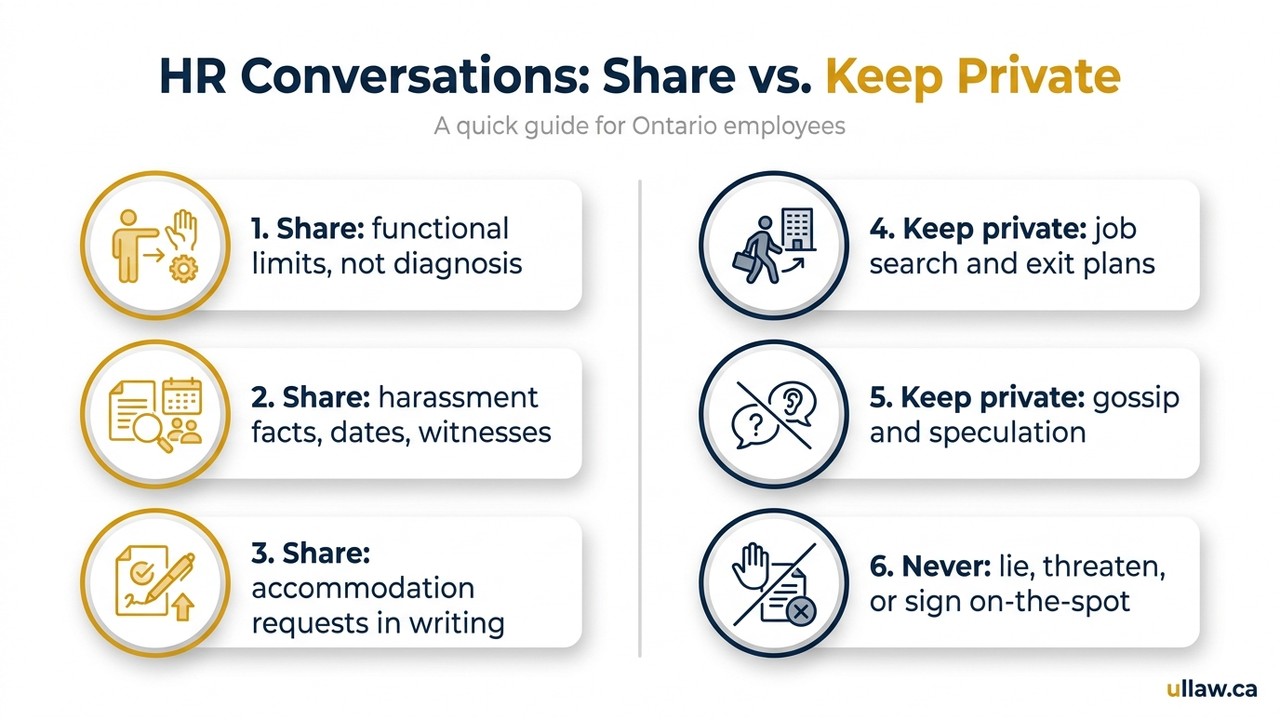
1. Your full medical diagnosis or history
If you need accommodation, your employer is usually entitled to know your functional limitations (what you can and can’t do), not every detail of your diagnosis. More on this below.
2. Plans to leave or a job search
Telling HR you’re “keeping your options open” can quietly take you off the promotion list, or make you the first name on a restructuring list.
3. Family planning you’re not ready to share
You don’t have to announce that you’re trying to get pregnant or planning to adopt. Once you need a leave, the Employment Standards Act, 2000 sets the notice you have to give.
4. Gossip, speculation and opinions about coworkers
Commenting on a colleague’s personal life, drinking or relationships can pull you into conflicts and investigations you have nothing to do with.
5. Off-the-cuff admissions
Don’t “confess” to things you haven’t thought through, like “I guess I’ve been slacking” or “Maybe I did cross a line.” Casual remarks can end up in a file as admissions.
6. Threats or ultimatums
“I’ll sue you” or “Fix this or I quit” can harden positions. The second one can even be treated as a resignation.
7. Personal finances, side businesses and private life
Unless your contract or a conflict-of-interest policy requires you to disclose it, outside work and money troubles are usually your business.
8. Your legal strategy
If you’ve spoken to a lawyer, it’s often best to decide with that lawyer when and how to tell your employer.
What you should not hold back: information you’re legally or contractually required to give, honest answers to direct questions in an investigation, and any accommodation needs you want your employer to meet. Lying to HR can itself be grounds for discipline.
Why HR Is Not Your Confidant
Many employees assume a conversation with HR is like a conversation with a doctor or a lawyer. It isn’t.
- There is no privilege. What you tell HR is generally not confidential from your employer. HR may share it with your manager, senior leadership, or the company’s lawyers.
- Notes are taken. HR often records meetings in notes or emails. Those records can be produced in a lawsuit, a human rights application, or a hearing.
- HR’s client is the organization. When your interests and the company’s interests conflict, for example in a termination, a harassment complaint against a senior manager, or a costly accommodation, HR’s duty runs to the employer.
That doesn’t make HR your enemy. HR is often the right place to raise harassment, request accommodation, or fix a payroll error, and Ontario law in fact requires employers to respond to some of these issues. It just means you should treat every HR conversation as on the record.
A useful test before you speak: “Would I be comfortable seeing this sentence quoted in a termination letter or a court document?” If not, rephrase it or leave it out.
It’s also worth knowing that privacy protections for employee information in Ontario’s provincially regulated private sector are limited compared with some other jurisdictions. Don’t assume a privacy law will stop your employer from using what you’ve shared.
Medical Needs: How Much Health Information Must You Share?
This is the area where employees most often over-disclose, and where it matters most.
Under the Ontario Human Rights Code, disability is a protected ground and employers have a duty to accommodate up to the point of undue hardship. You also have a duty to cooperate in that process. That usually means giving enough information for your employer to understand what you need.
What HR is generally entitled to
- Confirmation that you have a medical condition that requires accommodation
- Your functional limitations and restrictions (for example, “no lifting over 10 kg,” “needs flexible start times,” “must avoid night shifts”)
- How long the restrictions are expected to last
- Whether you can do your own job with modifications, or need alternative duties
What HR is usually not entitled to
- Your specific diagnosis, in most cases
- Your full medical chart, unrelated history, or medications
- Details of mental health treatment beyond what’s needed to accommodate you
Guidance from the Ontario Human Rights Commission takes the same general approach: the focus is on your needs, not your diagnosis. There are exceptions. If your request is unclear or your employer has a reasonable basis to question it, more information may be needed. So don’t refuse outright. Ask why the information is needed.
Practical tips
- Ask your doctor to write a note that focuses on limitations, not labels.
- Where possible, send detailed medical records to your disability insurer or an independent occupational health provider, not your manager.
- For short-term sick days, recent changes to the Employment Standards Act, 2000 limit an employer’s ability to demand a doctor’s note for ESA sick leave days, though employers can still ask for evidence that is reasonable in the circumstances. Check the current rules on Ontario’s employment standards pages.
Employment Discrimination: Pregnancy, Family Status and Other Protected Grounds
The Ontario Human Rights Code protects employees from discrimination based on grounds that include sex (including pregnancy), family status, marital status, disability, age, creed, race, ancestry, place of origin, ethnic origin, citizenship, colour, sexual orientation, gender identity, gender expression and, in some situations, record of offences.
Illegal discrimination still happens, and it’s often subtle. A pregnancy announcement is followed by “performance concerns.” A caregiving obligation leads to fewer shifts. That’s why you should be careful about volunteering personal information that touches a protected ground before you need to.
Examples of what you generally don’t have to volunteer
- That you’re trying to conceive, going through fertility treatment, or planning to adopt
- Your religious practices, unless you need an accommodation such as time off for observance
- Your age, relationship status, or sexual orientation
- Childcare or eldercare arrangements, unless you’re asking for a family-status accommodation or a job-protected leave
When disclosure helps you
You can’t get an accommodation your employer doesn’t know you need. If you need a schedule change for childcare, a prayer space, or a pregnancy-related modification, ask for it clearly and in writing. A written request creates a record and starts your employer’s legal duty to respond.
If you think you were treated differently after disclosing something personal, write down the timeline right away. The order of events, what you disclosed and what happened next, is often key evidence. You can read the Code itself on Ontario e-Laws.
Pay Issues: What to Say and Not Say About Compensation
Pay problems are one of the most common reasons employees go to HR: missing overtime, unpaid vacation pay, commission disputes, or a raise that never arrived.
Do
- Stick to facts and numbers. “My pay stub for the period ending March 15 shows 40 hours, but I worked 46” works far better than “You’re always ripping me off.”
- Put it in writing. Follow up any verbal conversation with an email.
- Keep copies of your pay stubs, schedules, timesheets and commission plans.
Don’t
- Don’t threaten to report the company or quit in the heat of the moment.
- Don’t sign a document confirming your hours or pay are correct if you don’t agree.
- Don’t share your salary history or competing offers unless it helps you strategically in a negotiation.
Your rights
The Employment Standards Act, 2000 sets minimum standards for wages, overtime, vacation pay and public holiday pay, and prohibits employers from reprising against (punishing) employees who ask about or try to enforce their ESA rights. Ontario has also amended the ESA to add protections for employees who ask about, discuss or disclose their compensation. Confirm what’s in force when you raise the issue.
You may be able to file a claim with Ontario’s Ministry of Labour, or pursue the matter in court. Be careful, though: choosing one route can affect your ability to use the other for the same issue, and time limits apply. Getting advice before you file can help you avoid closing a door by accident.
What Should You Not Say to HR? Phrases That Can Backfire
Beyond what you disclose, how you say it matters. Some phrases come up again and again in files that go badly for employees.
- “I quit” / “I’m done here.” Said in frustration, this can be treated as a resignation. In Ontario, a resignation generally means no severance. If you’re being treated unfairly, get advice about constructive dismissal before you walk away.
- “I’m going to sue.” Threats tend to end the informal problem-solving and put the company in defence mode. If legal action is possible, let a lawyer decide how and when to raise it.
- “I don’t care about this job anyway.” This hurts your credibility and can be quoted later.
- “Everyone does it.” In a misconduct discussion, this admits the conduct while trying to excuse it.
- “I think so-and-so is having an affair / has a drinking problem.” Speculation about coworkers can create defamation, privacy and conflict issues for you.
- “It’s no big deal, I’ll just deal with it.” If you’re reporting harassment or a safety issue, playing it down can undermine your complaint later.
- “Off the record…” With HR, nothing is off the record.
A better approach: stay calm, describe facts (who, what, when, where), say what you are asking for, and confirm it in writing afterward.

What Are HR Trigger Words, and When Should You Use Them?
“HR trigger words” are terms that signal a legal obligation for the employer. When HR hears them, it usually has to act, often by opening an investigation or starting an accommodation process.
Common trigger words include:
- Harassment or sexual harassment
- Discrimination (especially tied to a protected ground)
- Reprisal or retaliation
- Accommodation or disability
- Unsafe, hazard, or workplace violence
- Leave (pregnancy, parental, sick, family caregiver, domestic or sexual violence leave)
- Hostile work environment
Under Ontario’s Occupational Health and Safety Act, employers must have workplace harassment and violence policies and must investigate incidents and complaints of workplace harassment in a way that’s appropriate in the circumstances. The Human Rights Code and Employment Standards Act create their own duties around discrimination, accommodation and leaves.
Use them deliberately and honestly
These words aren’t magic. Using them falsely or loosely can hurt your credibility. But if what you’re experiencing really is harassment, discrimination or a safety risk, naming it clearly, ideally in writing, makes it harder for the employer to say later that it didn’t understand the seriousness of your concern.
Compare: “My manager is kind of difficult” with “I want to report ongoing harassment by my manager, including comments about my age on May 2 and May 9.” The second one creates a clear record.
What Not to Say in an HR Investigation
Workplace investigations are high-stakes, whether you’re the person complaining, the person accused, or a witness. Investigation notes and reports often become central evidence if the matter turns into a termination or legal claim.
Avoid
- Guessing or speculating. “I don’t know” or “I don’t remember” is a complete and honest answer.
- Exaggerating. Overstating facts, even with good intentions, can destroy your credibility when other evidence doesn’t match.
- Lying or minimizing. Dishonesty in an investigation is often treated as more serious than the original issue, and may support discipline or even termination for cause.
- Talking to other witnesses. Discussing the investigation with coworkers can look like interfering and may breach a confidentiality instruction.
- Deleting messages or documents. Destroying evidence can cause serious problems for you.
- Volunteering unrelated grievances. Raise them separately so your main point isn’t diluted.
- Retaliating against a complainant or witness, even with a pointed comment.
Do
- Ask for the allegations in detail if you are the respondent, and for a reasonable chance to respond.
- Ask for a short break if you need to gather your thoughts.
- Review and correct any written statement before you sign it. Don’t sign something that isn’t accurate.
- After the meeting, write your own notes of what was asked and answered.
If you are accused of serious misconduct, speaking with an employment lawyer before your interview can make a real difference.
What Not to Overshare at Work
Oversharing doesn’t only happen in HR’s office. Plenty of what ends up in an HR file comes from break-room chats, team Slack channels and social media.
Think carefully before sharing:
- Health details, including mental health, with coworkers who may pass them along
- Job searches, interviews, or plans to leave
- Side businesses or freelance work, especially if your contract has conflict-of-interest, non-solicitation or exclusivity terms
- Romantic relationships with colleagues. Some policies require disclosure, particularly where there’s a reporting relationship, so check your handbook
- Strong political or personal views that could spark conflict
- Venting about your boss or clients in writing
- Alcohol, drug use or wild weekend stories
- Money problems, which some employers may see as a risk in finance or trust roles
Remember: work systems are not private
Company email, chat platforms, laptops and phones can be monitored. Ontario’s Employment Standards Act, 2000 requires employers with 25 or more employees to have a written policy on electronic monitoring. Read yours. A good rule: don’t type anything on a work device that you wouldn’t want your manager to read.
Social media
Public posts criticizing your employer, sharing confidential information, or showing you active while “on sick leave” can and do lead to discipline. If you’re on a medical leave or in a dispute, consider tightening your privacy settings and posting less.
Be Smart About Cooperating With Your HR Department
Being careful about what you disclose is not the same as being uncooperative. In Ontario, employees generally owe their employer good faith and honest dealing, and a flat refusal to cooperate can backfire.
Cooperation that protects you
- Attend meetings you’re asked to attend. If the timing is unfair (for example, an ambush interview about serious allegations), ask politely for a short delay so you can prepare.
- Answer the question asked. You don’t need to volunteer extra stories, opinions or background.
- Participate in accommodation. Provide appropriate medical information and consider reasonable options. Refusing every reasonable accommodation can weaken a human rights claim.
- Follow lawful instructions, even while you dispute them. The usual rule is “comply now, grieve later,” unless the instruction is unsafe or illegal. Under the Occupational Health and Safety Act, workers have a right to refuse unsafe work, and specific procedures apply.
What cooperation does not require
- Signing documents on the spot
- Agreeing with a version of events you think is wrong
- Giving up your diagnosis when functional information is enough
- Waiving your legal rights
The sweet spot is polite, professional and precise. That posture tends to look good to a judge or tribunal later, and it often gets better results with HR now.

The Importance of Documentation
If a workplace problem turns into a legal dispute, the side with the better records often has the advantage. Memories fade, and HR will have its own notes.
What to document
- Dates, times and locations of incidents
- Exact words used, as closely as you can recall them
- Witnesses who were present
- Who you reported to, when, and what they said
- Effects on you, such as missed work, medical visits or stress symptoms
How to document
- Keep a dated journal on a personal device or on paper, written as close to the events as possible.
- After any important verbal conversation, send a short follow-up email: “Thanks for meeting today. To confirm, you said…” This turns a conversation into a record.
- Save copies of your employment contract, offer letter, policies, performance reviews, pay stubs and medical notes.
A caution
Don’t forward confidential company documents, client data or other employees’ personal information to your personal email. Doing that can breach policy, privacy obligations or your contract, and may hand your employer a reason to discipline you. If you’re unsure what you can keep, ask a lawyer first.
Can I Bring a Lawyer to an HR Meeting?
In most non-unionized Ontario workplaces, there is generally no automatic legal right to bring a lawyer into an internal HR meeting. Many employers will refuse. Some may agree, particularly in serious investigations, but it’s at their discretion.
If you’re unionized
Your collective agreement may give you the right to have a union representative present at disciplinary or investigative meetings. Ask for one. In many cases you should contact your union before the meeting.
Options for non-unionized employees
- Consult a lawyer before the meeting to prepare, especially if you’re the subject of allegations or expect a termination.
- Ask to bring a support person, such as a trusted colleague. Some employers allow this.
- Ask for a short adjournment if you’re blindsided by serious allegations.
- Take your own notes, and ask for a copy of any notes or statements you’re asked to sign.
Can I record the meeting?
Canadian criminal law generally allows a person to record a conversation they’re part of. However, secretly recording at work may breach workplace policy and, in some cases, has been treated as misconduct. It can also damage trust. Talk to a lawyer before you hit record.
Termination meetings
If the meeting turns out to be a termination, you usually don’t need a lawyer in the room. Listen, take any documents home, and don’t sign anything on the spot. Then get advice.
Can HR Fire You?
In practice, HR often carries out terminations, while the decision itself typically sits with management or leadership. Either way, the question that matters is whether the termination is lawful, and what you’re owed.
Ontario is not an “at-will” jurisdiction
Ontario employers can usually end employment without cause, but they generally must provide notice, pay in lieu of notice, or both. Your entitlements may come from:
- The Employment Standards Act, 2000 minimums (termination pay and, for some employees, severance pay)
- Common law reasonable notice, which is often greater than ESA minimums unless an enforceable termination clause limits it
- Your employment contract and any benefits, bonus or equity plans
Terminations that may be unlawful
- Firing because of a Human Rights Code ground, such as disability, pregnancy or age
- Reprisal for asserting ESA rights, raising a health and safety concern, or reporting harassment
- Claiming “just cause” without sufficient grounds. Just cause is a high bar in Ontario, and minor or one-off issues often don’t meet it
If it happens
- Don’t sign a release or severance offer right away. Offers often come with deadlines, but you can usually ask for reasonable time to get advice.
- Don’t resign in response to unfair treatment without advice.
- Get a rough idea of your potential entitlement with our severance pay calculator. It’s an estimate, not legal advice.
- Start looking for new work and keep records. Ontario law generally expects dismissed employees to mitigate their losses.
When to Talk to an Employment Lawyer Before Talking to HR
Many HR conversations are routine. Some aren’t. Consider getting independent legal advice before you speak with HR, or before you put anything in writing, if:
- You’ve been asked to an investigation interview about allegations against you
- You’re being offered a severance package or asked to sign a release
- You need a disability or family-status accommodation and your employer is pushing back, or demanding your full medical records
- You’re thinking of resigning because your job has changed or the workplace has become intolerable (possible constructive dismissal)
- You’ve reported harassment or a safety issue and are now facing discipline or cold-shouldering
- You’re returning from a pregnancy, parental or medical leave and your role has changed
An early consultation can help you work out what to say, what to leave out, and how to frame a complaint or request so it protects your rights. Learn more about how we help on our Employment Law practice page.
If you’re checking whether a lawyer is licensed in Ontario, the Law Society of Ontario keeps a public directory of licensees.
Talk to a UL Lawyers Team Member
Talking to HR doesn’t have to be nerve-racking, but it does pay to be prepared. If you’re facing an investigation, an accommodation dispute, a severance offer, or just aren’t sure how much to say, UL Lawyers offers a free, no-obligation consultation to Ontario employees. We’ll listen to your situation, explain your options in plain English, and help you decide what to say next. Every case depends on its own facts, and there’s no pressure to go further than you’re comfortable with.