
Ontario employees use the phrase “employment law violation” for many different problems. Unpaid wages, denied overtime, reprisals, discrimination, unsafe work, and an inadequate termination package may involve different laws, forums, deadlines, and remedies. Identify the legal category before signing a release or filing a claim.
A workplace problem can start with a small discrepancy: a missing hour on a pay statement, a leave request that goes unanswered, or a sudden schedule change after an employee raises a concern. It can also arrive all at once through a termination letter, harassment complaint, or demand to sign a release.
Ontario employment law is not one rulebook. Minimum standards, human rights, occupational health and safety, contracts, common law, privacy, workers’ compensation, and collective agreements can overlap. An employee can have a serious problem but lose time or leverage by choosing the wrong forum too quickly.
This guide explains frequent Ontario workplace violations, the records that help establish them, and the decisions to make before pursuing a remedy. It is general information, not legal advice. UL Lawyers’ employment law team assists employees with pay disputes, severance, dismissal, reprisals, accommodation, and workplace complaints.

Table of Contents
- The first question: which law applies?
- Unpaid wages and unlawful deductions
- Overtime and hours-of-work problems
- Vacation pay and public holiday errors
- Denied leaves and protected absences
- Employee misclassification
- Termination, severance, and releases
- Reprisals after asserting a right
- Discrimination and failure to accommodate
- Harassment, violence, and unsafe work
- Forums, deadlines, and election risks
- Evidence to preserve
- When to speak with an employment lawyer
The First Question: Which Law Applies?
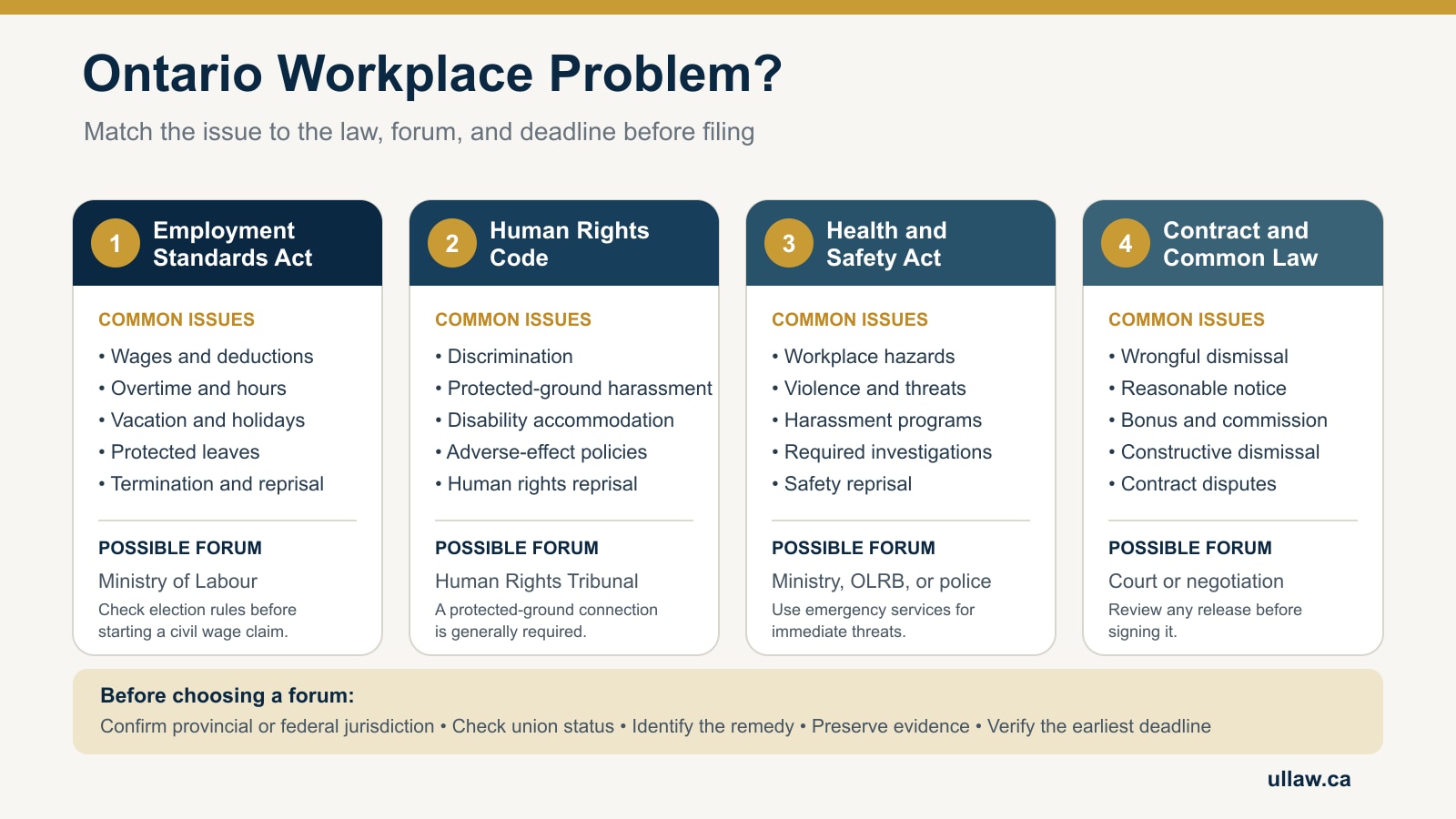
Before asking what a claim is worth, determine which legal framework applies. The same event can engage more than one statute, but each forum has its own jurisdiction.
Most employees in Ontario fall under provincial law. Workers in federally regulated sectors, such as banks, airlines, telecommunications, interprovincial transportation, and the federal public service, may fall under the Canada Labour Code instead. Unionized employees usually enforce workplace rights through the grievance and arbitration process in their collective agreement.
Employment Standards Act Minimums
The Employment Standards Act, 2000, commonly called the ESA, sets minimum standards for many Ontario employees. It covers topics including:
- minimum wage and payment of wages;
- hours of work, eating periods, and rest;
- overtime;
- vacation time and vacation pay;
- public holidays;
- job-protected leaves;
- termination and severance; and
- reprisals for exercising ESA rights.
The ESA is a floor, not necessarily the employee’s complete entitlement. An employment agreement, collective agreement, another statute, or the common law may provide greater rights. Employees cannot simply sign away minimum ESA standards.
Human Rights Code Protections
The Ontario Human Rights Code protects equal treatment in employment without discrimination on protected grounds. These include disability, race, creed, sex, sexual orientation, gender identity and expression, age, family status, marital status, and other listed grounds.
Not every unfair act is discrimination. There must generally be a connection to a protected ground or a protected activity. The Code can also require individualized accommodation to the point of undue hardship.
Occupational Health and Safety
The Occupational Health and Safety Act, or OHSA, addresses workplace hazards, violence, harassment programs, investigations, and safety reprisals. It is an enforcement and prevention framework. It is not a general damages claim for every instance of bullying or poor management.
Unpaid Wages and Unlawful Deductions
Employees should receive wages when required and a wage statement showing how pay was calculated. Common concerns include:
- regular hours missing from payroll;
- pay below the applicable minimum wage;
- unauthorized deductions for damage, shortages, uniforms, or errors;
- commissions or earned incentive pay withheld contrary to the plan;
- vacation or public holiday pay omitted from final pay;
- final wages paid late; or
- pay statements that do not explain the amount received.
A deduction is not lawful merely because an employer says the employee caused a loss. The ESA has specific requirements and restrictions. A broad authorization signed at hiring may not validate every future deduction.
Preserve pay statements, bank deposits, schedules, time records, commission plans, written authorizations, and messages about payroll corrections. If the dispute is part of a termination or larger contract claim, compare the available forums before filing.
Overtime and Hours-of-Work Problems
Many Ontario employees earn overtime after 44 hours in a work week, generally at one and one-half times the regular rate. Exemptions and special rules apply to certain occupations, industries, and duties. Averaging agreements and paid time off in place of overtime must satisfy legal requirements.
Frequent problems include:
- recording only scheduled hours rather than hours actually worked;
- removing time spent opening, closing, preparing, or completing mandatory tasks;
- treating all salaried employees as overtime-exempt;
- classifying a worker as a manager based on title rather than duties;
- banking overtime without a valid arrangement; or
- pressuring employees not to report hours.
Salary and Managerial Titles
Salary is a method of pay, not a universal overtime exemption. A managerial title is also not decisive. The actual work performed and the applicable regulation matter.
An employee who primarily performs the same work as non-managerial staff may need a closer review, even if occasional supervisory duties appear in the job description. Compare the written role with the day-to-day reality.
Work Outside Scheduled Hours
Required work can occur before or after a shift, remotely, or through mandatory calls and messages. Keep a contemporaneous record of start and end times, required logins, meetings, travel between work sites, and instructions received outside scheduled hours.
Use UL Lawyers’ Ontario overtime calculator as an estimate, then verify the role, exemption, records, and limitation period before relying on the result.
Vacation Pay and Public Holiday Errors
Vacation time and vacation pay are related but distinct. Ontario’s statutory minimum vacation pay is generally four per cent for employees with less than five years of employment and six per cent after five years, subject to the ESA’s detailed rules. Contracts or policies may offer more.
Common errors include:
- calculating vacation pay on an incomplete earnings base;
- failing to increase the rate when the employee reaches the statutory service threshold;
- treating vacation pay as included in wages without showing it properly;
- denying earned vacation time; or
- omitting accrued vacation pay from final wages.
Public holiday entitlement has separate eligibility, substitute-day, premium-pay, and calculation rules. A workplace cannot safely replace the statutory analysis with a simple “you did not work that day, so you are not paid” policy.
The vacation pay calculator can help organize the numbers. Verify current rules through Ontario’s ESA guide.
Denied Leaves and Protected Absences
The ESA includes several job-protected leaves. Pregnancy and parental leave, sick leave, family responsibility leave, family caregiver leave, family medical leave, critical illness leave, domestic or sexual violence leave, bereavement leave, and reservist leave have different eligibility, notice, evidence, duration, and pay rules.
Job-protected does not always mean paid. It generally means an eligible employee can be absent without losing employment for that reason and must receive the statutory protections attached to the leave.
Potential violations include:
- refusing an eligible leave;
- requiring evidence beyond what the statute permits;
- threatening attendance discipline for protected days;
- failing to continue required benefits;
- refusing reinstatement; or
- terminating an employee because leave was requested or taken.
Human rights accommodation may operate alongside ESA leave. A person who has exhausted a statutory leave may still have Code-related accommodation rights depending on disability, family status, or another protected ground.
Employee Misclassification
Calling a worker an independent contractor, volunteer, intern, or manager does not settle their legal status. Ontario prohibits employers from misclassifying employees as workers who are not covered by the ESA.
Relevant facts can include:
- who controls the schedule and manner of work;
- whether the worker can hire helpers;
- who owns the tools and equipment;
- the worker’s opportunity for profit and risk of loss;
- whether the worker serves other clients;
- how integrated the work is into the organization; and
- the economic reality of the relationship.
Misclassification can affect wages, overtime, vacation pay, public holidays, leaves, payroll deductions, termination rights, and tax treatment. The ESA employee analysis is also not identical to the common-law concept of a dependent contractor.
See our detailed guide to employee and independent contractor status in Ontario.
Termination, Severance, and Releases
A professional-looking termination package is not proof that every entitlement has been included. Ontario employees may need to compare three distinct concepts.
ESA Termination Pay
The ESA provides minimum notice or termination pay for eligible employees. Length of service, exceptions, mass-termination rules, benefits continuation, and the reason for termination can affect the calculation.
An allegation of cause does not automatically eliminate minimum entitlements. The ESA standard and the common-law standard are not identical.
ESA Severance Pay
Statutory severance is separate from termination pay. It generally requires at least five years of employment plus the ESA’s payroll or permanent-discontinuance conditions. Not every terminated employee receives ESA severance, and the statutory amount is capped.
Common-Law Reasonable Notice
Many non-union employees may have common-law notice rights beyond ESA minimums. Age, position, service, compensation, availability of similar employment, and an enforceable termination clause can all matter.
Before signing a release, check:
- salary and notice pay;
- benefits continuation;
- bonus and commission treatment;
- accrued vacation pay;
- expense reimbursement;
- restrictive covenants and confidentiality terms;
- reference and announcement language; and
- whether discrimination, reprisal, or leave issues overlap.
Use our severance pay calculator as a starting point and read the ESA termination guide. A signed release can limit future claims.
Reprisals After Asserting a Right
Section 74 of the ESA prohibits reprisals for exercising ESA rights, making ESA-related inquiries, giving information in an ESA investigation or proceeding, or participating in an ESA process. OHSA has separate protection for employees who exercise health and safety rights. The Human Rights Code also prohibits certain reprisals.
Possible reprisal evidence includes discipline, reduced hours, undesirable shifts, threats, demotion, suspension, or termination soon after an employee:
- asked about wages or overtime;
- requested an ESA leave;
- contacted the Ministry of Labour;
- refused to waive an ESA minimum;
- reported a safety hazard; or
- requested accommodation.
Timing can support an inference, but timing alone does not prove causation. Preserve the original complaint, the employer’s response, schedules before and after, performance records, discipline, and termination documents.

Discrimination and Failure to Accommodate
Employment discrimination may be direct or may result from a neutral rule that adversely affects a protected group. Examples that warrant closer review include:
- discipline after disclosing a disability;
- refusing modified duties without an individualized assessment;
- unnecessary demands for diagnosis rather than functional information;
- harassment connected to race, sex, disability, creed, gender identity, or another protected ground;
- refusing to consider schedule accommodation connected to family status; or
- terminating employment during an accommodation process.
The accommodation process requires participation from both sides. An employee generally needs to communicate the need and provide reasonable information about restrictions. The employer should investigate options and can refuse only when the legal undue-hardship standard is met, not simply because accommodation is inconvenient.
A Code claim requires evidence connecting the adverse treatment to a protected ground. Read our resource on Ontario human rights complaints for more forum-specific information.
Harassment, Violence, and Unsafe Work
OHSA requires workplace violence and harassment policies and programs and, in defined circumstances, an investigation appropriate to the complaint. Workplace harassment can include a course of vexatious comment or conduct known or reasonably expected to be unwelcome. Reasonable management action, carried out reasonably, is not automatically harassment.
The legal route depends on the issue:
- a physical hazard or unsafe process may involve an OHSA complaint;
- violence or an immediate threat may require emergency services or police;
- harassment linked to a protected ground may engage the Human Rights Code;
- a unionized employee may need a grievance;
- psychological injury may raise workers’ compensation issues; and
- severe employer conduct may overlap with constructive dismissal.
An OHSA inspector can enforce statutory duties, but the process is not a general damages action for hurt feelings. Obtain advice about the objective and the forum before starting parallel proceedings.
See Ontario’s guidance on workplace violence and harassment and our resource on workplace harassment.
Forums, Deadlines, and Election Risks
A workplace problem can have more than one possible route, but employees cannot assume every route can be pursued in sequence.
Ministry of Labour ESA Claim
An ESA claim generally addresses statutory minimums. Ontario’s public guidance says employees generally have two years to file, but recovery rules, exceptions, and the date of the alleged violation must be checked. Starting a civil proceeding about the same alleged failure to pay wages can affect the availability of an ESA complaint.
Human Rights Tribunal of Ontario
A Human Rights Tribunal application generally must be filed within one year of the incident, or the last incident in a series. The Code permits limited discretion for late applications, but an employee should not rely on receiving an extension.
Civil Court
Ontario’s Limitations Act commonly provides a two-year basic limitation period from discovery for civil claims. Discoverability, the cause of action, contract language, continuing conduct, and the ultimate limitation period can change the analysis.
Other Processes
Union grievances can have much shorter contractual deadlines. Federal employees follow federal processes. OHSA reprisals, workers’ compensation, privacy issues, and professional-regulator complaints each have separate rules.
Before filing, ask:
- What remedy do I want?
- Which forum can grant it?
- What is the earliest possible deadline?
- Does starting here limit another route?
- Is the workplace provincial, federal, or unionized?
Evidence to Preserve
Create a lawful, organized record before access changes or memories fade:
- employment agreement, offer letter, and amendments;
- policies and employee handbook;
- pay statements, T4s, ROE, bank deposits, and compensation plans;
- schedules, calendars, timesheets, and time-system exports;
- leave requests and responses;
- medical restrictions and accommodation correspondence;
- complaints, investigation communications, and outcomes;
- performance reviews, warnings, and discipline;
- termination letter, severance offer, and release;
- relevant emails, texts, and workplace messages; and
- a dated chronology identifying witnesses.
Keep original files and metadata where possible. Do not access systems without permission, alter records, secretly record conversations without advice, or remove confidential client or employer information you are not entitled to possess.
When to Speak With an Employment Lawyer
Prompt advice is particularly useful before you:
- sign a termination release;
- resign in response to changed conditions;
- accept an allegation of cause;
- choose between an ESA claim, tribunal application, grievance, or lawsuit;
- respond to a restrictive-covenant demand;
- make a sensitive accommodation or harassment complaint; or
- approach a possible deadline.
Seek immediate help where there is violence, an imminent safety risk, sudden termination, loss of medical benefits, or urgent income concerns. A consultation does not promise litigation or a particular outcome. It helps identify the law, forum, evidence, deadline, and proportionate remedy.
If you are dealing with unpaid wages, overtime, termination, reprisal, accommodation, or another workplace concern, contact UL Lawyers before making a decision that may narrow your options.
Official Ontario Sources
- Ontario, Employment Standards Act, 2000
- Ontario, Your guide to the Employment Standards Act
- Ontario, Filing an ESA claim
- Ontario, Human Rights Code
- Ontario, Occupational Health and Safety Act
- Ontario, Workplace violence and harassment guidance
- Ontario, Limitations Act, 2002