You’re sweating through your shirt before lunch. The warehouse air feels heavy. The shop floor is hotter than outside. Your supervisor keeps pushing output, but nobody’s talking about extra breaks, water, or a cooler work plan. You’re not being dramatic. You may be dealing with a real workplace safety issue.
That’s where many Ontario employees are right now as summer approaches. They know the heat feels dangerous, but they don’t know what their legal rights are, what their employer must do, or when it’s time to stop asking nicely and take formal action.
Table of Contents
- Your Guide to Workplace Heat Stress Rights in Ontario
- Understanding Your Legal Rights Under Ontario Law
- What Your Employer Is Legally Obligated to Do
- How to Recognize and Document Heat Stress Hazards
- Your Step-by-Step Guide to Taking Action at Work
- Exercising Your Right to Refuse Unsafe Work
- When and How to Contact an Employment Lawyer
Your Guide to Workplace Heat Stress Rights in Ontario
You report for a summer shift, the air is heavy, the fans are useless, and your supervisor expects business as usual. Ontario law does not require you to tough that out in silence. Your employer cannot ignore heat that is making the job unsafe.
This issue reaches far beyond outdoor work. Warehouses, kitchens, factories, transport yards, greenhouses, loading docks, mechanical rooms, and indoor spaces with poor ventilation can become dangerous fast. Humidity, heavy physical work, protective equipment, radiant heat, and long shifts can turn an already hot workplace into a serious safety problem.
Start with this rule. If the heat is affecting your body, your focus, or your ability to do the job safely, treat it as a workplace health and safety issue immediately.
Too many employees wait because they think they need a specific temperature reading before they can speak up. That mistake costs time, and sometimes health. The better approach is procedural. Raise the concern early, describe the conditions clearly, document what happened, and know your red lines. If your employer still does not respond properly, you may be dealing with a work refusal, reprisal, or a claim that also connects to workers’ compensation benefits in Ontario.
That is the practical focus here. You need to know what to say, what to write down, when to escalate, and when to stop handling it alone.
Understanding Your Legal Rights Under Ontario Law
Your legal rights do not depend on a magic temperature number.
Ontario still does not set a single maximum workplace temperature in the Occupational Health and Safety Act as of summer 2026. That point matters, but many employees stop there and miss the part that provides their protection. The essential protection is the employer’s duty under OHSA s. 25(2)(h) to take “every precaution reasonable in the circumstances” for worker safety, along with the supervisor’s duty under s. 27(2)(c) to respond properly to known hazards.
Legislative movement is underway. Bill 36, the Heat Stress Act, 2025, was introduced in the Ontario legislature and ordered for second reading in May 2025. If enacted, it would create a formal Worker Heat Protection Standard requiring engineering controls, mandatory breaks, cool drinking water near every work area, employer heat-stress policies, regular assessments, and approved training for workers and supervisors. As of summer 2026, the bill had not yet received royal assent, so the OHSA general duty remains the primary legal tool. Employers who ignore foreseeable heat risks today are operating against both existing law and the clear direction of proposed regulation.
That is the legal framework you use when the workplace is too hot to work safely. If the heat is causing dizziness, confusion, nausea, heavy sweating, weakness, poor concentration, or near misses, your employer cannot shrug and say there is no heat law. Ontario’s general safety duties still apply. The question is simple: was the heat a foreseeable hazard, and did the employer take reasonable steps to control it?
Ontario workplace guidance helps answer that question. The Workplace Safety and Insurance Board (WSIB) and occupational health clinics across Ontario publish practical heat-stress prevention resources. Reasonable precautions can include cool drinking water, frequent hydration reminders, added rest breaks, scheduling heavier work for cooler periods, and a gradual acclimatization period for workers who are new to hot conditions or returning after time away. Those are not empty suggestions. They are strong reference points when you need to show that your employer knew what sensible heat controls looked like and failed to use them.
Use that framework to assess your own situation.
If your employer has no heat reporting process, no practical response, no meaningful breaks, and no adjustment for physically demanding work or protective equipment, you may already be past the point of a casual complaint. You may be dealing with a real health and safety breach, and if you become ill, that may also connect to workers’ compensation benefits for Ontario employees.
Employees also miss a second point. Heat cases are often won or lost on procedure, not slogans. A worker who reports the symptoms, identifies the hazard, asks for a concrete fix, and keeps a written record is in a far stronger position than a worker who only says, “It’s too hot in here.” Ontario’s Guide to the Occupational Health and Safety Act sets out the internal responsibility system that should give every employer a framework for receiving, investigating, and addressing hazard reports. If your workplace has no real system, or management ignores the one it has, that failure matters.
Keep these legal points straight:
- No fixed temperature limit does not cancel your rights.
- General OHSA duties still require active steps to reduce known heat risks.
- Ontario guidance on heat precautions helps show what a reasonable employer should be doing.
- Written reporting and escalation often decide whether your concern is taken seriously or buried.
The practical rule is this. Once heat starts affecting safety, your job is to report it clearly and document it. Your employer’s job is to act. If they do not, you should escalate.
What Your Employer Is Legally Obligated to Do
You report that the warehouse floor is stifling by noon, people are getting dizzy, and the supervisor says to keep going. At that point, your employer cannot shrug and hope nobody collapses. Under Ontario health and safety law, the employer must assess the risk, reduce it, train people on what to watch for, and respond fast when someone shows signs of heat illness.
That duty has to show up in the way the workplace is run. Policies on paper are not enough. If management knows the job involves direct sun, heavy physical effort, hot equipment, thick protective gear, poor airflow, or a pattern of workers feeling sick in the heat, they need controls in place before somebody ends up in an ambulance.
A proper response usually includes practical changes to the work itself:
- ready access to cool drinking water
- more frequent rest breaks as heat conditions worsen
- scheduling heavier tasks during cooler parts of the day where possible
- reducing exposure to direct sun or heat-producing machinery
- closer supervision of new workers and workers returning to hot jobs
- clear first-aid steps for heat illness, including getting the worker to a cool area and obtaining medical help
- training workers and supervisors to recognize symptoms and report them early
If your employer has a written system, heat stress should be built into it. Under Ontario’s internal responsibility system, every workplace health and safety program should explain who receives hazard reports, who investigates them, what temporary controls can be ordered the same day, and when work has to stop.
Here is the point employees often miss. The legal question is not whether the employer promised to “take safety seriously.” The legal question is whether they took reasonable steps after they knew, or should have known, that heat was creating a risk.
What that looks like in practice
| Area | What your employer should be doing |
|---|---|
| Hazard assessment | Reviewing the actual conditions of the job, including workload, hot surfaces or equipment, indoor ventilation, outdoor sun exposure, and restrictive clothing or PPE |
| Prevention | Putting controls in place before workers get sick, such as water, shade, cooling areas, adjusted pace, and revised schedules |
| Supervision | Watching for signs that workers are struggling and stepping in early instead of waiting for a formal complaint |
| Training | Telling workers what symptoms matter, who to report to, and what happens after a report is made |
| Emergency response | Having supervisors who know how to react immediately if someone shows signs of heat illness |
| Follow-through | Investigating complaints, documenting what was done, and changing the plan if the first fix does not work |
If your employer does none of this, do not let the issue stay vague. Ask for specific action. For example: “The loading area is dangerously hot after 1 p.m. We need extra water nearby, added breaks, and a review of whether this task can be moved earlier in the day.” That kind of message is harder to ignore than “it’s too hot.”
Heat incidents can also cross into injury and benefit issues. If you become ill, miss work, or need medical care, read up on how WSIB insurance in Ontario may apply to a heat-related workplace injury. Your employment rights and workplace injury rights often run side by side.
A workplace that knows the heat is making people sick and changes nothing is exposing workers to an avoidable risk. It is also creating evidence against itself.
How to Recognize and Document Heat Stress Hazards
Heat stress problems often become legal problems because nobody writes anything down until it’s too late. By then, the employer says they didn’t know, the supervisor says nobody complained, and the worker is left trying to reconstruct events from memory.
Start with your body. If something feels wrong, pay attention.
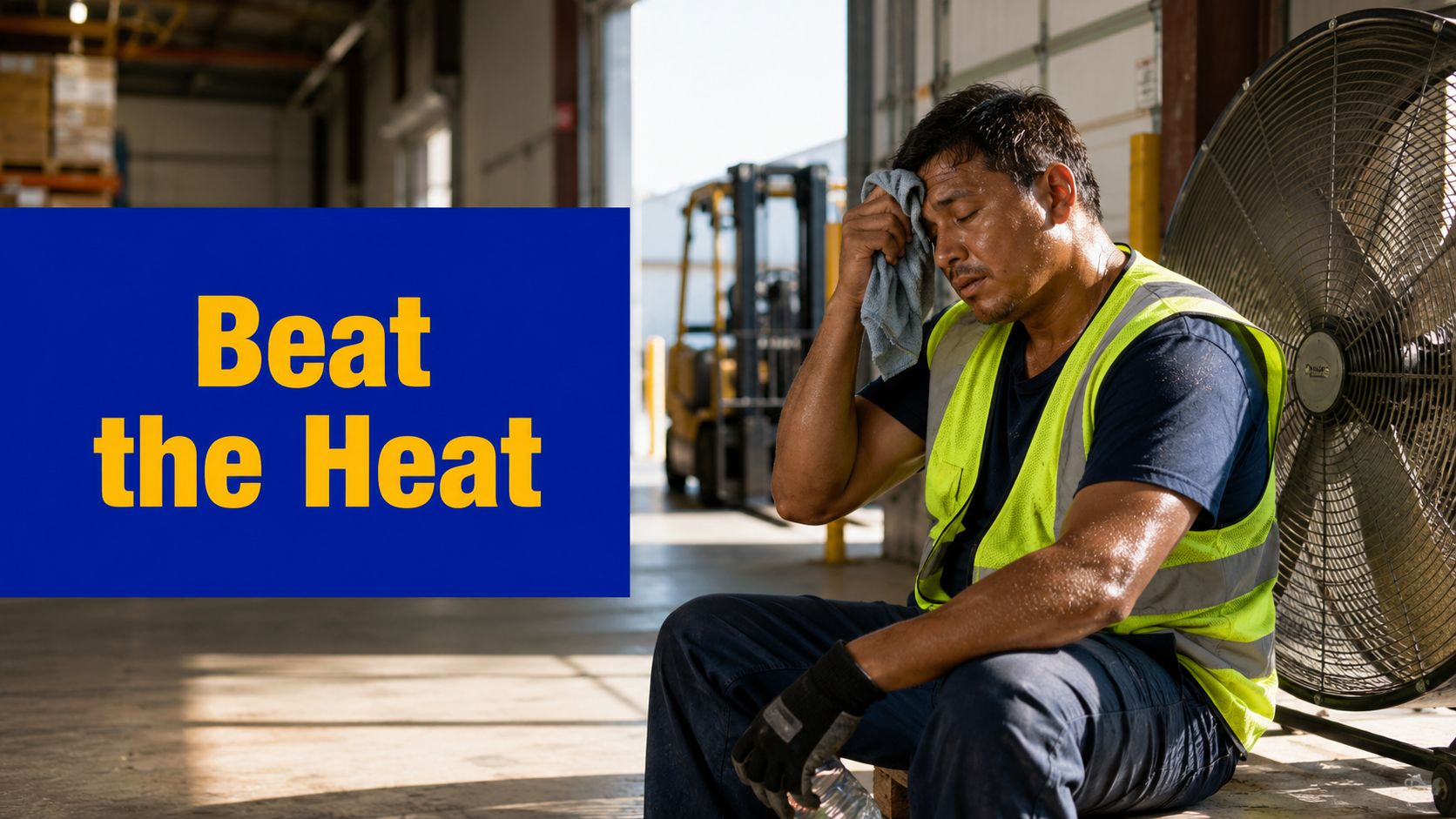
What heat illness can look like
You don’t need medical training to spot warning signs.
Heat exhaustion can show up as heavy sweating, weakness, muscle cramps, dizziness, headache, nausea, or fainting. Someone may look drained, unsteady, or unable to concentrate.
Heat stroke is far more serious. Confusion, collapse, seizure-like symptoms, or loss of consciousness are emergency signs. Treat that as urgent. Get help immediately.
If you’re looking to improve your general approach to spotting and recording hazards, the Canadian Centre for Occupational Health and Safety (CCOHS) offers practical guidance on hazard identification that applies across Ontario workplaces.
How to build a useful evidence trail
Your notes matter most when they’re specific and created close to the event. Don’t rely on memory.
Keep a private record of:
- Date and time: When did the heat issue happen?
- Location: Warehouse aisle, loading dock, truck cab, rooftop, kitchen line, mechanical room.
- Work conditions: Sun exposure, humidity, poor ventilation, protective gear, hot machinery, pace of work.
- Symptoms: Dizziness, headache, nausea, cramping, confusion, faintness, weakness.
- Requests made: Water, extra break, relocation, task change, medical attention.
- Responses from management: What was said, by whom, and when.
- Witnesses: Co-workers who saw the conditions or your symptoms.
Photos and videos can help if they’re taken lawfully and safely. A photo of a thermometer, a crowded unventilated room, a blocked water station, or radiant heat equipment may support your account. So can a screenshot of a text to your supervisor.
Write like someone else may read it later. Short, factual, and dated beats emotional and vague.
If the situation turns into an injury, disability, or negligence dispute, a strong record can also help you assess whether there may be a workplace injury lawsuit claim beyond the immediate internal complaint.
Your Step-by-Step Guide to Taking Action at Work
Most heat disputes should start with a calm, direct report. Not because the issue is minor, but because you want a clear paper trail and a fair chance for the employer to fix it quickly.
Start low conflict and get it in writing
Use this order.
-
Tell your supervisor immediately
Be direct. Say the heat is creating a health and safety concern. Name the problem. Ask for a specific fix such as water access, an extra cooling break, a task change, a shaded area, or moving heavy work to a cooler time.
-
Follow up in writing
Even if you speak in person, send a text or email. Written records stop arguments later about what was said.
-
Report to the health and safety representative or JHSC
If your workplace has a Joint Health and Safety Committee or worker representative, bring the concern there as well. That adds visibility and often gets faster action.
-
Document the employer’s response
Did they act, delay, dismiss, or retaliate? Record it.
-
Escalate if the risk continues
If the answer is effectively “keep working and stop complaining,” you may be moving toward a formal unsafe work issue.
Sample message you can send today
You do not need legal jargon. You need clarity.
I’m raising a health and safety concern about the heat conditions in my work area today. The temperature and working conditions are causing symptoms and creating a safety risk. I’m requesting immediate steps to reduce the risk, including cool drinking water, additional cooling breaks, and adjustment of strenuous duties until conditions are safer. Please confirm what steps will be taken.
If you want a firmer version, use this:
I’m reporting unsafe heat conditions in my work area. I’m experiencing symptoms consistent with heat stress and need this addressed right away. Please arrange immediate controls such as access to water, a cool rest area, and modified duties or scheduling. I’m documenting this as a workplace safety concern.
A few practical rules make these messages stronger:
- Be specific: Identify the area, the task, and what symptoms or hazards are present.
- Ask for remedies: Don’t just complain. Request concrete controls.
- Stay professional: You want to sound credible, not reckless.
- Keep copies: Save emails, screenshots, and replies on a personal device if possible.
This stage is often where employers make a choice. Responsible employers intervene. Bad employers minimise, deflect, or punish. If yours chooses the second path, stop assuming the problem will sort itself out.
Exercising Your Right to Refuse Unsafe Work
If internal reporting doesn’t fix the danger, Ontario law gives workers a stronger tool. You may have the right to refuse unsafe work. That’s not the same as storming off the site or not showing up. It’s a formal process, and you should use it properly.
How the refusal process works
The basic path is straightforward.
-
State the refusal clearly
Tell your supervisor you are refusing work because you believe the heat conditions are unsafe. Be specific about why.
-
Participate in the first investigation
The employer must investigate in your presence, usually with a worker representative or JHSC member if available.
-
If unresolved, continue the refusal
If the issue is not fixed and you still reasonably believe the work is unsafe, the matter moves forward for a further internal review.
-
The Ministry can become involved
If the dispute remains unresolved, the Ministry of Labour, Immigration, Training and Skills Development may be contacted to investigate.
-
Follow the outcome
An inspector can investigate and make directions or orders that the workplace must follow.
If you believe the work is unsafe, say so plainly. Don’t frame it as a personal preference or a request for comfort.
Employees are often afraid that a refusal will automatically get them fired. It shouldn’t. Reprisal for properly raising safety concerns or exercising a lawful work refusal can create serious legal exposure for the employer.
If the refusal later turns into discipline, suspension, or dismissal, the employment side of the dispute can become just as important as the safety side. That’s when it helps to understand the broader legal framework around termination rights under Ontario employment law.
What not to do
A few mistakes weaken otherwise valid concerns:
- Don’t just leave without explanation: Report the refusal and the reasons immediately.
- Don’t make it vague: “It’s too hot” is weaker than “there’s no cool water, no extra break, high heat from machinery, and I’m feeling dizzy.”
- Don’t argue by text only if you’re on site: Say it directly, then document it.
- Don’t downplay symptoms: If you’re unwell, say so.
Use the process. The law protects workers who use the process properly.
When and How to Contact an Employment Lawyer
Some heat stress issues can be fixed internally. Some can’t. Once retaliation, discipline, or serious illness enters the picture, you should stop trying to solve it alone.
Clear signs you should stop handling this alone
Call an employment lawyer if any of these happen:
- You’re punished for speaking up: Reduced shifts, threats, write-ups, demotion, exclusion, or sudden criticism after raising heat concerns.
- You’re disciplined after a work refusal: That often signals a reprisal problem, not just a safety disagreement.
- You’re fired or pushed out: If the employer ends your job after you complain about unsafe heat, the dismissal may be legally challengeable.
- You suffer a heat-related illness: Especially if the employer ignored obvious warning signs or failed to implement basic controls.
- The employer keeps ignoring the risk: Repeated reports with no meaningful response often justify legal advice before the situation gets worse.
An employment lawyer helps in two ways. First, they assess whether the employer’s conduct crossed the line under Ontario law. Second, they help you avoid mistakes in how you respond next. That can include preserving evidence, framing a reprisal complaint, assessing wrongful dismissal issues, and coordinating with any workplace injury or disability claim.
What to bring to a legal consultation
You don’t need a perfect file. Bring what you have.
Useful materials include:
- Your written timeline: Dates, symptoms, who you reported to, and what happened next.
- Messages and emails: Anything sent to supervisors, HR, or safety personnel.
- Photos or videos: Conditions, equipment, lack of water, or other relevant evidence.
- Medical notes or treatment records: If you received care.
- Discipline or termination documents: Warnings, suspension letters, dismissal letters, or meeting notes.
- Names of witnesses: Co-workers who saw the conditions or heard management’s response.
A lawyer should also tell you whether you’re dealing with one issue or several at once. Heat disputes often overlap with reprisal, wrongful dismissal, occupational health and safety issues, WSIB questions, and sometimes disability-related concerns. You need a strategy that fits the whole problem.
The moment your employer shifts from ignoring the hazard to targeting you, this stops being only a safety issue. It becomes a legal risk-management issue for you.
If you’re looking for guidance on choosing counsel, this overview of employment lawyers in Ontario can help you think about what experience and approach matter.
Don’t wait for the employer to define the story. If you were pressured to work through dangerous heat, got sick, were punished for objecting, or lost your job after raising safety concerns, get legal advice early. Early advice protects evidence, improves your options, and often changes the balance of power.
If unsafe heat at work has led to discipline, dismissal, illness, or a reprisal concern, contact UL Lawyers for a free consultation. Their Ontario team serves Burlington, the GTA, and clients across the province, and they handle employment, injury, disability, and overlapping workplace disputes with a practical, human approach. If the situation is urgent, reach out right away so you can protect your health, preserve evidence, and understand your options before taking the next step.