
Wrongful termination payouts in Canada are not a flat “average.” Ontario employees are owed the ESA floor, then usually common-law reasonable notice — often months of pay, with a practical ceiling around 24 months for long-tenured or senior roles.
The first offer is frequently ESA-only. Signing the release usually ends the claim. Age, tenure, position, and how hard it is to find similar work (the Bardal factors) drive the real number.
Do not sign. Call 905-744-8888 or email info@ullaw.ca. Hire a wrongful dismissal lawyer, book a consultation, or compare the offer on the severance pay calculator.

Table of Contents
- What Is the Average Payout for Wrongful Termination in Canada?
- Can I Sue for Wrongful Termination in Canada?
- What Is Considered Wrongful Termination in Ontario?
- How Do I Know if I’ve Been Wrongfully Dismissed?
- Wrongful Dismissal and Severance Pay: Understanding the Numbers
- Workplace Discrimination and Harassment: When Your Dismissal Is About More Than Notice
- Practical Steps to Take After a Wrongful Termination
What Is the Average Payout for Wrongful Termination in Canada?
There is no single “average” number that applies to every wrongful dismissal claim in Canada — and anyone who gives you a flat figure without knowing your situation should be treated with caution. That said, real-world outcomes follow recognisable patterns that can help you set reasonable expectations.
The two layers of entitlement
In Ontario (and across Canada), wrongfully dismissed employees are typically entitled to compensation at two levels:
- Statutory minimums under the Employment Standards Act, 2000 — the floor every employer must meet regardless of contract.
- Common law reasonable notice — a broader entitlement established by courts, often significantly larger than the statutory floor.
Typical ranges in practice
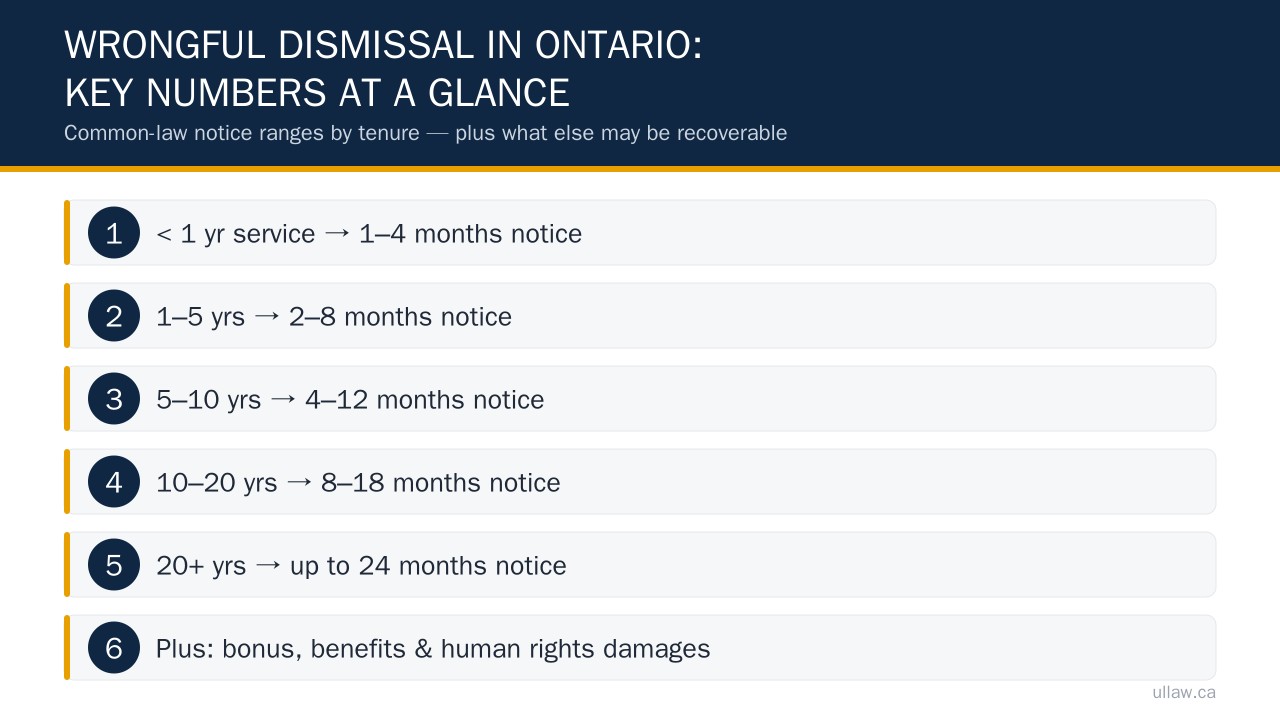
| Employment length | Rough common-law notice range |
|---|---|
| Less than 1 year | 1 – 4 months |
| 1 – 5 years | 2 – 8 months |
| 5 – 10 years | 4 – 12 months |
| 10 – 20 years | 8 – 18 months |
| 20 + years | 12 – 24 months |
These are ranges, not guarantees. Courts have awarded less and, in exceptional cases, more. The Bardal factors — named after a foundational Canadian employment case — guide judges when calculating reasonable notice. Those factors include:
- Age (older workers typically receive longer notice)
- Length of service
- Character of the position (a senior executive’s package often exceeds a junior employee’s)
- Availability of similar employment in the market
What is the maximum you can get?
The practical ceiling for most common-law wrongful dismissal claims is around 24 months’ compensation. Courts have occasionally exceeded that ceiling where there are aggravating circumstances — such as bad-faith conduct by the employer during the termination — but 24 months is the widely accepted upper boundary for notice damages alone.
Additional heads of damages
Beyond notice pay, a successful claim may also recover:
- Continuation of benefits for the notice period
- Bonus and commission amounts that would have been earned
- Human rights damages if discrimination played a role (awarded under the Ontario Human Rights Code)
- Moral / punitive damages where the employer acted in bad faith
Use our severance pay calculator to get a quick personalised estimate based on your own details.
Can I Sue for Wrongful Termination in Canada?
Yes — employees in Canada have the legal right to pursue a claim when they are dismissed without proper notice or cause. The route you take depends on the size of your claim and how you want to proceed.
Your legal options in Ontario
1. Ontario Superior Court of Justice For larger claims — generally where the value of lost compensation exceeds the Small Claims Court limit — most employees file a civil action in the Ontario Superior Court. This is the traditional path for senior employees or those with substantial notice entitlements.
2. Ontario Small Claims Court Claims up to the current monetary limit can be pursued in Small Claims Court, which is faster and less expensive. It may be the right fit for shorter-tenured employees with more modest entitlements.
3. Ministry of Labour complaint You can file a complaint with the Ontario Ministry of Labour under the Employment Standards Act, 2000 for violations of your minimum statutory entitlements (termination pay, severance pay, vacation pay). This is free and does not require a lawyer — but it caps your recovery at the statutory floor.
4. Human Rights Tribunal of Ontario If your termination involved discrimination based on a protected ground (disability, age, race, sex, etc.), you may file an application with the Human Rights Tribunal of Ontario, which can award general damages in addition to lost wages.
Is it worth suing for wrongful dismissal?
For most employees whose entitlements exceed what the employer offered, the answer is yes — pursuing a claim is worth it. Studies of negotiated outcomes consistently show that employees represented by a lawyer recover significantly more than those who accept an employer’s first offer. Employers know the legal landscape and frequently offer the minimum they think they can get away with.
That said, litigation takes time and carries costs. Many wrongful dismissal matters in Ontario settle before trial through negotiation or mediation — often within weeks to a few months of retaining counsel. A qualified employment lawyer can assess whether the likely recovery justifies the process in your specific situation.
Limitation periods — act quickly
In Ontario, the general limitation period under the Limitations Act, 2002 is two years from the date you knew (or ought to have known) about the claim. Missing that window can extinguish your rights entirely. If you were recently dismissed, speak to counsel as soon as possible.
What Is Considered Wrongful Termination in Ontario?
The term “wrongful termination” (more precisely called wrongful dismissal in Canadian law) covers a wider set of situations than most employees realise.
The basic principle
In Ontario, an employer can generally end an employment relationship — but not without consequence. Unless the employer has just cause (a high legal bar), they must provide:
- Working notice of termination, or
- Pay in lieu of notice (termination pay), or
- A combination of both
Failing to do either — or providing less than the law requires — is wrongful dismissal.
Common forms of wrongful dismissal
Termination without proper notice The most straightforward form: the employer fires you without cause and without providing sufficient notice or severance.
Constructive dismissal This is one of the most misunderstood concepts in employment law. Constructive dismissal occurs when an employer makes a fundamental unilateral change to your employment — cutting your pay significantly, demoting you, relocating you without consent, or creating a hostile work environment — such that staying would be unreasonable. The law treats this as a dismissal even if the employer never said the words “you’re fired.”
Termination in bad faith Where an employer dismisses an employee in a manner that is callous, deceptive, or that causes undue mental distress, courts may award additional damages beyond the notice period.
Termination linked to discrimination A dismissal that is connected — even partly — to a protected characteristic under the Ontario Human Rights Code (race, sex, age, disability, family status, and others) may support both a wrongful dismissal claim and a separate human rights application.
When employment IS terminated for cause
Employers sometimes claim “just cause” to avoid paying any notice or severance. Courts hold employers to an extremely high standard here. Just cause typically requires serious misconduct — persistent insubordination, theft, fraud, or conduct fundamentally incompatible with the employment relationship. Poor performance alone, without documented warnings and an opportunity to improve, rarely meets this threshold.
If your employer claimed just cause, do not simply accept that characterisation — have it reviewed by an employment lawyer.
How Do I Know if I’ve Been Wrongfully Dismissed?
Many employees are unsure whether what happened to them actually qualifies as wrongful dismissal. Here are the key signals to watch for:
Signs your dismissal may be wrongful
- You were fired “without cause” but received no notice period or inadequate termination pay
- Your employer claimed “just cause” but you were not warned about the conduct in question
- Your role, pay, or responsibilities were substantially changed without your agreement (potential constructive dismissal)
- You were let go shortly after asserting a workplace right — taking parental leave, filing a harassment complaint, requesting accommodation
- Your termination coincided with a protected characteristic (e.g., you disclosed a medical condition, announced a pregnancy, or turned a certain age)
- You were pressured to sign a release quickly and told the offer expires in days
A common misconception about wrongful dismissal
Many employees believe that because they were dismissed as part of a mass layoff or “restructuring,” they have no claim. This is incorrect. A genuine restructuring does not relieve an employer of the obligation to provide proper notice or pay in lieu. You may still be entitled to full common-law reasonable notice regardless of the business reason given.
Another misconception: signing an employment contract with a termination clause means you can only ever receive the statutory minimum. Termination clauses are frequently challenged — and struck down — by Ontario courts when they fail to meet precise legal requirements. If your contract has a termination clause, it is worth having a lawyer review it before you accept any package.
Our employment law team regularly identifies termination clauses that don’t hold up, recovering significantly more for clients than the employer initially offered.

Wrongful Dismissal and Severance Pay: Understanding the Numbers
Severance and termination pay are not the same thing, and confusing them can cost you money.
Termination pay vs. severance pay under the ESA
Under the Employment Standards Act, 2000, Ontario employees are entitled to:
- Termination pay: 1 week per year of service (up to a maximum of 8 weeks) for employees with at least 3 months of tenure
- Severance pay (a separate entitlement): applies only if you worked for the employer for 5 or more years and the employer has a payroll of $2.5 million or more (or terminated 50+ employees in a 6-month period). The rate is 1 week per year of service, up to a maximum of 26 weeks.
These are the statutory floors — not the ceiling.
Common law adds significantly more
Most employees are entitled to reasonable notice at common law, which is calculated in months, not capped at 8 or 26 weeks. This is where the biggest gap between what employers offer and what employees are owed typically appears.
How much is 1 week of severance pay?
One week of severance pay equals your regular weekly wages — typically your annual salary divided by 52. If you earn $80,000 per year, one week is approximately $1,538 before tax. That figure forms the building block for calculating both your statutory entitlements and your common-law reasonable notice package.
For a personalised breakdown of your specific entitlements, try our severance pay calculator.
Bonus, benefits, and other compensation
Severance packages should also account for:
- Health and dental benefit continuation during the notice period
- Pension contributions that would have accrued
- Target bonuses or commissions you would likely have earned
- Stock options or equity that would have vested
Failing to include these amounts is one of the most common ways employers underpay dismissed employees.
Workplace Discrimination and Harassment: When Your Dismissal Is About More Than Notice
Sometimes a dismissal is not just about notice pay — it is about something more serious: discrimination or workplace harassment.
The Ontario Human Rights Code prohibits adverse treatment in employment on the basis of protected grounds including:
- Race, colour, ancestry, or place of origin
- Disability (physical or mental)
- Sex (including pregnancy and gender identity)
- Age
- Family status or marital status
- Sexual orientation
- Religion or creed
If your termination was connected — even partly — to any of these characteristics, you may have a human rights claim in addition to a wrongful dismissal claim. The Human Rights Tribunal of Ontario can award general damages for injury to dignity, as well as compensation for lost income.
Similarly, if you were dismissed after raising a harassment complaint or because you exercised a right under the Occupational Health and Safety Act (such as refusing unsafe work), your employer may have committed reprisal — which carries its own remedies.
These additional layers of protection mean that, in some cases, the total compensation available to a dismissed employee substantially exceeds what a straightforward wrongful dismissal claim would produce. Speak with an employment lawyer who can evaluate all potential claims, not just the notice calculation.
Our employment law team handles the full spectrum of dismissal-related claims, including discrimination, harassment, and reprisal.
Practical Steps to Take After a Wrongful Termination
If you believe you have been wrongfully dismissed, the actions you take in the first days and weeks matter. Here is what to do — and what to avoid.
Do this immediately
-
Do not sign anything without legal advice. Employers often present a release or separation agreement with an artificial deadline. Signing away your rights before getting independent legal advice is one of the most costly mistakes a dismissed employee can make.
-
Collect your documents. Gather copies of your employment contract, any amendments, the most recent offer letters, performance reviews, pay stubs, your termination letter, and any written communication about the dismissal. Keep personal copies outside company email.
-
Note the timeline. Write down dates — when you were told, how you were told, what was said, and who was present. Memory fades quickly and contemporaneous notes carry real evidentiary weight.
-
Mitigate your losses. Ontario law requires dismissed employees to take reasonable steps to find comparable employment. Keep records of your job search — applications, interviews, offers received. Failure to mitigate can reduce your recovery.
-
Speak to an employment lawyer promptly. Many employment lawyers offer a free initial consultation. Early advice helps you understand what you are owed, whether to negotiate or litigate, and how to avoid missteps.
What to avoid
- Do not badmouth the employer on social media. It can complicate your claim and affect your credibility.
- Do not destroy documents or company property.
- Do not miss limitation deadlines — Ontario’s two-year limitation period starts running from the date of dismissal.
Review your employment contract and severance package
Before engaging further with your employer, have your employment contract and the termination offer reviewed by counsel. As noted above, contractual termination clauses are frequently unenforceable — and even where they are valid, the full value of your benefits, bonus, and other compensation may not have been properly included in the offer.
Talk to a UL Lawyers Team Member
Ready to find out what the dismissal is actually worth? Do not sign the release on ESA-only numbers. Call 905-744-8888 or email info@ullaw.ca. You can also book a free consultation, start on our employment law page, or run a first estimate with the severance pay calculator.
Related UL Lawyers resources
- What is wrongful dismissal in Ontario? — ESA floor vs common-law notice.
- Wrongful dismissal services — claim path after a without-cause firing.