Being struck by a vehicle can turn your life upside down in seconds. Medical bills pile up, income disappears, and the at-fault driver’s insurer may already be building a case against you. One of the first questions injured Ontarians ask is simple and urgent: can I actually sue the person who hit me?
The short answer is yes — Ontario law gives injured people the right to pursue a civil lawsuit against a negligent driver. But the path from collision to compensation is not automatic. You must navigate Ontario’s mandatory insurance system, strict limitation periods, and a legal test that requires you to prove liability, causation, and the extent of your damages. Each of those three pillars can be contested, and insurers contest them aggressively.
This article explains how the right to sue works in a motor vehicle accident context — what you need to prove, how long you have to act, what damages are available, and what can go wrong. If you are dealing with an injury right now, our motor vehicle accident legal team is here to help you understand your options at no cost.
Table of Contents
- Can You Sue Someone for Hitting You With Their Car in Canada?
- What Do You Need to Prove to Win a Motor Vehicle Accident Lawsuit?
- What Are the Time Limits for Suing After a Car Accident?
- How Does Ontario’s No-Fault Insurance System Affect Your Lawsuit?
- What Compensation Can You Realistically Expect?
- What Should You Do Immediately After Being Hit by a Car?
Can You Sue Someone for Hitting You With Their Car in Canada?
Yes — in Ontario and across Canada, a person injured by a negligent driver may bring a civil lawsuit for damages. The legal foundation is the tort of negligence, which exists independently of the provincial insurance system. Even though Ontario operates a no-fault accident benefits scheme under the Insurance Act (which gives you access to Statutory Accident Benefits Schedule, or SABS, benefits regardless of fault), those benefits do not extinguish your right to sue the at-fault driver in court.
However, Ontario’s system does place one important threshold on lawsuits: to claim non-economic damages (like pain and suffering), your injury must meet the legal definition of a “permanent serious disfigurement” or a “permanent serious impairment of an important physical, mental, or psychological function.” This is called the verbal threshold, and it was introduced to screen out minor soft-tissue claims from the courts.
Who Can Be Sued?
- The at-fault driver — the most common defendant
- The vehicle owner — Ontario’s Highway Traffic Act makes vehicle owners potentially liable for negligent use of their car by another person
- A municipality — if dangerous road design or poor maintenance contributed to the crash
- An employer — if the driver was operating a vehicle in the course of employment
- A commercial host or social host — in some circumstances where alcohol was involved
What About Contributory Negligence?
If you were partly at fault — say, you were jaywalking or not wearing a seatbelt — Ontario follows contributory negligence rules under the Negligence Act. Your damages are reduced in proportion to your share of fault, but you are not barred from suing entirely unless you were 100% responsible.
The bottom line: a collision on an Ontario road almost always gives rise to the right to sue. Whether that lawsuit succeeds, and for how much, depends on what you can prove.
What Do You Need to Prove to Win a Motor Vehicle Accident Lawsuit?
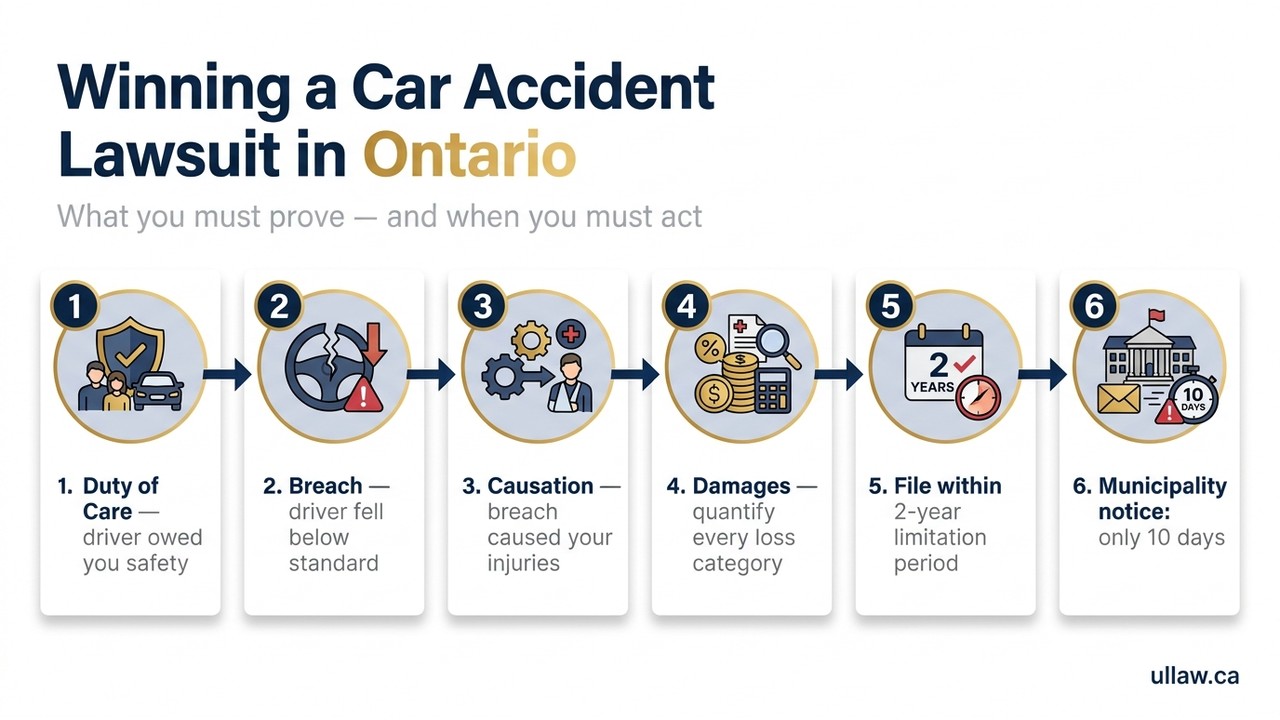
Ontario courts use a three-part test for negligence. You — through your lawyer — must establish all three elements on a balance of probabilities (meaning it is more likely than not that each element is true).
1. Duty of Care
Every licensed driver in Canada owes a duty of care to other road users, cyclists, and pedestrians. This element is almost never seriously disputed in a motor vehicle case. The moment someone gets behind the wheel on a public road, the duty exists.
2. Breach of the Standard of Care (Liability)
You must show the defendant drove below the standard of a reasonably careful driver. Evidence used to prove breach can include:
- Police collision reports — officers’ notes about charges, fault designations, or Highway Traffic Act violations
- Photographs and video — dashcam footage, intersection cameras, bystander cell-phone video
- Witness statements — independent bystanders carry significant weight
- Accident reconstruction experts — retained for high-speed, fatal, or complex crashes
- Electronic data — vehicle black-box data recording speed, braking, and steering inputs
- Cell phone records — to establish distracted driving
Common breaches include speeding, running a red light, failing to yield, drunk or distracted driving, and failing to signal. A Highway Traffic Act conviction, though not binding on a civil court, is powerful supporting evidence.
3. Causation
This is often the most contested element. You must prove the defendant’s breach caused your injuries — not merely that the collision happened and you are now hurt. Insurers routinely argue that your symptoms stem from a pre-existing condition unrelated to the crash.
Strong causation evidence includes:
- Emergency room records from the day of the collision
- Treating physician notes documenting the onset and mechanism of injury
- Imaging (X-rays, MRI, CT scans) obtained promptly after the accident
- A physiatrist, orthopaedic surgeon, or neurologist opinion linking the injury mechanism to your diagnosis
- A chronological gap analysis — showing you had no relevant complaints before the collision and developed them immediately after
4. Damages
Even with proven liability and causation, you must quantify your losses. Ontario courts can award:
- Non-pecuniary general damages — pain, suffering, loss of enjoyment of life (subject to the verbal threshold and a statutory deductible under the Insurance Act)
- Loss of income and future earning capacity — supported by employment records, tax returns, and vocational expert reports
- Future care costs — a life-care planner or occupational therapist may project ongoing medical needs
- Out-of-pocket expenses — prescription costs, travel for treatment, home adaptations
- Family law claims — family members may claim loss of guidance, care, and companionship under the Family Law Act
Use our personal injury settlement calculator to get a rough sense of the range of damages that may apply to your situation — then speak with a lawyer to understand how the specific facts of your case affect that estimate.
What Are the Time Limits for Suing After a Car Accident?
Time limits in Ontario motor vehicle cases are strict, and missing them can permanently bar your claim.
The Basic Two-Year Limitation Period
The Limitations Act, 2002 sets a two-year limitation period for most civil claims. The clock generally starts on the date you discovered (or ought reasonably to have discovered) that you have a claim — which is usually the date of the collision itself. In most car accident cases, that means you have two years from the crash date to issue your statement of claim in court. Waiting to see whether you recover does not reliably pause that clock: in a 2026 Court of Appeal decision (2026 ONCA 434), a lawsuit was dismissed because the injured person knew, or ought to have known, that their injuries likely met the Insurance Act threshold well before they sued, even without a formal expert opinion.
Accident Benefits — 7-Day and 30-Day Deadlines
Separate from the lawsuit, SABS accident benefits under the Insurance Act have their own notice requirements. You must notify your own insurer of the accident promptly, and there are deadlines for submitting specific benefit applications. Missing an accident benefits deadline can affect your entitlement to those benefits, so act quickly.
Suing a Municipality — 10-Day Notice
If a dangerous road condition contributed to your accident and you intend to sue a municipality, the Municipal Act requires written notice to the municipality within 10 days of the accident. This is a very short window and is frequently missed without legal advice.
Minors and the Limitation Period
If the injured person is under 18, the two-year period does not begin until they turn 18 — but a litigation guardian can commence an action earlier on their behalf, and doing so early is usually in the minor’s best interest.
Why Acting Early Matters Beyond Deadlines
Even when you are well inside the two-year window, delay hurts your case. Witnesses’ memories fade, surveillance footage gets overwritten within days, skid marks disappear, and vehicle damage is repaired. A lawyer can send preservation letters to retain critical evidence before it is lost.
Key takeaway: Do not assume you have “plenty of time.” If you were injured in a motor vehicle accident, contact a lawyer as soon as you are physically able to do so.

How Does Ontario’s No-Fault Insurance System Affect Your Lawsuit?
Ontario’s auto insurance system has two parallel tracks, and understanding how they interact is essential.
Track 1 — Accident Benefits (No-Fault)
Regardless of who caused the crash, your own insurer must pay Statutory Accident Benefits (SABS): income replacement benefits, medical and rehabilitation benefits, attendant care, and others. These benefits are governed by Ontario’s Insurance Act and its regulations and are available to you even if you were at fault.
If your insurer denies or reduces your accident benefits, you may dispute that decision at the Licence Appeal Tribunal (LAT), an administrative body that hears SABS disputes.
Track 2 — The Tort Lawsuit
Separately, if another driver was at fault, you can sue them (and their insurer defends them) for damages beyond what SABS covers. The two tracks run simultaneously — accident benefits are not a reason to give up the tort claim.
The Deductible and Threshold
For claims that clear the verbal threshold, Ontario’s Insurance Act currently imposes a statutory deductible that is applied against general damages awards below a set amount. This deductible is adjusted periodically. A lawyer can confirm the current figure and advise whether your damages are likely to exceed it.
Subrogation
In some situations, your insurer may seek to recover from the at-fault driver’s insurer amounts they paid you in accident benefits — this is called subrogation. How subrogation interacts with your tort damages is a nuanced issue that an experienced car accident lawyer can help you navigate.
What Compensation Can You Realistically Expect?
The amount of compensation available in a motor vehicle accident lawsuit in Ontario varies enormously depending on the nature and severity of your injuries, your pre-accident income, your age, and the strength of your evidence. There is no single “average” figure that applies to all cases.
Factors That Increase Compensation
- Severity and permanence of the injury (e.g., spinal cord injury, traumatic brain injury, serious orthopaedic fractures)
- High pre-accident income that you can no longer earn
- Young age — a longer period of lost earning capacity
- Clear liability with no contributory negligence on your part
- Well-documented treatment history from day one
Factors That Reduce Compensation
- Pre-existing conditions in the same body region
- Gaps in treatment that insurers argue show your injury was not serious
- Contributory negligence (not wearing a seatbelt, speeding, distracted walking)
- Failure to mitigate — not following your doctor’s treatment recommendations
- Injuries that do not meet the verbal threshold, removing the right to general damages
Types of Awards
| Damage Category | Description |
|---|---|
| Non-pecuniary general damages | Pain, suffering, loss of enjoyment |
| Loss of income (past) | Wages lost between crash and trial |
| Loss of earning capacity (future) | Projected income loss over career |
| Future care costs | Medical, rehabilitation, attendant care |
| Special damages | Out-of-pocket expenses, receipts required |
| Family Law Act claims | Spouse/children’s loss of guidance and care |
To get a personalised starting point, try our personal injury settlement calculator — but remember that a calculator cannot replace professional legal advice tailored to your file.

What Should You Do Immediately After Being Hit by a Car?
The actions you take in the hours and days after a collision can make or break your lawsuit. Here is what matters most:
At the Scene
- Call 911 — Report the collision. A police report creates an official record.
- Get medical attention immediately — Even if you feel “okay,” adrenaline masks pain. Emergency records tie your injury to the event.
- Document everything — Photograph vehicle damage, road conditions, skid marks, traffic signals, and your visible injuries.
- Exchange information — Obtain the driver’s name, licence plate, insurer, and policy number.
- Gather witnesses — Names and contact information of bystanders who saw the collision.
In the Days Following
- Notify your own insurer promptly — Ontario law requires timely notice of an accident.
- See your family doctor and describe every symptom, no matter how minor it seems.
- Keep a pain and symptoms journal — Daily notes of your limitations, pain levels, and how the injury affects your life are powerful evidence.
- Save all receipts — Prescriptions, physiotherapy, taxi rides to appointments — everything.
- Avoid posting on social media — Insurers monitor social media for posts that contradict your injury claims.
Consult a Lawyer Early
Most personal injury lawyers, including our team at UL Lawyers’ motor vehicle accident practice, offer free initial consultations and work on a contingency fee basis — meaning you pay no legal fees unless you recover compensation. Early legal advice helps preserve evidence and ensures you meet all critical deadlines.
How Much Can You Get for Pain and Suffering After a Car Accident in Ontario?
Pain and suffering compensation — formally called non-pecuniary general damages — is often the largest single head of damages in a motor vehicle accident lawsuit, yet it is also the most heavily regulated in Ontario. Understanding both the ceiling and the deductible is essential before forming any expectations.
The Supreme Court “Trilogy” Cap
Canadian courts trace the upper limit of non-pecuniary general damages to a trio of Supreme Court of Canada decisions from 1978, commonly called the trilogy. The cap set in those cases has been indexed to inflation over the decades and now sits at roughly $440,000–$450,000. Only the most catastrophic injuries — such as severe traumatic brain injury or permanent quadriplegia — approach that ceiling.
Ontario’s Statutory Threshold
Ontario’s Insurance Act, R.S.O. 1990, c. I.8, and O. Reg. 461/96 impose a threshold test: to recover any non-pecuniary damages in a tort claim, the plaintiff must prove that the impairment resulting from the accident was:
- Permanent and serious in nature, or
- Resulted in death.
Courts assess permanence and seriousness based on medical evidence, functional limitations, and the effect on the plaintiff’s daily life and enjoyment of activities. Soft-tissue injuries that fully resolve generally do not meet the threshold.
The Statutory Deductible
Even when a plaintiff clears the threshold, Ontario’s Insurance Act mandates that a statutory deductible be subtracted from the non-pecuniary damages award. This deductible is adjusted each calendar year by regulation; for recent years it has exceeded $46,000. Critically, the deductible disappears entirely if the award surpasses a separate (higher) regulatory cap — meaning very large awards are paid in full, while mid-range awards are reduced.
Example (illustrative only): An award of $80,000 in general damages, minus the deductible, might result in a net recovery in the range of $30,000–$35,000. An award of $300,000 would not be reduced at all.
Where Most Real Claims Actually Land
In practice, the range of outcomes is wide:
| Injury Profile | Approximate General Damages Range* |
|---|---|
| Soft-tissue / whiplash (threshold met) | $30,000 – $100,000 |
| Moderate orthopaedic / chronic pain | $80,000 – $175,000 |
| Serious brain or spinal injury | $175,000 – $350,000 |
| Catastrophic (paralysis, severe TBI) | $350,000 – cap (~$450,000) |
*These are illustrative ranges drawn from reported Ontario decisions. Every case turns on its own facts, medical evidence, and credibility findings. No specific outcome is guaranteed.
Pain and Suffering Is Not Your Only Remedy
Non-pecuniary damages are only one component of a full tort claim. Lost income (past and future), medical and rehabilitation expenses, housekeeping costs, and — where applicable — a Family Law Act R.S.O. 1990, c. F.3 claim by close family members for loss of care, guidance, and companionship can substantially increase overall recovery, sometimes far beyond the general damages award itself.
Ontario vs. the Rest of Canada
The trilogy cap applies across all Canadian common-law provinces, so the ceiling is essentially the same nationwide. What differs by province is the threshold mechanism and deductible. Quebec operates under a distinct civil-law framework with its own SAAQ no-fault scheme. Ontario’s combination of a strict threshold and a large deductible means net general damages awards here can be lower than equivalent awards in provinces such as British Columbia or Alberta, where no comparable deductible applies. If your accident occurred outside Ontario, the applicable rules will differ — another reason to speak with a lawyer familiar with the law of the relevant province.
Talk to a UL Lawyers Team Member
If you or someone you love was injured in a motor vehicle accident in Ontario, you do not have to face the insurance system alone. Our team offers a free, no-obligation consultation — we will listen to what happened, explain your rights, and tell you honestly what your options are. Contact UL Lawyers today, because every day you wait is a day closer to a deadline you cannot afford to miss.