Quick answer: Use the free interactive CPP Disability calculator to estimate how much per month in Ontario for 2026 (maximum $1,741.20 plus $307.81 per eligible child). It is a planning tool, not a Service Canada decision. Denied, appealing, or planning conversion at 65? Call 905-744-8888 or email info@ullaw.ca for a free Ontario consult. For the age-65 conversion, see Does CPP Disability affect CPP pension?.
Before you even think about plugging numbers into a CPP disability calculator, let’s take a step back. The most important first move is to make sure you actually qualify for the benefit in the first place. This might sound obvious, but it’s a step people often skip, leading to a lot of frustration down the road.
The Canada Pension Plan (CPP) disability benefit is a monthly payment designed for contributors under 65 who can’t work regularly because of a mental or physical disability. The key words from Service Canada here are “severe” and “prolonged.” Getting a handle on what those terms really mean is the foundation of your entire claim.
Understanding Your CPP Disability Eligibility in Ontario

Here in Burlington, and as we serve clients across the Greater Toronto Area and all of Ontario, I’ve seen countless people jump straight to estimating how much money they’ll get. But the CPP disability program isn’t just about having a medical diagnosis; it’s about proving how that condition stops you from earning a living.
Service Canada has very specific definitions they use when they look at your application:
- Severe: This doesn’t just mean you can’t do your old job. It means your condition regularly stops you from doing any kind of substantially gainful work. It’s a high bar to clear.
- Prolonged: Your condition must be long-term and of indefinite duration, or it’s likely to result in death. This is what separates it from a temporary or short-term illness.
Your Work History and Contributions
Just as important as the medical side is your work history. The CPP is a contributory plan, which is a formal way of saying you have to have paid into it to get anything out of it. This is where your Minimum Qualifying Period (MQP) comes in.
Generally, to meet the MQP, you need to have made valid contributions to the CPP in either:
- Four of the last six years before your disability began.
- Three of the last six years, but only if you have a long history of contributing (at least 25 years).
Think of your contributions as the fuel for the financial safety net you now need. Not meeting this MQP requirement is one of the most common reasons we see for an application being denied right out of the gate, no matter how serious the medical evidence is. For a full walkthrough of the paperwork, check out our guide on how to apply for CPP disability.
The link between your contributions and your eligibility is absolute. A severe disability without sufficient contributions will not qualify for CPP disability benefits, which is why verifying your MQP is a non-negotiable first step.
The stakes are incredibly high. Back in 2019, mental health issues accounted for 59.4% of the caseload for the Ontario Disability Support Program (ODSP), a program many rely on while fighting for federal benefits. With ODSP cases expected to keep rising, as noted in social assistance data from Statistics Canada, a denied CPP application can push you into a very difficult financial corner.
So, before you move on to any calculator, take a hard look at your medical situation and your contribution history. A solid understanding of this foundation is the best way to set yourself up for a successful claim.
Preparing Your Information for an Accurate Calculation

Any estimate you get from a CPP disability calculator is only as good as the information you feed it. It’s a classic case of “garbage in, garbage out.” Before you can get a number that means anything, you’ll need to round up a few key pieces of financial information.
Taking the time to do this groundwork now will save you a ton of frustration later. It ensures your first estimate is grounded in reality and gives you a clear starting point for what to expect.
Your Essential Document Checklist
Let’s walk through exactly what you need to find. Having these documents on hand before you start will make plugging numbers into any calculator a much smoother experience.
-
Your Social Insurance Number (SIN): This nine-digit number is your unique identifier for all things government-related. You absolutely need it to access your online accounts.
-
Your Statement of Contributions: This is the most critical document for this entire process. It’s a year-by-year breakdown of your contributions to the Canada Pension Plan and the specific earnings you contributed on.
-
Your Recent T4 Slips: While your Statement of Contributions should be the final word, your latest T4 slips are great for cross-referencing your most recent earnings, which might not have hit your official statement yet.
The easiest way to get your most current Statement of Contributions is by logging into your My Service Canada Account (MSCA). If you haven’t set one up, now is the time. It’s the secure, central hub for all your federal benefit information.
Decoding Your Statement of Contributions
Okay, you’ve got your Statement of Contributions—now what? This document lists your “pensionable earnings” for each year, which is the income you actually paid CPP premiums on. This earnings history is the raw data that fuels the entire disability benefit calculation.
You’ll want to find the summary of your total pensionable earnings and the total number of years you’ve contributed. Those are the big ones. But also take a hard look at any years where you had zero or very low earnings. These periods are important because some, like time spent raising young children, can potentially be “dropped out” of the calculation, which could actually increase your final benefit amount.
A quick tip: When you’re asked for your “last day of work,” this means the date your disability actually stopped you from being able to work. This isn’t always the same as your last official payday. Getting this date right is crucial because it helps Service Canada establish the official timeline of your disability.
If you’re juggling years of financial records and a mountain of medical reports, keeping everything straight can feel overwhelming. Keep the calculation inputs grounded in official Service Canada records where possible, including contribution statements, benefit letters, and medical evidence that explains when disability stopped regular work.
Proper preparation isn’t just about making things easier; it’s about ensuring accuracy. By taking the time to gather and understand these documents, you put yourself in the driver’s seat. This solid foundation is essential as you move forward with your claim. If you need help navigating the legal side of things, our team at UL Lawyers offers expert support for CPP Disability claims throughout Ontario.
Getting a Handle on the Official CPP Disability Calculator
Now that you have your documents in hand, let’s dive into the main tool the federal government provides. It’s a bit of a quirk, but there isn’t a dedicated “CPP disability calculator.” Instead, you’ll be using the government’s Canadian Retirement Income Calculator, which cleverly pulls double duty, estimating both retirement and disability benefits.
My goal here is to walk you through how to use this tool correctly. It’s not just about plugging in numbers; it’s about understanding why you’re entering certain information and avoiding the common slip-ups that can give you a completely skewed estimate. Think of this as creating a solid baseline for your financial planning.
First Steps on the Government’s Website
Your starting point is the official Canadian Retirement Income Calculator page on the Canada.ca website. While it’s built for public use, don’t be fooled—it asks for some very specific details, which is why having your Statement of Contributions ready is non-negotiable.
Here’s what you’ll see when you land on the page. This is where the process begins.
This is where you’ll start feeding the system the basics, like your date of birth and your earnings history, which are the building blocks of your final estimate.
Right away, it will ask for a few key pieces of information:
- Your Date of Birth: This is fundamental, as it dictates how CPP rules apply to your specific situation.
- Your Estimated Annual Income: This is the most labour-intensive part. You’ll need to punch in your pensionable earnings for every single year, pulling them directly from that Statement of Contributions.
- Periods of Low or No Income: The calculator has options to account for life events, like taking time off to raise young children. Don’t skip this.
The Devil’s in the Details: Entering Earnings and Using Provisions
This is the step where precision is everything. You have to manually enter your CPP pensionable earnings for each year you’ve worked. Take your time and transfer the numbers directly from your Statement of Contributions. Accuracy is your best friend here.
I’ve seen it happen time and again: people rush this part or just ballpark the numbers. A simple error of a few thousand dollars in a couple of key earning years can throw the entire calculation off, leaving you with a totally unrealistic expectation of what you might receive.
Now, let’s talk about one of the most powerful—and frequently missed—features: the CPP provisions. These are rules designed to help you by letting you drop certain low-earning years from your calculation, which can give your benefit amount a real boost.
The Child-Rearing Provision is a big one. If your earnings dropped or stopped completely because you were home raising a child under the age of seven, you can have those years excluded from your calculation. You have to manually tell the calculator about these periods to see how it affects your numbers.
Forgetting to apply this provision when you’re eligible is one of the most common mistakes I see. It can lead to an estimate that’s significantly lower than what you could actually be entitled to. The calculator will prompt you for this, so make sure you’ve identified any years that qualify.
Making Sense of Your Disability Benefit Estimate
After you’ve carefully entered all your information, the calculator will spit out a results page. It’ll show you a few different numbers, including what your retirement pension might look like, but what we’re focused on is your estimated CPP disability benefit.
The final number you see is actually made of two distinct parts, just like the real CPP disability benefit:
- The Flat-Rate Portion: This is a set amount that every single person approved for CPP Disability in Canada gets. For 2024, that amount is $583.32 per month.
- The Earnings-Related Portion: This is the part that’s unique to you. It’s calculated based on how much you’ve contributed to the CPP over your working life and is equal to 75% of what your retirement pension would be.
The calculator adds these two pieces together to give you a total estimated monthly payment. It’s crucial to remember this is an estimate, not a guarantee. If the number looks shockingly low, your very first move should be to go back and check every single earnings figure you entered. A simple typo can make a world of difference.
One last thing to keep in mind: if you have dependent children, there’s an additional benefit. For children under 18 (or under 25 if they are a full-time student), they could be eligible for a monthly children’s benefit. This is a separate, flat-rate payment of $294.12 per month for each child (as of 2024). This amount is not included in the main calculator’s estimate, so you’ll need to add it in yourself when figuring out your family’s total potential income.
Breaking Down the CPP Disability Benefit Formula
While an online calculator gives you a quick number, really understanding the math behind your CPP Disability benefit is where the power lies. It pulls back the curtain on a process that can feel confusing and arbitrary, showing you exactly how your years of work translate into a monthly payment.
When you look closely, you’ll see your total benefit isn’t just one number. It’s actually a combination of two separate parts, and knowing how they fit together is the key to understanding what you’re entitled to.
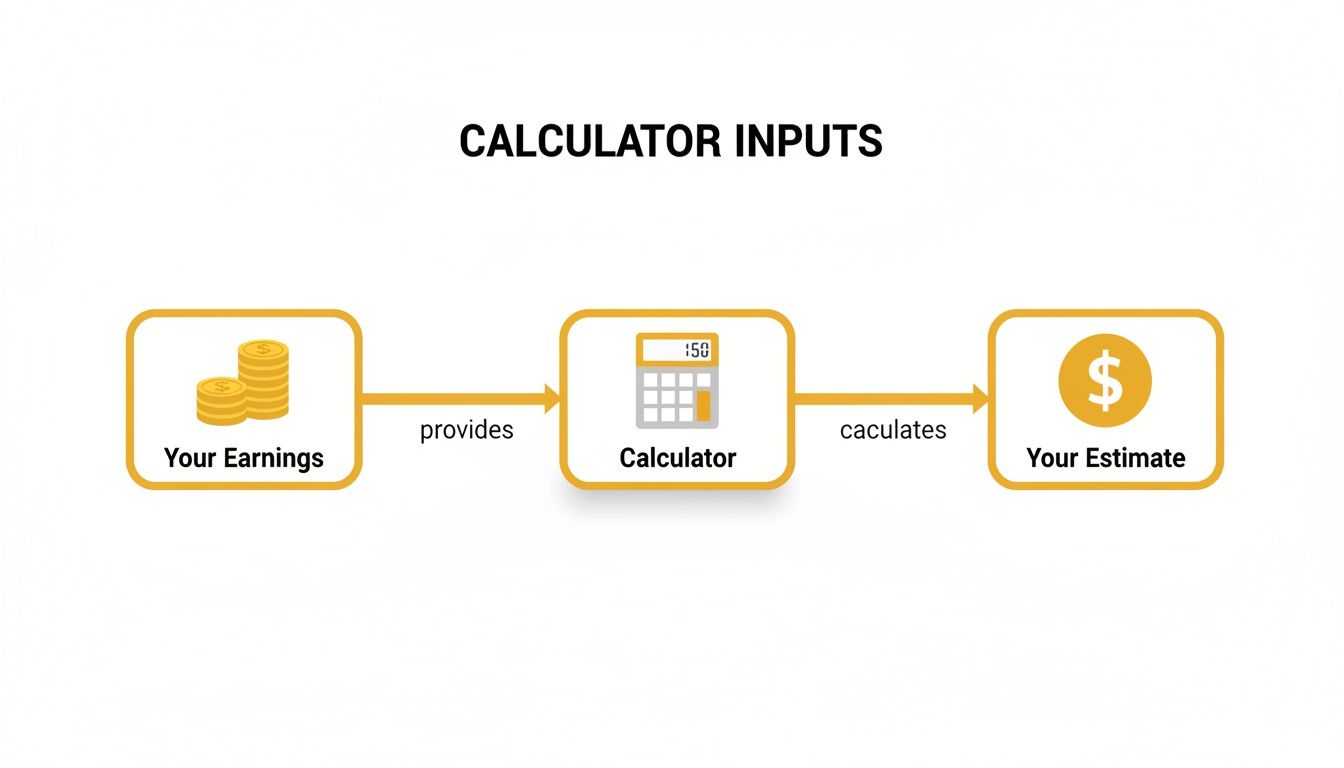
This simple flow highlights a crucial point: the accuracy of your earnings history is the bedrock of any reliable benefit calculation. Garbage in, garbage out.
The Two Core Components of Your Benefit
Every CPP Disability payment is built from the same two blocks: a flat-rate amount and an amount based on your earnings. This two-part structure is designed to provide a foundational level of support for everyone, while also recognizing your individual contribution history.
-
The Flat-Rate Portion: This is the base of your benefit. It’s a set monthly amount that every single person approved for CPP Disability receives, no matter how much they earned in the past. For 2024, this universal base amount is $583.32.
-
The Earnings-Related Portion: This is the part that’s unique to you. It’s calculated as 75% of your estimated CPP retirement pension. The more you’ve paid into the Canada Pension Plan during your career, the higher this portion of your benefit will be.
An online calculator just adds these two figures together. Understanding this simple addition is your first step to being able to check the math yourself and make sure it’s right.
A Practical Example: A Mississauga HVAC Technician
Let’s put this into a real-world context. Imagine David, a 48-year-old HVAC technician from Mississauga who has been working steadily for the past 25 years. A serious back injury means he can no longer handle the physical demands of his job.
David gets his Statement of Contributions from Service Canada and sees that, based on his consistent work history, his calculated retirement pension would be $1,100 per month.
Here’s how we calculate his potential disability benefit:
-
First, we figure out his Earnings-Related Portion by taking 75% of his retirement pension amount.
- $1,100 x 0.75 = $825.00
-
Next, we add the Flat-Rate Portion for 2024.
- $825.00 (Earnings-Related) + $583.32 (Flat-Rate) = $1,408.32
David’s estimated monthly CPP Disability payment comes out to $1,408.32. By doing this quick calculation, he can confidently verify the numbers he gets from any online tool.
To make it even clearer, here’s a table showing how those two pieces come together.
Sample CPP Disability Benefit Calculation (Hypothetical Example)
| Benefit Component | Description | Example Amount |
|---|---|---|
| Flat-Rate Portion | The universal base amount paid to all recipients in 2024. | $583.32 |
| Earnings-Related Portion | 75% of your calculated CPP retirement pension, based on your contributions. | $825.00 |
| Total Monthly Benefit | The sum of the flat-rate and earnings-related portions. | $1,408.32 |
This simple breakdown is vital. If the decision letter from Service Canada shows a calculation that seems wrong, you can ask specific questions about whether the error is in the flat rate or how they calculated your earnings-related portion.
The Impact of Drop-Out Provisions
The CPP formula isn’t completely rigid; it has some built-in flexibility. One of the most important features is the general drop-out provision, which lets you exclude some of your lowest-earning years from the calculation.
This is a massive help. It means that periods where you were in school, unemployed, or just had a low-income year won’t permanently drag down your average earnings. For more details on the application itself, feel free to review our guide on how to apply for disability in Canada.
The system automatically ignores up to 17% of your lowest-earning months. For someone who worked from age 18 to 48 (a 30-year span), this could mean dropping more than five of their worst years, significantly boosting their benefit amount.
Unfortunately, even with these provisions, the final number can be a shock. When you stack CPP Disability benefits against the cost of living, especially when compared to provincial supports like ODSP—where annual allowances max out at $16,896 for a single person—the gap is alarming. The reality is stark: people with disabilities in Ontario are 55.4% more likely to live in poverty than their non-disabled peers.
By understanding how this formula works, you’re no longer just passively waiting for a decision. You become an informed applicant who can check the numbers, ask the right questions, and advocate for the full benefit you’re owed.
What to Do When Your Benefit Calculation Seems Too Low
It’s a gut-wrenching moment. You open the letter from Service Canada, or you plug your numbers into a calculator, and the amount staring back at you is far less than you expected. Your first thought might be panic, but I’ve seen this happen countless times. This isn’t a final verdict; it’s a signal that something needs a much closer look.
An unexpectedly low benefit calculation is your cue to start investigating. Don’t give up. More often than not, there’s a specific reason for the low number—and a clear path to getting it corrected.
Uncovering the Common Culprits
Before you even think about a formal appeal, the first thing to do is some detective work on your own records. A surprising number of low calculations come down to simple, fixable errors.
Grab your Statement of Contributions and look for these red flags:
- Missing or Incorrect Earnings: Scan your earnings history year by year. Do you see a year with $0 or unusually low pensionable earnings when you know you were working? An old payroll error from a former employer could be the culprit, unfairly dragging down your average.
- Misapplied Drop-Out Provisions: The CPP system is designed to help you by letting you “drop out” certain low-earning years, like when you were raising young children or just starting your career. If the general drop-out or the child-rearing provision wasn’t applied correctly, your benefit amount will be artificially deflated.
- The Wrong Disability Date: Service Canada’s decision on when your disability officially began is critical. If they’ve picked a date that’s later than when you actually had to stop working, it can mess up the entire calculation and lower your payment.
It’s a common misconception that the first decision from Service Canada is set in stone. In reality, the system has a built-in appeals process precisely because initial assessments can be flawed. A low calculation is a starting point for a conversation, not the end of it.
Starting the Formal Reconsideration Process
If you’ve double-checked your own information and you’re still convinced the calculation is wrong, it’s time to take the next formal step: filing a Request for Reconsideration. This is the first level of appeal, and you have to act fast.
You have a strict 90-day deadline from the day you get your decision letter to submit this request in writing. At this stage, your file is handed over to a different Service Canada staff member for a fresh review. This is your chance to build a stronger case, but simply saying you disagree won’t cut it. You need to prove why the calculation is wrong.
This means gathering evidence, which might include:
- Pay stubs or T4s to correct earnings records.
- Your children’s birth certificates to prove eligibility for the child-rearing provision.
- A detailed letter from your doctor clarifying the exact date your medical condition made it impossible to work.
Navigating the appeals process can feel like a full-time job. If you’re feeling overwhelmed by the paperwork and deadlines, getting professional advice is a smart move. Our team has been down this road many times; you can learn more about how a CPP disability lawyer in Brampton can support you.
When to Call in a Professional
Some errors are straightforward enough to fix on your own. But many aren’t. If your case involves a messy contribution history, overlaps with other benefits, or a denial tied to your medical eligibility, it’s probably time to bring in a lawyer.
A lawyer specializing in disability law can dissect Service Canada’s assessment, pinpointing the precise legal or mathematical mistakes. They know what evidence is needed and how to present it effectively through every stage of an appeal. This support is more critical than ever, especially considering the financial pressures facing disabled Ontarians. The Financial Accountability Office of Ontario’s spending plan review projects ODSP caseloads will climb to over 402,639 by 2027-28, highlighting the widening financial gap for those with insufficient CPP disability benefits.
Having an expert on your side helps ensure your recalculation is done right, securing the financial support your family depends on.
Frequently Asked Questions About CPP Disability Benefits
Trying to figure out the CPP disability system can feel like you’re left with more questions than answers. Even with a calculator in hand, it’s easy to get bogged down in the details of the benefit, the application itself, and what comes next. Here are some straightforward answers to the questions we hear most often from people across Ontario.
Can I Still Get CPP Disability Benefits if I’m Over 60?
Yes, you absolutely can, but the rules have a few more layers. If you’re between 60 and 65 and have a disability that prevents you from working, you can apply for the standard CPP disability benefit. The main condition is that you can’t have been receiving your regular CPP retirement pension for more than 15 months.
What if you’ve been on your retirement pension for longer? You might still be eligible for the CPP Post-Retirement Disability Benefit (PRDB). This is a smaller, flat-rate monthly payment that gets added to your existing retirement pension until you turn 65.
What’s the Difference Between CPP Disability and ODSP?
This is a really important one for anyone in Ontario, as the two are often confused.
- CPP Disability is a federal benefit that you earn. Think of it like an insurance plan you’ve paid into through deductions from your paycheques. Your eligibility and how much you receive are directly linked to how much you’ve contributed over your working years.
- The Ontario Disability Support Program (ODSP) is a provincial social assistance program. It’s based on financial need, not your work history, and is there to support people with disabilities who have limited income and assets.
It’s quite common for people to apply for ODSP to get some financial help while they’re waiting for Service Canada to make a decision on their CPP disability claim.
How Long Will It Take to Get a Decision on My Application?
Service Canada’s official target for processing a complete CPP disability application is four months (120 days). But honestly, you should view that as a best-case scenario.
Delays are frequent, especially if your application is missing documents, your medical situation is complicated, or there’s simply a backlog of claims.
There are exceptions for urgent situations. If someone has a terminal illness, Service Canada can fast-track the decision, often within five business days. Cases involving what they call “grave” conditions can also be expedited, usually within 30 days.
Will My CPP Disability Benefit Go Up with Inflation?
Yes, it will. Your CPP disability benefit is designed to keep pace with the cost of living. Every January, payments are adjusted based on the Consumer Price Index (CPI), which is the standard measure of inflation. This annual adjustment applies to both the flat-rate portion of your benefit and the part based on your earnings, protecting your purchasing power over time.
What Happens to My Benefit When I Turn 65?
This is a transition you need to be prepared for. The month after you turn 65, your CPP disability benefit automatically converts into a standard CPP retirement pension. You don’t have to fill out any new forms—Service Canada handles the switch automatically.
The key thing to know is that your CPP retirement pension will almost always be less than what you were receiving for your disability benefit. That’s because the disability payment includes an extra flat-rate amount that the retirement pension doesn’t. It’s smart to start planning for this income change as you get closer to 65.
If you’re feeling unsure about your rights or what an appeal looks like, connecting with a knowledgeable disability lawyer near you can make all the difference.
Navigating a CPP disability claim is a tough road, but you shouldn’t have to walk it by yourself. If you’ve received a denial letter or feel your benefit amount is wrong, the team at UL Lawyers is ready to step in. We offer free consultations to review your case, explain your options, and fight for the full benefits you’re entitled to. Visit us at https://ullaw.ca to learn more.
Related CPP disability resources
CPP disability questions often turn on where you are in the claim process. These pages can help you choose the next step:
- CPP disability calculator — estimate how the benefit is calculated.
- How to apply for CPP disability — application steps and evidence planning.
- CPP disability appeal service — focused service page for denied claims and appeals.
- CPP disability legal services — service overview for applications, denials, and benefit disputes.