Related service
AD&D claim review
When an insurer disputes whether a loss qualifies under an accidental death policy, we review the policy wording and evidence to clarify your rights.
Review an AD&D decision
Wills & Estates
Losing someone close is devastating. Discovering that their will — or the lack of one — leaves you without adequate financial support can make an already painful time feel impossible. If you depended on the deceased for financial support, Ontario law may give you a right to claim from their estate, regardless of what their will says.
This right is called a dependant support claim, and it exists specifically to protect people who might otherwise be left financially vulnerable after a loved one’s death. The claim is rooted in the principle that a person’s legal and moral duty to support those who depended on them does not simply disappear when they die — that obligation follows their estate.
This guide explains exactly what a dependant support claim is, who can make one, how the process works, and what a court will look at when deciding the outcome. If you believe you may have a claim, or if you are an estate trustee facing one, understanding your rights early can make a significant difference. Our wills and estates legal team is here to help you navigate every step.

A dependant support claim is a legal mechanism that allows certain people to ask an Ontario court to order adequate support from the estate of a deceased person. The claim is governed by Part V of the Succession Law Reform Act, one of Ontario’s foundational estate statutes.
The core idea is straightforward: when a person dies, their obligation to financially support those who depended on them does not simply vanish. If the deceased’s will — or the rules of intestacy (dying without a will) — fails to make adequate provision for a dependant, that dependant can apply to the court for an order that the estate pay them proper support.
This is not a challenge to the validity of a will. You are not arguing that the will was forged or that the deceased lacked capacity. Instead, you are saying: “The will may be legally valid, but it does not provide me with the support I need and that the law requires.”
The court has broad discretion in these claims. It can order a lump-sum payment, periodic payments, a transfer of specific property, or some combination of these. The goal is to ensure adequate provision for the dependant — not to give them a windfall, but to meet their genuine support needs.
Dependant support claims sit alongside — and can interact with — other estate disputes, such as those involving an executor’s conduct. If you are also dealing with an executor who is withholding funds, see our related guide on executor withholding inheritance in Ontario.
Not everyone who feels hurt by a will can make a dependant support claim. The Succession Law Reform Act sets out a specific definition of “dependant” that you must meet before a court will consider your claim.
To qualify, you must fall into one of these categories in relation to the deceased:
Meeting one of these relationship categories is only the first requirement. You must also show that you were actually dependent on the deceased for support, or that the deceased had a legal obligation to provide you support, at the time of their death.
The dependency does not need to be total. Even partial financial dependency — where the deceased contributed to your housing, living expenses, or care — can be sufficient. Courts look at the reality of the relationship and the financial dynamic that existed, not just formal legal arrangements.
While the categories above define who is legally a “dependant,” it helps to understand how each type of dependant is typically treated in practice.
Spouses — including qualifying common-law partners — are generally the most commonly seen claimants. A surviving spouse who was financially dependent on the deceased, even partially, has a strong basis for a claim if the estate does not provide adequate support. Note that married spouses also have separate rights under the Family Law Act (the equalization of net family property), which may overlap with or affect a dependant support claim.
Minor children who depended on the deceased for support are strong candidates. Adult children can also claim, but they generally need to show an ongoing dependency — for example, due to a disability, continuing education, or a pattern of financial support the deceased provided. Courts are less likely to award support to a fully financially independent adult child.
Parents or siblings who relied on the deceased for financial support — perhaps an aging parent who depended on the deceased’s income for care — can claim, though these cases require clear evidence of actual financial dependency.
A person the deceased treated as their own child (e.g., a stepchild) may qualify even without a formal legal relationship, provided there is evidence of that parental-type support relationship during the deceased’s lifetime.
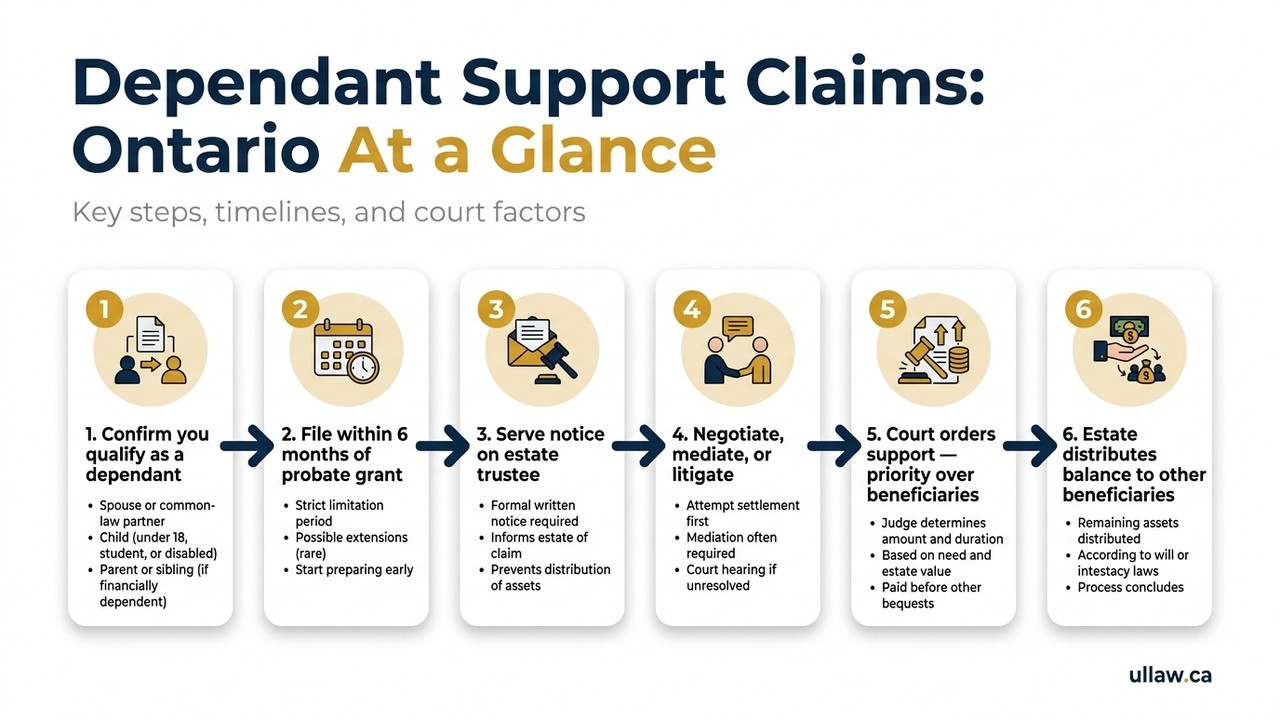
Filing a dependant support claim involves court proceedings, and the process has strict timelines. Here is an overview of how it typically unfolds:
This is critical. Under the Succession Law Reform Act, a dependant support claim must generally be commenced within six months of the grant of the Certificate of Appointment of Estate Trustee (formerly called probate). This is a hard deadline. Courts can grant an extension in exceptional circumstances, but you should never rely on that. Contact a lawyer as soon as possible.
Before filing, your lawyer will help you document:
A dependant support claimant must give notice to the estate trustee and, in many cases, to beneficiaries of the estate. This notifies the estate that a claim is being made and may effectively pause distributions of estate assets while the claim is pending.
Many dependant support claims settle before trial. Once the estate trustee and beneficiaries understand the strength of the claim, parties often negotiate a fair resolution. Mediation — a structured, confidential negotiation with a neutral third party — is common and frequently successful.
If settlement is not reached, the matter proceeds to the Ontario Superior Court of Justice. The court reviews evidence and argument from all parties and makes an order for support, if warranted.
Our wills and estates team can guide you through each of these steps and advise on the strength of your specific claim.
There is no fixed formula for calculating the amount of a dependant support award in Ontario. The court exercises broad discretion, guided by the goal of making adequate provision for the dependant’s proper support and maintenance.
That said, several practical considerations shape the range of outcomes:
The court may order:
In practice, lump-sum payments are common because they achieve finality and avoid the administrative complexity of ongoing payments from an estate. The amount ultimately depends on your individual circumstances, and an experienced lawyer can help you assess what a realistic range might look like in your situation.
The Succession Law Reform Act lists a range of factors the court must weigh when deciding both whether to award support and how much to award. Understanding these factors helps you assess the strength of your claim.
No single factor is decisive. The court looks at the full picture of the dependant’s need and the estate’s capacity to respond to it.

The timeline for resolving a dependant support claim in Ontario varies significantly depending on whether the matter settles or proceeds to trial.
Many claims resolve through negotiation or mediation within several months of the claim being initiated. Once the estate trustee and legal counsel have exchanged financial information and assessed the merits, a settlement offer may emerge relatively quickly — sometimes within 3 to 6 months.
Contested claims that proceed to a full court hearing can take 1 to 3 years or more, depending on the complexity of the estate, the number of parties involved, and court scheduling in your region. Ontario Superior Court of Justice wait times can be significant.
While a dependant support claim is active, estate trustees are generally advised not to distribute the estate to beneficiaries, since distributed assets may be difficult to recover if the court later makes a support order. This can create tension between the claimant and beneficiaries, and underscores the importance of moving efficiently.
Time matters in these claims, both because of the strict filing deadline and because unresolved claims can delay the entire estate administration for everyone involved.
When a court makes a dependant support order — or when the parties reach a negotiated settlement — the outcome has concrete effects on the estate.
A successful dependant support order takes priority over the gifts in the will and over the rights of residuary beneficiaries. In other words, the estate must satisfy the support order before distributing what remains to beneficiaries. This can meaningfully reduce what beneficiaries receive.
In some cases, the court may order that a specific asset — such as the matrimonial home — be transferred to the dependant rather than sold and distributed. This can be particularly important for a surviving spouse who has been living in the family home.
Where a dependant is in urgent financial need while the claim is being resolved, it is possible to seek an interim order for temporary support from the estate. This can provide critical financial relief during what can be a lengthy legal process.
The estate trustee must hold sufficient assets to satisfy any potential support order until the matter is fully resolved. This is one reason dependant support claims can significantly affect the pace of estate administration.
If you are an estate trustee (executor) and a dependant support claim has been made — or you believe one may be made — you face a careful balancing act.
Your duty is to the estate and to its beneficiaries, but you must also respond appropriately to a valid dependant support claim. You cannot simply ignore it or distribute the estate as though no claim exists.
If you distribute the estate before a dependant support claim is resolved and a court later makes a support order, you may be personally liable to the claimant for the amounts distributed. This is a serious risk that makes early legal advice essential.
In some situations, an estate trustee can seek court guidance on how to proceed — including whether to make an interim payment to a dependant while the broader claim is negotiated.
You may face pressure from beneficiaries who want their inheritance quickly, and from a claimant who urgently needs support. A skilled estates lawyer can help you navigate these competing pressures, protect yourself from personal liability, and move the estate toward resolution.
For more on the executor’s role in handling estate disputes, see our guide on executor withholding inheritance in Ontario.
No estate plan can guarantee that a dependant support claim will never be made. However, thoughtful planning can reduce both the likelihood of a claim and the disruption one might cause.
A will that explicitly addresses the needs of dependants — by providing adequate support — leaves far less room for a successful claim. Working with an estates lawyer to understand your legal obligations while you are alive is the most effective prevention.
Naming dependants as direct beneficiaries of life insurance policies or registered accounts (RRSPs, TFSAs, RRIFs) means those assets pass outside the estate and directly to the person who needs support. This can satisfy a dependant’s needs without going through the estate at all.
If you are reducing or ending financial support for a dependant (for example, because they have become financially independent), documenting that change clearly can be important evidence if a claim is later made.
Divorce, remarriage, the birth of children or grandchildren, and changes in family members’ financial situations should all prompt a review of your will and estate plan. Outdated plans are a common source of dependant support disputes.
Balancing legal obligations with the freedom to distribute your estate as you choose is genuinely complex. The wills and estates team at UL Lawyers can help you build a plan that respects both.
If you believe you may have a dependant support claim — or if you are an estate trustee managing one — early legal advice can protect your rights and significantly affect the outcome. Contact UL Lawyers for a free, confidential consultation. Our Burlington-based wills and estates team serves clients throughout the GTA and all of Ontario, and we are ready to listen.
Frequently Asked Questions
Common questions about wills & estates in Ontario.
A dependant support claim is a court application under Ontario's Succession Law Reform Act that allows certain family members who financially depended on a deceased person to ask a judge to order the estate to pay them adequate support. The claim can succeed even if the will gives the dependant nothing, or where there is no will at all. It is not a challenge to the validity of the will — it is a separate legal right grounded in the principle that a person's duty to support their dependants survives their death and follows their estate.
A child's dependant support claim against an estate is based on the state of dependency at the time of the deceased's death, not on historical arrears. However, if there were unpaid child support arrears under a court order or separation agreement at the time of death, those arrears form a debt of the estate and must be paid before the estate is distributed. For a forward-looking dependant support claim, the six-month limitation period from the grant of probate applies. Always consult a lawyer promptly so you do not miss any deadlines.
When a person dies without a will (intestate) in Ontario, their estate is distributed according to the Succession Law Reform Act's intestacy rules. Generally, a surviving married spouse receives the first portion of the estate (the "preferential share"), and the remainder is divided between the spouse and children. If there is no spouse or children, the estate passes to parents, then siblings, then more distant relatives. Common-law partners do not inherit automatically under intestacy rules — a major reason why dependant support claims are particularly important for common-law partners who have no will protection.
Yes — a common-law partner can qualify as a "spouse" for the purposes of a dependant support claim under the Succession Law Reform Act, provided they lived with the deceased in a conjugal relationship continuously for at least three years, or in a relationship of some permanence if they are the parent of a child together with the deceased. This is important because common-law partners have no automatic right to inherit under Ontario's intestacy rules — a dependant support claim may be their primary legal avenue to obtain support from the estate.
Yes, adult children can make a dependant support claim, but they face a higher bar than minor children. An adult child must demonstrate genuine financial dependency on the deceased at the time of death — for example, because of a disability, a chronic health condition, or a sustained pattern of financial support the deceased provided. An adult child who is fully financially independent will generally not succeed. The claim is about meeting real support needs, not about receiving a share of the estate simply because of the family relationship.
A successful dependant support order takes priority over the gifts in the will. The estate must satisfy the support order before distributing assets to beneficiaries. This can reduce or, in smaller estates, eliminate what beneficiaries receive. However, courts balance the dependant's genuine needs against the legitimate interests of beneficiaries — the goal is adequate provision for the dependant, not to override the will entirely. The Succession Law Reform Act gives courts broad discretion to craft an order that is fair to all parties given the size of the estate and the competing claims on it.
Relevant next step
If this guide affects probate, wills, or estate planning, get advice before you act on it.
Call 905-744-8888 or email info@ullaw.ca. Free consultation.
Related services
Related service
When an insurer disputes whether a loss qualifies under an accidental death policy, we review the policy wording and evidence to clarify your rights.
Review an AD&D decisionRelated service
A denied or delayed critical illness benefit can place unexpected financial strain on a family. We help clients understand their coverage and options.
Review a critical illness claimRelated service
When long-term disability benefits are denied or terminated, we examine the policy wording and medical evidence to identify a practical next step.
Review an LTD decisionWhy Us
Keep Reading
Hi, I'm Mira, the virtual assistant for UL Lawyers. Tell me what's going on in plain language — I'll help you understand your options and connect you with our 24/7 intake line when you're ready.
General information only — not legal advice.
General information, not legal advice. Messages may be saved to improve our service — please don't share sensitive personal details. Privacy.