Related service
AD&D claim review
When an insurer disputes whether a loss qualifies under an accidental death policy, we review the policy wording and evidence to clarify your rights.
Review an AD&D decision
Wills & Estates
A person named as executor, called an estate trustee in Ontario, is not automatically required to act. Renunciation is generally safest before taking substantive steps for the estate. If you have already handled assets, paid debts, signed documents, or represented yourself as executor, obtain legal advice before trying to step away.
Being named in a will can feel like an honour. It can also create immediate pressure. Family members may want access to the deceased’s home. Banks may ask for documents. Bills, taxes, insurance, business interests, and funeral arrangements may need attention while everyone is still grieving.
You are allowed to consider whether you are the right person for the role. The important issue is how you make that decision and what you do before it is resolved. Ontario distinguishes between a person who has been named as executor and a person who has accepted the office or begun to administer the estate.
This guide explains executor renunciation in Ontario, the current role of Form 74G, conduct that may complicate a renunciation, and what happens when another person must apply. It is general legal information, not advice about a particular estate. UL Lawyers’ wills and estates team can review the will, the steps already taken, and the safest route forward.
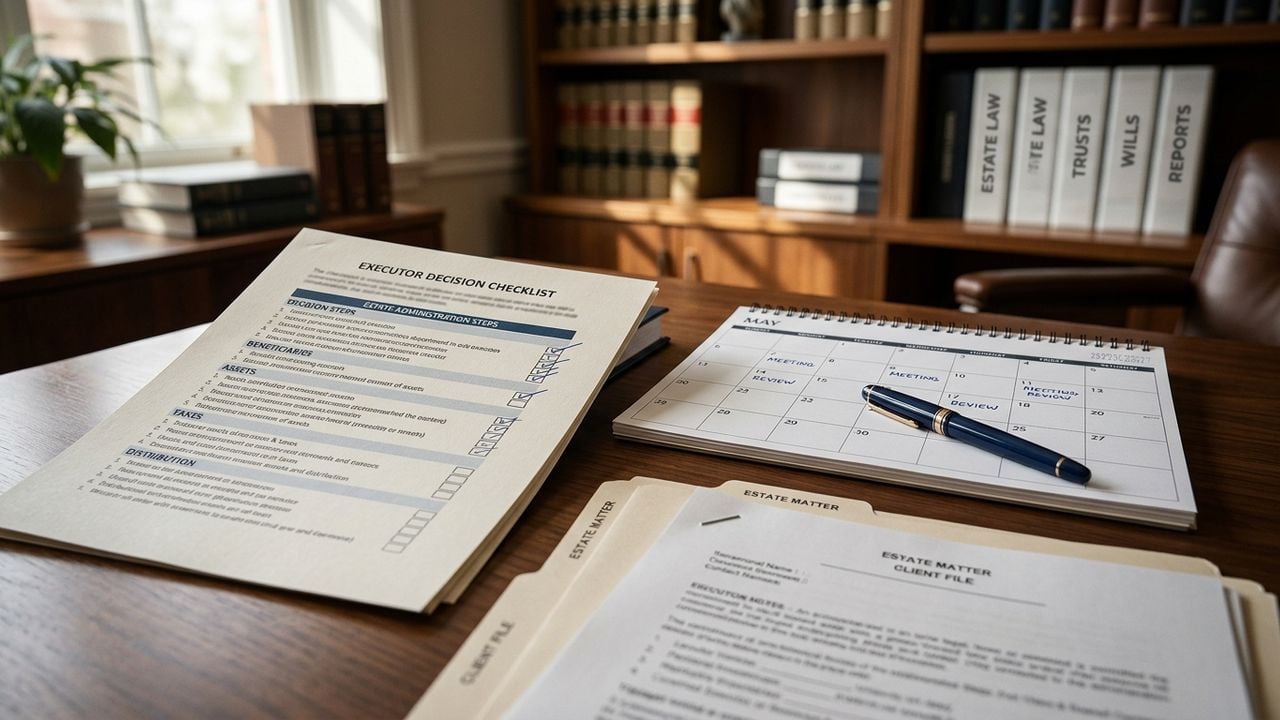
Renunciation is a formal decision not to take the office of estate trustee. Section 34 of Ontario’s Estates Act says that when a person renounces probate of a will that appointed them executor, their rights in respect of the executorship cease. The estate can then proceed as though that person had not been appointed.
That consequence is important. Renunciation is not simply telling relatives that you are too busy. The probate application should accurately show who was named, who is applying, and why another named or higher-priority person is not joining.
Ontario court materials generally use estate trustee. Wills and everyday conversations often use executor. In a will, the executor is the person chosen to administer the estate. A court certificate may confirm that person’s authority when probate is required.
The estate trustee’s work can include:
A person should not accept that responsibility by default. Time, location, health, family conflict, tax complexity, business interests, insolvency, and potential litigation can all affect whether the appointment is realistic.
A person can be both executor and beneficiary. Giving up the executor role does not automatically give up a gift in the will. A disclaimer of an inheritance is a separate legal and tax decision.
This distinction also works in the other direction. A person who does not want an inheritance does not automatically stop being executor. Each role must be addressed properly.
Ontario’s public guidance confirms that a person named as estate trustee is not required to act. In many estates, the person can formally renounce and allow a co-executor, alternate, or other eligible applicant to proceed.
Common reasons for declining include:
The reason does not need to satisfy disappointed beneficiaries. The practical question is whether the person has remained free to renounce and whether the correct probate documents are used.
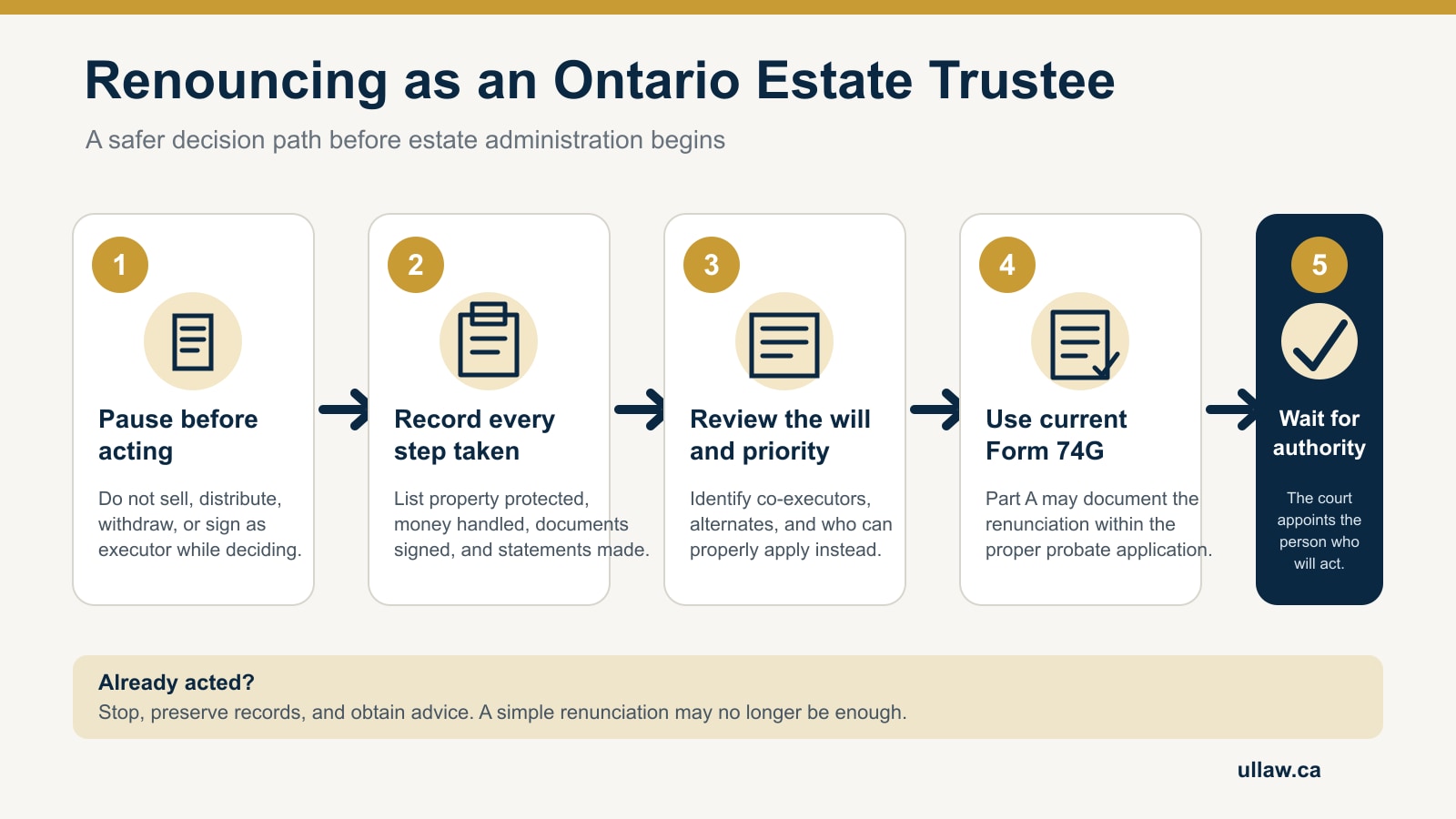
The safest time to decide is before assuming control. Lawyers often use the term intermeddling to describe conduct that may show a person has accepted the office or acted as executor.
There is no short statutory checklist that decides every case. The analysis is factual. An urgent preservation step is not necessarily the same as administering the estate, but repeated or substantive acts can make a simple renunciation inappropriate.
Obtain advice before attempting to renounce if you have:
These examples are warning signs, not automatic conclusions. Keep a complete record of what was done, when it happened, whose funds were used, and what documents were signed.
Some situations cannot wait. A door may need to be secured, an insurer notified of a death, a pet cared for, or an original will protected. The goal should be preservation, not administration.
Before moving, selling, paying for, or distributing anything substantial:
A funeral arrangement or a compassionate act does not answer every executorship question. Context matters.
Ontario’s current Form 74G is titled Renunciation and Consent. The official version is available from the Ontario Court Services estate forms page. Forms and rules can change, so use the version in force when the application is prepared.
Part A addresses renunciation by a person who is not joining the application but was named in the will or may be entitled in priority. Rule 74.04 of the Rules of Civil Procedure identifies when a renunciation must accompany an application.
The form is normally completed as part of a larger probate record. The name of the deceased, court file information, the applicant, the will, and the person’s basis for renouncing must all align with the application.
Part B addresses consent to another person’s appointment where consent is required. Consent does not itself appoint the applicant. The court still reviews the application and issues the certificate.
Older websites and precedents may refer to a separate Form 74H. Ontario combined renunciation and consent into the current Form 74G. Rely on the current court forms page rather than an archived form found through a search engine.
The exact filing steps depend on the will and the proposed applicant, but this sequence reduces avoidable risk:
Keep the original will and codicils safe. Record where they were found. Obtain the death certificate or funeral director’s proof of death needed for the estate process.
Search available court information and ask the estate lawyer whether a probate application or certificate already exists. A person cannot make a sound decision without knowing the estate’s current status.
Do not sell, distribute, withdraw, sign, or make new estate decisions while the issue is being reviewed. Prepare a dated list of every step already taken.
Read the entire will, including alternate and co-executor clauses. If no named person can act, review priority, beneficiary consent, bond, and service requirements under the Estates Act and Rule 74.
Use Form 74G Part A when it applies. Signing requirements and the rest of the probate package should be checked by the applicant’s lawyer. Court staff can explain filing mechanics but cannot give legal advice.
Retain the signed form and confirmation that it was included in the application. Tell institutions that you are not authorized to administer the estate and direct questions to the person who receives the certificate.
Renunciation does not leave beneficiaries free to administer the estate themselves. Another person must have authority under the will, statute, or court certificate.
A willing co-executor may apply without the renouncing person, subject to the will and probate requirements. If the will names an alternate, that person may apply when the prior appointment cannot or will not take effect.
The application should clearly establish the chain of appointment. The alternate should not assume that the role begins merely because the first person signed a form.
If the will has no willing and capable executor, section 29 of the Estates Act allows the court to appoint an eligible person. Depending on the facts, that may be a spouse or common-law partner, next of kin, a person requested by those entitled, a trust company, or another appropriate applicant.
The application may require consents, renunciations, service, and a bond. A disagreement about the best applicant may need a judge’s direction.
An intestate estate follows a different priority analysis. A person with a prior or equal right may need to renounce or consent before another person applies. The current Rule 74 application package should be used. A family agreement is relevant, but it is not a substitute for a certificate when a certificate is required.
The Ontario guide to applying for probate explains the basic application and service process. Our guide to probating a will in Ontario provides additional context.

Renunciation is designed for a person who has not taken the office. A person who has already acted, or who has obtained a certificate, may need a different process.
Possible steps can include:
The Trustee Act contains mechanisms for appointing new trustees in certain circumstances. Rule 74 also addresses succeeding estate trustees. Neither should be treated as a do-it-yourself exit after administration has begun.
Do not destroy records or quietly hand estate property to a relative. The outgoing and incoming trustees need a documented transition.
Beneficiaries have a legitimate interest in timely administration, but they do not gain authority because the named executor declines.
They may need to:
Minors and incapable beneficiaries can create additional notice requirements involving the Office of the Children’s Lawyer or the Public Guardian and Trustee. A bond may also be required depending on who applies and where they live.
If the concern is not renunciation but delay or misconduct by someone who is already acting, the remedy may involve an accounting, court directions, or replacement rather than Form 74G. See our guides on executor personal liability and executor withholding an inheritance.
A proper renunciation generally prevents the person from becoming the estate trustee merely because they were named. It does not erase independent liability or misconduct that occurred before the renunciation.
The estate itself still has obligations. Valid debts, taxes, funeral expenses, administration costs, and beneficiary rights do not disappear. The person who is ultimately appointed must collect and protect assets, address creditors, file tax returns, pay Estate Administration Tax where applicable, maintain accounts, and distribute properly.
There is no universal deadline that says every executor must renounce within a fixed number of days. Delay can still cause serious problems:
Once a certificate is issued, Ontario generally requires the Estate Information Return within 180 calendar days. That is an obligation of the appointed estate trustee, not a general renunciation deadline.
Get prompt advice before signing a renunciation if:
Renunciation can be straightforward when it is considered early and documented correctly. It can be much harder after authority, property, and family expectations have become mixed together. Choosing not to act is not abandoning the family or the estate. A timely, properly documented decision can prevent delay, confusion, and personal risk. It also gives the person who will actually administer the estate a clearer application record and a better opportunity to protect assets from the beginning. The practical objective is not simply to sign a form. It is to create an orderly transition from the person named in the will to the person who will have lawful authority.
UL Lawyers assists executors, proposed estate trustees, and beneficiaries across Ontario with probate, renunciation, estate administration, accounts, and contested appointments. If you need to decide whether to act or determine who can apply instead, contact UL Lawyers before substantive estate steps are taken.
Frequently Asked Questions
Common questions about renouncing as executor in Ontario.
Usually, yes. Being named in a will does not normally force a person to administer the estate. Renunciation is generally most straightforward before the person has accepted the office or taken substantive estate-administration steps.
The current Ontario Form 74G is called Renunciation and Consent. Part A addresses renunciation by a person named or entitled in priority who is not joining the application. Part B addresses consent to another person's appointment where consent is required. Always use the current court form and instructions.
Possibly, but a simple pre-appointment renunciation may no longer be enough. Collecting assets, paying debts, signing as executor, selling property, or making distribution decisions can create legal and accounting issues. Obtain advice before taking another step.
No. Renunciation concerns the office of estate trustee. A beneficiary who also renounces as executor does not automatically disclaim a gift under the will. Giving up an inheritance is a separate decision with different legal and tax consequences.
The will may name an alternate. If no named person can act, another eligible person may apply under Ontario's probate rules and priority provisions. Consents, renunciations, a bond, service on beneficiaries, or a court decision may be required.
There is no single universal renunciation deadline that applies to every estate. Delay is still risky because estate, tax, court, creditor, and limitation deadlines continue to run, and conduct during the delay may affect whether a simple renunciation remains available.
Relevant next step
If this guide affects probate, wills, or estate planning, get advice before you act on it.
Call 905-744-8888 or email info@ullaw.ca. Free consultation.
Related services
Related service
When an insurer disputes whether a loss qualifies under an accidental death policy, we review the policy wording and evidence to clarify your rights.
Review an AD&D decisionRelated service
A denied or delayed critical illness benefit can place unexpected financial strain on a family. We help clients understand their coverage and options.
Review a critical illness claimRelated service
When long-term disability benefits are denied or terminated, we examine the policy wording and medical evidence to identify a practical next step.
Review an LTD decisionWhy Us
Keep Reading
Hi, I'm Mira, the virtual assistant for UL Lawyers. Tell me what's going on in plain language — I'll help you understand your options and connect you with our 24/7 intake line when you're ready.
General information only — not legal advice.
General information, not legal advice. Messages may be saved to improve our service — please don't share sensitive personal details. Privacy.