Legal Guidance
Canada Open Work Permit Extension Guide
If your open work permit is about to expire, you’re probably feeling the pressure to figure out your next steps. Extending your permit is the key to continuing to live and work legally in Canada, and with so many permits set to expire across Ontario, getting ahead of the game is more important than ever.
Think of it this way: a successful extension isn’t just about filling out forms; it’s about securing your future here.
Understanding Your Open Work Permit Extension

If your permit’s expiry date is creeping up, you are definitely not alone. Canada is heading into a period where a massive number of temporary residents will be in the same boat. The best thing you can do for yourself is to understand the process inside and out and start preparing well in advance. This will save you a world of stress and help ensure you can keep building your life in Canada without any interruptions.
The beauty of an open work permit is its flexibility—it’s not tied to one specific job or employer, giving you the freedom to switch roles or explore different career paths. But with that freedom comes the responsibility of managing your immigration status proactively. Extending your permit isn’t an automatic renewal; you have to submit a formal, detailed application to Immigration, Refugees and Citizenship Canada (IRCC).
The Current Immigration Landscape in Ontario
Ontario, particularly the Greater Toronto Area (GTA), is a magnet for temporary residents, which means the region is ground zero for a major immigration event. In 2025, Canada is bracing for over 500,000 work permits to expire, and Ontario alone is home to more than 300,000 of those.
This sheer volume is going to put a huge strain on the immigration system and, frankly, on every single person applying.
With so many applications flooding the system, there’s little room for error. A simple mistake or a missing document could easily lead to frustrating delays or, even worse, a refusal. This is why it’s so critical to get the fundamentals right from the start. If you’re still getting your bearings, it’s a good idea to review the different Canadian work visa types to understand the full context.
Key Factors for a Successful Application
Before you dive into the paperwork, it’s crucial to understand what IRCC officers are looking for. Focusing on these core components will dramatically increase your chances of a smooth approval.
Here’s a breakdown of the most critical elements for your application.
Key Factors for a Successful Open Work Permit Extension
| Factor | Why It’s Important | Action Required |
|---|---|---|
| Valid Status | You must apply before your current permit expires to maintain your legal right to work under what’s called “maintained status.” | Find your permit’s expiry date now and set a calendar reminder to apply at least 90-120 days beforehand. |
| Eligibility Pathway | You can’t just apply without a reason. You need to qualify under a specific stream (e.g., spouse of a skilled worker, PGWP holder). | Identify your exact eligibility category and start gathering the specific documents required for that particular stream. |
| Proof of Funds | This shows the officer you can support yourself and your family financially without needing public assistance. | Get recent bank statements or an official letter from your bank that clearly shows you have sufficient funds available. |
| Accurate Forms | Submitting an old or incorrectly completed form is one of the most common and easily avoidable reasons for rejection. | Always download the latest forms directly from the official IRCC website right before you start filling them out. |
Paying attention to these details signals to the immigration officer that you’re a serious and organized applicant, making their job of approving your file much easier.
A well-prepared application does more than just meet the minimum requirements; it tells a clear and convincing story. Your goal is to make it as easy as possible for the immigration officer to approve your request by presenting a complete and organized package.
Confirming Your Extension Eligibility
Before you even think about filling out forms or gathering documents, the very first thing you need to do is figure out if you actually qualify for an open work permit extension. This isn’t a simple yes-or-no question; your eligibility is tied to very specific situations laid out by Immigration, Refugees and Citizenship Canada (IRCC). Getting this part wrong is the fastest way to a refusal, so let’s break down the main paths available.
Think of it like this: just wanting to stay and work in Canada isn’t enough. You have to fit squarely into a category that the government recognizes. For most people, this means qualifying because of a relationship to another permit holder, being a recent graduate under a special policy, or having a provincial nomination.
Common Eligibility Pathways
The most common scenarios we see day-to-day involve spouses or common-law partners of skilled workers or international students. But the rules for each are different, and they’ve changed quite a bit recently. Another large group are Post-Graduation Work Permit (PGWP) holders, who sometimes get a chance to extend their stay, but only under very specific conditions.
Here’s how this looks in practice:
- Spouse or Common-Law Partner of a Skilled Worker: If your partner has a work permit for a skilled job—that’s anything in TEER 0, 1, 2, or 3—and they’re working in Canada, you’re very likely eligible for an open work permit extension.
- Spouse or Common-Law Partner of an International Student: This has become much stricter. Your eligibility now hinges on your partner’s programme. They must be enrolled full-time in a master’s or doctoral degree programme at a university or polytechnic, or in one of a few specific professional degree programmes.
- Post-Graduation Work Permit (PGWP) Holders: As a rule, a PGWP is a one-time deal and can’t be extended. That said, IRCC does occasionally create public policies that let certain PGWP holders apply for another open work permit, usually to fill urgent labour shortages.
- Provincial Nominee Program (PNP) Applicants: If you’ve been nominated by a province like Ontario (through the OINP, for example), you can often apply for an open work permit extension while you wait for your permanent residency application to be processed.
These rules aren’t set in stone. The government often tweaks them to respond to what the economy needs. For instance, as of early 2025, the tougher rules for spouses of international students are in full effect, while policies letting provincial nominees get two-year open work permits were extended to the end of 2025. It’s crucial to know which rules apply to you right now.
Real-World Scenarios From Our Ontario Clients
Knowing the rules is one thing, but seeing how they apply to real people makes it much clearer. Let’s walk through two common situations we handle for clients all the time in the GTA and across Ontario.
Scenario A: The PGWP Holder and Skilled Worker Spouse
Maria lives in Mississauga, and her PGWP is expiring in four months. Her partner, David, works in Toronto as a software developer (TEER 1) on a valid closed work permit. Because David is employed in a skilled job, Maria is eligible to apply for a spousal open work permit. Her ability to stay and work is directly linked to his status as a skilled worker.
Scenario B: The Spouse of an International Student
Now, let’s look at Chen. His partner, Li, is studying for a college diploma in marketing in Hamilton. Under the current rules, Chen would almost certainly not be eligible for an open work permit. A college diploma doesn’t meet the new criteria of a master’s, doctoral, or professional degree programme. This small detail is what trips a lot of people up.
The most important thing to remember is that your eligibility often has nothing to do with your own qualifications. It’s usually tied to the status, occupation, or study programme of your partner or spouse in Canada. Always confirm their details are up to snuff before you start your own application.
Staying Updated on Policy Changes
Immigration policies can, and do, change overnight. A rule that made you eligible last year might not exist today. It’s on you to make sure you’re looking at the most current information and using the latest forms directly from the IRCC website. This is especially true for any temporary public policies, which always have firm start and end dates.
If you don’t meet the eligibility criteria, a refusal is guaranteed. Before you spend your time and money on an application, triple-check that your situation fits perfectly into one of the official pathways. If you’re not 100% sure, it’s always best to get a clear answer first. For more information, you can check our firm’s frequently asked questions about Canadian immigration. A little bit of homework now can save you a lot of headache later.
Building Your Application Package
So, you’ve confirmed you’re eligible to extend your open work permit. That’s the first hurdle cleared. Now comes the critical part: putting together an application package that’s impossible for an officer at Immigration, Refugees and Citizenship Canada (IRCC) to fault.
This isn’t just a paper-pushing exercise. You’re building a case. The goal is to present your situation so clearly and completely that the officer has no questions left to ask. A meticulously organized application is your best shot at avoiding frustrating delays or, worse, a refusal.
Every form needs to be the latest version, every detail consistent, and every claim you make backed by solid proof. Think of it this way: you’re telling a story about why you should be allowed to keep working in Canada, and your documents are the evidence.
Getting the Core Documents Right
No matter which open work permit stream you’re applying under, a handful of documents form the bedrock of your application. These are the absolute non-negotiables, and getting them perfect is the first, most important step.
You’d be surprised how many applications get tripped up by simple, avoidable mistakes. We’ve seen people from all over Ontario accidentally upload an old form they had saved on their computer or submit a blurry, unreadable scan of their passport. IRCC is incredibly strict about this stuff. A poor-quality document will almost certainly get your application sent back, forcing you to start all over again.
Here’s a quick visual of how the whole process flows.
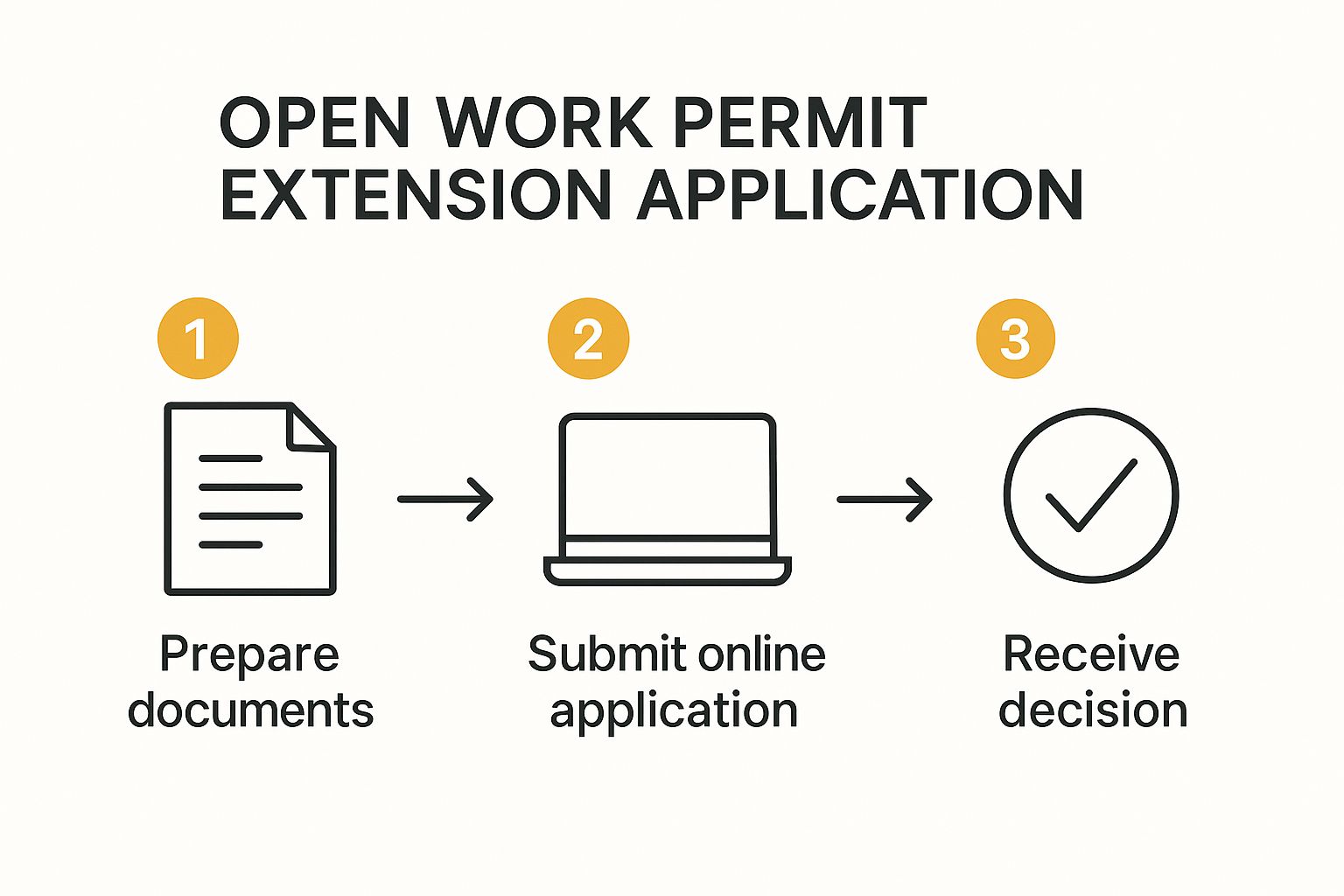
As you can see, solid preparation is the foundation. It’s the work you do before you even log into the IRCC portal that makes all the difference.
When you start your online application, the IRCC portal will generate a personalized document checklist for you. Still, almost every open work permit extension will require these fundamentals:
- Application Form (IMM 5710): This is the main form, officially titled “Application to Change Conditions, Extend my Stay or Remain in Canada as a Worker.” Fill it out on your computer, hit the ‘Validate’ button to generate the barcode page, and save the final version.
- Passport: You’ll need crystal-clear copies of your passport’s main biodata page (the one with your photo) and every single page that has a stamp, visa, or marking. Critically, make sure your passport is valid long enough to cover the extension you’re asking for.
- Digital Photo: IRCC’s photo specifications are no joke. It must be a recent photo (taken in the last 6 months), set against a plain white background, and meet very specific digital dimensions and file size limits.
- Proof of Current Status: This is simply a copy of the document that shows you’re legally in Canada right now—your current work permit, study permit, or visitor record.
For a deeper dive, our guide on general work permit application requirements offers more context on what immigration officers are trained to look for in these documents.
Essential vs. Situational Documents Checklist
Putting together your document package requires knowing what everyone needs versus what you specifically need. I’ve created this table to help you distinguish between the two. It breaks down the universal documents from those tied to specific eligibility streams, like spousal permits or post-nomination permits.
| Document Type | Required For | Key Details to Check |
|---|---|---|
| IMM 5710 Form | All Applicants | Must be the latest version from the IRCC site and validated (barcodes generated). |
| Valid Passport | All Applicants | Scans must be clear. Expiry date must be well after your requested permit end date. |
| Digital Photo | All Applicants | Must be taken within the last 6 months and meet IRCC’s strict size/background specs. |
| Proof of Current Status | All Applicants | A clean copy of your current work permit, study permit, or visitor record. |
| Proof of Relationship | Spousal/Common-Law | Marriage certificate is not enough. Add joint bank statements, leases, photos. |
| Spouse’s Status & Job | Spousal/Common-Law | Copy of spouse’s permit, plus their job letter and recent pay stubs. |
| Provincial Nomination | PNP Applicants | Both the official Nomination Certificate and the Letter of Support for the work permit. |
| Proof of Medical Exam | Situational | Required if you’ve lived in a designated country or will work in a specific field (e.g., healthcare). |
Remember, this checklist is a guide. Your personal checklist generated on the IRCC portal is the ultimate authority for your specific application. Double-check it before you submit.
Proving Your Case with Supporting Documents
Once you have the basics covered, the supporting documents are what seal the deal. This is where you prove you actually meet the criteria for the permit you’re asking for, and it’s where applications can look vastly different from one another.
If you’re applying as the spouse of a skilled worker, for example, your application is just as much about proving your partner’s status and employment as it is about you.
Your application isn’t just a collection of forms; it’s a narrative. The documents you provide must tell a consistent and believable story that aligns perfectly with the eligibility criteria for the stream you are applying under.
Here’s how to get those crucial situational documents right.
For Spousal Open Work Permit Extensions
- Proof of Relationship: Don’t just rely on your marriage certificate. You need to show a genuine, ongoing relationship. Think: joint rental agreements, shared utility bills, bank statements from a joint account, and photos of you together over time.
- Spouse’s Status in Canada: Include a clear copy of their work permit, study permit, or if applicable, their PR card.
- Spouse’s Employment Proof: This is the big one. You’ll need a recent employment letter from their company that details their job title, duties, and salary (confirming it’s a skilled job in TEER 0, 1, 2, or 3), along with their last few pay stubs. If you have their T4, include that too.
For Provincial Nominee Program (PNP) Applicants
- Letter of Support: This is the golden ticket. You must include the official letter of support for a work permit that was issued by the province that nominated you (like the one from the Ontario Immigrant Nominee Program). Without this letter, you aren’t eligible under this stream.
- Nomination Certificate: Alongside the support letter, provide a copy of your official certificate of nomination from the province.
Taking the time to assemble your package meticulously is the single most important thing you can do to ensure your open work permit extension is approved without a hitch.
Navigating the Application Submission

You’ve gathered every last document, checked them twice, and now it’s time for the final push: submitting your application through the IRCC online portal. This is where all your hard work comes together, turning that neat pile of PDFs into an official request to extend your stay and work in Canada.
The portal itself is relatively straightforward, but I’ve seen my share of clients get tripped up by technical quirks. The best advice I can give is to move slowly and deliberately. Double-check that every document is uploaded to the right category and that all the information you type in matches your forms perfectly. A little patience here can save you from a major headache—and a potential delay—down the road.
Once you log into your IRCC Secure Account, the system will walk you through some questions to generate a personalized document checklist. This is a great final check to ensure you haven’t missed anything. Upload each file, keeping an eye on the required file sizes and formats, and then you’ll be directed to pay the fees.
The Power of Maintained Status
After you’ve paid and hit that final “submit” button, you’ll get an instant confirmation from IRCC. Do not lose this document. If you submitted your application before your current work permit expired, you have now automatically entered what’s legally known as maintained status (which you might have heard of by its old name, implied status).
Maintained status is your legal lifeline. It allows you to continue working in Canada under the exact same conditions as your previous permit while you wait for a decision. Think of your submission confirmation and payment receipt as your proof. Keep them safe.
This status is a crucial protection that kicks in automatically as long as you applied on time. It means you don’t have to stop working, and you don’t have to stress about your legal status in Canada while your application is processing. For our clients across the GTA and Ontario, this provides enormous peace of mind.
Understanding the Wait and What Comes Next
With your application submitted, the waiting game begins. How long will it take? Honestly, it varies wildly depending on how busy IRCC is and the specifics of your file. While it’s tempting to refresh the official processing time tool every day, a better use of your energy is making sure you’re prepared for any communication from IRCC.
For a realistic look at current timelines, you can check out our guide on Canadian immigration processing times.
Canada has seen a huge influx of temporary residents lately. The number of people here on work permits alone grew by over 262,000 between January 2024 and June 2025. This puts incredible strain on the system, which is why a clean, complete, and error-free application is your single best strategy to avoid unnecessary delays.
While you wait, IRCC might reach out for a couple of common reasons:
- A Biometrics Request: If it’s been more than 10 years since you last gave biometrics (fingerprints and a photo) for a temporary resident application, you’ll get a Biometric Instruction Letter (BIL). You need to book an appointment at a Service Canada location and get this done promptly.
- A Request for More Documents: Sometimes, an officer just needs a little more information. It could be a more recent pay stub from your spouse or a clearer scan of a passport page. Whatever it is, respond as quickly and thoroughly as you can.
Getting one of these requests is a normal part of the process, not a sign of trouble. The key is to keep a close eye on your IRCC account and the email you registered with. A fast, complete response shows the officer you’re on top of things and helps keep your application moving toward approval.
Common Mistakes and Pro Tips for Success
Getting an open work permit extension often comes down to avoiding the small, unforced errors that can unfortunately sink an otherwise solid application. From my experience helping clients, I’ve seen how easily simple mistakes can lead to major delays or even refusals.
The thing is, many people underestimate just how precise Immigration, Refugees and Citizenship Canada (IRCC) expects you to be. A slightly blurry scan of your passport or misreading a single eligibility question on the IMM 5710 form isn’t just a minor oversight. To an officer, it can be grounds to return your file, forcing you to start all over while your status hangs in the balance.
By knowing what these issues are ahead of time, you can build a much stronger case and give yourself the best shot at a quick, positive outcome. Let’s walk through the most common missteps I see and some insider tips to make your application stand out.
Dodging Common Application Pitfalls
The most frustrating part of this process is that the biggest issues are often the most avoidable. If you know what to look for, you can sidestep weeks or even months of unnecessary stress.
Here are the top three mistakes I see time and time again:
- Poor-Quality Document Scans: A pixelated passport page or a fuzzy bank statement is an immediate red flag for an IRCC officer. Every single document needs to be a high-resolution, colour scan that’s perfectly clear and easy to read. No exceptions.
- Misinterpreting Eligibility Questions: The application forms use very specific legal language. For instance, when a form asks about previous visa refusals, it means for any country, not just Canada. Answering incorrectly, even by accident, can be flagged as misrepresentation, which is a serious problem.
- Not Explaining Gaps or Inconsistencies: Do you have a period of unemployment on your record? Does your spouse’s job title not perfectly match their official duties? You have to address these things head-on. Just ignoring them and hoping the officer won’t notice is a gamble that rarely pays off.
The goal is simple: leave no room for doubt. Your application should be so clear, complete, and well-supported that the officer’s only logical conclusion is to approve it. Don’t make them work to connect the dots for you.
Pro Tips for a Stronger Application
Avoiding mistakes is half the battle. The other half is actively making your application stronger. These tips are all about presenting your case in the best possible light and showing the officer that you’re a diligent and credible applicant.
Something as simple as a compelling letter of explanation or timing your submission just right can make all the difference.
Master the Letter of Explanation
Think of the Letter of Explanation (LOE) as your one chance to speak directly to the immigration officer reviewing your file. It’s not always a mandatory document, but in my opinion, it’s almost always a good idea to include one. Use it to get ahead of any potential questions or weaknesses in your application.
For example, an LOE is the perfect place to:
- Clarify Employment Gaps: Briefly explain any time you were between jobs.
- Detail Your Proof of Funds: If you have a recent large deposit in your bank account, explain where it came from (e.g., personal savings, a gift from family).
- Strengthen Relationship Evidence: For spousal applications, this is where you can tell the story of your relationship, adding a personal touch that complements the official documents.
Time Your Submission Strategically
Technically, you can apply right up to the last day your permit is valid, but I can’t stress enough what a high-risk move that is. I always advise clients to submit their open work permit extension application at least 90 to 120 days before their current status is set to expire.
This buffer is your safety net. It protects you from last-minute problems, like an outage on the IRCC portal or a sudden request for an extra document from your spouse’s employer. Filing early secures your maintained status and dramatically reduces the stress of waiting for a decision.
If your situation feels a bit complicated, it never hurts to get a professional opinion. You can find more information on how to get an immigration lawyer near me free consultation to have an expert assess your case.
Your Open Work Permit Extension Questions Answered
Once you’ve submitted your application, the waiting game begins. It’s totally normal to have a bunch of “what-if” questions pop into your head during this time. Drawing from our experience helping clients from Burlington right across the GTA and Ontario, we’ve put together some straightforward answers to the questions we hear most often.
These are the practical, real-world concerns that official guides don’t always cover but are crucial for your peace of mind.
Can I Keep Working After My Permit Expires?
Yes, you absolutely can, and this is one of the most important things to understand. As long as you submitted your open work permit extension application before your current one expired, you are legally on what’s called maintained status.
This special status means you can keep working under the very same conditions of your original permit until Immigration, Refugees and Citizenship Canada (IRCC) makes a decision on your extension. Think of it as a bridge that keeps you legally employed.
Pro Tip: Your application submission confirmation and payment receipt are your proof of maintained status. Save these documents somewhere safe and keep a digital copy handy. A new employer might ask to see them.
What Happens If My Extension Is Refused?
Getting a refusal is tough news, and it’s critical to handle it correctly. The moment you receive a refusal from IRCC, your maintained status ends, and you must stop working immediately.
The refusal letter will explain why the decision was made. Your next step is likely to apply for a restoration of status, which you must do within 90 days of the refusal. The catch? You can’t work while waiting for a decision on a restoration application.
This is a tricky situation. It’s really best to get professional legal advice right away to go over the officer’s notes and figure out the smartest way forward.
How Long Does Processing Take?
Processing times are a moving target. They can change a lot depending on how many applications IRCC is dealing with at any given time. You can always check the latest estimates on the official IRCC website, but treat them as just that—estimates, not promises.
Honestly, the best thing you can do to speed things up is to get it right the first time. A clean, complete, and perfectly organized application is your best defence against unnecessary delays. We always tell our clients in Ontario to apply at least three to four months before their current permit expires. It just gives you that extra breathing room in case things get backed up.
Navigating the ins and outs of an open work permit extension can feel overwhelming, but you’re not on your own. The team at UL Lawyers, based in Burlington and serving clients across the GTA and Ontario, is here to offer the expert guidance you need to build a strong application. For a personalized look at your case, visit us at https://ullaw.ca to book your consultation.
Relevant next step
Talk to an immigration lawyer
If this guide affects your application, status, or permit, get advice before you submit or renew anything.
View immigration law servicesGET STARTED WITH A FREE CONSULTATION
Why Us
Why Choose UL Lawyers
- Decades of combined experience
- Millions recovered for our clients
- No fee unless we win your case
- 24/7 client support
- Personalized legal strategies
Keep Reading