
Developing a disability — whether physical, mental, or chronic — is stressful enough on its own. Finding out that your employer refuses to adjust your duties, your schedule, or your workspace can make an already difficult situation feel impossible. In Ontario, that refusal is not just unfair. It is often illegal.
The Ontario Human Rights Code places a firm legal duty on employers to accommodate employees with disabilities, up to the point of undue hardship. That duty exists alongside obligations under the Accessibility for Ontarians with Disabilities Act (AODA). When an employer ignores those obligations, the consequences can be significant — for the employer. Compensation orders, lost-wages awards, and damages for injury to dignity are all tools the Human Rights Tribunal of Ontario can deploy.
This article explains what the law requires, what can go wrong for employers who skip the accommodation process, and what options may be available to you if you believe your employer has fallen short. If you need legal advice specific to your situation, our employment law team is ready to help.
Table of Contents
- What Are the Consequences of a Failure to Accommodate a Disability in Ontario?
- What Legal Liability Does an Employer Face for Failing to Accommodate?
- What Remedies Are Available for Accommodation Failures?
- Can I Claim Damages for Lack of Accommodation?
- How a Failure to Accommodate Can Lead to a Constructive Dismissal Claim
- What Is the Employer’s Duty to Accommodate Under the Human Rights Code?
- Can a Disability Frustrate an Employment Contract — and What Does That Mean for Accommodation?
What Are the Consequences of a Failure to Accommodate a Disability in Ontario?
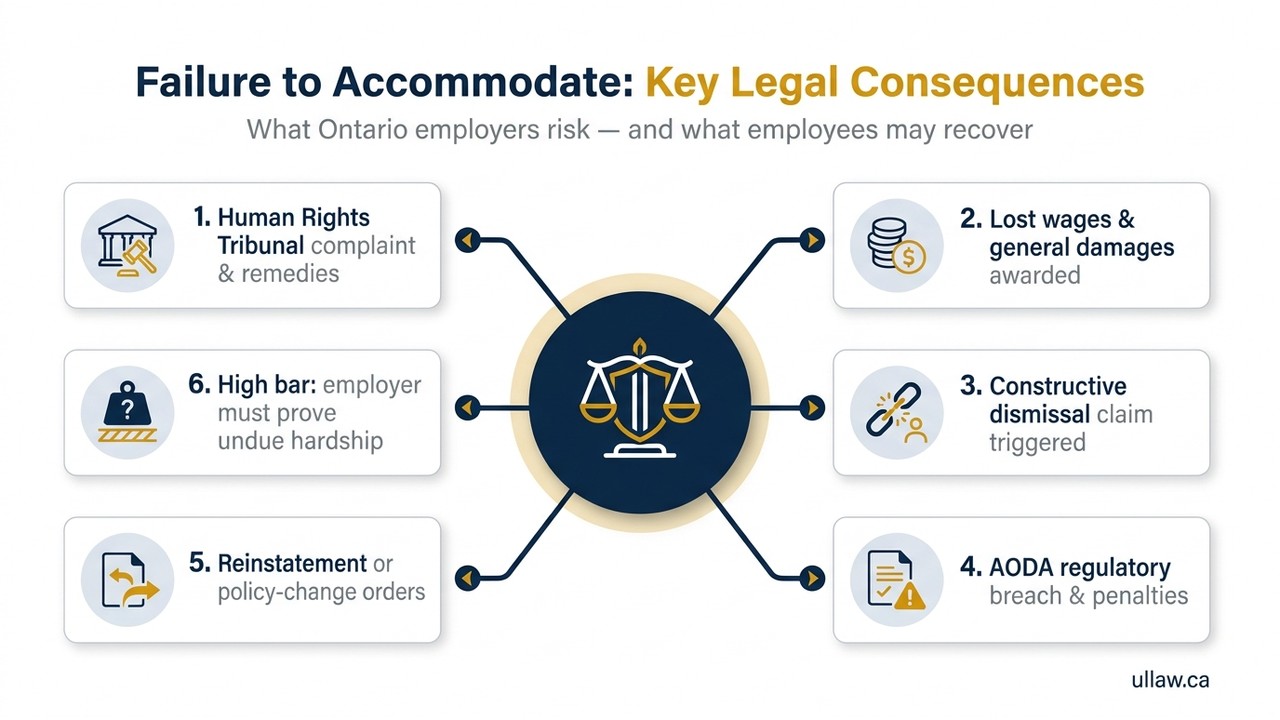
When an Ontario employer fails to accommodate an employee’s disability, it risks being found to have engaged in discrimination on the basis of disability under the Ontario Human Rights Code. That finding carries real consequences — not theoretical ones.
The Human Rights Tribunal of Ontario (HRTO) has broad remedial powers. It can order an employer to:
- Pay monetary compensation — covering lost wages, lost benefits, and future income losses;
- Award general damages for injury to dignity, feelings, and self-respect;
- Issue public interest remedies, such as requiring the employer to implement an accommodation policy or provide staff training;
- Reinstate the employee to their position, or a comparable one, in appropriate cases.
Beyond the Tribunal, an employee whose employment ends because proper accommodation was never offered may also have claims in the civil courts — most notably a constructive dismissal claim. We explore that below.
Employers who are found to have violated the Code also face reputational damage, potential regulatory scrutiny under the AODA, and the significant cost and disruption of defending proceedings.
Perhaps most importantly: employers who bypass accommodation entirely — moving straight to discipline or termination without exploring options — are in a particularly vulnerable position. The duty to accommodate is a process, and skipping it is difficult to justify after the fact.
What Legal Liability Does an Employer Face for Failing to Accommodate?
Ontario law imposes two overlapping sets of obligations on employers dealing with an employee who has a disability.
1. The Ontario Human Rights Code
The Ontario Human Rights Code prohibits discrimination in employment on the basis of disability. Disability is defined broadly — it includes physical conditions, mental health diagnoses, chronic illness, and perceived disability. The Code’s duty to accommodate requires employers to take meaningful, documented steps to adjust working conditions so an employee with a disability can continue to participate in the workplace.
The ceiling on that duty is undue hardship — a high standard that considers cost, health, safety, and outside sources of funding. Minor inconvenience, modest expense, or the need to reorganize tasks does not constitute undue hardship.
2. The Accessibility for Ontarians with Disabilities Act (AODA)
The AODA sets specific accessibility standards for Ontario employers, including requirements around employment practices such as return-to-work processes and individualized accommodation plans. Failing to follow these standards is a regulatory offence in its own right, separate from a human rights complaint.
The Risk of Skipping the Process
A key point: liability often flows not from the disability itself but from how the employer responded to it. An employer who conducts a good-faith accommodation process — gathering medical information, exploring options, documenting decisions — is in a much stronger position than one who simply terminates or disciplines without investigation.
A Human Rights Tribunal decision we have written up illustrates this clearly. In a case where the employer terminated an employee with physical disabilities without adequately accommodating their condition, the HRTO found disability-based discrimination and ordered remedies including compensation for lost wages and damages for injury to dignity. The decision underlines that the accommodation process is not a formality employers can skip.
What Remedies Are Available for Accommodation Failures?
If the Human Rights Tribunal of Ontario finds that an employer has failed in its duty to accommodate, the range of remedies available is substantial.
Monetary Remedies
- Lost wages and benefits — the Tribunal can award compensation for income the employee lost as a direct result of the discrimination, including wages, bonuses, and employment benefits;
- General damages for injury to dignity — these are non-economic damages that recognize the personal harm caused by being discriminated against. The Tribunal regularly awards these in cases of accommodation failure;
- Future loss — where an employee cannot return to their former role or has suffered lasting career harm, forward-looking compensation may be available.
Non-Monetary Remedies
- Reinstatement to the employee’s former position or a comparable one;
- Policy changes — the employer may be ordered to develop or revise its accommodation policy;
- Training — the Tribunal can require the employer to train managers and HR on the duty to accommodate;
- Public interest orders — in more serious cases, broader systemic remedies are possible.
Remedies Through the Civil Courts
Depending on the circumstances, an employee may also pursue claims through the Ontario courts — particularly if the accommodation failure amounted to constructive dismissal (see below) or if the employer’s conduct was egregious enough to attract aggravated or punitive damages in a wrongful dismissal action.
If your employment was terminated and accommodation was never properly offered, you may also want to review your entitlements using our severance pay calculator as a starting point.

Can I Claim Damages for Lack of Accommodation?
Yes — in many circumstances, employees who have been denied proper accommodation can pursue damages through the Human Rights Tribunal of Ontario or the civil courts, or both.
What You Need to Show
To succeed, an employee generally needs to establish:
- They have a disability within the meaning of the Ontario Human Rights Code;
- The disability was a factor in the employer’s decision — whether that was a failure to modify duties, a refusal to allow a modified schedule, a demotion, or a termination;
- The employer did not meet the duty to accommodate up to the point of undue hardship.
Once those elements are established, the burden shifts to the employer to show either that accommodation would have caused undue hardship, or that the adverse treatment was entirely unrelated to the disability.
A Note on Complexity
Not every situation results in a successful claim. The employee still needs to demonstrate a genuine connection between the disability and the treatment they received. As we explain in our case write-up, a finding of discrimination is not automatic simply because a termination occurred while an employee had a health condition — but an employer who never engaged in the accommodation process faces a difficult argument.
Damages can vary considerably depending on the severity of the discrimination, the length of time affected, and the financial and personal impact on the employee. Speaking with an employment lawyer about your specific circumstances is the most reliable way to understand what may be available to you.
How a Failure to Accommodate Can Lead to a Constructive Dismissal Claim
One of the most significant — and sometimes underappreciated — consequences of a failure to accommodate is its connection to constructive dismissal.
Constructive dismissal occurs when an employer, without the employee’s consent, makes a fundamental and unilateral change to the terms of employment. The employee has not been formally let go, but the working conditions have become so untenable that the law treats it as a dismissal.
How Accommodation Failures Trigger This
When an employer refuses to adjust duties or the work environment for an employee with a disability, the resulting situation can amount to a constructive dismissal. For example:
- Forcing an employee with a mental health condition to continue in a high-stress role with no modification;
- Removing duties, pay, or status from an employee because they need accommodation;
- Creating a hostile or unsupportive environment that makes continued employment impossible.
In these situations, an employee may be entitled to resign and sue for wrongful dismissal damages — including reasonable notice pay calculated under common law, potentially far exceeding statutory minimums under the Employment Standards Act, 2000.
The Interaction with Human Rights Claims
A constructive dismissal claim and a human rights complaint are not mutually exclusive. An employee may pursue both — a civil claim for wrongful dismissal damages and an HRTO application for human rights remedies — though there are procedural considerations about how those run together. Getting legal advice early helps you understand which route, or combination of routes, is best in your situation.
Use our severance pay calculator to get a rough sense of what reasonable notice might look like in your case.

What Is the Employer’s Duty to Accommodate Under the Human Rights Code?
The duty to accommodate is not a vague aspiration — it is a concrete legal obligation with identifiable steps. Understanding what it requires helps employees recognize when it has been breached.
What Employers Must Do
- Engage in a genuine process — The employer must actively work with the employee (and, in unionized workplaces, the union) to identify accommodation options. Doing nothing, or offering only token gestures, does not satisfy the duty.
- Request and consider medical information — Employers are entitled to ask for functional medical information: what the employee can and cannot do, and for how long. They are not entitled to a diagnosis, but they do need enough information to identify appropriate accommodation.
- Explore a range of options — The duty does not require the employer to find a perfect solution, but it does require a genuine search. That might mean modified duties, a different shift, ergonomic equipment, a phased return, or a temporary transfer.
- Document the process — Courts and the HRTO will look at what steps the employer actually took. Proper documentation is critical for both sides.
The Undue Hardship Standard
An employer only escapes the accommodation obligation when it can demonstrate undue hardship — not mere inconvenience. The Ontario Human Rights Code identifies cost, and health and safety as the relevant considerations. The standard is demanding, and employers rarely succeed in meeting it without detailed evidence.
The Law Society of Ontario maintains resources for understanding professional obligations, and the Ontario Human Rights Commission publishes detailed policy guidance on the duty to accommodate that sets out what is — and is not — acceptable employer conduct.
Can a Disability Frustrate an Employment Contract — and What Does That Mean for Accommodation?
Employers sometimes argue that a disability has frustrated the employment contract — a legal doctrine that says a contract can be discharged when an unforeseen event makes performance impossible. If frustration applies, the employer claims there is no wrongful dismissal and no severance obligation.
Ontario courts have made clear that frustration of an employment contract due to disability is an extremely high bar to clear.
In a recent decision we have written up, the Ontario Court of Appeal rejected a frustration argument in a disability-related dismissal case (2026 ONCA 577). The court confirmed that an employer cannot simply point to an employee’s current inability to perform their job and declare the contract frustrated. The employer must show there is no reasonable likelihood of return within a reasonable time — and must have fully engaged with the duty to accommodate before reaching that conclusion.
Why This Matters for Employees
- If your employer claims frustration to avoid paying you severance, that claim needs to be scrutinized carefully;
- The employer’s accommodation obligations must be exhausted first;
- Medical evidence about your prognosis is central — a temporary or uncertain condition does not easily satisfy the frustration standard;
- Even if frustration were established, it does not wipe out potential human rights remedies.
If you are facing a dismissal tied to your disability or medical leave, speaking with an employment lawyer about whether frustration was properly invoked is an important early step.
Talk to a UL Lawyers Team Member
If you believe your employer has failed to accommodate your disability — or if your job ended without any real accommodation process — you may have meaningful legal options. The team at UL Lawyers offers a free initial consultation to help you understand your rights under the Ontario Human Rights Code, the AODA, and the common law. Reach out today through our employment law practice page and let’s talk about your situation.