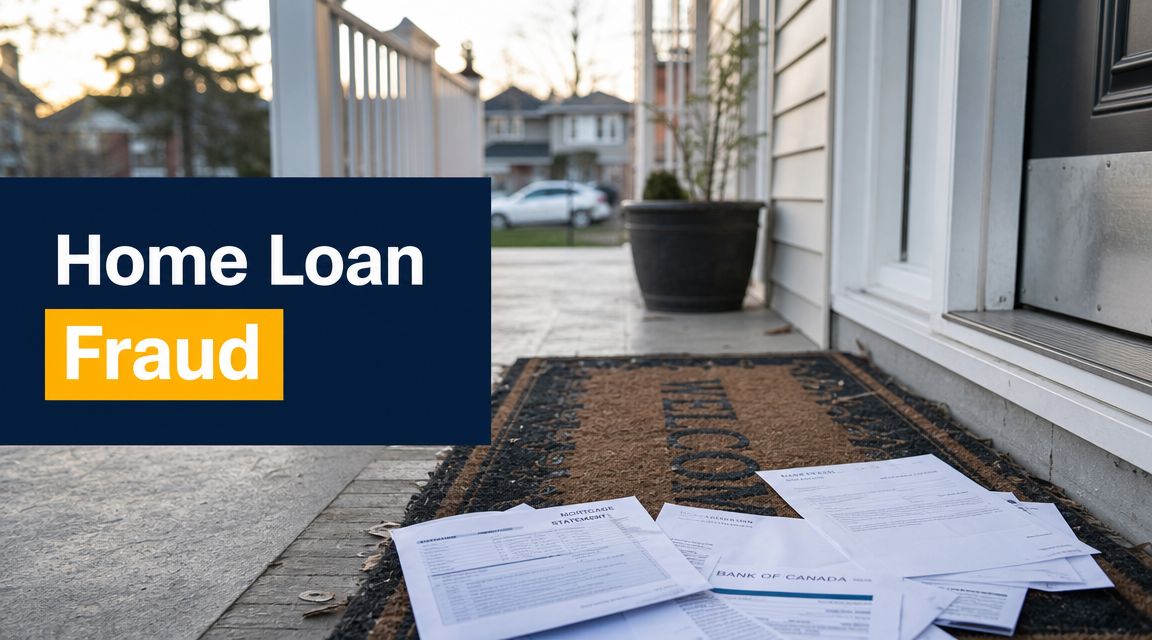
You’re opening mail after dinner in Oakville, Mississauga, Brampton, or Burlington. It looks routine. A lender statement, a title notice, maybe a collection letter that makes no sense. Then you realise someone has registered a mortgage you never agreed to, or your credit file shows a loan application you never made. That moment is disorienting for a reason. Your home is supposed to be the safest asset you own, and suddenly it doesn’t feel safe at all.
That scenario isn’t rare enough to dismiss. Equifax Canada reported a 52.3% increase in suspected mortgage fraud applications in early 2022 compared to the previous year in its Canada newsroom reporting. For Ontario homeowners and buyers, that should end any complacency. Home loan frauds are real, expensive, and often engineered to look ordinary until the damage is done.
People need straight answers. Not American advice that doesn’t match Ontario law. Not vague warnings. You need to know what home loan fraud looks like here, how to spot it early, what to do if it happens, and how Ontario’s criminal and civil systems deal with it differently.
Table of Contents
- A Danger Hiding in Plain Sight
- Understanding Home Loan Fraud in Canada
- Common Mortgage Fraud Schemes in Ontario
- Recognizing the Warning Signs of Fraud
- A Step-by-Step Guide for Victims of Fraud
- Your Legal Recourse in Ontario Criminal vs Civil Actions
- Prevention and How UL Lawyers Can Help
A Danger Hiding in Plain Sight
An Ontario family doesn’t usually learn about mortgage fraud in a dramatic movie-style reveal. They learn about it through a rejected refinance, an unexplained lender letter, a credit alert, or a lawyer telling them a charge is on title that shouldn’t be there.
That’s what makes home loan frauds so dangerous. They hide inside paperwork, rushed closings, forged identification, fake instructions, and transactions that appear legitimate at first glance. By the time the homeowner sees the problem, the fraudster may already have borrowed against the property, redirected funds, or damaged the owner’s credit.
In Ontario, the risk is especially serious because homes carry substantial equity and transactions move quickly. Criminals know that a valuable property, a busy market, and a distracted owner create opportunity. They also know that many people assume “the system” will catch every false signature or fake instruction automatically. It won’t.
Practical rule: If something about a mortgage, title document, lender notice, or closing instruction feels off, treat it as urgent immediately. Delay helps the fraudster, not you.
The hard truth is that many victims are careful people. They’re not reckless. They signed what looked like proper documents, dealt with people who sounded professional, or trusted someone who had access to their information.
The good news is that fraud leaves patterns. Once you know those patterns, you can protect yourself far better. And if you’ve already been hit, there are concrete steps you can take in Ontario to contain the damage and pursue recovery.
Understanding Home Loan Fraud in Canada

Home loan fraud is deliberate deception used to obtain a mortgage, register a charge against property, divert funds, or profit from a real estate financing transaction. The key word is deliberate. A typo on an application isn’t fraud. Knowingly submitting false income documents, impersonating an owner, or hiding the true nature of a transaction can be.
Think of it this way. A mistake is getting a number wrong and correcting it. Fraud is building a false story and asking a lender, buyer, seller, or land registration system to rely on it.
Two broad categories
In practice, most home loan frauds in Canada fall into two broad categories.
Fraud for housing usually involves someone misrepresenting income, assets, debts, employment, occupancy, or down payment sources to qualify for financing they otherwise wouldn’t get.
Fraud for profit is more organised and often more destructive. It can involve identity theft, fake buyers, false appraisals, forged transfers, title manipulation, or insiders who help move the transaction through.
Ontario is an attractive target for both. High property values across the GTA mean there’s more equity to steal and more pressure on borrowers to “make the numbers work.” That pressure creates openings for bad actors who offer shortcuts, fake fixes, and supposedly harmless document adjustments.
A lender can survive a suspicious file. A homeowner may spend years cleaning up the consequences of one.
Why intent matters in law
Ontario courts and investigators care about intent, documents, and reliance. If someone intentionally creates or uses false information to obtain a mortgage advance or interfere with ownership, that moves well beyond a sloppy application.
That distinction matters for victims too. If your name, title, or credit was used without authority, you’re not dealing with a mere administrative error. You’re dealing with conduct that can trigger police involvement, lender investigations, land title issues, insurance questions, and a possible civil claim.
The practical takeaway is simple. If a mortgage transaction depends on secrecy, speed, altered documents, or unexplained signatures, assume risk first and convenience second.
Common Mortgage Fraud Schemes in Ontario
Some frauds are simple. Many aren’t. The most damaging Ontario cases usually involve ordinary documents used in dishonest ways.
Quick Guide to Common Mortgage Frauds
| Fraud Scheme | What It Is | Key Warning Sign |
|---|---|---|
| Identity theft | Someone uses your personal information to apply for financing or impersonate you in a property transaction | You receive lender notices for accounts or applications you never made |
| Straw buyer scheme | A person lends their name or credit to front a transaction for someone else | The “buyer” has little real involvement and can’t explain the deal clearly |
| Income or asset misrepresentation | False pay stubs, bank records, job letters, or down payment details are used to secure approval | You’re told to “adjust” documents because the lender “won’t check anyway” |
| Appraisal fraud | Property value is inflated or manipulated to support a larger loan | The valuation seems disconnected from the property’s condition or actual market context |
| Equity skimming or title fraud | A fraudster targets the owner’s equity through title manipulation, unauthorised charges, or sale proceeds diversion | You discover a mortgage, transfer, or payout instruction you never authorised |
FCT states that attempted title and mortgage fraud in Ontario and BC has cost the industry over $30 million in losses over the past few years on its fraud protection information page. That matters because title fraud is not an abstract registry problem. It’s a direct attack on home equity.
Five schemes Ontarians should recognise
Identity theft often starts far from the property itself. A fraudster gets enough personal information to imitate the owner or applicant, then uses that identity to open the door to a loan, refinance, or title change. The victim often learns about it only after a lender, lawyer, or credit bureau raises a question.
Straw buyer arrangements are common where someone with better credit agrees to stand in as the borrower or buyer for somebody else. In Brampton, for example, the person on paper may say they’re buying a home for themselves while another party provides the money, controls the property, or expects to profit from the deal. That’s a legal and financial trap.
Income and asset misrepresentation is the scheme people underestimate most. A broker, adviser, or acquaintance says they can “clean up” your file with a stronger letter of employment, a polished bank statement, or a down payment story that looks better on paper. If it isn’t true, it can become fraud quickly.
Appraisal fraud pushes value beyond reality to justify financing that shouldn’t exist. Buyers, lenders, and even later purchasers can get burned because the transaction rests on a false number, not a real market valuation.
Equity skimming and title fraud hit hardest because they target people who already own a home. Someone registers against the property, diverts proceeds, or manipulates ownership records to extract value from the title itself. If you’re already dealing with arrears or a threatened sale process, confusion grows fast. That’s why it helps to understand Ontario remedies around power of sale and how legitimate enforcement differs from fraud dressed up as enforcement.
If a transaction only works when one person stays confused, it’s not a legitimate transaction.
Recognizing the Warning Signs of Fraud

Fraud usually announces itself before it fully lands. The problem is that people ignore the signs because they don’t want to slow down a purchase, refinance, or rescue plan.
Red flags during a transaction
- Pressure to sign immediately. If someone insists there’s no time to review documents, no time to ask questions, or no time to involve your own lawyer, treat that as a serious warning.
- Blank or incomplete paperwork. Never sign forms with empty fields, missing schedules, or unexplained attachments.
- Mismatched details. Different names, inconsistent addresses, odd signatures, incorrect employment information, or banking instructions that suddenly change are not minor glitches.
- Upfront fees for “guaranteed” mortgage help. Real professionals explain what they’re doing and why. Scammers push payment first and clarity later.
- Discouraging independent advice. Anyone who tells you not to call your bank, not to verify title, or not to get separate legal advice is telling on themselves.
- Unsolicited debt or loan rescue promises. Distressed borrowers are common targets. The same kind of pressure tactics show up in other consumer scams, which is why guidance on how to avoid credit repair fraud is useful reading if someone is bundling credit help with mortgage promises.
Why these signs matter
Home loan frauds often overlap with family pressure, elder abuse, or misuse of authority. A relative, caregiver, or trusted friend may present documents as “routine” and ask an owner to sign without understanding the consequences. That risk becomes sharper where someone else manages property or banking decisions. If that’s part of your situation, learn what legal authority exists under an Ontario power of attorney for property.
Slow the deal down. Honest transactions survive scrutiny.
A legitimate lender, lawyer, or broker should welcome verification. They should be able to explain every charge, every document, every signature, and every source of funds in plain language. If they can’t, step back before you step in.
A Step-by-Step Guide for Victims of Fraud

Panic is understandable. It’s also unhelpful. When you suspect mortgage or title fraud, your job is to preserve evidence, stop further movement, and get the right people involved fast.
The urgency is real. The Canadian Anti-Fraud Centre reports that Canadians lost over $554 million to various frauds reported in 2023, which is why quick reporting matters so much according to the Canadian Anti-Fraud Centre.
Act first and organise second
Don’t spend days trying to decode the whole story before acting. You can sort out the timeline later. Right now, focus on protecting your title, your credit, and your ability to prove what happened.
Five actions that matter most
-
Gather every document you can find
Pull mortgage statements, lender emails, broker messages, identification records, title documents, bank records, closing papers, and screenshots of online accounts. Save voicemails. Keep envelopes. Fraud cases often turn on document trails and timing. -
Call the lender or financial institution immediately
Tell them you suspect fraud and ask them to note the file, freeze activity where possible, and explain the current status of the mortgage, application, or payout. Be calm and direct. Ask for names, dates, reference numbers, and written confirmation of your report. -
Report it to police and the Canadian Anti-Fraud Centre
A police report creates an official record. A report to the CAFC helps document the fraud pattern and can support your broader response. If identity theft is involved, say that clearly and provide copies of supporting documents. -
Place fraud alerts and review your credit
Contact the credit bureaus and ask about fraud alerts or flags. Then read your file carefully for unfamiliar inquiries, addresses, loans, or accounts. Don’t assume there’s only one false transaction. -
Speak to a lawyer quickly
Many people lose time by delaying legal consultation. A lawyer can assess title issues, preservation steps, notice obligations, and whether a civil claim is necessary. If financial loss, forged documents, or disputed authority are involved, you may also need advice on how to file a lawsuit.
Save first, explain second. Delete nothing, sign nothing new, and don’t rely on verbal promises that the problem will “sort itself out.”
If professionals are involved, don’t confront everyone at once. A rushed accusation can alert the wrong person before records are secured. Move methodically.
Your Legal Recourse in Ontario Criminal vs Civil Actions
Victims often assume that once police are involved, the legal system will recover their money automatically. Usually, it won’t. That’s the distinction too many articles miss.

Criminal law punishes wrongdoing
The criminal process is about public wrongdoing. Police investigate. The Crown prosecutes. The court decides guilt and penalty.
Under the Criminal Code of Canada, fraud can be prosecuted as a serious offence. Section 380 can carry a maximum sentence of 14 years in prison, as set out in the Criminal Code of Canada. That matters for accountability, denunciation, and deterrence.
But criminal court is not built primarily to make you financially whole. Even if the fraudster is charged or convicted, you may still be left dealing with title repair, credit damage, lender pressure, legal fees, and lost funds.
Civil law pursues recovery
A civil case serves a different purpose. It focuses on your loss and what can be done to recover it. That may include claims against the fraudster, and in some cases claims involving others connected to the transaction, depending on the facts and legal duties involved.
Civil remedies can include tracing funds, seeking damages, challenging improper transactions, and obtaining court orders. Timing matters. Delay can make it harder to secure evidence, preserve assets, and stay within Ontario limitation periods. If you suspect a claim exists, get advice early about the statute of limitations in Canada and how it may apply to your case.
| Legal Path | Main Goal | Who Starts It | Main Outcome |
|---|---|---|---|
| Criminal case | Punish unlawful conduct | Police and Crown | Conviction, sentence, criminal penalties |
| Civil action | Recover losses or undo damage | Victim, usually through counsel | Damages, tracing, court orders, financial recovery efforts |
The point is simple. Criminal law asks whether the fraudster should be punished. Civil law asks how the victim can be compensated. If you care about getting money back or repairing the legal consequences of the fraud, the civil side often matters just as much.
Prevention and How UL Lawyers Can Help
You can’t eliminate all risk. You can reduce it sharply by refusing shortcuts and verifying the people handling your money, title, and documents.
Prevention habits that actually reduce risk
- Use your own professionals. Don’t rely on a stranger’s preferred lawyer, broker, or adviser without checking credentials and role.
- Protect your identity documents. Driver’s licence copies, banking details, tax records, and signed forms are valuable tools for fraudsters.
- Verify changes offline. If account instructions, payout details, or signing arrangements change, confirm through a known phone number.
- Read every page before signing. If a document is incomplete, stop.
- Be careful when someone offers rescue from mortgage trouble. Distress attracts scams.
- Buy title insurance where appropriate. FSRA explains that title insurance is a one-time premium, often just a few hundred dollars, that protects a homeowner’s title from fraud and other issues for as long as they own the property on its Ontario consumer information about title insurance.
If fraud has already happened, prevention advice is no longer enough. You need case-specific legal action. In that situation, firms such as UL Lawyers may assist with civil litigation strategy, document review, and recovery-focused claims where the facts support them.
Frequently Asked Questions
| Question | Answer |
|---|---|
| Is mortgage fraud only a problem for buyers? | No. Owners with substantial home equity can be targeted through title fraud, forged charges, and impersonation schemes. |
| If police are investigating, do I still need a civil lawyer? | Often yes. A criminal investigation does not automatically recover your losses or fix title and credit problems. |
| Does title insurance matter after closing? | Yes. Its value often appears after closing, when a fraud or title defect is discovered. |
| What if I signed something but didn’t understand it? | Get legal advice immediately. The effect of a signature depends on the facts, the document, the circumstances, and whether fraud or misrepresentation was involved. |
| Can delay hurt my case? | Yes. Evidence can disappear, funds can move, and limitation issues can arise if you wait too long. |
Home loan frauds thrive when people feel embarrassed, rushed, or unsure of what to do next. Don’t give the problem that advantage. If something about your mortgage, title, or refinancing doesn’t add up, act early and get Ontario legal advice based on your actual documents, not generic internet reassurance.
If you’re dealing with suspected home loan fraud in Burlington, the GTA, or anywhere in Ontario, UL Lawyers can review the documents, explain whether you’re facing a criminal issue, a civil recovery issue, or both, and help you take the next practical step quickly.