
So, you’re thinking about incorporating your business in Ontario. The process itself involves a few key steps: you’ll need to decide on a business structure, pick a unique name (and prove it’s unique with a NUANS search), file your Articles of Incorporation, and then set up a corporate minute book.
Searching for an LLC in Canada? There isn’t one. Ontario uses a corporation (Ltd or Inc) for limited liability. Read what an LLC is in Canada, then call 905-744-8888 or email info@ullaw.ca before you file.
Going through these motions officially turns your business into a separate legal entity, which unlocks some major perks like limited liability and potential tax breaks.
Is Incorporating Your Ontario Business the Right Move?

Deciding to incorporate is a huge milestone for any Ontario entrepreneur. It’s more than just paperwork; it’s a fundamental shift in how your business operates, how it’s taxed, and how much personal risk you’re exposed to.
When you incorporate, you’re creating a legal entity that is completely separate from you, the owner. Think of it as building a legal wall between your business dealings and your personal life. That separation is the single biggest reason people incorporate, but it’s worth asking if it’s the right step for your business right now.
The Core Benefits of Incorporation
For most business owners we talk to, especially those in the GTA and across Ontario, the decision comes down to a handful of game-changing advantages.
The biggest driver is almost always liability protection. If you’re running a sole proprietorship, there’s no legal difference between you and the company. That means your personal assets—your house, your car, your savings—are on the line if the business gets sued or racks up debt.
Incorporation completely changes that game. The corporation itself is on the hook for its own debts and legal troubles, shielding your personal finances.
Beyond that crucial protection, there are other powerful reasons to incorporate:
- Tax Advantages: Ontario corporations can tap into the Small Business Deduction, which brings a much lower corporate tax rate on the first $500,000 of active business income. This can mean a lot more cash left over for reinvesting in growth compared to the higher personal tax rates you’d pay as a sole proprietor.
- Enhanced Credibility: Seeing “Inc.” or “Ltd.” after a business name just feels more official. It signals to potential clients, suppliers, and banks that you’re a serious, stable operation. That professional polish can make it easier to land bigger contracts or secure a business loan.
- Easier Access to Capital: Need to raise money? A corporation makes it much simpler. You can sell shares to bring on investors and raise capital without taking on new debt—an option that just isn’t available to a sole proprietorship. While you could explore a limited liability partnership, understanding the nuances is crucial. You can learn more about business structures and what an LLC means in a Canadian context in our guide.
A classic example we often see is a successful contractor in Burlington who started out as a sole proprietorship. Once they start hiring a team and taking on bigger, more complex jobs, their personal liability risk goes through the roof. For them, incorporating isn’t just a good idea—it’s a critical move to protect their family’s financial future.
This isn’t just a move for big companies. For entrepreneurs at every stage, incorporating is a strategic decision that aligns your business structure with your goals for growth, risk management, and long-term financial health.
Choosing and Clearing Your Corporate Name
Your business name is so much more than a label on a website—it’s a legal asset. Getting it right from the start is one of the most critical steps in incorporating your Ontario business. A little diligence here saves you from costly rejections and legal headaches down the line.
Right out of the gate, you have a choice to make: do you want a ‘named’ corporation or a ‘numbered’ one?
Named vs. Numbered Corporations
A numbered corporation is easily the fastest and most straightforward path. The government simply assigns you a unique number, and your legal name becomes something like “1234567 Ontario Inc.”
This is a fantastic option if you’re already planning to operate under a separate trade name (also known as a “business name”). For example, your legal entity could be “1234567 Ontario Inc.,” but your friendly neighbourhood coffee shop is known to everyone as “Burlington Brews.”
Choosing this route is quicker and cheaper because you get to skip the mandatory name search process. It’s a pragmatic solution for many small businesses, holding companies, or entrepreneurs who just want to get up and running without fussing over their legal name.
If your brand identity is front and centre, though, a named corporation is the only way to go. This officially registers a name like “Acme Innovations Inc.,” embedding your brand directly into your legal corporate identity. But to do this, you first have to prove your name is truly unique.
While a numbered corporation offers solid liability protection, those considering more complex business structures might also want to look into the nuances of a limited liability partnership in Canada.
The Mandatory NUANS Report
To register a named corporation in Ontario, you absolutely must get a NUANS (Newly Updated Automated Name Search) report. This isn’t optional; it’s a required step in the provincial incorporation process. The report scours Canadian corporate and business name registries to see if your proposed name is confusingly similar to any existing ones.
Think of the NUANS report as a background check for your business name. Its job is to prevent public confusion between two different companies and protect existing businesses from having their names copied too closely.
Getting a “clean” report doesn’t automatically guarantee the government will approve your name, but it’s the evidence you need to submit with your application. The final call rests with the government registrar, who can still reject a name if they feel it’s too similar to another. For instance, “GTA Quality Roofing Ltd.” would almost certainly be rejected if “Greater Toronto Quality Roofing Inc.” is already on the books. Distinctiveness is everything.
The federal government’s online portal is a great resource for getting a feel for these naming rules.
While this is the federal portal, the principles of name distinctiveness it outlines are very similar to what Ontario requires.
Beyond the NUANS Search
Clearing your name goes deeper than just the NUANS report. It’s also crucial to understand how to avoid trademark infringement to build a brand that lasts. The NUANS system is designed to check for registered corporate and business names, but it does not search the Canadian trademark database.
This is a blind spot many entrepreneurs miss. A name might be available for incorporation but could still infringe on someone’s registered trademark, potentially landing you in legal hot water.
Before you get too attached to a name, it’s smart to run a preliminary search on the Canadian Intellectual Property Office (CIPO) trademark database. This extra bit of homework can save you from an expensive and painful rebrand later on. A name that is both unique for incorporation and clear of trademark conflicts is the gold standard.
Alright, you’ve chosen a business name and you’re ready to make it official. The next step is filing your Articles of Incorporation.
This isn’t just paperwork; it’s the legal birth of your company. Think of it as the constitution for your business. The details you put in this document will dictate how your company is owned, governed, and structured for years to come. Getting this right from the start is one of the most important things you can do to build a solid foundation.
Defining Your Corporate Structure
Before you can file, you need to hammer out a few fundamental details. These aren’t just boxes to check on a form—they are strategic decisions about your business’s legal identity.
First up is your registered office address. This has to be a physical street address in Ontario, as it’s the official place where legal notices and government mail will be sent. We have to stress this: P.O. boxes are not allowed. The government needs a real, physical location where documents can be legally served if needed.
Next, you’ll name your initial directors. Under Ontario’s Business Corporations Act, a private corporation needs at least one director. There’s also a residency rule: at least 25% of your directors must be resident Canadians. If you have fewer than four directors, that means at least one must be a resident Canadian. These are the people responsible for managing the company, making the big decisions, and making sure you’re following the law.
The infographic below shows how the initial choice between a named or numbered corporation leads into this formal process.
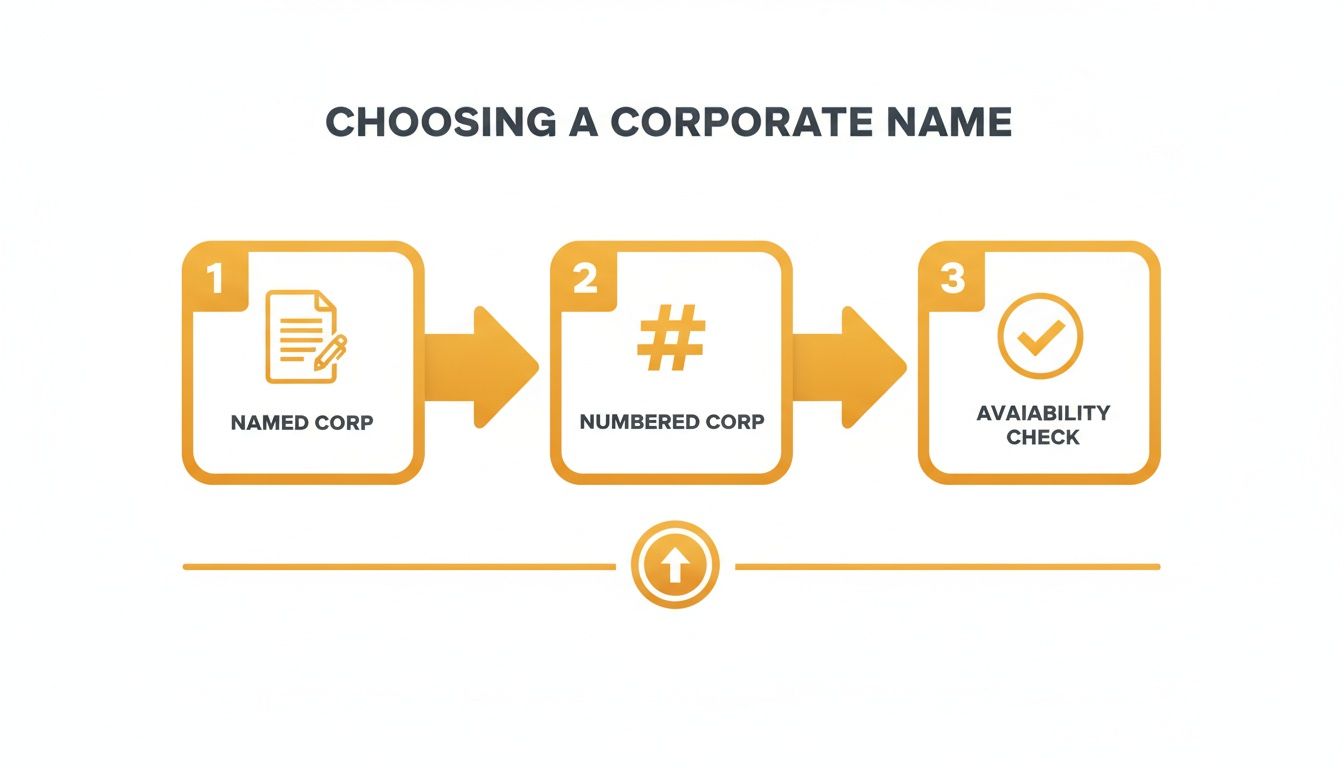
Whether you picked a creative name or a simple numbered one, the next step is the same: building out the structure in your Articles of Incorporation.
Demystifying Your Share Structure
This is where many entrepreneurs get stuck, but it’s also where you have a lot of power to shape your company’s future. Your share structure defines ownership, profit distribution, and control. A poorly thought-out structure can cause massive headaches down the road when you’re trying to bring on investors or partners.
A “share” is simply a slice of ownership in the company. You can keep things simple with one class of shares, or you can get more sophisticated.
- Share Classes: You can create different categories, like Class A, Class B, etc. Each class can have its own unique set of rights and rules.
- Voting Rights: Some shares give the holder a vote on major company decisions (like choosing directors), while others might be non-voting. For instance, founders might keep all the Class A voting shares to maintain control, while issuing Class B non-voting shares to early investors.
- Dividends: You can also define how profits are paid out. One class of shares might get a fixed dividend payment, while another gets dividends only when the directors decide to issue them.
Let’s say two founders are launching a tech startup in Waterloo. One founder is providing most of the cash, while the other is the programming genius. They could create a structure where the money-in founder gets “Class A Preferred Shares,” guaranteeing they get their investment back first. Both could then take an equal number of “Class B Common Shares” with voting rights, ensuring they have an equal say in the company’s day-to-day direction.
This kind of flexibility is a huge advantage of incorporating. It lets you protect your control, reward different kinds of contributions, and set yourself up for future growth.
Ontario Provincial vs Federal Incorporation
One of the biggest forks in the road is deciding whether to incorporate provincially in Ontario or federally with the Government of Canada. This choice impacts everything from your name protection to your ongoing administrative workload.
Incorporating provincially under the Ontario Business Corporations Act is generally the simpler and more affordable route. Your company is governed by Ontario law, and your business name is only protected within the province. This is a perfect fit for a business that will operate exclusively in Ontario, like a local Kingston brewery or a marketing agency focused on the GTA.
On the other hand, federal incorporation under the Canada Business Corporations Act gives you nationwide name protection. If you federally incorporate as “Maple Leaf Tech Inc.”, no one else in Canada—from B.C. to Newfoundland—can use that exact name. This is a massive plus if you plan to expand nationally. The trade-off? A federally incorporated company still has to register as an extra-provincial corporation in every single province where it has a physical presence, which means more paperwork and fees.
To make this clearer, let’s break down the key differences.
Ontario Provincial vs Federal Incorporation at a Glance
| Feature | Ontario Provincial Incorporation | Federal Incorporation |
|---|---|---|
| Name Protection | Your corporate name is protected only within Ontario. | Your corporate name is protected across all of Canada. |
| Geographic Scope | Best suited for businesses operating primarily in Ontario. | Ideal for companies with plans for national expansion. |
| Governing Law | Governed by the Ontario Business Corporations Act. | Governed by the Canada Business Corporations Act. |
| Administrative Burden | Simpler process; one set of rules and annual filings. | Requires extra-provincial registration in each province of operation. |
| Director Residency | At least 25% of directors must be resident Canadians. | At least 25% of directors must be resident Canadians. |
For most new businesses starting out in Ontario, provincial incorporation is the most direct and cost-effective option. But if your vision is Canada-wide from day one, the extra steps of federal incorporation are well worth the long-term brand protection.
Setting Up Your Corporation After Filing

Getting that official Certificate of Incorporation in your hands is a great feeling. It’s a huge milestone. While it’s tempting to pop the champagne and dive straight into running the business, there are a few critical organizational steps you need to tackle first.
Think of this as the phase where you bring the corporate structure you designed on paper to life. These aren’t just administrative suggestions; they are legal requirements under Ontario’s Business Corporations Act. Getting these “first acts” right from the get-go ensures your corporation starts on solid legal footing and protects the limited liability you just worked to create.
Holding the First Directors’ Meeting
The very first thing you need to do is hold an initial meeting of the directors you named in your Articles of Incorporation. Even if you’re the only director and shareholder, you still have to go through the motions. This meeting is where the foundational decisions about your company’s management are made and officially documented.
During this meeting, the directors will pass several key resolutions. These are just formal, written decisions that authorize specific actions and lay the groundwork for how the company will operate. These documents become the very first official records in your corporation’s history.
Typically, the key items on the agenda for this first meeting include:
- Adopting Corporate By-laws: This is your company’s internal rulebook. It covers everything from how meetings are run to the duties of officers and other procedural nuts and bolts.
- Appointing Officers: The directors will formally appoint people to key roles like President, Secretary, and Treasurer. It’s common for one person to wear multiple hats here.
- Authorizing Share Issuance: A resolution is passed to officially issue shares to the founding shareholders in exchange for their investment (whether it’s cash or other assets). This is what formalizes ownership.
- Approving a Corporate Bank Account: You’ll need a resolution to give the corporation the authority to open its own business bank account.
A common mistake we see entrepreneurs make is skipping these formalities, especially in a one-person show. But without these resolutions, there’s no official paper trail of who the officers are or who actually owns the shares. This can cause massive headaches later when you try to get a loan, bring on an investor, or even just prove you own the company.
The All-Important Corporate Minute Book
Every resolution, by-law, and major corporate document from that initial meeting—and every meeting thereafter—needs to be kept in one central place: the corporate minute book. This isn’t optional. Maintaining an accurate and up-to-date minute book is a legal requirement in Ontario.
Think of it as the official diary of your corporation. It provides a complete history of all major decisions and structural changes. It’s also the very first thing that lawyers, accountants, potential buyers, or the Canada Revenue Agency (CRA) will ask to see during an audit or due diligence.
At a minimum, your minute book must contain:
- The original Articles of Incorporation
- The corporate by-laws
- Minutes from all director and shareholder meetings
- All resolutions passed by directors and shareholders
- Registers listing all directors, officers, and shareholders
- Share certificates and transfer ledgers
Trust us, keeping this organized from day one is infinitely easier than trying to piece it all together years down the road under pressure. A tidy minute book is the hallmark of a well-run business.
Mandatory Government Registrations
With your internal governance sorted, the last piece of the puzzle is registering your new corporation with the necessary government bodies. Your Certificate of Incorporation doesn’t do this for you automatically. These registrations are absolutely essential for handling taxes and hiring people.
First up, you need a Business Number (BN) from the Canada Revenue Agency (CRA). This nine-digit number is your company’s main identifier for all things federal. Once you have a BN, you can register for specific program accounts that are tied to it.
The most common accounts you’ll likely need are:
- HST/GST Account: You are legally required to register for, collect, and remit Harmonized Sales Tax (HST) if your corporation’s annual worldwide revenues top $30,000. Many new businesses register voluntarily right away so they can claim input tax credits on their start-up expenses.
- Payroll Account: Planning to hire anyone, including yourself? You must open a payroll account. This is how you’ll remit deductions like Canada Pension Plan (CPP) contributions, Employment Insurance (EI) premiums, and income tax.
- WSIB Registration: Depending on your industry, you may also need to register with the Workplace Safety and Insurance Board (WSIB). As we explain in our guide, understanding when you need WSIB insurance coverage in Ontario is crucial for staying compliant.
Properly managing your company’s finances is key to its survival. To handle this well, many founders look for external help; a great guide on the best outsourced accounting services can offer some valuable direction. Once you’ve checked these registrations off your list, your corporation is fully operational and ready to do business legally in Ontario.
Maintaining Your Ontario Corporation Annually
Getting your business incorporated isn’t a “set it and forget it” task. Think of it as the starting line, not the finish. To keep your corporation’s legal shield in good working order, you have to stay on top of a few annual routines. This is the yearly check-up that keeps your company in good standing with both the Ontario government and the Canada Revenue Agency (CRA).
Skipping these essential maintenance steps can get you into hot water. We’re talking about serious consequences like steep fines, the government dissolving your corporation, and even directors becoming personally liable for company debts. This annual upkeep is a fundamental part of successfully running an incorporated business in Ontario for the long haul.
The Annual Meeting and Minute Book Upkeep
Ontario’s Business Corporations Act is clear: every corporation must hold annual meetings for its directors and shareholders. Now, if you’re the sole director and shareholder, this might sound a little silly. But the law still applies.
You don’t need to book a conference room. For most small businesses, this requirement is met by drafting written resolutions that officially document the year’s key decisions and review the company’s financial picture.
So, what needs to be in these documents?
- Financial Statement Approval: The shareholders must formally sign off on the corporation’s financial statements from the last fiscal year.
- Director Appointments: This is where shareholders officially elect (or re-elect) the directors who will serve for the next year.
- Auditor Appointment: Shareholders must either appoint an auditor or, as is common for private corporations, unanimously agree to waive the audit requirement.
Each of these decisions needs to be captured in a signed resolution and tucked safely into your corporate minute book. This creates a clean, continuous paper trail that proves your corporation is being managed by the book.
A pristine minute book isn’t just a nice-to-have; it’s a must. If the CRA comes knocking for an audit, or if you ever decide to sell your business, the first thing they’ll ask to see is your minute book. Missing records are a huge red flag.
Filing Your Annual Corporate Tax Returns
Every corporation based in Canada is required to file a T2 Corporate Income Tax Return with the CRA each year. This is a completely separate process from your personal tax filings and it’s due within six months of your corporation’s fiscal year-end.
Let’s say your fiscal year ends on December 31st. Your T2 return needs to be filed by June 30th of the following year. But here’s a crucial detail: any tax you owe is usually due within two or three months of your year-end. Don’t wait until the last minute to file, or you could face a hefty bill with interest.
Along with the federal T2 return, you also have to file an Ontario Corporations Tax return (Schedule 546/547). The good news is that this is built right into the T2 form, so you can handle both federal and provincial obligations at once. Blowing past these deadlines triggers automatic penalties and interest from the CRA, so mark your calendar.
Keeping Corporate Information Current
As your business grows and changes, your official corporate records have to keep pace. The Ontario government mandates that you report certain changes within 15 days of the event.
Some of the most common updates that require an official filing include:
- A new registered office address for the corporation.
- Any changes to the board of directors, like someone joining or leaving.
- A shuffle in the corporation’s officers (for instance, appointing a new President or Secretary).
You can file these updates through the Ontario Business Registry. Staying on top of this ensures the public record is always accurate about who’s running the company and where legal notices should be sent. It’s a small administrative chore that prevents massive compliance headaches down the road. Proper management of these details is crucial, as oversights can lead to legal issues. For a deeper dive into how legal disputes are handled, you can learn about the available remedies for a breach of contract.
Common Questions About Incorporating in Ontario
Even with a clear plan, taking the leap to incorporate your business in Ontario naturally brings up a few questions. We get these all the time from founders across the GTA, so let’s tackle some of the most frequent ones head-on.
How Much Does It Cost to Incorporate a Business in Ontario?
The final bill for incorporation can swing quite a bit. You’ve got your fixed government costs, like the provincial filing fee for the Articles of Incorporation which is about $300, plus the cost of a mandatory NUANS name search report.
Where the cost really varies is in professional fees. Sure, a DIY online filing service looks cheap at first glance, but they typically just push the basic form through. Working with a lawyer is about getting strategic advice on your share structure, making sure your initial corporate resolutions are solid, and sidestepping costly errors that can haunt you later.
We’ve seen it happen: a founder uses a budget service to save a few hundred dollars, only to discover a year later that their share structure is totally wrong for bringing on investors. The legal fees to clean up that mess dwarf the initial savings.
How Long Does the Ontario Incorporation Process Take?
The government part is actually quite fast. If you file online, the official processing can be done in just a business day or two. But that’s just one step in the journey.
A realistic timeline for the whole process, from the first conversation to having your new corporation ready to go, is closer to one or two weeks. This gives you enough time for the NUANS search, a proper consultation to iron out the structural details, and carefully preparing the information for your Articles of Incorporation. Trust us, you don’t want to rush the foundation.
Do I Really Need a Lawyer to Incorporate in Ontario?
Legally, no, you don’t have to use a lawyer to incorporate in Ontario. But we strongly advise it, especially if you have partners or plan to raise money down the road. A corporate lawyer does so much more than just file paperwork.
The real value is in the strategic, forward-thinking guidance. This includes:
- Designing a Share Structure: We’ll help you set up different share classes to properly manage ownership, control, and how profits are distributed. This is critical for future growth.
- Drafting Key Agreements: A lawyer is essential for drafting a shareholders’ agreement. This document outlines everyone’s rights and responsibilities and is your best defence against expensive disputes between owners.
- Ensuring Day-One Compliance: We make sure your corporate minute book is set up correctly from the very beginning, keeping you on the right side of Ontario law.
This upfront investment pays for itself by preventing major legal and financial headaches as your business scales. Understanding legal timelines is crucial in business, and you can learn more by reading about the statute of limitations in Canada in our detailed article.
Launching a corporation is a major milestone, and doing it right from the start paves the way for success. If you need a hand navigating the process of how to incorporate a business in Ontario or have other corporate legal needs, the team at UL Lawyers is ready to help. Contact us today to build your business on a rock-solid legal foundation.