What is an LLC? An LLC is a limited liability company — a United States business entity that can protect owners (members) from many company debts. Canada has no LLC. Ontario uses a corporation (Ltd or Inc), not a US-style LLC. What is a LLC and what is LLC are the same question: LLC still means that US form.
LLC meaning / what does LLC stand for? LLC stands for limited liability company. That is a US filing type, not a Canadian statute.
Canadian equivalent: Ontario businesses that want similar protection form a federal or provincial corporation (often named Ltd., Inc., Limited, Corp., or Corporation). Those endings mark a corporation — not an LLC. The other domestic options are a partnership (including an LLP for some professions) or a sole proprietorship, which is simpler but does not create that liability shield. Call 905-744-8888 or email info@ullaw.ca for a business consult — or start with civil litigation and business services.
- What is an LLC / what is a LLC / what is LLC: a US limited liability company.
- LLC meaning / what LLC stands for: limited liability company.
- Closest Canadian equivalent: a private corporation (often named Ltd, Inc, or Corp).
- Other Canadian options: sole proprietorship, general partnership, or (for some professions) an LLP.
Choosing the wrong structure can leave you personally liable. If you need to incorporate in Ontario, register a US LLC extra-provincially, or handle a corporate dispute, call 905-744-8888 or email info@ullaw.ca for a business consult. You can also book a free consultation.
What Is an LLC in Canada? There Isn’t One — Use Ltd or Inc

If you’re an entrepreneur in Ontario looking for an “LLC,” what you’re really looking for is a Canadian private corporation — often named Ltd., Inc., or Corp. This is by far the most common business structure used here to limit personal liability. Ltd and Inc are name endings on a corporation, not a Canadian LLC.
So, how does it work? A corporation is legally considered a separate “person” from its owners, who are known as shareholders. This crucial distinction is what creates the shield of “limited liability.” If the business racks up debt or gets sued, the lawsuit targets the corporation’s assets, not your personal savings, your home, or your car.
The real magic is the creation of a “corporate veil”—a legal barrier that separates your personal finances from your business operations. This protection is absolutely fundamental for managing risk as your business grows.
What Makes a Canadian Corporation a Good Fit?
A Canadian corporation is a solid framework for any serious business owner, offering a lot more than just a liability shield. Here’s what makes it the go-to choice for so many entrepreneurs in Burlington, the GTA, and across Ontario:
- A Separate Legal Identity: The business can own property, sign contracts, and even sue or be sued, all under its own name.
- Potential Tax Perks: Corporations are taxed separately from their owners. This often opens the door to lower tax rates, like the valuable Small Business Deduction.
- Easier to Raise Money: Need to bring on investors? A corporate structure makes it simple. You can sell ownership stakes by issuing shares, a clean and well-understood process.
To help you see the similarities and differences more clearly, here’s a quick comparison of the American LLC and its closest Canadian cousin, the private corporation.
US LLC vs Canadian Corporation at a Glance
| Feature | US Limited Liability Company (LLC) | Canadian Private Corporation |
|---|---|---|
| Liability | Owners have limited personal liability for business debts. | Shareholders have limited personal liability. |
| Taxation | Flexible. Taxed as a pass-through entity by default (profits “pass through” to owners’ personal returns). Can elect to be taxed like a corporation. | A separate taxpayer. The corporation pays its own taxes at corporate rates. Shareholders are taxed on dividends or salaries they receive. |
| Formation | Governed by state law. Generally simpler formation process and fewer ongoing formalities. | Governed by federal or provincial law. Requires more formal setup (e.g., Articles of Incorporation) and annual compliance. |
| Management | Can be managed by members (owners) or designated managers. | Managed by a board of directors, elected by the shareholders. |
| Legal Status | A hybrid structure combining features of a partnership and a corporation. | A distinct legal entity, separate from its owners. |
This table shows that while both structures achieve the core goal of liability protection, they handle taxes and governance quite differently.
Call before you file. Canada has no LLC. If you want that protection in Ontario, talk to UL Lawyers about a corporation (Ltd or Inc) — not a US filing. Call 905-744-8888 or email info@ullaw.ca now.
Now, while a U.S.-style LLC doesn’t exist here, Canada does have other business structures that offer some form of liability protection. For certain regulated professions like law or accounting, a limited liability partnership (LLP) in Canada might be an option. However, for most businesses, a corporation provides much broader and more comprehensive protection against general business debts and lawsuits. If you have already decided to incorporate, start with how to incorporate a business in Ontario.
What Does “Limited Liability” Actually Mean?
At its core, limited liability is a financial shield. It’s the single biggest reason business owners in Canada go through the process of incorporating—to build a wall between their business and their personal life. This concept separates you, the person, from the company you run.
Let’s make this real. Picture a skilled general contractor in Burlington, Ontario. For years, she’s run a thriving renovation business as a sole proprietorship, tackling everything from kitchen makeovers in Oakville to basement projects in Mississauga. She’s successful and well-respected.
Then, disaster strikes. An accident on a job site causes major property damage, and a lawsuit follows. The claim is huge, way more than her business insurance will cover. Because she’s a sole proprietor, the law sees no difference between her business assets and her personal assets.
Suddenly, the lawsuit isn’t just aimed at her company’s bank account. It’s coming for everything she owns personally: her family home, her savings, her car, even the money she’s put away for retirement. Her entire financial world is on the line because of one business mishap. That’s the brutal reality of running a business without the protection of limited liability.
Building a Financial Firewall Through Incorporation
Now, let’s hit the rewind button. What if our Burlington contractor had incorporated her business from day one? By filing Articles of Incorporation, she would have created a private corporation, which Canadian law recognizes as a completely separate legal entity.
This one step erects a powerful legal barrier often called the “corporate veil” between her and the business.
Think of the corporation as its own “person.” It has a name, opens its own bank accounts, owns property, and takes on debt. If that same unfortunate accident happens now, the lawsuit is filed against “Burlington Contracting Inc.,” not against the contractor personally.
The bedrock principle here is that a shareholder’s personal liability for the corporation’s debts and legal troubles is capped at the amount they’ve invested in the business. In most situations, their personal assets are safely tucked away, out of reach of anyone trying to collect from the company.
This separation is the cornerstone of building a secure business in Ontario. It gives entrepreneurs the confidence to take calculated risks and grow their ventures without the constant worry that one bad day at work could unravel their personal financial stability.
How the Corporate Veil Works in the Real World
This “corporate veil” isn’t just a fancy legal term; it has tangible benefits that protect you day-in and day-out. Here’s a look at how it shields you:
- Business Debts: Let’s say the corporation finances a new work truck and falls behind on payments. The bank can repossess the company’s truck, but they can’t come after your personal car.
- Supplier Disagreements: A dispute over a large order of materials ends up in court, and the supplier wins. They can only make a claim against the corporation’s bank account, not your personal savings.
- Employee-Related Issues: The corporation, not you, is generally held responsible for incidents involving staff. For instance, if an employee causes an accident while driving a company vehicle, the corporation is the one on the hook. Of course, this doesn’t replace the need for sound safety practices and understanding your responsibilities for things like WSIB insurance in Ontario.
By incorporating, our Burlington contractor makes sure that even if her business stumbles, her personal finances don’t fall with it. The corporate structure contains business risks, protecting the wealth she’s worked so hard to build. This peace of mind is, without a doubt, the greatest advantage of incorporating your business in Canada.
Choosing Your Business Structure in Canada
So, you’ve realized that a Canadian corporation is the go-to for that liability shield most entrepreneurs need. That’s the first step. The next is figuring out how it stacks up against the other options on the table. For any business owner in Ontario—whether you’re in Burlington, Mississauga, or anywhere in the GTA—this isn’t just paperwork. Your choice directly impacts your personal liability, your tax situation, and even your daily administrative headaches.
Every structure strikes a different balance between protection, simplicity, and cost. The sections below walk through the main Canadian options—sole proprietorship, partnership, LLP, and corporation—so you can see why incorporating is often the move people want when they ask for an LLC.
The Simplest Option: The Sole Proprietorship
The sole proprietorship is the quickest way to get up and running in Canada. From a legal standpoint, you and your business are the exact same entity. This makes getting started a breeze—often, all you need to do is register a business name, and you’re off.
But that simplicity comes with a hefty price: unlimited personal liability. As we touched on earlier, any business debt, lawsuit, or financial mess is your personal problem. Creditors can come after your personal assets—your house, your savings, your car—to settle what the business owes.
Working Together: The Partnership
A general partnership is basically a sole proprietorship with two or more owners. Like its solo counterpart, it’s fairly easy to set up, and all the business income flows directly to the partners’ personal tax returns. Simple enough.
The catch? The liability risk gets even bigger. In a general partnership, you’re not just on the hook for your own actions and debts; you’re also responsible for your partners’. This is called joint and several liability, which is a legal way of saying a creditor can chase any one partner for the entire business debt, no matter who actually caused the problem.
A Specialized Option: The Limited Liability Partnership (LLP)
Next up is the Limited Liability Partnership, or LLP. This is a special structure that’s only available to certain regulated professionals in Ontario—think lawyers, accountants, and doctors. It provides a specific kind of protection that’s often misunderstood.
In an LLP, partners are shielded from the personal fallout of another partner’s professional negligence or malpractice. That’s a key distinction. It means you won’t lose your house because your colleague made a critical error. However, it does not protect your personal assets from the business’s general debts, like an office lease or a loan from the bank.
An LLP acts as a shield against your partners’ professional mistakes, but it won’t protect you from the business’s overall financial obligations. Only a corporation offers that kind of comprehensive protection from a wider range of risks.
The Ultimate Shield: The Corporation
This brings us right back to the corporation. By creating a separate legal entity, it delivers the strongest liability protection you can get. This legal separation, often called the “corporate veil,” is the number one reason entrepreneurs decide to incorporate.
The flowchart below gives you a great visual of how this corporate shield works to keep your personal assets safe when the business runs into trouble.
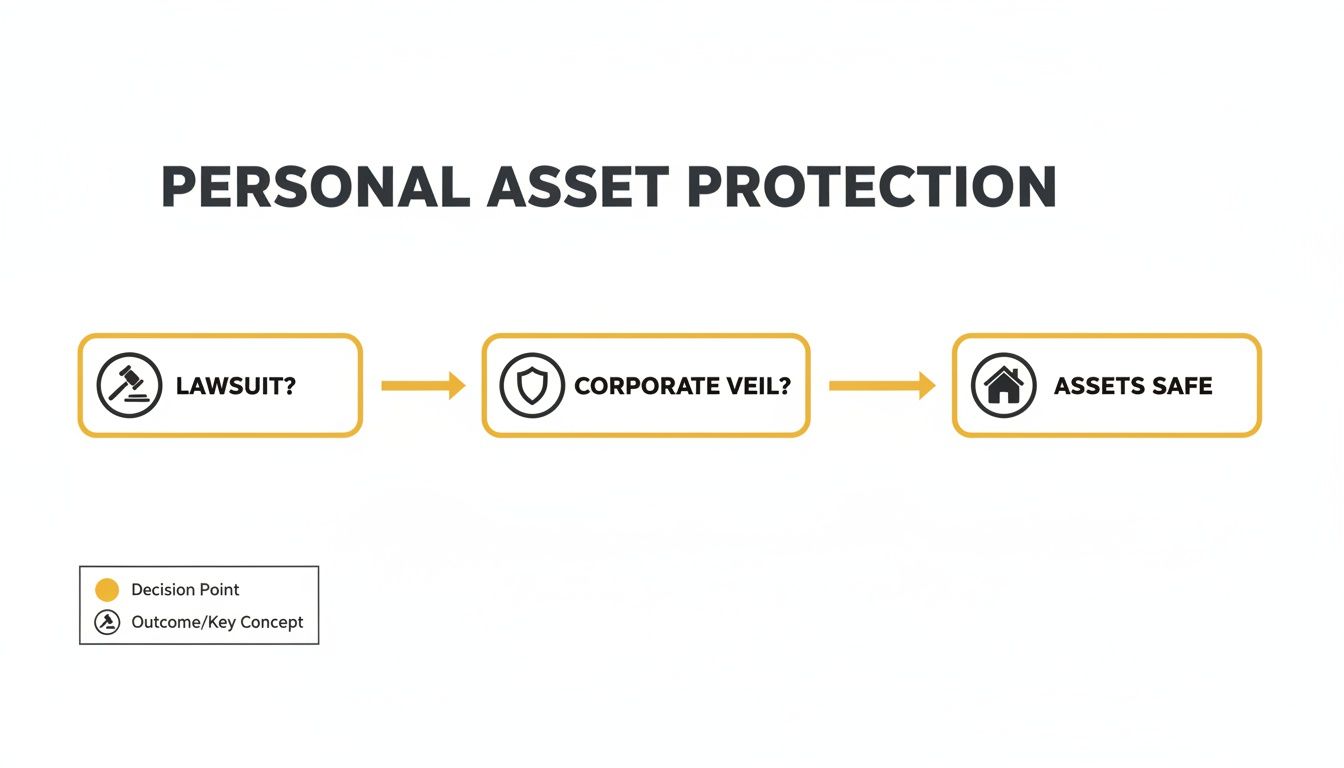
As you can see, the corporate veil acts like a firewall. It stops business liabilities, like a lawsuit, from burning through to your personal life.
Essentially, a corporation rings a fence around business risks. If the company can’t pay its bills or gets hit with a legal judgment it can’t cover, the damage is generally contained to the assets owned by the corporation itself. Your personal financial world stays separate. For example, if your incorporated business defaults on a loan (and you haven’t signed a personal guarantee), the lender can only go after the company’s assets.
This protection is crucial in many situations, including contract disputes. If your corporation gets sued, it’s good to know the potential remedies for a breach of contract, but the most important thing is that the lawsuit is against the corporation, not you.
To help you see it all side-by-side, here is a quick comparison of how these structures handle the two most critical factors: liability and tax.
Comparing Liability and Tax for Canadian Business Structures
This table breaks down the key differences to help you weigh your options as an Ontario business owner.
| Structure Type | Liability Protection | Taxation Method | Best For |
|---|---|---|---|
| Sole Proprietorship | None. Owner is personally liable for all business debts. | Business income is reported on the owner’s personal tax return. | Freelancers, consultants, and small one-person businesses with low liability risk. |
| General Partnership | None. Partners are jointly and severally liable for all business debts. | Profits and losses are passed through to the partners’ personal tax returns. | Collaborative ventures where partners fully trust each other and liability risk is low. |
| Limited Liability Partnership (LLP) | Partial. Protects partners from each other’s professional negligence, but not from general business debts. | Similar to a general partnership; profits pass through to partners. | Groups of regulated professionals (e.g., lawyers, accountants) in Ontario. |
| Corporation | Strong. Shareholders’ personal assets are protected from business debts and lawsuits. | The corporation is a separate taxpayer and pays corporate income tax. | Any business aiming for growth, seeking to limit personal risk, or planning to raise capital. |
In the end, picking the right structure comes down to matching your business ambitions with the level of risk you’re comfortable taking on. For most serious entrepreneurs in Canada who want to build something lasting and secure, the powerful asset protection and tax advantages of a corporation make it the obvious choice.
How Corporations Protect Your Personal Assets
So, we’ve talked about the different business structures. Now, let’s get into what really matters: how does a corporation actually shield your personal finances from business risks? This isn’t just legal theory; it’s a powerful, real-world tool called the “corporate veil,” and it’s designed to separate your business life from your personal life. Let’s walk through a few common scenarios entrepreneurs face in Ontario to see it in action.
Picture this: you run a thriving catering company in Burlington, properly set up as “GTA Feasts Inc.” You land a massive contract for a corporate gala, but on the day of the event, your main refrigeration unit completely dies. You can’t safely serve the food, and the event is a disaster. The client, understandably furious and facing huge losses, decides to sue.
Because your business is incorporated, the lawsuit targets GTA Feasts Inc., not you. The claim is limited to the assets owned by the corporation itself—the money in its bank account, the kitchen gear, and the delivery vans. Your personal world, like your family home in Oakville or your personal savings account, is safely walled off. That’s the corporate veil at work, keeping the business’s problems inside the business.
The Shield Against Business Failure
Let’s be honest, business is a rollercoaster. Even the most carefully planned ventures can hit a wall, whether it’s a sudden market downturn or a disruptive new competitor. This is where incorporation truly offers priceless peace of mind.
Imagine a small, incorporated retail shop in Mississauga. The owner poured their heart and soul into it, but after a few tough years, the business has to close down with outstanding debts to suppliers. Those suppliers can go after the corporation for what they’re owed, and they might be able to claim any remaining inventory or cash in the business account.
But here’s the key: they can’t touch the owner’s personal assets. The owner’s house, car, and personal savings are out of reach. This protection allows an entrepreneur to take a calculated risk, and if it doesn’t work out, they aren’t left personally bankrupt. It’s a fundamental part of what encourages people to start businesses and build a thriving economy.
When the Corporate Shield Has Cracks
While the corporate veil is strong, it’s not invincible. There are a few very specific situations where you, the owner, can be held personally responsible for corporate debts. It’s crucial to know what they are. The most common one by far is the personal guarantee.
When your new corporation tries to get a loan or lease a commercial space, the bank or landlord will almost certainly ask you to sign a personal guarantee. By signing that document, you are voluntarily agreeing to set aside the corporate veil for that specific debt.
A personal guarantee is a legally binding promise to be personally responsible for the debt if the corporation cannot pay. It effectively makes your personal assets collateral for the business’s commitment.
For example, if you personally guarantee a $100,000 business loan and your company defaults, the bank can come after you directly for that money. They have the legal right to pursue your personal assets to cover the debt. It’s a serious commitment that you should never take lightly.
The other major exception involves wrongful acts. If a court finds an owner used the corporation to commit fraud, it can “pierce the corporate veil” and hold the individuals behind the company personally liable. Directors also have specific legal duties. Failing to remit taxes collected on behalf of the government, like GST/HST or employee payroll deductions, will almost always lead to personal liability for the directors.
Understanding these limits is just smart risk management. A corporation offers incredible protection, but it requires you to run the business honestly and be fully aware of any personal commitments you make. Managing those responsibilities is as important as choosing the structure. If you need help with incorporation paperwork, a shareholders’ agreement, or a commercial dispute, what corporate lawyers do is a practical next read.
Strategic Tax Planning with a Corporation
Setting up a corporation in Canada isn’t just about putting a legal shield around your personal assets. It’s also one of the most powerful financial tools an entrepreneur can have. For many business owners in Burlington and across Ontario, the tax advantages of incorporating are just as compelling as the liability protection. This is the point where your business structure stops being just a legal formality and starts becoming a core part of your financial strategy.
The biggest win comes from the difference between corporate and personal tax rates. Put simply, the profits your corporation earns are taxed at a much friendlier rate than if that same money landed directly in your personal bank account as a sole proprietor. The magic behind this is the Small Business Deduction (SBD).
The Power of the Small Business Deduction
Think of the SBD as the Canadian government’s way of giving small businesses a leg up. It dramatically lowers the corporate tax rate on the first $500,000 of active business income for a Canadian-controlled private corporation (CCPC). In Ontario, for instance, this combined federal and provincial rate is a world away from the top marginal personal tax rates.
This opens up a massive opportunity right away. Instead of seeing a huge chunk of every dollar your business earns go to taxes at your personal rate, you pay a much lower corporate rate on profits you keep inside the company. This introduces a crucial concept for any business owner: tax deferral.
Fueling Growth Through Tax Deferral
Tax deferral isn’t about avoiding tax. It’s about controlling when you pay it. By leaving profits in the corporation, you’re hitting the pause button on paying personal income tax on that cash. This simple move leaves more money in your company’s hands, ready to be put back to work.
Here’s a way to look at it: Tax deferral lets you grow your business using pre-tax dollars. The funds that would have otherwise gone straight to the Canada Revenue Agency (CRA) can now be used to buy that new piece of equipment, hire your next key employee, or launch that marketing campaign you’ve been planning.
Let’s say you run an incorporated design agency in Mississauga that clears a $100,000 profit.
-
As a Sole Proprietor: The whole $100,000 gets added to your personal income. You’ll be taxed at your marginal rate, which could easily be over 40% or even 50%. A big slice of your hard-earned profit is gone before you can even think about reinvesting it.
-
As a Corporation: The company pays the low SBD rate on that profit (around 12.2% in Ontario). Suddenly, there’s nearly $88,000 left in the business to fuel growth, compared to maybe $50,000-$60,000 if you’d taken it all as personal income.
This difference is an absolute game-changer for scaling your business. Having that much more capital to reinvest means you can grow faster and stronger.
Paying Yourself from the Corporation
Of course, you still need to pay your own bills. The way you pull money out of the company is another area where smart planning pays off. For most owner-managers, it comes down to two main options: taking a salary or paying yourself dividends.
-
Salary: When you pay yourself a salary, the corporation treats it as a business expense, which lowers its taxable income. You then report that salary on your personal T1 tax return and pay income tax on it, just like a regular employee. This route also means you’re contributing to the Canada Pension Plan (CPP), building up your public pension for retirement.
-
Dividends: A dividend is essentially a slice of the corporation’s after-tax profits paid out to its shareholders (that’s you). The company pays tax on its profits first, and then distributes the remainder. You still pay personal tax on the dividend, but it’s calculated at a lower rate thanks to the dividend tax credit. This credit is designed to recognize that the corporation already paid tax on that money.
Deciding between a salary, dividends, or a mix of both is a major strategic decision. It depends entirely on your personal cash flow needs, how you want to plan for retirement (CPP is a big factor), and your overall tax picture. Nailing this mix is one of the keys to getting the most out of your corporate structure, and it’s a critical conversation to have with your accountant and lawyer.
Knowing When to Consult a Business Lawyer

Sure, incorporating a business in Ontario might look like a simple, do-it-yourself task on the surface. But going it alone can be a minefield of unseen risks. Understanding precisely when to call in a legal expert is one of the most important decisions you’ll make for your company’s future.
Think of legal advice not as a cost, but as an investment in your business’s stability and longevity. A good lawyer ensures your company is structured properly from the get-go, shoring up your liability protection and setting the stage for future growth. This is especially true when the economic forecast is a bit uncertain.
For example, a recent Bank of Canada survey from the first quarter of 2025 showed that recession expectations among Canadian businesses shot up to 32%, causing many to pump the brakes on investment plans. In an uncertain climate like this, a rock-solid legal foundation isn’t just nice to have—it’s essential. You can dig into the business outlook survey findings for more detail.
Key Milestones That Demand Legal Advice
Certain moments in your business journey should serve as a big, flashing sign that it’s time to get a lawyer involved. Trying to navigate these complex scenarios by yourself can leave you vulnerable to serious headaches down the line.
Here are a few times when you absolutely should consult a business lawyer:
- Forming a Partnership: If you’re teaming up with others, a well-drafted shareholders’ agreement is non-negotiable. It’s the playbook for your business relationship, clearly defining how decisions are made, how conflicts are handled, and the exit strategy if a partner wants out.
- Raising Capital: Bringing on investors is a huge step. A lawyer can help you structure the deal properly, making sure you comply with all securities laws while protecting the interests of both you and your new backers.
- Signing a Major Lease: That commercial lease is a massive, long-term financial commitment. Before you sign on the dotted line, have a lawyer review it to spot potential traps and negotiate terms that favour your business.
- Hiring Employees: As your team grows, so do your legal obligations. Getting professional advice on employment contracts and workplace policies from the start can save you from expensive disputes later on.
A business lawyer does more than just file documents. They are a strategic partner who helps you see around corners, anticipating challenges and building a company that is resilient, compliant, and ready for anything.
Protecting Your Business and Your Future
Ultimately, bringing a lawyer on board is about smart, proactive risk management. For entrepreneurs all across the GTA and Ontario, from Burlington to Toronto, having that expert counsel brings invaluable peace of mind. It frees you up to focus on what you do best—running your business—knowing its legal backbone is secure.
Whether you’re wrestling with contracts, navigating compliance, or choosing a structure, having a professional in your corner makes all the difference. If you are deciding between a corporation, partnership, or sole proprietorship—or you already have a US LLC and need to operate in Ontario—call 905-744-8888 or email info@ullaw.ca now. You can also start with a free consultation or review our civil litigation and business services.
Related UL Lawyers resources
If you are past the definition and need a Canadian next step, these pages stay on this topic:
- Civil litigation and business services — commercial disputes, contracts, and business files.
- How to incorporate a business in Ontario — filing steps after you choose a corporation.
- What corporate lawyers do — when to get counsel on structure, governance, and deals.
- Limited liability partnership in Canada — the professional LLP alternative, not a US LLC.
Frequently Asked Questions
When you’re setting up a business, the legal structures can feel a bit overwhelming. Let’s clear up what an LLC is, what LLC stands for, what LLC means, and the Canadian corporation (Ltd / Inc) equivalent.
What is an LLC?
An LLC is a limited liability company: a US business entity whose owners (members) usually have limited personal liability. US tax rules often treat it as a pass-through unless it elects to be taxed as a corporation. What is a LLC? What is LLC? Same answer — LLC still means that US form. Canada does not have a US-style LLC.
What does LLC stand for?
LLC stands for limited liability company. That is the US name for a company that can separate many business debts from the owners’ personal assets. It is not a Canadian statute name and not something you file at Ontario’s corporate registry.
What is the meaning of LLC?
LLC meaning is limited liability company. In the US, that hybrid structure offers limited personal liability and flexible tax treatment. In Canada, people use “LLC” as shorthand for limited-liability protection, but it is not a filing category. Searching “what is an LLC in Canada” or “LLC Canada” is a search for the domestic substitute: usually a private corporation (Ltd, Inc, or Corp), otherwise a partnership or sole proprietorship.
What is the Canadian equivalent of an LLC?
A Canadian private corporation. Canada has no US-style LLC. Ontario businesses that want similar protection incorporate federally or provincially. The legal name typically ends in Ltd., Inc., Limited, Corp., or Corporation. Those endings mark a corporation, not a separate “Canadian LLC” type.
Is Ltd or Inc the same as an LLC in Canada?
No. Ltd. and Inc. are legal name endings for a Canadian corporation. They are not an LLC and they are not a different entity type from a corporation. If you want LLC-style protection in Ontario, you incorporate — you do not file an LLC.
Call 905-744-8888 or email info@ullaw.ca if you need to pick a structure or register a US LLC extra-provincially.
Can I Operate My US LLC in Ontario?
Yes, you absolutely can, but it’s not just a matter of hanging up a sign. To do business in Ontario, a US LLC needs to register as an extra-provincial corporation with the provincial government. Think of this as getting official permission for your foreign company to operate legally on Canadian soil.
The real tricky part, however, is the taxes. The Canada Revenue Agency (CRA) generally views a US LLC as a standard corporation for tax purposes, regardless of its “flow-through” status back in the States. This can lead to some complicated—and often expensive—cross-border tax issues. Before you make any moves, call 905-744-8888 or email info@ullaw.ca and speak with a lawyer and an accountant who live and breathe Canada-US business law.
What Is the Difference Between a Federal and a Provincial Corporation?
This choice really boils down to your business’s ambition and where you plan to operate.
-
Provincial Corporation: This is when you incorporate under the laws of one province, like Ontario. It gives you the right to operate and protects your business name within that province. It’s typically the simpler, more affordable option, perfect for businesses with a local or regional focus.
-
Federal Corporation: Incorporating federally gives you the right to operate anywhere in Canada and protects your business name across the entire country. If you have plans for national expansion right from the start, this is almost always the better choice.
How Much Does It Cost to Incorporate in Ontario?
The total cost to set up a corporation in Ontario has two main components: government filing fees and professional legal fees. The government’s charge for filing the Articles of Incorporation is usually a few hundred dollars.
On top of that, you have the legal fees. A lawyer will properly draft your articles, set up your corporate minute book, issue shares, and provide that crucial initial advice to get you started on the right foot. These fees can run from several hundred to a few thousand dollars, depending on how complex your share structure is and how much guidance you need. Getting those foundational documents right is part of using the corporate form properly. For the filing sequence itself, see how to incorporate a business in Ontario.
At UL Lawyers, we help Ontario business owners understand what an LLC is, what LLC stands for, why Canada does not use that form, and which structure actually fits the file. Do not file a US LLC and expect it to work like a Canadian corporation. Call 905-744-8888 or email info@ullaw.ca now to incorporate, review a shareholders’ agreement, or deal with a commercial dispute. You can also book a consultation or start with our litigation and business practice.