
The statute of limitations in Canada is the deadline to start a lawsuit. In Ontario, most civil claims — including personal injury and contract disputes — have a basic two-year limitation period from the day you discovered (or reasonably should have discovered) the claim. Miss it, and you usually cannot sue, no matter how strong the facts are.
Some clocks are shorter: municipal sidewalk notices can be 10 days. Ontario also has an ultimate 15-year cutoff that can bar a claim even if you discovered it late.
Deadline running, or unsure when the clock started? Call 905-744-8888 or email info@ullaw.ca. Hire a civil litigation lawyer or book a consultation before the window closes.
Understanding Canada’s Legal Timelines
Think of a limitation period as a legal stopwatch. The moment something goes wrong—a car accident, a broken contract, a personal injury—that watch starts ticking. If you don’t file a lawsuit before time runs out, your right to sue is usually lost forever. It’s not a minor setback; it’s a permanent door closing on your ability to seek justice through the courts.
Why do these deadlines exist? It’s all about fairness and practicality. Limitation periods push people to resolve disputes while evidence is still easy to find and memories are reliable. They also prevent defendants from living under the endless threat of a lawsuit, which brings a sense of finality and stability to the legal system.
The Importance of Acting Quickly
Simply knowing these timelines exist is the first and most critical step in protecting your legal rights. All too often, people are caught off guard by these deadlines, only realizing their mistake when it’s far too late. The courts are very strict about this, and missing the deadline means your claim is almost certainly barred.
The old saying “justice delayed is justice denied” is the very heart of limitation periods. They exist to make sure the legal system works efficiently and fairly, preventing old claims from clogging the courts and creating uncertainty.
The firm structure of these legal timelines is a cornerstone of Canadian law. To appreciate why they’re so non-negotiable, it’s helpful to look at the broader legal framework, including constitutional tools like the one explored in this analysis of Alberta’s Notwithstanding Clause, which shows how legal rights and their limits are defined in our country.
The Discoverability Rule: A Key Concept
Now, it’s not always as simple as starting the clock on the day of the incident. Canadian law includes a crucial concept called the discoverability rule. This principle means the two-year clock doesn’t start ticking until the moment you knew—or reasonably should have known—that you had a potential lawsuit.
This usually means you must have been aware of a few key things:
- That an injury, loss, or some other form of damage actually happened.
- That the person or company you plan to sue was responsible for (or contributed to) that damage.
- That launching a lawsuit is a legally appropriate step to take.
This guide will walk you through exactly how these different legal clocks work and what you need to do to make sure your rights are fully protected before it’s too late.
Understanding The Two Clocks That Limit Your Claim
When you’re dealing with a potential lawsuit in Canada, it helps to think of two different clocks running at the same time. Together, they create the window you have to file your claim. Getting a handle on how both of them work is absolutely critical to protecting your legal rights, whether you’re in Ontario or another common law province.
The first, and most immediate, is the basic limitation period. This is the one you’ve probably heard about—it’s a two-year countdown that starts the moment you “discover” you have a claim.
But “discovery” isn’t always as simple as it sounds. It’s not necessarily about when the bad thing happened, but when you realized—or should have reasonably realized—that you had a legal problem on your hands. This powerful legal concept is known as the discoverability rule.
The Discoverability Rule Explained
The whole point of the discoverability rule is to prevent the clock from starting unfairly. Let’s say a contractor does some shoddy electrical work in your home. The dangerous wiring is hidden behind a wall, and you don’t find out about it for three years until it causes a fire. It wouldn’t be fair if your two-year window to sue had already closed before you even knew a problem existed.
The law agrees. The clock only starts ticking once you know (or a reasonable person in your shoes should have known) the key facts:
- That you suffered an injury or financial loss.
- That the loss was caused or contributed to by the person you plan to sue.
- That launching a lawsuit is a legitimate way to seek a remedy.
This timeline breaks down how the clock only starts running upon discovery, not at the moment of the incident itself.
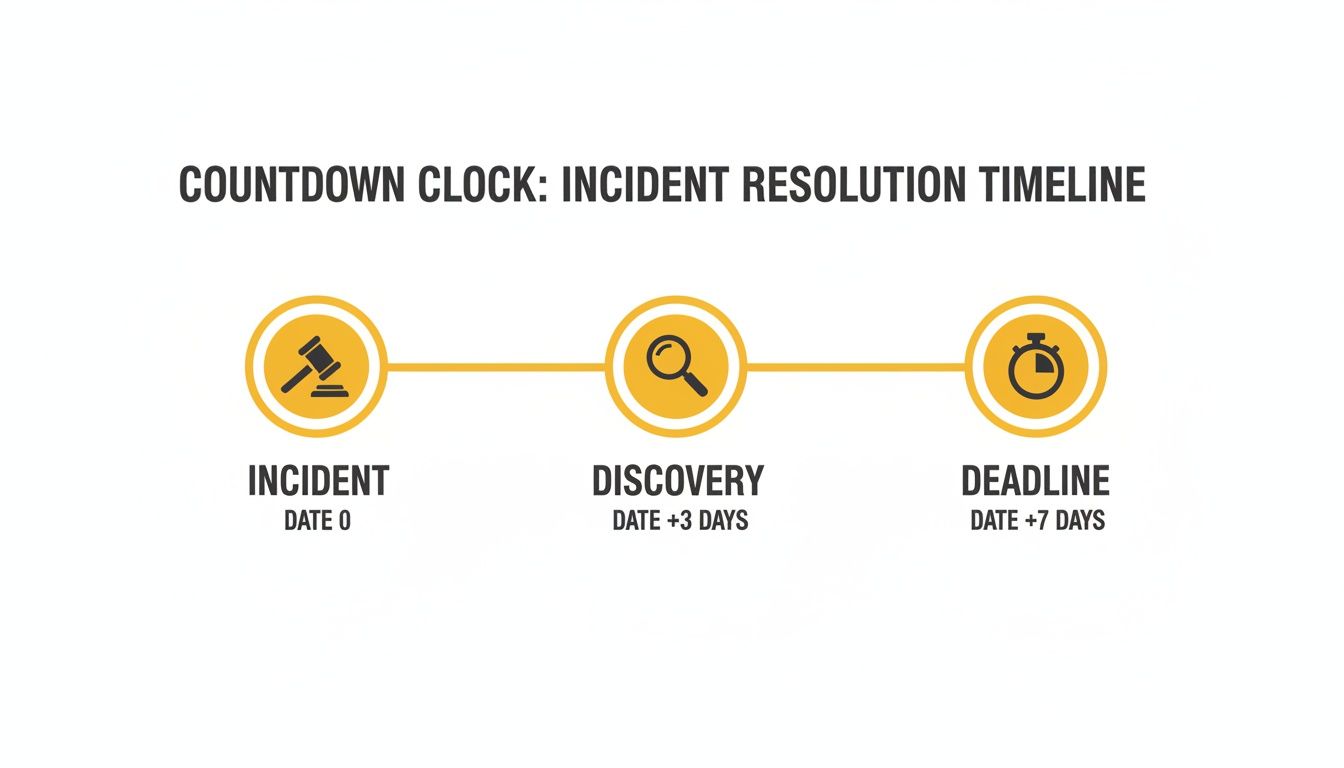
As you can see, the starting pistol for that two-year race is fired at the moment of discovery, which might be long after the initial wrongful act occurred.
The Ultimate Limitation Period: A Final Cutoff
While the discoverability rule offers some much-needed flexibility, it doesn’t give you forever. This is where the second clock comes in: the ultimate limitation period. Think of this as the final, non-negotiable deadline that cuts off your right to file a claim, regardless of when you discovered it.
In Ontario, this absolute deadline is 15 years from the day the act or omission happened. It doesn’t matter if you knew about it or not; after 15 years, your right to sue is gone for good.
This two-clock system strikes a crucial balance. The two-year basic period ensures that once a problem is discovered, it’s dealt with promptly. The 15-year ultimate period provides finality, so defendants aren’t left looking over their shoulder forever.
This dual-timer system is a cornerstone of civil law across Canada. Most common-law provinces, including Alberta, British Columbia, and Saskatchewan, use a similar model with a two-year basic period and a longer ultimate limit. The big exception is Quebec, which operates on a civil code and typically uses a three-year prescriptive period.
How The Two Clocks Work Together
Let’s walk through a real-world example. Imagine a contractor messes up the installation of a support beam in your new home extension back in 2025. You don’t see any problems right away.
-
Scenario A: In 2028, a big crack appears in the wall. You hire an engineer who confirms the beam was installed incorrectly. Your “discovery” date is in 2028. The two-year clock starts now, giving you until 2030 to file your lawsuit.
-
Scenario B: The faulty beam goes completely unnoticed for years. In 2041—a full 16 years later—the beam gives out, causing massive damage. Even though you just discovered the problem, you’re too late. You’ve passed Ontario’s 15-year ultimate limitation period, which ended in 2040 (2025 + 15 years). Your right to sue has been extinguished.
This interplay is vital in many legal fields, from professional negligence cases to complicated business disputes. Knowing your options in these situations often means digging into the specifics of your case, such as the different breach of contract remedies available in Ontario. At the end of the day, these two clocks—the two-year basic period and the 15-year ultimate period—draw the lines for your claim.
How Limitation Periods Work for Common Legal Claims
Alright, now that we’ve covered the “two-clock” system—the two-year basic period and the 15-year ultimate cutoff—let’s bring it down to earth. How do these rules actually play out in real-world situations you might face here in Ontario?
The theory is one thing, but the practical application is everything. The start date for that two-year clock isn’t always as simple as looking at a calendar; it hinges on the specific details of your case, which is why the “discoverability rule” is so critical.

By looking at a few common legal claims, we can see exactly how the statute of limitations in Canada operates when it matters most.
Personal Injury Claims After an Accident
From car accidents to slip-and-falls, personal injury lawsuits are some of the most frequent civil claims we see. The general rule is a two-year limitation period, but the key question is: when does that period start? It’s not always on the day of the accident, especially when the true extent of an injury takes time to surface.
Let’s walk through an example. Imagine you’re in a minor car accident in Burlington. You feel sore, but you figure it’s just some bruising and whiplash that will clear up in a week or two. Six months pass, and not only has the pain not gone away, it’s actually getting worse. Your doctor sends you for an MRI, which reveals a serious spinal injury that needs surgery and could affect your ability to work for the rest of your life.
So, when did your two-year clock really start ticking?
- Was it on the day of the accident, when you first knew something happened?
- Or was it on the day of the diagnosis, when you finally understood the true severity of your injury and realized a lawsuit was a necessary step?
In a situation like this, a court would almost certainly agree that the limitation period began on the day you received that diagnosis. This is the discoverability rule in action. It’s a crucial protection that ensures you don’t lose your right to sue just because the full, devastating consequences of an incident took time to become clear.
The key takeaway is that “discovery” isn’t just knowing you were hurt. It’s having a reasonable understanding of how serious that harm is and being able to connect it to the actions (or inaction) of the person at fault.
Breach of Contract Disputes
A breach of contract happens when someone fails to hold up their end of a formal agreement. This could be anything from a home renovation gone wrong to a supplier who never delivered the goods you paid for. Here again, the two-year limitation period usually kicks in from the moment the breach was, or should have been, discovered.
Picture this: you hire a contractor to build a deck for your Mississauga home in June 2023. They finish the job, you pay them, and everything seems fine. But the following spring, in April 2024, you notice the deck boards are warping badly and the whole structure feels shaky. An inspector confirms your fears: the contractor used cheap, substandard materials and cut corners on the construction, violating your agreement.
In this case, your discovery date is April 2024. That’s the moment you reasonably knew you had suffered a loss (a faulty deck) and could point the finger at the contractor. Your two-year window to file a claim would close in April 2026. If you waited until the summer of 2026, you’d be out of luck.
Professional Negligence Claims
When you put your trust in a professional—like an accountant, engineer, or financial advisor—and their mistake costs you, it’s known as professional negligence. These cases are often tricky because the error might not become obvious for years.
For instance, say your Oakville accountant gives you some bad tax advice in 2022. You file your taxes based on their guidance, thinking all is well. Fast forward to 2024, when the Canada Revenue Agency (CRA) decides to audit you. It’s only then, when you get a notice of reassessment with a massive bill for penalties and interest, that you realize your accountant messed up.
Your two-year clock would start in 2024 when the CRA audit brought the negligence and its financial fallout to light. It would be completely unfair to start the clock back in 2022 when you had no way of knowing anything was wrong. Keep in mind, though, that the 15-year ultimate limitation period still runs from the date the negligent act actually occurred in 2022.
The table below provides a quick summary for some common claims in Ontario.
Common Limitation Periods in Ontario
This table summarizes the standard limitation periods for various types of civil claims in Ontario, highlighting the general rule and key considerations.
| Type of Claim | Basic Limitation Period | Ultimate Limitation Period | Key Discoverability Considerations |
|---|---|---|---|
| Personal Injury | 2 years | 15 years | Clock often starts on the date the full extent of the injury is diagnosed, not the date of the accident. |
| Breach of Contract | 2 years | 15 years | Starts when the breach was known or ought to have been known. For hidden defects, this could be long after the work was completed. |
| Professional Negligence | 2 years | 15 years | Begins when the client discovers the error and the financial or other harm it caused, such as a CRA audit notice. |
| Property Damage | 2 years | 15 years | Starts from the date the damage was discovered and its cause reasonably identified. |
As you can see, while the two-year rule is the standard, figuring out your specific deadline is all about the details. Pinpointing the exact moment your personal countdown began is the most important step in protecting your legal rights.
A Cross-Canada Look at Limitation Rules
It’s tempting to think the two-year rule you might know from Ontario is the standard across the country. That’s a dangerous assumption, and a costly one to make. There’s no single, federal law that governs the statute of limitations in Canada for civil claims. Instead, each province and territory has its own set of rules, creating a patchwork of deadlines that can easily catch you off guard.
Knowing these regional differences is absolutely critical. A claim that’s perfectly valid in one province could be dead in the water just across the border. Let’s compare Ontario’s system with a few other jurisdictions to see just how much these timelines can vary.
How Provincial Rules Differ for Civil Claims
While many common law provinces have moved toward a similar two-year “discoverability” model, the devil is truly in the details. Places like British Columbia and Alberta also have a basic two-year limitation period, which feels familiar if you’re used to Ontario’s system. But even there, the ultimate deadlines and the specific exceptions can be quite different.
The biggest outlier, by far, is Quebec. It operates under a civil law system, which is a whole different legal tradition.
-
Quebec’s Prescriptive Period: In Quebec, they don’t call it a “limitation period.” It’s a “prescriptive period,” and it’s typically three years from when the harm was discovered. That extra year can be a lifesaver for someone who doesn’t realize the clock runs faster in other provinces.
-
Common Law Provinces: In contrast, provinces like Ontario, Alberta, and British Columbia generally stick to a two-year basic limitation period. This creates some consistency, but it also reinforces just how important it is to check the specific rules for your case.
These aren’t just minor legal technicalities; they have huge real-world consequences. For example, someone dealing with a denied insurance claim needs to understand how the provincial limitation period affects their right to sue. The rules governing disability benefits across Canada are a prime example of where these provincial differences can have a massive financial impact. You can learn more about the complexities of long-term disability in Canada to see how these interactions play out.
The bottom line is this: never, ever assume. The clock on your claim is set by the laws of the province where the issue happened. Always verify the rules for that specific jurisdiction.
Civil vs. Criminal Law: A Tale of Two Timelines
One of the biggest points of confusion around the statute of limitations in Canada is the massive difference between civil lawsuits and criminal prosecutions. The timelines, the rules, and the entire philosophy behind them are worlds apart. Civil law is about resolving disputes between people or companies, whereas criminal law is about the state prosecuting someone for a public offence.
This is where the idea of a “limitation period” really diverges. For most civil claims, the clock is always ticking. For criminal matters? It all depends on how serious the crime is.
In Canadian criminal law, there is generally no statute of limitations for serious (indictable) offences. However, for minor (summary conviction) offences, charges must typically be laid within 12 months of the incident. This means that a historic allegation of a serious crime, like sexual assault, can be prosecuted decades after the fact. At the same time, a minor infraction has a firm deadline. This reflects a core principle: society believes serious crimes should always be answerable, while less serious matters have a deadline to ensure fairness.
This distinction is crucial. It stops people from wrongly assuming that just because a long time has passed, an event has no legal consequences. While a civil lawsuit for an assault might be barred after two years, a criminal prosecution for that same assault could move forward twenty years later if it’s treated as a serious offence. Getting this difference right is fundamental to understanding your legal rights and risks in Canada.
When The Limitation Clock Can Be Paused or Extended
While the two-year and fifteen-year deadlines might sound absolute, Canadian law is built to accommodate the complexities of real life. Think of it like a “pause button” on the limitation period countdown. The legal system can hit this button in certain situations where it would simply be unfair to let time run out. This is a legal concept called tolling, and it’s a critical safeguard for vulnerable people.
These exceptions aren’t loopholes. They are carefully designed measures to ensure that justice remains within reach for everyone, no matter their age or mental state. Knowing when a deadline might be paused is every bit as important as knowing the deadline itself.
Claims Involving Minors
The most common example of tolling involves legal claims for children. Across Canada, including Ontario, the limitation clock doesn’t even start for a minor until they reach the age of majority, which is 18 years old.
So, if a 10-year-old is injured in an accident, the standard two-year limitation period doesn’t start that day. Instead, the clock starts ticking on their 18th birthday. This gives them until their 20th birthday to file a lawsuit.
The reasoning here is simple and fair: we can’t expect a child to understand their legal rights or navigate the complexities of starting a lawsuit. The law presses pause to give them a fair shot at seeking justice once they are legally an adult.
This rule ensures a child’s right to compensation isn’t lost just because they were too young to take action when the injury happened.
When a Person Is Incapable
Another crucial pause button applies when someone can’t manage their own affairs because of a physical, mental, or psychological condition. This could be someone who has suffered a severe brain injury, a person with an advanced cognitive illness, or an individual in a coma.
Under Ontario’s Limitations Act, 2002, the limitation period is completely suspended for as long as that person is incapable. The clock only starts to run if and when they regain their capacity. It might also start if a litigation guardian is appointed to act on their behalf. The core principle is that a person can’t be penalized for missing a deadline when they are medically unable to act. This protection is especially vital in complex injury cases. For instance, fighting an Ontario accident benefits denial is a difficult process for anyone, let alone someone dealing with a serious medical incapacity.
Other Important Exceptions
Beyond age and capacity, a few other situations can effectively pause or even restart the limitation clock. These usually come into play based on the defendant’s own actions.
-
Fraudulent Concealment: If someone deliberately hides their wrongdoing, the limitation period may be suspended. Imagine a builder who knowingly covers up a dangerous structural defect in a new home. The clock wouldn’t start when the shoddy work was done, but only when the homeowner eventually discovers the hidden problem. The law won’t let a defendant benefit from their own deceit.
-
Acknowledgement of Debt: For debt claims, the clock can actually restart. This happens if the person who owes the money acknowledges the debt in writing or makes a partial payment. Let’s say a friend owes you money and the debt is three years old. If they send you an email today admitting they still owe it, the two-year limitation period to sue for that money starts all over again from the date of that email. This prevents debtors from simply running out the clock.
What to Do When Your Deadline Is Approaching
That sinking feeling you get when you realize the clock is ticking on your legal claim is completely understandable. It’s a stressful spot to be in, but the worst thing you can do is nothing. If you think the statute of limitations in Canada for your case is about to expire, you need to move quickly.

The first, most critical step is to call a lawyer. Right away. Don’t put it off until tomorrow. A legal expert can size up your situation in a hurry, pinpoint the exact deadline, and take immediate action to file the necessary documents to protect your right to sue.
Preparing for Your Legal Consultation
To get the most out of that first meeting, a little prep work goes a long way. Pulling together all your key information beforehand helps your lawyer understand the whole picture from the get-go. With a tight deadline looming, every moment counts, and this initial efficiency is crucial. It’s helpful to understand how law firms enhance client intake to appreciate the systems they have in place for urgent situations like these.
Before you head to your consultation, try to have these things ready:
- A Detailed Timeline: Jot down a play-by-play of what happened. Be sure to include the date of the incident and, just as importantly, the date you realized you had suffered a loss or injury.
- All Relevant Documents: Gather up everything you have—contracts, emails, medical records, photos, text messages, you name it. If it’s related to your claim, bring it.
- Key Contact Information: Make a list of names and phone numbers for anyone involved, including witnesses.
Getting organized like this really helps your lawyer hit the ground running. The reality is, if you miss that limitation period, the consequences are harsh. Your claim is almost certainly dead in the water, and you lose any right to compensation forever. That holds true whether you’re in Burlington, somewhere else in the GTA, or anywhere in Ontario.
A critical mistake people make is assuming that talking or negotiating with the other side stops the clock. It doesn’t. The only thing that officially protects your legal rights is filing a formal Statement of Claim with the court before that deadline hits.
Trying to navigate a looming deadline on your own is a huge risk. You really need professional legal advice. For specific problems, like a denied insurance payout, you can find out more about what a specialized lawyer for an insurance claim can do to provide the immediate clarity and action required.
Related UL Lawyers resources
If your situation is moving from general research to a real legal problem, these service pages may help you choose the next step:
- Civil litigation services — hire page if a deadline is close. Call 905-744-8888.
- Burlington litigation lawyer — city-specific service page.
- Toronto litigation lawyer — city-specific service page.
Ontario Quick Reference and Important Caveats
In Ontario, the primary statute governing limitation periods for civil claims is the Ontario Limitations Act, 2002. It establishes a basic limitation period of two years from the day the claim was discovered (or ought to have been discovered). However, this is a general rule; many specific types of claims have different limitation periods set out in other legislation or in contracts. For example, claims against municipalities, certain insurance disputes, and employment matters may be subject to shorter or longer deadlines.
It is also critical to remember that limitation periods vary significantly across Canada. Each province and territory has its own limitations legislation, and the applicable period can depend on the nature of the claim. Even within Ontario, the two-year basic period may be extended or shortened by the discoverability principle, statutory exceptions, or contractual terms. Relying on a general understanding of limitation periods without examining the specific law and facts of your case can be risky. If you believe you have a potential claim, you should seek legal advice promptly to determine the precise deadline that applies. Missing a limitation period can permanently bar your right to sue, regardless of the strength of your case.
Frequently Asked Questions About Limitation Periods
It’s completely normal to find the rules around legal deadlines confusing. To help you get a clearer picture, we’ve tackled some of the most common questions we hear from people thinking about a potential legal claim.
Does Sending a Demand Letter Stop the Limitation Period in Ontario?
This is a critical point and probably the biggest misunderstanding out there: no, it does not.
Sending a strongly worded letter, making a phone call, or even starting settlement talks will not pause the limitation clock. It keeps ticking. The only guaranteed way to stop it is to formally file a lawsuit—in Ontario, that means issuing a Statement of Claim with the court before your deadline hits. Relying on negotiations to protect your right to sue is a gamble that can cost you your entire case.
What if I Didn’t Realize I Had a Case?
This gets into a legal concept we call the “discoverability principle.” Essentially, the two-year clock doesn’t start ticking until the moment you knew—or should have reasonably known—all the key pieces of your potential claim.
What does that mean in practice? It means you have to know:
- That you actually suffered an injury or loss.
- Who caused it.
- That a lawsuit is a legitimate option for your situation.
So, while you can’t just say, “I didn’t know the law,” the deadline might be delayed if it was genuinely impossible for you to connect your injury to the other party’s actions at the time. A lawyer can dig into the specifics of your timeline to figure out exactly when your “discovery date” was.
Are the Rules Different for Suing the Government?
Yes, absolutely—and this is a major trap for the unwary. When your claim is against any government body, be it your local city, a provincial ministry, or a federal agency, you’re often dealing with much shorter deadlines.
For instance, let’s say you slip on an icy city sidewalk in Ontario. You might have as little as 10 days just to give the municipality formal written notice of your claim. If you miss that initial notice period, your case could be over before it even starts, regardless of the standard two-year limitation period. If your case involves the government in any way, seeking immediate legal advice isn’t just a good idea; it’s essential.
The rules surrounding the statute of limitations in Canada are strict and unforgiving. If your deadline is approaching, call UL Lawyers at 905-744-8888 or email info@ullaw.ca.
You can also book a consultation or start on our civil litigation page.